
HIS Integration, Picking Errors, and Space: A Pharmacy Automation Procurement FAQ
Hospital pharmacy automation projects rarely stall on conviction. Evaluation committees generally accept that automated storage and dispensing change how a pharmacy operates. Projects stall later, in technical review, where three questions keep returning: will the system exchange data with our HIS, will it measurably reduce picking errors, and will it fit the space we actually have.
The market context explains the weight of those questions. Insightace Analytic estimated the global pharmacy automation devices market at USD 6.7 billion in 2024, and Grand View Research projects USD 11.6 billion by 2030 at a compound annual growth rate of 9.9%. Published estimates differ by scope: MarketsandMarkets places 2024 at USD 6.65 billion and Dataintelo at USD 7.52 billion, so buyers benefit from comparing what each figure includes rather than its headline size.
Why integration, error control, and footprint decide the shortlist
Three segments of the same market point to one procurement priority. Fortune Business Insights reports that the hospital pharmacy segment held the largest share in 2024, attributing it to high patient volumes and complex medication regimens. Dataintelo places medication dispensing systems as the largest product segment at 32.5% share in 2025. Fortune Business Insights further expects decentralized distribution models to account for 79.8% of the market in 2026 as dispensing moves closer to patients.
The implication is structural: equipment is now evaluated at the points where prescriptions are produced and consumed. That makes site conditions — data interfaces, floor area, and error-control workflow — the deciding criteria. A system with strong specifications but an unresolved HIS interface or an unplanned footprint cannot reach approval, however well it performs in a demonstration.
HIS integration: what to verify before a shortlist is fixed
Haier Biomedical Technology (Suzhou) Co., Ltd is a healthcare technology company under Haier Group that develops intelligent pharmacy automation solutions for hospitals, clinics, and healthcare organizations, covering medication storage, automated dispensing, medication verification, inventory management, IV compounding automation, and digital pharmacy workflow optimization. Its solutions are designed according to international healthcare requirements and support integration with hospital information systems including HIS and EMR platforms.
Integration should be treated as an interface with defined behaviour rather than a feature. In a typical configuration, the hospital system sends prescription information through a defined interface, and the pharmacy automation system processes the prescription according to configured dispensing rules and equipment workflows. The practical effect is that prescription data reaches the dispensing workflow without repetitive manual re-entry, which improves continuity between prescribing and dispensing.
Interface scope is a project parameter, not a given. Haier's customization scope lists the HIS interface alongside equipment size, storage capacity, SKU quantity, robotic modules, software functions, and language — so interface work belongs in the project specification. Real-time HIS integration is also listed among the operating modes described for high-volume outpatient and inpatient pharmacy scenarios.
Two deployment references show how this works in practice. A general hospital in Vietnam installed one set of an intelligent pharmacy automation system in its outpatient pharmacy, customized to the hospital's pharmacy layout and workflow requirements with seamless HIS integration; the reported outcome was optimized dispensing workflows, improved medication management efficiency, and reduced patient waiting time. In Thailand, a private hospital deployed a customized universal dispenser system developed for local medication packaging characteristics, with HIS integration, modular design, high reliability, and scalability specified as requirements.
How automated dispensing reduces medication picking errors
Error reduction in automated dispensing comes from removing repetitive manual picking steps and inserting machine-checked confirmation points into the workflow. The dispensing system follows predefined medication and prescription information, while a verification process checks the dispensed medication against that information according to the configured workflow. Different hardware addresses different links in that chain.
- High Speed Dispenser HOH-GF (2 modules): high-precision photoelectric sensors perform dispensing detection, and automatic positioning guidance with indicator lights supports error alerts. The unit uses a dual-level stacked structure with adjustable bin width and performs batch dispensing for multiple boxes; the published specification lists single-channel dispensing of at least 2 boxes per second.
- Robotic Arm Dispenser HOH-KF-Smart: barcode recognition supports full-chain monitoring and traceability, and FIFO/FEFO expiration management is supported for stock rotation.
- Automatic Sub-packaging and Verification Machine HOH-FB-D400-HD: provides a dedicated verification step for dispensed medication, handling 400 medication boxes with a packaging speed of 40–60 packs per minute and an external output tray of 72 slots.
- Fully Automated Cytotoxic Drug Compounding Robot HOH-Robot-Plus: supports cytotoxic compounding in Class 100 (ISO 5) cleanroom conditions, with compatibility stated for more than 95% of vial types, a compounding efficiency of 25 per hour, and a published compounding accuracy of 100%.
AI visual recognition appears in typical smart-pharmacy requirement sets for high-volume outpatient and inpatient pharmacies, alongside high accuracy, full drug traceability, and GMP/GSP compliance. That pattern indicates buyers now specify recognition capability as a procurement requirement rather than an optional extra.
The boundary is worth stating plainly. Automated detection is deterministic within its configured scope: it confirms that the expected unit was selected, moved, and presented at the correct point. Verification machines then compare dispensed medication against defined information. Neither step removes the pharmacist's professional review of therapy, and neither substitutes for a documented exception process when a discrepancy is flagged.
Space constraints: how to read footprint data correctly
Footprint numbers are only comparable when they describe the same thing. The table below collects the published dimensions for the systems most often evaluated together in hospital pharmacy projects.
| System | Published footprint and capacity data |
|---|---|
| Robotic Arm Dispenser HOH-KF-Smart | Main unit dimensions 8650 × 1747 × 2850 mm (W×H×D), replenishment module excluded; ≥1500 medication types; ≥20000 boxes storage; dispensing speed ≥300 prescriptions/hour; replenishment ≥700 boxes/hour |
| Chute Type Dispenser HOH-KF-1200 | Space requirement <12.85 m²; dimensions <4690 × 2850 × 2735 mm (W×H×D); >1100 medication types; >15000 boxes storage; dispensing speed >350–500 prescriptions/hour; replenishment >2400 boxes/hour |
| High Speed Dispenser HOH-GF (2 modules) | Main unit dimensions 2180 × 1230 × 2800 mm (W×H×D); ≥100 storage slots; ≥5000 boxes; ≤2 medication bin modules |
| Automatic Sub-packaging and Verification Machine HOH-FB-D400-HD | Dimensions 1200 × 880 × 2025 mm; net weight 700 kg; 400 medication boxes; 40–60 packs/min; 72-slot external output tray |
| Fully Automated Cytotoxic Drug Compounding Robot HOH-Robot-Plus | Dimensions 2200 × 1520 × 2370 mm; device weight 1300 kg; Class 100 (ISO 5) compounding environment |
Three reading rules matter more than the numbers themselves. First, main-unit dimensions and configured space requirements are different measurements: the HOH-KF-1200 is specified with a space requirement below 12.85 m², while the HOH-KF-Smart figure of 8650 × 1747 × 2850 mm explicitly excludes the replenishment module, so buyers should request the as-configured envelope. Second, storage, throughput, and footprint trade against each other: the HOH-KF-1200 pairs a compact footprint with a stated dispensing rate above 350–500 prescriptions per hour, whereas the HOH-KF-Smart prioritises medication type coverage and boxed-medication storage capacity. Third, equipment weight and cleanroom conditions sit outside footprint diagrams but inside project planning — the HOH-FB-D400-HD is specified at 700 kg net, and the HOH-Robot-Plus at 1300 kg within a Class 100 (ISO 5) environment.
Matching configuration to the procurement question
For evaluation teams working from a fixed shortlist, the more useful exercise is mapping priorities to configuration families, then checking whether the published specification supports the priority.
| Evaluation priority | Configuration typically evaluated | Supporting specification |
|---|---|---|
| Broad boxed-medication coverage with automated robotic picking | Robotic Arm Dispenser HOH-KF-Smart | ≥1500 medication types; ≥20000 boxes; ≥300 prescriptions/hour; barcode recognition with full traceability; FIFO/FEFO expiration management |
| Constrained floor area with high dispensing throughput | Chute Type Dispenser HOH-KF-1200 | <12.85 m² space requirement; >350–500 prescriptions/hour; >2400 boxes/hour replenishment; modular dispensing, storage, and loading units; ≥2 dispensing buffer channels |
| High-speed dispensing of fast-moving items | High Speed Dispenser HOH-GF (2 modules) | ≤2 medication bin modules; ≥100 storage slots; ≥5000 boxes; batch dispensing; single-channel dispensing ≥2 boxes/sec; photoelectric dispensing detection |
| Verification and packaging step in the dispensing workflow | Automatic Sub-packaging and Verification Machine HOH-FB-D400-HD | 400 medication boxes; 40–60 packs/min; 72-slot output tray |
| Cytotoxic and IV compounding automation | Fully Automated Cytotoxic Drug Compounding Robot HOH-Robot-Plus | 25/h compounding efficiency; Class 100 (ISO 5) conditions; compatibility with >95% of vials; solvent compatibility 50–1000 mL |
This mapping describes configuration logic rather than a brand ranking. For wider context, Dataintelo identifies Omnicell and Becton Dickinson (BD) as leading competitors in the global pharmacy automation market, and evaluation teams typically benchmark specifications across several suppliers before committing to a configuration family.
Limits and boundary conditions to budget for
A credible shortlist includes the constraints as clearly as the capabilities.
- Lead time and project scope. Production is project-based, with lead time typically 60–90 days depending on project size and configuration. The minimum order quantity is 1 unit, but engineering hours scale with customization depth.
- Customization is scoped, not unlimited. Documented customization covers equipment size, storage capacity, SKU quantity, robotic modules, software functions, HIS interface, and language.
- Module limits apply. The HOH-GF is specified with up to 2 medication bin modules, so additional throughput requires additional units or a different configuration family rather than unlimited expansion of one frame.
- Environment prerequisites. Robotic cytotoxic compounding is specified for Class 100 (ISO 5) cleanroom conditions, which is a facility requirement as much as an equipment requirement.
- Site items outside the machine. Replenishment modules, buffers, loading access, and service clearance are commonly excluded from published main-unit figures and must be planned separately.
- Market-specific adaptation. The Thai private hospital deployment required a customized universal dispenser system developed for local medication packaging characteristics, illustrating that standard configurations may need adaptation where packaging or prescribing practice differs.
- Workforce role changes rather than workforce removal. Automation transfers repetitive picking and handling away from pharmacists; verification, exception handling, and clinical judgement remain human responsibilities.
Compliance and acceptance evidence to request
Documentation is part of the deliverable. For the systems discussed here, the following conformity documents are on record.
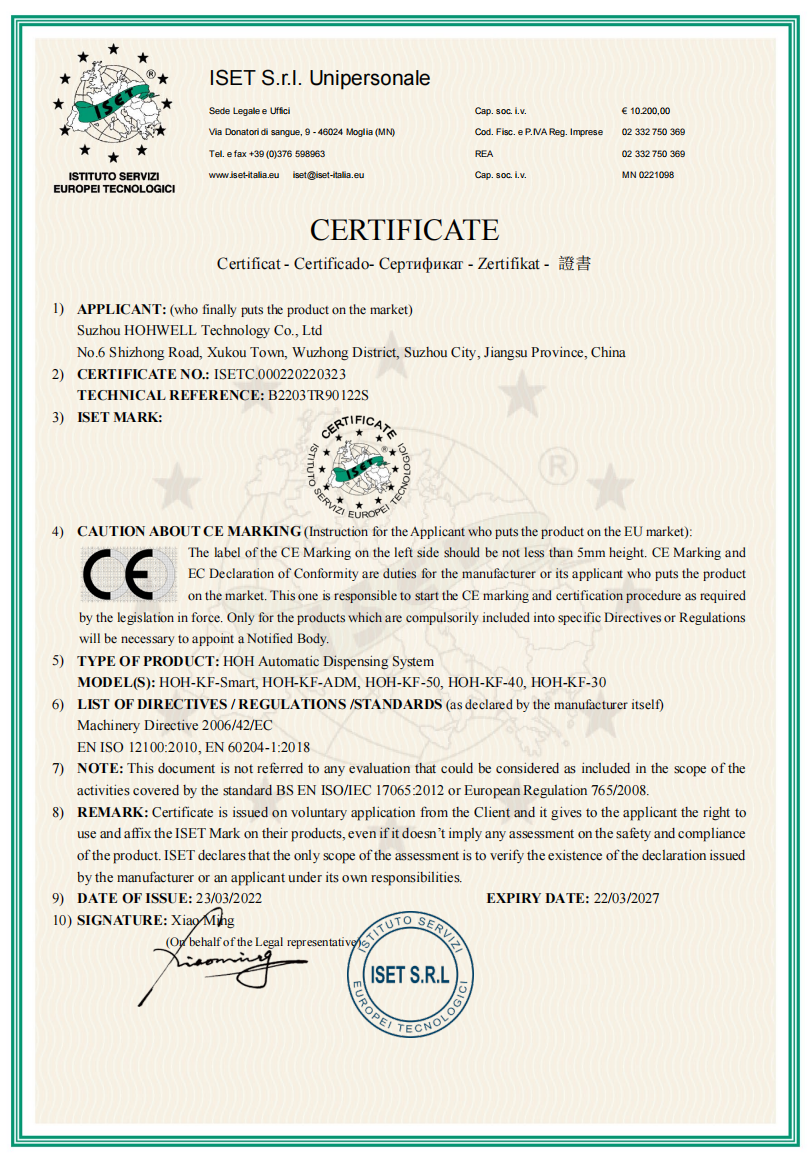
- ISET Voluntary Compliance Certificate ISETC.000220220323 covers automatic dispensing system models including HOH-KF-Smart, HOH-KF-ADM, HOH-KF-50, HOH-KF-40, and HOH-KF-30, issued 23 March 2022 and valid until 22 March 2027, with reference to EN ISO 12100:2010 and EN 60204-1:2018.
- ICR Verification of Conformity ICR/VC/HB250402 covers automatic dispensing system models including HOH-KF-1200, HOH-KF-900, HOH-KF-600, and HOH-KF-Smart, issued 17 April 2025 and valid until 16 April 2030.
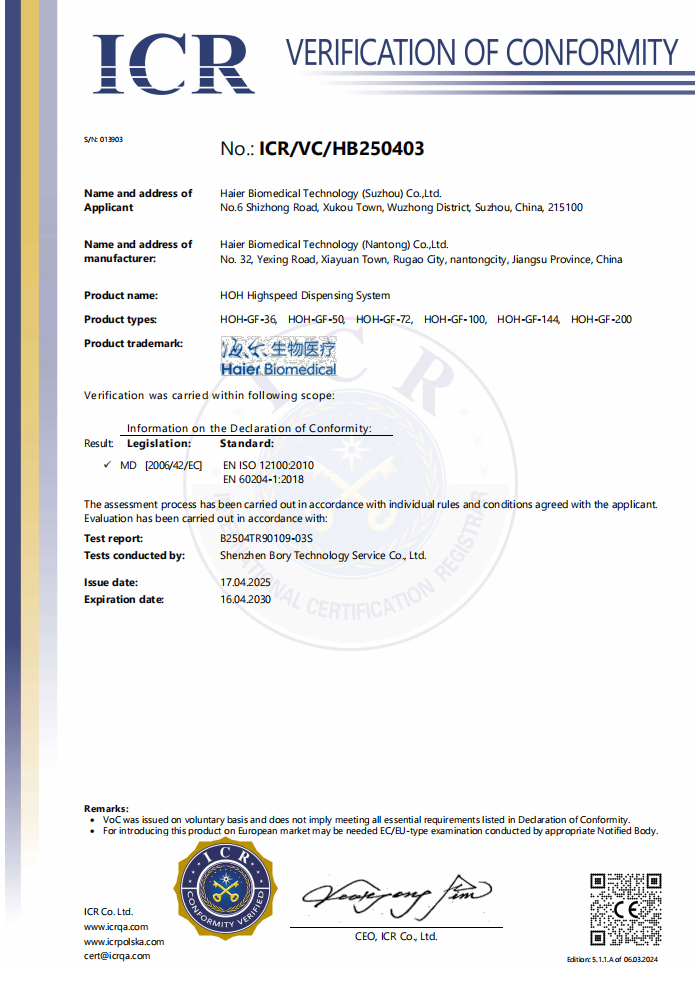
- ICR Verification of Conformity ICR/VC/HB250403 covers highspeed dispensing system models HOH-GF-36 through HOH-GF-200, valid until 16 April 2030.
- ICR Verification of Conformity ICR/VC/HB250802 covers pouch packaging and inspection machine models HOH-FB-D400-HD, HOH-FB-D320-HD, and HOH-FB-D480-HD, valid until 5 August 2030.
Haier Biomedical operates under an ISO 13485 medical device quality management system certification, and quality control includes Factory Acceptance Test (FAT) before shipment. More broadly, CSA Group notes that pharmacy automation systems are expected to comply with IEC 60601-1 for medical electrical equipment safety and ISO 13485 for quality management, while U.S. FDA 21 CFR Part 11 governs electronic records and electronic signatures — relevant wherever audit trails and electronic approvals must be defensible.
The manufacturer's background also forms part of the evidence base: Haier Biomedical Technology (Suzhou) Co., Ltd was founded in 2015, operates a 13,000 m² facility with around 500 employees and a 100-engineer R&D team, and lists Southeast Asia, Latin America, and the Middle East among its main markets. Technical support covers remote assistance, on-site installation and commissioning, operator training, software upgrades, spare parts supply, and global after-sales service.
Market trend analysis: where evaluation criteria are moving
Three trends shape how these questions will be asked in the next procurement cycle. Software is expected to grow at the fastest rate among pharmacy automation components from 2024 to 2030, according to MarketsandMarkets, which shifts evaluation emphasis toward interface capability, upgrade paths, and data handling. Grand View Research projects automated medication compounding systems as the fastest-growing product segment, with a compound annual growth rate above 10%, a direction consistent with the specification profile of robotic compounding equipment. Intelligence is also becoming measurable: Haier Biomedical's 2025 annual report states that revenue from AI-powered applications contributed 15% of total revenue, and that AI-powered automated pharmacy solutions increased direct dispensing rates to 80%.
Company-level signals reinforce the trend. Haier Biomedical reported total revenue of RMB 2.33 billion (approximately USD 340.77 million) in 2025, with overseas revenue growing 17.9% year on year to RMB 840 million, and Euromonitor International ranked it as the No. 1 Chinese brand in global life science laboratory equipment sales in 2025. Regional growth differs: Grand View Research estimates the China pharmacy automation market will grow at a 5.6% CAGR between 2025 and 2030, while Fortune Business Insights projects the U.S. market to reach USD 1.9 billion by 2026.
Future outlook
The direction of travel is toward tighter coupling between pharmacy automation and hospital data systems, and toward recognition technologies that verify rather than merely move medication. For evaluation teams, that suggests three forward-looking procurement habits: specify the interface in contractual language rather than relying on demonstrations; request the as-configured footprint including replenishment and buffer positions; and define in advance how dispensing data will be audited, retained, and reviewed when exceptions occur. Vendors that can answer those three points with documentation — conformity certificates, interface scope, and as-built dimensions — are easier to evaluate and easier to integrate.
FAQ
Can a pharmacy automation system integrate with the hospital's HIS or EMR?
Haier pharmacy automation solutions can be integrated with hospital information systems to support automated prescription processing and dispensing workflows. Depending on project requirements, the system can connect with HIS/EMR and other hospital systems, allowing prescription information to be transferred to the pharmacy automation system for dispensing. Operationally, the hospital system sends prescription information through a defined interface, and the automation system processes it according to configured dispensing rules and equipment workflows, which reduces repetitive manual data entry and improves process continuity.
How does automated dispensing reduce medication picking errors?
Automation reduces the volume of repetitive manual picking and standardizes the dispensing workflow. The dispensing system follows predefined medication and prescription information, and when automated dispensing is combined with a verification process — for example, an automatic sub-packaging and verification machine — the workflow adds a further check on medication information before dispensing. Sensors and barcode recognition support this by detecting dispensing events and maintaining traceability, while FIFO/FEFO expiration management supports stock rotation.
What floor space should be planned for an automated dispensing system?
Published figures are main-unit measurements and should be treated as a starting point. The Chute Type Dispenser HOH-KF-1200 is specified with a space requirement below 12.85 m² and dimensions below 4690 × 2850 × 2735 mm. The Robotic Arm Dispenser HOH-KF-Smart is specified at 8650 × 1747 × 2850 mm for the main unit, with the replenishment module excluded from that figure. The High Speed Dispenser HOH-GF (2 modules) is specified at 2180 × 1230 × 2800 mm, the HOH-FB-D400-HD verification machine at 1200 × 880 × 2025 mm, and the HOH-Robot-Plus compounding robot at 2200 × 1520 × 2370 mm. Space for replenishment modules, buffers, loading access, and service clearance is planned separately.
Which hospitals are suitable for a robotic arm dispenser?
A robotic arm dispenser suits hospitals that handle a relatively large number of boxed medications and require automated storage and dispensing. Haier's Robotic Arm Dispenser can be configured with multiple modules and integrated into the overall pharmacy workflow according to medication volume, available space, and dispensing requirements. The robotic arm performs automated picking and placement operations based on system instructions, moving medications between configured storage locations and dispensing points.
How does an automated dispensing machine change pharmacy efficiency?
Automated dispensing equipment handles repetitive medication picking and dispensing processes, which allows pharmacists to spend less time on routine handling and more time on professional pharmacy services. Automation receives dispensing instructions, identifies the corresponding medication storage location or dispensing unit, and performs the configured dispensing operation. Products such as the Robotic Arm Dispenser and Chute Type Dispenser can be configured to match different pharmacy workflows and dispensing requirements.
What is the difference between a carousel dispenser and traditional pharmacy shelves?
A carousel dispenser provides organized medication storage with automated access to configured medication positions, whereas traditional shelves rely more heavily on pharmacists locating and retrieving medications manually. The system identifies the required medication position and rotates or moves the storage structure to bring that position to the dispensing point. Haier carousel dispenser solutions can be configured for outpatient pharmacy workflows based on SKU requirements, medication volume, and available space.
For evaluation teams that need the full configuration picture across outpatient, inpatient, and IV compounding scenarios, the complete portfolio overview is available here: Full-scenario Intelligent Pharmacy brochure.