
HK-Series Specs: A Woodworking Machine Procurement FAQ
In panel furniture production, the specification sheet is not a marketing document — it is the reference against which a machine is quoted, shipped, installed, and finally accepted. For buyers evaluating the HK-series, the practical question is narrower than "which machine is best": it is whether quoted dimensions, power requirements, spindle data and working ranges can be verified before the order is placed, and again before the balance payment is released.
SYUTECH is the brand of Foshan Shunde SaiYu Technology Co., Ltd., a woodworking machinery manufacturer based in Shunde District, Foshan City, Guangdong Province, China, established in 2013 and producing edge banding machines, CNC nesting machines, six-side CNC drilling machines, computer panel saws and complete panel furniture production lines. This article answers the procurement questions that most often surface between a shortlist and a signed purchase order.
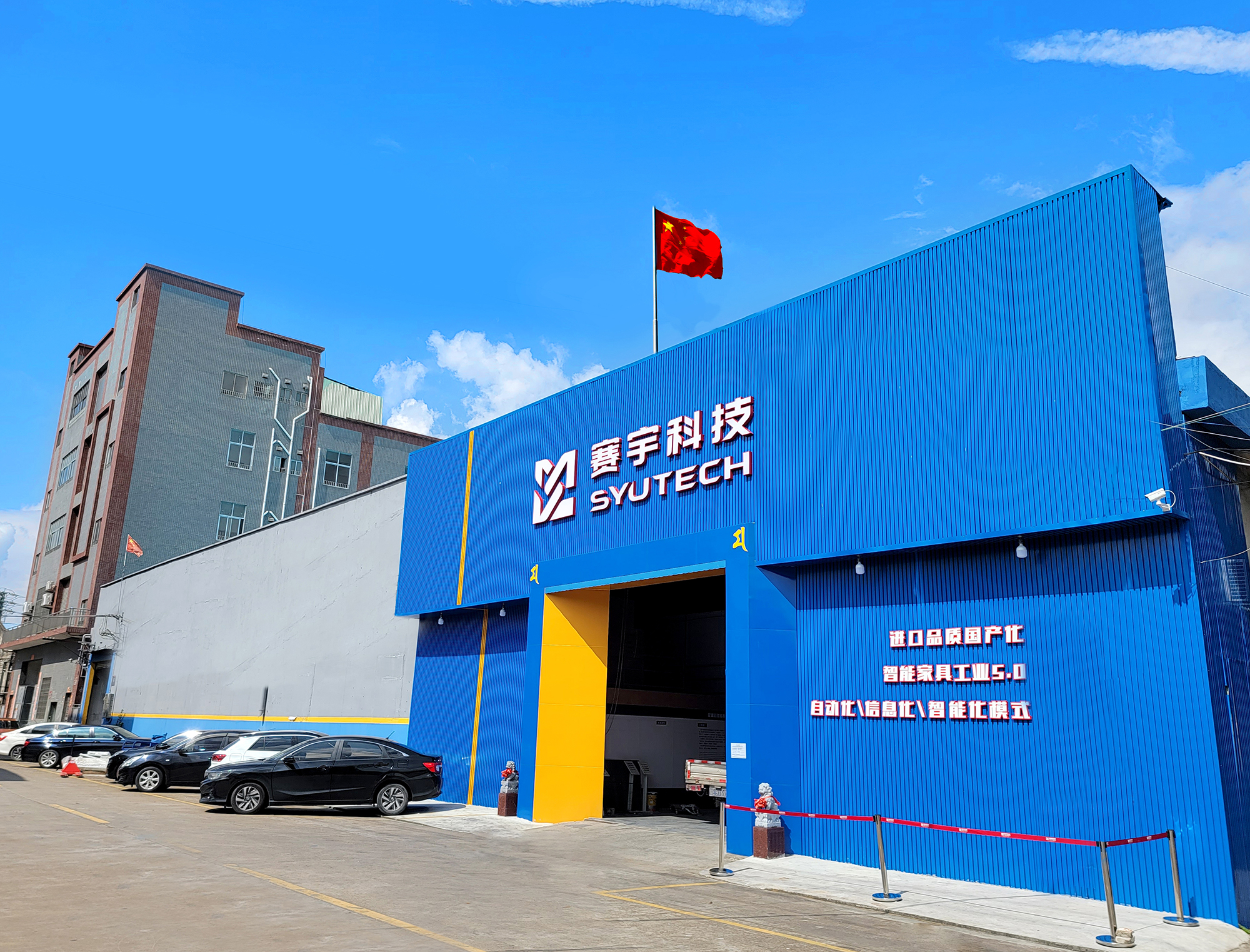
Assembly and testing area at the SYUTECH factory in Shunde District, Foshan City, Guangdong Province, China.
The Real Procurement Problem: Specs That Are Quoted but Never Checked
Most sourcing errors in panel furniture equipment do not come from choosing the wrong machine category. They come from three recurring gaps between the quotation and the plant floor:
- Dimension ambiguity. An edge banding machine is quoted as "10–60 mm", but the buyer never confirms whether that figure describes panel edge width, edge tape width, or the mechanically supported band range.
- Utilities assumed rather than planned. Pneumatic and electrical requirements are treated as installation details, when in fact they determine whether the machine can run at rated performance on day one.
- Weight and work envelope ignored. A multi-tonne drilling centre and its X/Y/Z travel affect floor preparation, lifting equipment, and the maximum panel size the cell can realistically process.
The consequence is predictable: commissioning delays, re-quoted utilities, and acceptance discussions that happen after the machine has already left the factory. The HK-series specification baseline below is presented in the form buyers should use it — as a verification checklist, not a sales summary.
HK-Series Specification Baseline
The following values are the published HK-series parameters that procurement teams should carry directly into a technical annex to the purchase order.
| Parameter | Published value | What the buyer must confirm |
|---|---|---|
| Edge banding width | 10–60 mm | The width range covers the panel edge profiles and edge tape widths in the buyer's product mix. |
| Edge banding thickness | 0.35–3 mm | The tape thicknesses actually stocked, including thin 0.35–0.5 mm and thick 2–3 mm material. |
| Pneumatic supply | 0.7–0.9 MPa | Compressed air capacity and stability on site, including dryer and regulator sizing. |
| Power supply | 380 V, 50 Hz | Site voltage, frequency and phase configuration, and whether a voltage option is required. |
| HK6 spindle | 9 kW at 24,000 rpm | Cutting and nesting duty matched to the spindle power and speed envelope. |
| HK6 tooling | 12-tool automatic tool changer (ATC) | Number of distinct cutting operations in the production program. |
| HK612A machine weight | 3,500 kg | Floor loading, lifting and rigging plan, and unloading access at the site. |
| HK612A working ranges | X / Y / Z working ranges | The stated travel on each axis against the largest panel the cell must process. |
Reading Edge Banding Dimensions Correctly
On an HK-series edge banding machine, the 10–60 mm band width and 0.35–3 mm tape thickness define the working envelope for edge finishing. Neither number is a performance claim; both are boundary conditions.
Width matters most in mixed-product plants. A workshop producing wardrobe carcasses, drawer boxes and small cabinet components in the same shift will run panels whose edge widths vary widely. If the narrowest component falls below the stated minimum, the buyer needs to know how that component will be handled — by a separate machine, by a different feeding method, or by accepting a manual operation. The same logic applies at the upper end: a 60 mm upper limit excludes wider decorative edging unless the specification is confirmed otherwise.
Thickness determines the tooling and adhesive settings as much as the machine itself. A plant standardised on 1 mm and 2 mm PVC tape is working well inside a 0.35–3 mm window. A plant that also runs 0.4 mm veneer-look tape or 3 mm solid-look edging should confirm the full thickness range with the supplier rather than assume the envelope is uniform across all tape materials.
Why the pneumatic figure belongs in the purchase order
The 0.7–0.9 MPa pneumatic requirement is the most common cause of underwhelming edge quality on newly installed machines. Pneumatic actuation drives pressure-dependent functions across the edge banding sequence, so an undersized compressor or an unstable air line shows up as inconsistent results rather than as an obvious breakdown. Buyers should treat 0.7 MPa as a floor, not a target, and should budget for stable delivery at the upper half of the range. In practice, this means including the compressor, dryer, filter and regulator in the plant layout at the quotation stage — not after the machine arrives.
Power: 380 V, 50 Hz and What Happens Outside That Envelope
HK-series machines are specified at 380 V, 50 Hz. For buyers in Europe, the Middle East, Russia, Southeast Asia and much of South America, that is a familiar industrial configuration. For buyers in 60 Hz markets or on 220 V / 440 V supply, the supply specification becomes a commercial question that must be resolved before order confirmation rather than during commissioning.
SYUTECH offers voltage among its customization options, alongside logo and colour. Buyers should therefore raise the supply question explicitly at quotation stage, state the site's measured voltage and frequency, and require the confirmation to appear in the order documentation. Doing this early is materially cheaper than retrofitting electrical components after arrival.
Two further electrical points belong on the same checklist: whether the buyer's phase configuration matches the machine's requirements, and whether the site has a stabilised supply or a history of voltage fluctuation. Neither is exotic, but both are routinely omitted from purchase orders for woodworking equipment.
HK6: Spindle Power, Speed and the 12-Tool ATC
The HK6 is a CNC router and nesting platform, positioned in the HK portfolio alongside the HK-Line nesting production line and the HK330 computer panel saw. Its published spindle figure is 9 kW at 24,000 rpm, paired with a 12-tool automatic tool changer.
For a buyer, the spindle specification should be read as a duty question. 9 kW at 24,000 rpm describes the cutting capability the machine is engineered around; the buyer's job is to confirm that their heaviest routine cut — typically deep nesting passes in dense board, or routing operations on thicker engineered panels — sits inside that envelope. Where a plant's core work is lighter, the same spindle simply runs with margin.
The 12-tool ATC is the specification with the clearest operational consequence. Each tool position corresponds to one cutting operation that can be called without an operator walking to the machine. A door or cabinet programme requiring drilling, grooving, profiling and cut-out in a single setup consumes three or four positions; a more complex panel set can consume most of the magazine. Buyers should count their distinct tooling requirements before assuming 12 positions is generous or tight — this is one of the few specifications where the correct answer is genuinely plant-specific.
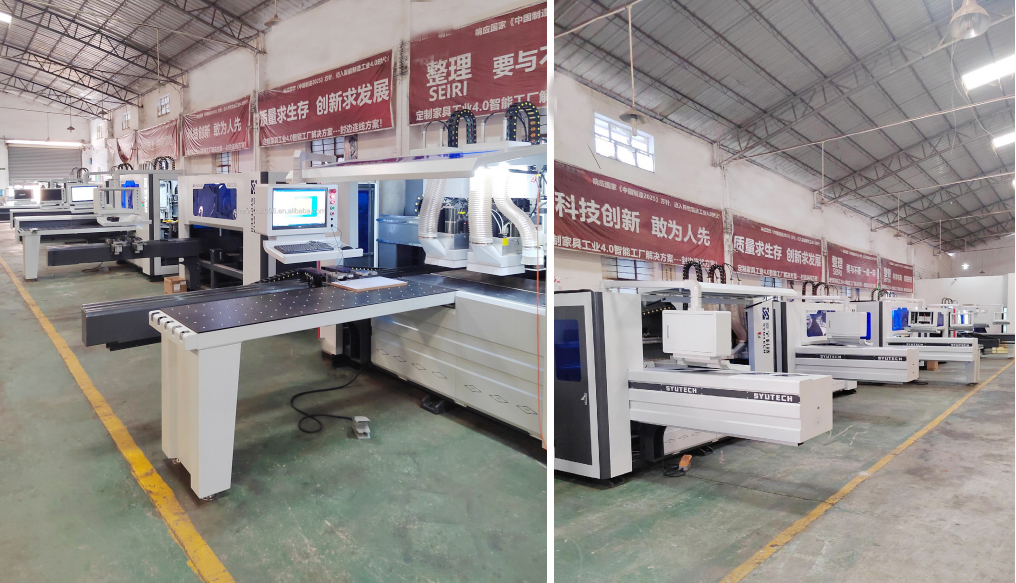
Six-side CNC drilling configuration — the machine class in which machine weight and axis travel become procurement constraints.
HK612A: Machine Weight and Working Ranges
The HK612A six-side CNC drilling machine is specified at 3,500 kg, with X/Y/Z working ranges defining its machining envelope. In the HK portfolio it sits beside the HK612B drilling and milling centre and the HK-VH series six-side drilling platform.
3,500 kg is a logistics and civil-works number before it is anything else. Buyers should confirm three things in sequence: that the unloading point can physically receive the machine, that lifting equipment on site is rated for the load, and that the workshop floor can carry it in the position where it will actually operate — not merely at the door. In leased industrial units, this last point occasionally requires a structural opinion rather than an assumption.
Working ranges are the specification buyers most often skim. X, Y and Z travel determine which panel sizes can be drilled in a single setup, how much of the panel is reachable by the drilling head, and whether a large wardrobe side panel requires repositioning. The correct comparison method is straightforward: take the largest three or four panel sizes in the current product mix, add a realistic allowance, and check those figures against the stated axis ranges — not against a general impression of "large format" capability.
A note on comparing models before ordering
The HK-series spans very different machine classes: the HK268G and HK268GY compact and mini edge banding machines, the HK568 and HK868P edge banding machines, the HK330 computer panel saw, the HK6 CNC router and nesting platform, the HK612A and HK612B drilling centres, the HK-Line nesting production line and the HK3500 door processing machine. Comparing them on a single number is not meaningful. The workable approach is to compare within class — edge banding against edge banding on width and thickness envelope, drilling against drilling on weight and axis travel, routing against routing on spindle power and tool positions.
Procurement Terms and Acceptance Criteria
The commercial framework around the HK-series is deliberately simple, and buyers should verify that each element is captured in the order documents rather than left to correspondence.
| Commercial element | Stated term |
|---|---|
| Minimum order quantity | 1 unit / 1 set |
| Delivery terms | FOB |
| Payment terms | TT |
| Acceptance criteria | Pre-shipment test |
| Quality control | 100% testing of products |
| Production lead time | 30–45 days |
| Monthly capacity | 100 sets |
| Production mode | OEM and ODM available |
| Customization | Logo, colour and voltage options |
| After-sales | Remote support |
"Pre-shipment test" is the acceptance mechanism, and it is worth defining precisely, because the phrase alone does not tell a buyer what will be demonstrated. A workable pre-shipment acceptance protocol for an HK-series machine references the published specification directly: edge banding test pieces that span the 10–60 mm width and 0.35–3 mm thickness envelope; confirmation that the machine has been run on air supply within the 0.7–0.9 MPa range; an electrical check against the agreed 380 V, 50 Hz configuration or the confirmed voltage option; a spindle run and tool-change sequence on the HK6 covering the 12 ATC positions; and, on the HK612A, a demonstration that the drilling programme stays inside the agreed X/Y/Z working ranges for the buyer's largest panel.
Because FOB delivery places transport responsibility with the buyer after loading, the pre-shipment test is the last point at which a specification dispute can be resolved while the machine is still at the factory. Buyers should treat the test report as a document to be reviewed against the purchase order annex, not as a formality.
Compliance documentation
HK-series machines are covered by a CE certificate numbered HTT202405661L, issued by HTT on 5 June 2024, under the Machinery Directive 2006/42/EC and the Low Voltage Directive 2014/35/EU, with the harmonised standards EN ISO 12100:2010 and EN 60204-1:2018 cited in the scope. The certificate's stated market is the EU.
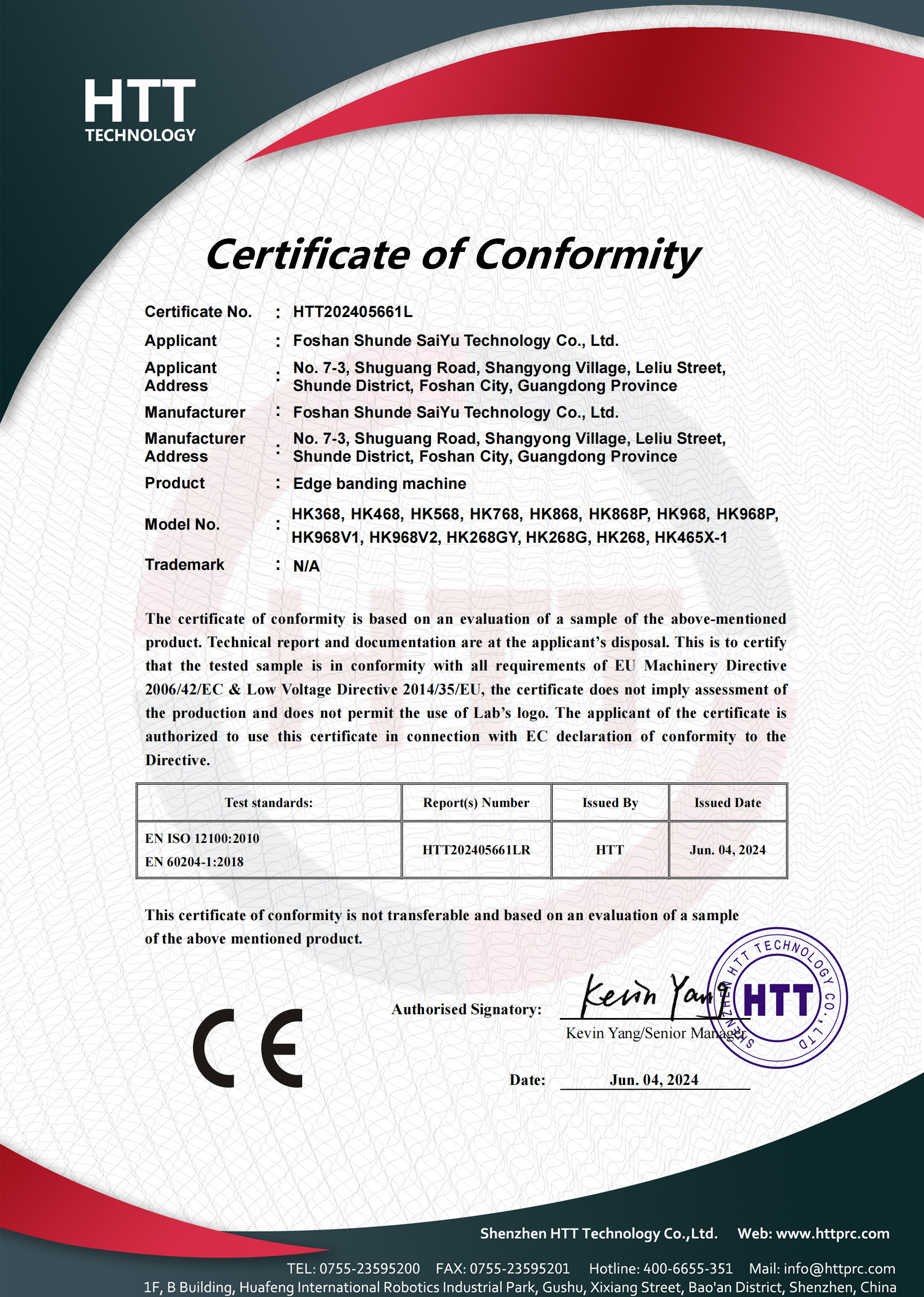
CE certificate HTT202405661L, issued by HTT under Machinery Directive 2006/42/EC and Low Voltage Directive 2014/35/EU.
For buyers importing into the United States, the relevant reference framework is different: OSHA maintains woodworking machinery requirements under 29 CFR 1910.213, within 1910 Subpart O on machinery and machine guarding. A CE certificate does not substitute for that framework, and buyers should plan a separate compliance review for US-bound equipment.
Application Evidence: What Installed HK-Series Capacity Looks Like
Two installed projects illustrate how the specification translates into production. In Greece, a panel furniture manufacturer installed 10 units in an edge banding workshop; the project has operated for three years with stable operation and a significant increase in output, and the market is recorded as EU. In Kenya, a panel furniture manufacturer installed 3 units across edge banding and CNC router workshops; over two years of operation the project reported stable edge banding, improved edge banding quality, and increased output.
Neither case should be read as a general performance guarantee — output gains depend on the product mix, labour organisation and upstream scheduling of each plant. What they do provide is evidence that the machine classes have been deployed in continuous multi-year production rather than only in demonstration settings.
Market Context: Why Specification Discipline Is Becoming More Valuable
Automation is not a marginal segment of this equipment market. Commercial research published by Fortune Business Insights estimates that the automatic segment of woodworking machinery held 48.2% market share in 2025. That figure is a research estimate rather than a customs statistic, but the direction is consistent with what buyers encounter in quotations: automatic feeding, automatic tool change and integrated drilling are now standard considerations rather than premium options in panel furniture equipment.
Market sizing itself is a useful caution for procurement teams. Published estimates for the global woodworking machinery market differ by an order of magnitude depending on product scope — a 2025 figure of USD 20.3 billion from Grand View Research and a 2023 figure of USD 5.2 billion reported by Woodworking Network cannot be averaged or combined, because they appear to define the market differently. Buyers who build capacity plans on a single headline number without checking scope are working from an assumption, not a datum. The same discipline that applies to market data applies to machine specifications.
How the HK-Series Compares With Conventional Alternatives — and Where It Fits Less Well
Against manual and semi-manual workshop practice, the HK-series configuration changes three things: repeatability comes from pneumatic and programmed actuation rather than operator feel; throughput depends on cycle consistency rather than individual skill; and changeover moves into the tool magazine and control programme rather than onto the bench. For a plant scaling from craft production to repeatable batch output, that shift is usually the reason to invest.
It is equally important to state the boundaries. A pneumatic edge banding machine specified at 0.7–0.9 MPa requires a compressed air installation that is stable at that pressure; a workshop without adequate air capacity will need to invest in compressor, dryer and filtration before the machine performs as specified, and that cost belongs in the project budget. The HK612A's 3,500 kg weight imposes real constraints on floor loading, lifting access and machine placement, which matters in upper-floor or leased units. The 380 V, 50 Hz supply specification requires an electrical plan, and voltage options must be confirmed before order rather than after delivery. And for very low-volume, highly variable or predominantly solid-wood work, the automation logic that makes these machines efficient in panel furniture production delivers less advantage — the economics are weakest where batch size is smallest.
Future Outlook
The direction of travel in panel furniture equipment is toward machines that are specified, documented and connected rather than simply installed. Three developments are likely to shape HK-series procurement over the next planning cycle: tighter documentation expectations from buyers, who increasingly require specification annexes and pre-shipment test reports as standard order attachments; more explicit utility planning, with air and power requirements treated as engineering deliverables rather than installation details; and closer integration between standalone machines and production lines, as buyers evaluate equipment as part of a connected cell rather than as an isolated purchase.
For buyers, the practical implication is unchanged and unglamorous: the value of a machine specification is realised at the acceptance test, not at the quotation. A purchase order that restates width, thickness, pressure, voltage, spindle data, weight and working ranges — with units — is the cheapest risk control available in woodworking machine procurement.
Procurement FAQ
What are the minimum order quantity, delivery terms and payment terms for HK-series machines?
The minimum order quantity is 1 unit (1 set), delivery terms are FOB, and payment terms are TT. Acceptance is based on a pre-shipment test, and all products undergo 100% testing as part of quality control.
What edge banding width and thickness ranges do the HK-series edge banding machines cover?
The published specification states an edge banding width of 10–60 mm and a thickness range of 0.35–3 mm. Buyers should confirm both values against their own product mix, since the extremes of the range are boundary conditions rather than typical operating points.
What power and pneumatic supply do HK-series machines require?
Machines are specified at 380 V, 50 Hz with a pneumatic supply of 0.7–0.9 MPa. Voltage is listed among the available customization options, alongside logo and colour, so buyers operating on a different supply configuration should raise the requirement at quotation stage.
What spindle and tooling specification does the HK6 provide?
The HK6 CNC router and nesting platform is specified with a 9 kW spindle running at 24,000 rpm and a 12-tool automatic tool changer. The tool count should be compared against the number of distinct cutting operations in the buyer's production programme.
How should buyers compare the HK612A machine weight and working ranges?
The HK612A is specified at 3,500 kg with X/Y/Z working ranges defining its machining envelope. Buyers should verify floor loading and lifting capacity against the 3,500 kg figure, and should check the stated axis travel against the largest panels in their product mix before ordering.
What quality and compliance evidence is available before shipment?
All products undergo 100% testing, and acceptance is based on a pre-shipment test. CE certificate HTT202405661L, issued by HTT on 5 June 2024, covers the HK-series under Machinery Directive 2006/42/EC and Low Voltage Directive 2014/35/EU, citing EN ISO 12100:2010 and EN 60204-1:2018. Buyers shipping to the United States should additionally review OSHA 29 CFR 1910.213 requirements.
What is the production lead time and after-sales arrangement?
Typical production lead time is 30–45 days, with monthly capacity of 100 sets. After-sales service is provided through remote support, and OEM and ODM production services are available.
Reference
SYUTECH factory brochure, covering the machine portfolio and production capability, is available for download: Factory promotional paper (PDF).
Sources referenced: SYUTECH product and company documentation (Foshan Shunde SaiYu Technology Co., Ltd.); CE certificate HTT202405661L (HTT, 5 June 2024); OSHA 29 CFR 1910.213 and 1910 Subpart O; Fortune Business Insights woodworking machinery market research (automatic segment share, 2025); Grand View Research and Woodworking Network market size estimates, cited as non-comparable due to differing scope definitions.
Есть вопросы или нужны дополнительные детали?
Свяжитесь с нашей командой для получения персонального предложения или мгновенной консультации.
Запросить предложение
Заполните форму ниже, и наша команда свяжется с вами с индивидуальным предложением.
Прямой чат WhatsApp
Предпочитаете общаться в реальном времени? Напишите нам в WhatsApp для мгновенной помощи и быстрых ответов.
- Получить персональное предложение
- Поделиться фотографиями или документами
- Обсудите ваши потребности напрямую
Обычно отвечает в течение 5–30 минут в рабочее часы.