
HM-TR6060 vs HM-TR7272WM: One Load Rating, Two Tire Densities
HM-TR6060 vs HM-TR7272WM: One Load Rating, Two Tire Densities
Two car tire storage racks from HM Group carry the same headline load rating and the same steel grade, yet they are not interchangeable. HM-TR6060 is published at 60 x 60 x 60 inches and listed to hold 24–32 tires; HM-TR7272WM is published at 72 x 72 x 72 inches and listed for up to 63 tires. Both are stated as 2,400 lb / 1,100 kg units in mild steel Q235. For a buyer at the decision stage, the useful question is not which unit is stronger — the published rating is identical — but what that identical rating buys in each footprint.
This comparison uses only the published specifications and the supplier's stated quality and process information. Where a figure is derived from those specifications, the arithmetic is shown. Where a statement comes from the manufacturer rather than an independent test body, it is identified as such.
What the two units actually specify
The published data set for these two models is compact, which makes the differences easy to isolate. Both are stackable steel racks, both are specified in mild steel Q235, and both carry a 2,400 lb rating that is also expressed as 1,100 kg.
| Published specification | HM-TR6060 | HM-TR7272WM |
|---|---|---|
| Stated dimensions | 60 x 60 x 60 inches | 72 x 72 x 72 inches |
| Stated tire capacity | 24–32 tires | Up to 63 tires |
| Stated load rating | 2,400 lb / 1,100 kg | 2,400 lb / 1,100 kg |
| Stated material | Mild steel Q235 | Mild steel Q235 |
| Product category | Car tire storage rack | Car tire storage rack |
One detail deserves attention before any comparison of strength is attempted. A 2,400 lb rating equals about 1,088.6 kg, and 1,100 kg equals about 2,425 lb. The two figures published side by side are therefore a rounded pair rather than an exact conversion. Buyers working to a destination-market tolerance should ask which unit governs the declared rating and how the rating was determined — static load, uniform distribution, or a specific test method.
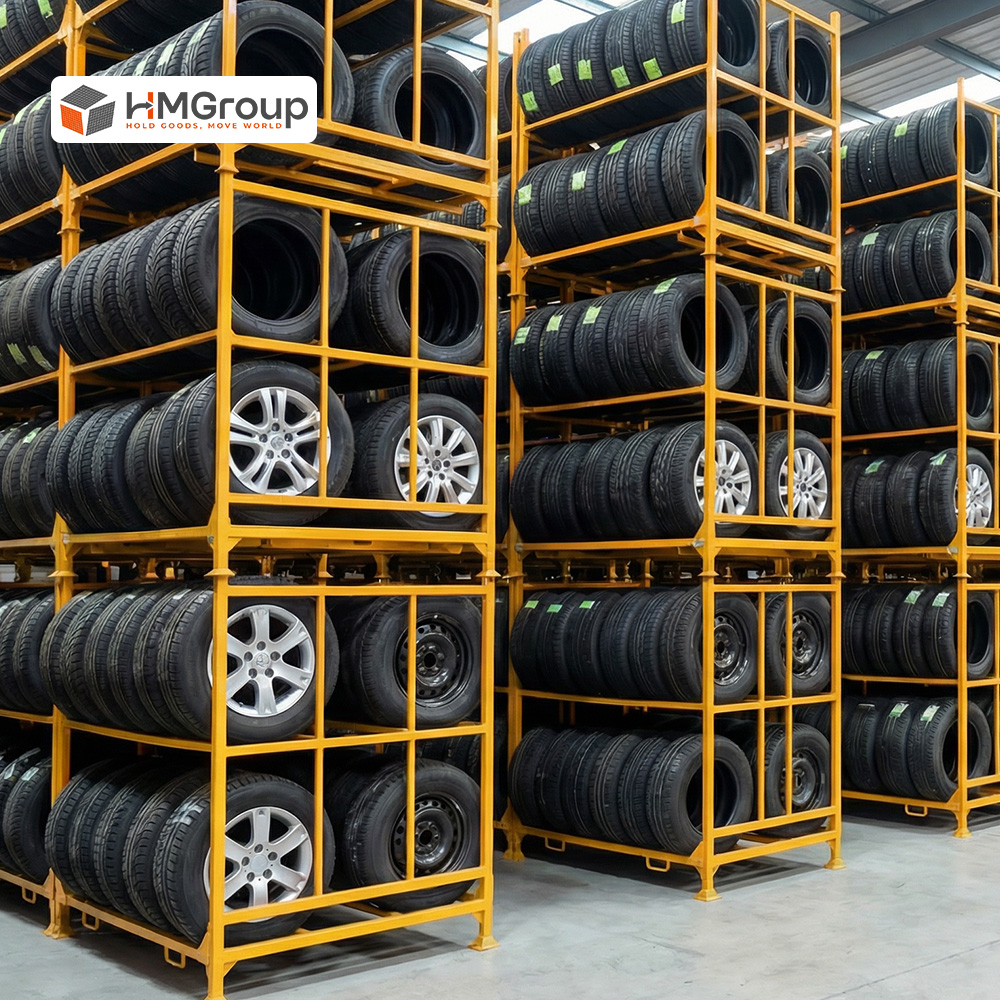
Car tire storage racks convert vertical space into usable tire capacity; the base size determines how much floor each unit claims.
Footprint: 25 square feet against 36 square feet
Reading the published dimensions in the conventional length x width x height order, HM-TR6060 occupies a 60 x 60 inch base and HM-TR7272WM a 72 x 72 inch base. That is 3,600 square inches against 5,184 square inches, or 25.0 square feet against 36.0 square feet. The larger unit claims 11 additional square feet — 44% more floor per rack position.
That single calculation drives most of the layout decision. A block of ten HM-TR6060 positions would claim roughly 250 square feet of footprint; the same number of HM-TR7272WM positions would claim about 360 square feet. The larger unit only justifies that premium if it delivers proportionally more tires or fewer handling moves, which is the density question examined next.
The 44% figure also interacts with aisle design and with handling equipment. HM Group's published material on its tire stacking racks describes four-way forklift entry, which matters more as the base grows: a wider unit is harder to place accurately in a tight rack room, and the clearance needed for entry on all four sides should be checked against the actual aisle width rather than assumed from the rack footprint alone.
Tire density: 1.28 against 1.75 tires per square foot
Density, not capacity, is the comparable measure between two racks of different size. Using the published counts and the calculated base areas, HM-TR6060 delivers up to 1.28 tires per square foot at the top of its stated 24–32 range (32 ÷ 25.0), while HM-TR7272WM delivers up to 1.75 tires per square foot (63 ÷ 36.0). At their stated maxima, the larger unit packs roughly 37% more tires into each square foot of floor.
| Measure (calculated from published specs) | HM-TR6060 | HM-TR7272WM |
|---|---|---|
| Base area | 25.0 sq ft | 36.0 sq ft |
| Stated tire count | 24–32 | Up to 63 |
| Tires per sq ft at stated maximum | 1.28 | 1.75 |
| Relative floor claim per rack position | Baseline | 44% more |
Two cautions keep this comparison honest. First, the two specifications are not phrased the same way: HM-TR6060 carries a range with a floor and a ceiling, while HM-TR7272WM carries only a ceiling described as "up to 63." A buyer should ask for both models to be expressed on the same basis, because a ceiling alone does not reveal how far capacity falls with larger tires. Second, neither published figure states the reference tire size, orientation, or whether tires are counted horizontally or vertically. Until that reference is defined, density figures are planning estimates rather than guaranteed counts.
The 2,400 lb rating read per tire
The most consequential difference between these two racks is invisible in the load rating itself. A 2,400 lb rating is a rack-level rating: it describes what the unit is declared to carry, not what each tire may weigh. Dividing that rating by the stated tire count shows how much headroom remains per position.
| Tires on the rack | Rating available per tire (2,400 lb ÷ count) |
|---|---|
| 24 (HM-TR6060, low end) | 100 lb |
| 32 (HM-TR6060, high end) | 75 lb |
| 63 (HM-TR7272WM, stated maximum) | About 38 lb |
This arithmetic is not a product specification and should not be presented as one. The rack does not allocate load per tire, and the calculation assumes an even distribution that a real loading pattern may not achieve. What it does establish is a decision rule: the same 2,400 lb rating leaves roughly 100 lb of allowance per position at 24 tires and roughly 38 lb at 63 tires. A buyer loading the same tire into both racks is therefore operating the larger unit much closer to its declared limit at full count than the smaller unit.
For mixed fleets, this pushes the conversation toward tire type and weight verification rather than rack strength. HM-TR7272WM at its stated maximum is a high-count, lower-per-position configuration; HM-TR6060 at 24 is a lower-count, higher-per-position configuration. Neither is better in the abstract. They answer different questions about what the warehouse actually stores.
Stacking implications of a 60-inch and a 72-inch cube
Stacking multiplies both the benefit and the risk of the footprint decision. Each tier of HM-TR6060 adds 60 inches of height; each tier of HM-TR7272WM adds 72 inches. Two tiers reach 120 inches against 144 inches. Four tiers reach 240 inches (20 ft) against 288 inches (24 ft). These are arithmetic per tier, not recommended stack heights — the permissible stack for either model, and whether it is counted with units open or closed, has to be confirmed with the supplier and against the building.
HM Group's published material for its stackable rack range describes vertical stacking of up to 4–5 tiers and a reduction in floor footprint of up to 75% compared with single-level floor placement. Those statements are general to the range. They do not, on their own, authorize any specific stack height for HM-TR6060 or HM-TR7272WM, and they should be treated as design intent until the model-specific limit is confirmed in writing.
Height also changes handling. A 72-inch tier gains height faster per unit stacked, which raises the reach requirement for the forklift or stacker earlier in the stack. A warehouse with a fixed overhead clearance may find that HM-TR6060 reaches a useful tier count within the available headroom while HM-TR7272WM does not — a constraint that is invisible when the two racks are compared only on tire count.
Build and process: Q235 and the joints that carry the stack
Both models are specified in mild steel Q235, and HM Group states that it prohibits spliced material or inferior steel grades where Q235 is required for high-strength applications. Because the steel grade is common to both models, the differentiator is process control rather than material selection.
The manufacturer describes a set of controls aimed directly at the failure modes that matter in a stacked rack: leaning and collapse from non-vertical legs, posts that fail to seat in base sockets, sharp burrs, and coating defects that shorten service life. Its stated methods include jig inspection before each welding session to hold verticality, dimensional tolerances applied to overall dimensions and diagonals to preserve compatibility between units, and continuous full-welding on critical joints including sockets, stacking bowls and tube-to-tube connections. Surface treatment is described as hot-dip galvanizing with flow holes to prevent zinc blockage and manual grinding of sharp edges, or powder coating supported by cross-cut adhesion tests and furnace temperature monitoring.

Tire rack welding at HM Group: joint quality determines whether stacked units seat and stay vertical.
Quality control is described as six inspection phases — pre-production, raw material, component, semi-finished product, finished product and packaging — supported by 100% self-inspection of every unit, an OK/NOK visual standard on the production floor, and a 10% pre-shipment sampling inspection with assembly videos and loading photographs supplied to the customer. These are company-reported practices, not the result of an independent audit, but they are the specific claims a buyer can test against the order.
Which operation suits which unit
Fit follows from the two numbers already established: floor claimed per position and tires carried per position. The scenarios below are conditional examples of that logic, not accounts of completed installations.
- Passenger tire retail and service bays. Where space is tight, aisle widths are short and tires arrive in smaller batches, the 25 sq ft base of HM-TR6060 and its 24–32 tire range keep the stack dense in plan view while staying within a modest footprint.
- High-volume distribution and consolidation. Where the goal is tires handled per forklift movement and the building has clear height, HM-TR7272WM's 63-tire ceiling and 1.75 tires per square foot reduce the number of rack positions and moves per tire — provided the per-position allowance of roughly 38 lb at full count matches the tires actually stored.
- Mixed or heavy tire inventories. Heavier tires consume the shared rating faster. A buyer storing a mixed range should model the heavier units against HM-TR6060's higher per-position allowance rather than assume the larger rack absorbs the difference.
- Buildings with fixed overhead clearance. A 72-inch tier adds height faster than a 60-inch tier, so the available headroom may cap the usable tier count before the rack's own limit is reached.
Reading the floor-stacking comparison correctly
HM Group's published comparison of its tire stacking racks against traditional floor stacking reports a 25% higher initial investment offset by long-term operating costs reduced by 40% through improved handling speed and zero product damage, together with a reduction in loading and unloading time and a lower damage rate than wooden pallets. It also describes the core design intent as high-density vertical stacking without tire compression or tread deformation.
These figures are company-reported and relate to the tire stacking rack category rather than to HM-TR6060 or HM-TR7272WM individually. They are useful as a statement of design intent and as a list of the cost lines a buyer should test — initial unit cost, handling time, damage rate and pallet replacement — but they are not an independently audited result and should not be written into a business case as a guaranteed return.
Purchasing terms and acceptance criteria to specify
Because the two models differ mainly in geometry, most purchase risk sits in how the specification is written rather than in which model is chosen. The following items translate the published data into order language.
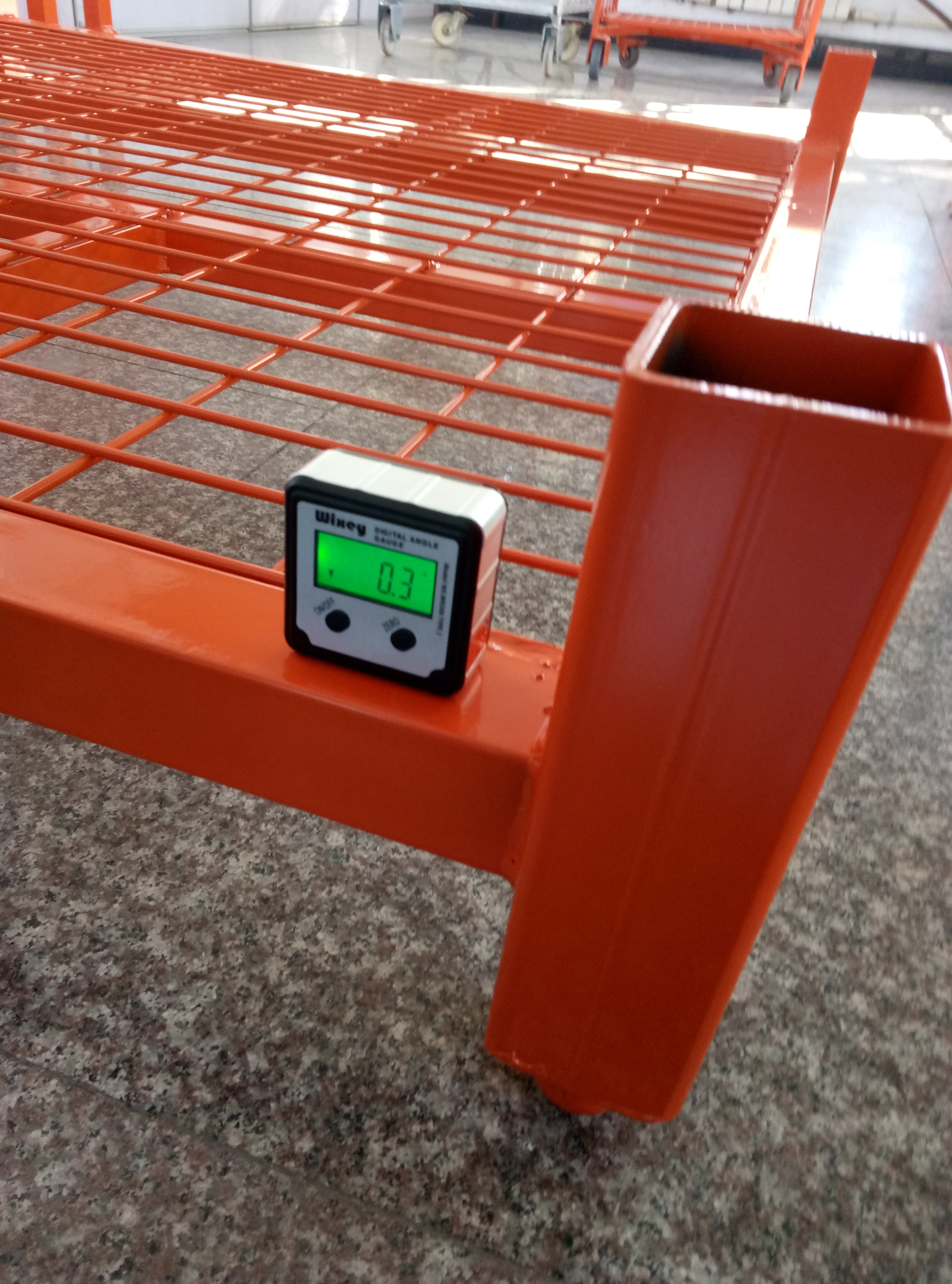
Base levelness inspection: uneven bases are a stated cause of leaning in stacked racks.
- Define the tire count. State the reference tire size, orientation and loading method behind "24–32" and "up to 63" so the two models are quoted on one basis.
- State the load basis. Require the rating to be declared as static or dynamic, per unit, under uniform distribution, and confirm whether 2,400 lb or 1,100 kg governs.
- Fix the stack configuration. Specify the permitted number of tiers and whether that figure applies to units open or closed, with the floor load capacity at the installation point.
- Confirm material evidence. Require Q235 grade confirmation and a statement that spliced material is excluded from load-bearing members.
- Set the dimensional tolerances. Ask for the tolerance on overall dimensions and diagonals, plus the verticality requirement for legs and sockets — these determine whether units stack squarely.
- Specify the finish. Hot-dip galvanized or powder coated, with edge grinding to remove burrs and an adhesion test requirement where powder coating is used.
- Agree the inspection record. Six-phase inspection documentation, 100% self-inspection, and a pre-shipment sampling percentage with photographs and assembly video.
- Check the handling assumptions. Confirm forklift entry, aisle clearance for the 72-inch base, and the reach equipment needed for the intended stack height.
- Record the after-sales terms. HM Group states process reports throughout production, online video audit support, and a 3 to 5 year warranty under proper use.
- Verify stability obligations. In the United States, OSHA 29 CFR 1910.176(b) requires stored materials to be stacked, blocked, interlocked and limited in height so that they are stable and secure against sliding or collapse — a workplace obligation that sits with the operator, not the rack.
Market context and outlook
The decision sits inside a category that research firms track as industrial racking systems. Market Research Future, in a report published in 2026, sized the global industrial racking systems market at USD 16.76 billion in 2024. That figure describes the category as a whole, not tire rack demand specifically, and it should not be used to infer growth in any single product line.
For buyers, the practical outlook is less about category size than about specification discipline. Two racks sharing a rating and a steel grade can behave very differently once tire count, footprint and stack height are fixed. Whether HM-TR7272WM's higher density or HM-TR6060's higher per-position allowance is the right answer depends on verified tire weights, verified headroom and a verified stack limit — three items that should be confirmed before a purchase order is issued rather than after the first stack is built.
FAQ
What is the main difference between HM-TR6060 and HM-TR7272WM?
Base size and tire count. HM-TR6060 is published at 60 x 60 x 60 inches with a stated capacity of 24–32 tires; HM-TR7272WM is published at 72 x 72 x 72 inches with a stated capacity of up to 63 tires. Both are listed at 2,400 lb / 1,100 kg and both are specified in mild steel Q235.
If both racks are rated 2,400 lb, why does the tire count differ so much?
The rating is a rack-level limit, not a per-tire allowance. Dividing 2,400 lb by the stated count gives roughly 100 lb per position at 24 tires, 75 lb at 32 tires, and about 38 lb at 63 tires. The larger rack carries more tires by leaving less rating available for each one, so the fit depends on how heavy the stored tires actually are.
How much floor space does each model require?
Using the published horizontal dimensions, HM-TR6060 claims 3,600 square inches, or 25.0 square feet, and HM-TR7272WM claims 5,184 square inches, or 36.0 square feet. The larger unit takes 44% more floor per rack position, which must be justified by its higher tire density of up to 1.75 tires per square foot against 1.28 for the smaller unit.
How high can each rack be stacked?
The published specifications for these two models do not state a model-specific stack limit. HM Group's general material for its stackable rack range describes vertical stacking of up to 4–5 tiers, and each tier adds 60 inches for HM-TR6060 or 72 inches for HM-TR7272WM. Buyers should obtain the written tier limit, the open or closed configuration it refers to, and the floor load capacity at the installation point before planning a stack.
What should be verified before placing an order?
Confirm the reference tire size behind each stated count, whether 2,400 lb or 1,100 kg governs the rating, the permitted stack height and configuration, the Q235 material declaration, dimensional and diagonal tolerances, the finish specification, and the inspection record covering the six production phases with a pre-shipment sampling report.
Resources
HM Group (hmlwires.com) publishes its storage rack range and product documentation, and its brochure is available for download at this PDF link. Technical queries can be directed to the trading team at mary@net-railing.com or +86 150 4058 7228.
Есть вопросы или нужны дополнительные детали?
Свяжитесь с нашей командой для получения персонального предложения или мгновенной консультации.
Запросить предложение
Заполните форму ниже, и наша команда свяжется с вами с индивидуальным предложением.
Прямой чат WhatsApp
Предпочитаете общаться в реальном времени? Напишите нам в WhatsApp для мгновенной помощи и быстрых ответов.
- Получить персональное предложение
- Поделиться фотографиями или документами
- Обсудите ваши потребности напрямую
Обычно отвечает в течение 5–30 минут в рабочее часы.