
HOCHI PPF & Window Film: Capability and Buyer Value
Window tint film and paint protection film (PPF) are no longer bought on colour and price alone. Distributors, brand owners and specifiers increasingly shortlist suppliers by published optical data, warranty structure, coating environment and quality-system certification — before a container price is ever discussed. This reference analysis examines Haian Ho Chi Technology Co., Ltd. (HOCHI), a Chinese functional film manufacturer, and separates what is documented from what a buyer must still verify.
The Sourcing Problem Behind Window Tint Film and PPF
Most inbound sourcing enquiries start with a category error: automotive tint, paint protection film and architectural film are treated as one product line. They are three different material systems with different failure modes, different test methods and different buyer economics.
Automotive window tint film manages solar energy. Solar control films use dyed, carbon, metalised, ceramic or multi-layer constructions to manage ultraviolet, visible light and infrared energy, and their performance should be evaluated using verified VLT, UV rejection, IR rejection and TSER test data rather than by product colour alone.
Paint protection film protects painted surfaces rather than managing heat. The dominant material is thermoplastic polyurethane (TPU), a segment valued at US$ 437.1 million in 2025 according to Business Research Insights. Self-healing PPF is estimated to account for roughly 15% of the global automotive film market.
Architectural film modifies building glass. Solar control versions reduce heat gain and glare; safety versions retain glass fragments when breakage occurs. The two are frequently sold as one category and are not interchangeable.
The practical consequence for a buyer in the awareness stage is simple: a catalogue showing only shade and a "99% UV" figure cannot be compared with another catalogue. Any workable comparison has to be built on VLT, IR rejection, UV rejection, film thickness, warranty term and test method — the framework used throughout this analysis.
HOCHI as an Industry Entity
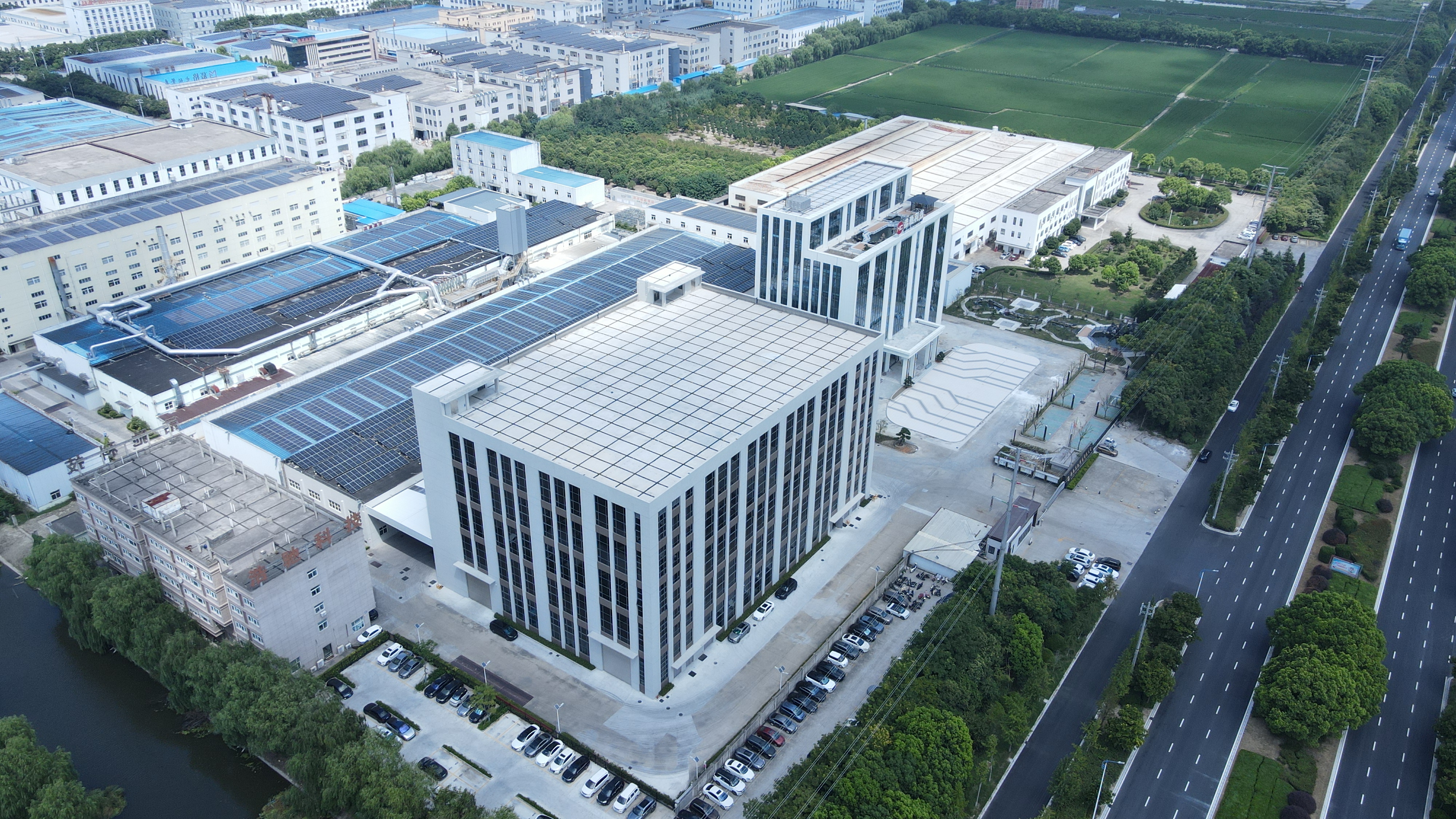
Haian Ho Chi Technology Co., Ltd. is a functional film manufacturer established in 2009 and a wholly-owned subsidiary of Shanghai Haochi Technology Co., Ltd. The company researches, develops, produces and sells automotive window film, car wraps, colour-changing films, architectural films, explosion-proof films and special protective film solutions.
It has held National High-tech Enterprise status for nine consecutive years and is described as a national-level specialised and innovative high-tech enterprise operating a "1+3+N" business group with automotive window film as its core business. That organisational structure matters commercially because it indicates where capital and engineering attention sit: the automotive window film line is the lead business, with architectural, wrap and protective film lines attached to it rather than run as unrelated ventures.
Its manufacturing base is located at No. 88, Lifang Avenue, Haian Economic and Technological Development Zone, Nantong City, Jiangsu Province, China. Export business accounts for 60% of total sales, with shipments reaching markets in Europe (Germany, France, the U.K., the Netherlands, Spain, Italy, the Nordics, and Central and Eastern Europe), the Americas (United States, Mexico, Brazil, Chile, Colombia, Peru, Argentina), the Middle East (UAE, Saudi Arabia, Qatar, Bahrain, Kuwait, Türkiye), Asia-Pacific (Malaysia, Singapore, Cambodia, Laos, Uzbekistan) and Oceania (Australia, New Zealand).
Its declared main products are nano-ceramic film, carbon film, original colour film, paint protection film, front layer film, iridescent film, architectural film, dyed film and explosion-proof film.
| Item | Documented value |
|---|---|
| Established | 2009 |
| Parent company | Shanghai Haochi Technology Co., Ltd. |
| Manufacturing facility area | 133,333 m² |
| Annual production capacity | 48,000,000 metres |
| Employees | 220+ |
| R&D team | 100 engineers |
| Patents | 50+ (14 invention, 19 utility model, 18 software copyrights) |
| Customisation catalogue | 400+ customised solar film types; 200+ customised colour-changing film types |
| Export share of sales | 60% |
| Quality system certification | IATF 16949:2016, valid until 2028-03-15 |
| Coating environment | Class 1000 dust-free coating workshop, 3,000 m² |
Capability Review: Manufacturing, R&D and Quality Systems
Facility scale and production capacity
The manufacturing facility covers 133,333 square metres and the company reports annual production capacity of 48,000,000 metres, with approximately 220 employees.
For a buyer, the useful reading of those figures is not the headline number but what it implies about allocation behaviour. Capacity at this scale can support master-roll and programme volumes, private-label runs and mixed-container orders without the supplier re-tooling between small batches. The qualification question is not "is the factory large" but "is my programme getting a stable allocation window" — and that should be confirmed as lead time and minimum order quantity in writing, not inferred from a capacity figure.
Coating environment
Company documentation describes a Class 1000 dust-free coating workshop covering 3,000 square metres. In film coating, airborne particulate is the leading cause of optical defects — pinholes, embedded specks and haze — and it is one of the few process variables a buyer can assess indirectly through incoming roll quality. Even with a controlled coating environment, buyers should inspect rolls against a defined standard: the IWFA Visual Quality Standard, for example, specifies inspection from 6 feet (approximately 2 metres) under natural daylight.
Quality system certification and its limits
The paint protection film and solar film products are certified to IATF 16949:2016, with the certification stated as valid until 2028-03-15. IATF 16949 is an automotive-sector quality management system standard; it evidences documented process control, traceability discipline and structured continuous improvement. It does not certify optical performance. Buyers should treat the certificate as evidence of process maturity and request product-level test data separately.
R&D structure and customisation depth
The R&D function is staffed by 100 engineers, led by a postdoctoral fellow from Harvard University, and works with institutions including the Chinese Academy of Sciences, East China University of Science and Technology and Nanjing University. The company holds more than 50 patents, comprising 14 invention patents, 19 utility model patents and 18 software copyrights.
The commercial output of that function is visible in the customisation catalogue: over 400 types of customised solar film products and over 200 types of customised colour-changing films. For distributors, customisation depth is the difference between reselling a generic roll and running a private-label programme with its own VLT ladder. For specifiers, it is the ability to hit a defined visible light transmission target rather than accept the nearest stock shade.
Industry tenure
The chairman has more than 30 years of experience in new materials operations and the automotive window film market. Long tenure is not itself a product claim, but it is a reasonable proxy for how a supplier reads market cycles, regulatory shifts on tint darkness, and the difference between an installer-friendly film and one that generates claims.
Portfolio Map: How the Range Is Structured
HOCHI's automotive window film range spans four distinct performance tiers rather than one continuous line. Understanding the tiers is a precondition for comparing quotations fairly, because two films sold at the same VLT can sit in completely different price and performance brackets.
| Model | Type | Structure | VLT | IR cut | UV rejection | Warranty |
|---|---|---|---|---|---|---|
| CLASSIC03P | Glue tint | 2PLY 1.5 mil | 3% | 10% | 99% | 4 years |
| CLASSIC35P | Glue tint | 2PLY 1.5 mil | 35% | 10% | 99% | 4 years |
| CARBONBRONZE 10 | Carbon | Optical grade PET | 10% | 90% | 99% | Not published |
| NEX4MIL05 | Glue tint security | 2PLY 4.0 mil | 5% | 11% | 99% | 5 years |
| NEX8MIL05 | Glue tint security | 2PLY 8.0 mil | 5% | 11% | 99% | 5 years |
| SL05R | Glue tint reflective | 2PLY 1.5 mil | 5% | 95% | 99% | 5 years |
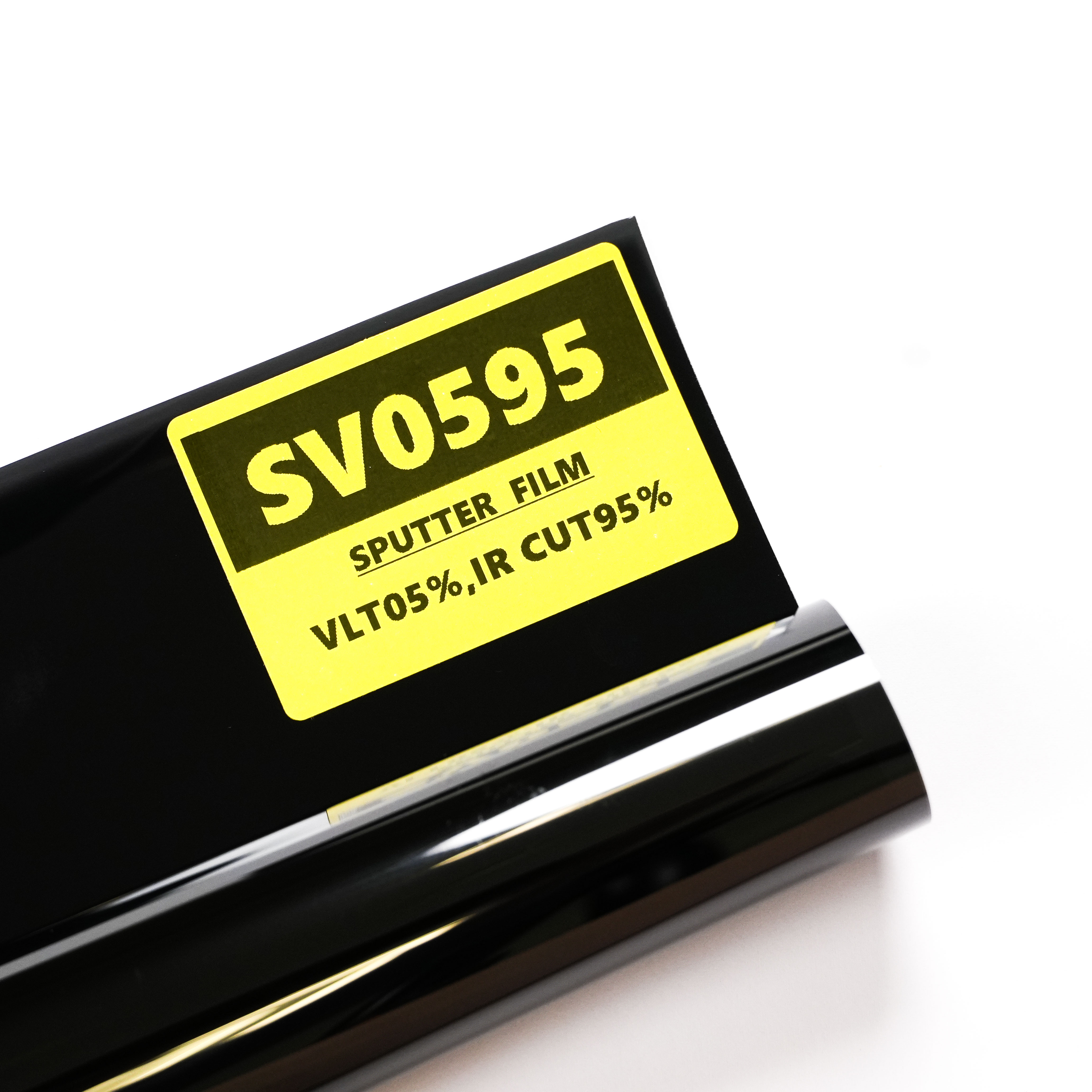
| QS0595 | Sputter | 2PLY 2.0 mil | 5% | 95% | 99% | 10 years |
| QS5095 | Sputter | 2PLY 2.0 mil | 50% | 95% | 99% | 10 years |
| SV0595 | Sputter | 2PLY 3.0 mil | 5% | 95% | 99% | 10 years |
| SV3095 | Sputter | 2PLY 3.0 mil | 30% | 95% | 99% | 10 years |
The architectural range follows the same logic but splits into two functional groups. The silver reflective and silver coloured films are solar control products; the safety clear films are glass-retention products.
| Model | Type | Structure | VLT | IR cut | UV rejection | Warranty |
|---|---|---|---|---|---|---|
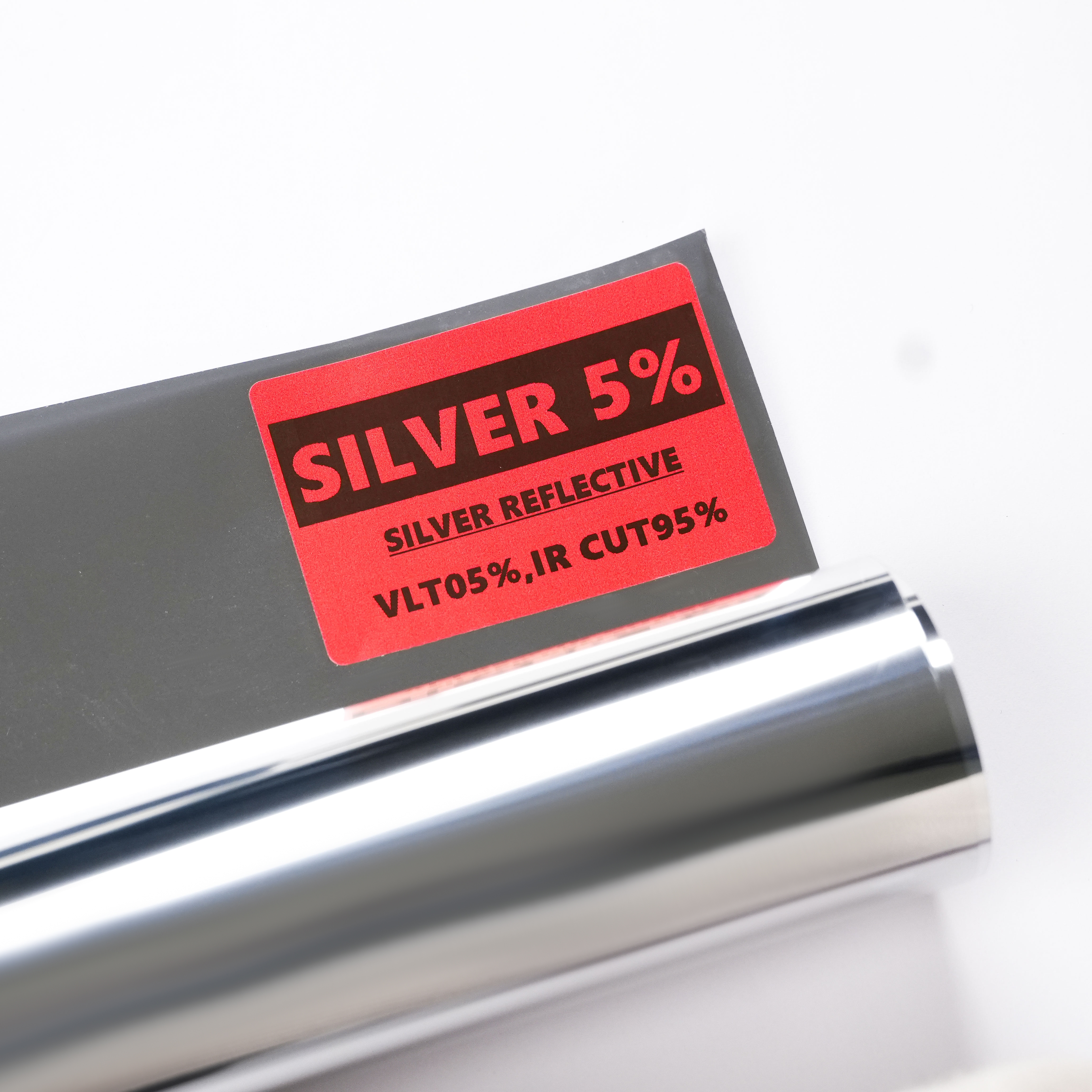
| SILVER 5% | Silver reflective | 2PLY 1.5 mil | 5% | 95% | 99% | 6 years |
| SILVER 10% | Silver reflective | 2PLY 1.5 mil | 10% | 88% | 99% | 6 years |
| SILVER/BLUE 15 | Silver coloured | 2PLY 1.5 mil | 8% | 90% | 99% | 4 years |
| SILVER/GREEN 10 | Silver coloured | 2PLY 1.5 mil | 8% | 90% | 99% | 4 years |
| SILVER/GREY 05 | Silver coloured | 2PLY 1.5 mil | 10% | 75% | 99% | 4 years |
| SILVER/GOLD 20 | Silver coloured | 2PLY 1.5 mil | 25% | 75% | 99% | 4 years |
| SF02 | Safety clear | 1PLY 2.0 mil | 90% | 10% | 88% | 6 years |
| SF12 | Safety clear | 1PLY 12.0 mil | 90% | 10% | 88% | 6 years |
How to Read Optical Specifications Without Being Misled
Visible light transmission and heat rejection are independent variables. This is the single most expensive misunderstanding in window film procurement, and HOCHI's own catalogue demonstrates it clearly.
| Model | VLT | IR cut | What the buyer actually gets |
|---|---|---|---|
| CLASSIC03P | 3% | 10% | Very dark, low-cost tint. Privacy and glare control, minimal heat rejection. |
| NEX4MIL05 | 5% | 11% | Dark security film. Shatter retention and intrusion delay, minimal heat rejection. |
| CARBONBRONZE 10 | 10% | 90% | Carbon film with balanced heat and colour stability, no metal content. |
| QS0595 | 5% | 95% | Sputtered film. High heat rejection at a dark shade, 10-year warranty. |
Two films at 5% VLT can differ by more than 80 percentage points on infrared rejection. A quotation that lists only shade and UV rejection therefore conceals the variable that determines whether the end customer feels a difference.
Why sputtered films behave differently
Dyed and carbon films manage solar energy largely by absorption: the film heats up and re-radiates energy inward and outward. Sputtered films deposit multiple metallic layers onto the PET substrate, reflecting a defined portion of the infrared spectrum while transmitting visible light — a property the manufacturer describes as spectral selectivity. Published attributes for this line include true reflective heat rejection, ultra-high optical clarity and low haze, a natural metallic aesthetic and zero fading, together with a 10-year quality warranty. Several models in the range, including SV3095 and the NEX security films, are specified as causing no signal interference.
Where these numbers stop being sufficient
IR cut percentages are manufacturer specifications measured under defined conditions. They are not a substitute for total solar energy rejection (TSER), which accounts for absorption, reflection and re-radiation together. Where a project is specified on TSER, the buyer should request a full test report rather than extrapolate from IR cut. Reflective sputtered films also raise exterior reflectivity, and mirror-like tints are restricted or prohibited in some jurisdictions; local vehicle tint rules must be checked before ordering, not after installation.
PPF Material Selection: Aliphatic TPU Versus PVC and TPH
Paint protection film appears on HOCHI's main product list alongside the solar control lines. The material decision that determines whether a PPF programme generates warranty claims is the base resin, and the company's technical position is unambiguous: 100% aliphatic TPU.
According to the manufacturer's material comparison documentation, its PPF uses optical-grade aliphatic TPU resin with a premium pressure-sensitive adhesive. The stated performance envelope includes UV yellowing controlled to Delta E below 1.5 over five years, no edge peeling, no adhesive residue, instant thermal self-healing for scratches, tensile elongation above 300% for edge wrapping, and a 7–10 year factory warranty.
The same document sets out the failure mechanism of the alternative. PVC and TPH films rely on plasticisers that degrade under UV and heat exposure, which leads to brittle cracking, yellowing within one to two years, and glue residue that can damage paint during removal.
| Attribute | Aliphatic TPU PPF | PVC / TPH film |
|---|---|---|
| Base resin | Optical-grade aliphatic TPU | PVC / TPH with plasticisers |
| Yellowing resistance | Delta E < 1.5 over 5 years (stated) | Visible yellowing within 1–2 years (stated) |
| Self-healing | Instant thermal self-healing for scratches | No comparable mechanism described |
| Elongation | 300%+ tensile elongation for edge wrapping | Lower elasticity; cracking risk under UV and heat |
| Removal behaviour | No adhesive residue stated | Glue residue risk; paint damage possible |
| Warranty | 7–10 year factory warranty | Not intended for long-term protection |
| Recommended use | Professional detailing, distributors, long-life vehicle protection | Short-term temporary protection, budget projects |
The boundary matters as much as the recommendation. These are supplier-stated figures tied to defined test conditions, and PPF outcomes depend heavily on installation quality, substrate condition and removal technique. The manufacturer's own guidance is that PVC and TPH are suitable only for short-term temporary protection where paint-safety risk is acceptable, and that aliphatic TPU is the appropriate choice for professional detailing, distributors and vehicles requiring long service life. A sample programme and written warranty terms — including exclusions and installer qualification requirements — remain the correct way to validate the claim.
Application Scenarios and Operating Conditions
The manufacturer's application data covers five industries: automotive aftermarket and detailing, building and construction, commercial and residential real estate, glass glazing and tinting, and automotive parts. The project types listed are automotive paint protection, car window heat and solar insulation, commercial building energy-saving retrofit, and residential privacy and solar control glass tinting.
Specified working conditions are demanding and worth reading literally, because they define the warranty boundary: intense solar radiation, high UV exposure, high ambient temperature, humidity, road debris impact, stone chips, gravel abrasion, and outdoor weathering across a stated range of −30°C to 80°C. The stated operation mode is passive and continuous — 24/7 thermal insulation, UV shielding, physical surface protection and self-healing, with no power input.
| Category | Specified requirement |
|---|---|
| Stated functions | 99%+ UV rejection, infrared heat reduction, scratch resistance and thermal self-healing, anti-yellowing paint protection, glare reduction, HVAC energy efficiency improvement, glass shatter resistance |
| Special requirements | High optical clarity, zero visual distortion, anti-scratch hard coating, colour stability against fading, strong weatherability, residue-free adhesive removal, explosion-proof safety |
| Matched equipment | Hot air gun, installation squeegees, CNC film cutting plotter, DAP cutting software, slip solution sprayer |
Two implications follow for buyers. First, a supplier whose range requires CNC plotters and cutting software is positioning for professional installers rather than DIY resale — relevant when a distributor is building an installer network. Second, the stated −30°C to 80°C weathering envelope and the colour stability requirement are the commercial reason entry-level dyed film and premium sputtered film cannot be sold interchangeably in harsh markets.
Market Trend Analysis
Independent market data supports the direction the category is moving, though absolute values should be read with care because research houses define the market boundary differently.
| Indicator | Value | Period | Source |
|---|---|---|---|
| Global automotive tinting film market | Projected to reach US$ 14.7 billion | by 2033 | Grand View Research |
| TPU paint protection film segment | US$ 437.1 million | 2025 | Business Research Insights |
| Nano-ceramic film heat rejection capability | Up to 85% of solar heat, with high visible light transmission | — | Market Research Reports |
| China motor vehicle production | Exceeded 31 million units | 2024 | OICA, referenced by market analysis |
| Self-healing PPF share of global automotive film market | Approximately 15% | 2024 | Market Research Reports (derived) |
| 72-inch wide format PPF segment | Projected to reach US$ 1.9 billion | by 2030 | Strategic Market Research |
Three readings are defensible from this data set. First, TPU is the established PPF material, not an emerging alternative, which means a supplier's TPU sourcing and conversion capability is now a baseline requirement rather than a differentiator. Second, the wide-format master roll segment carries its own forecast, reflecting installer demand for fewer seams on large panels — relevant to any distributor buying master rolls rather than pre-cut kits. Third, nano-ceramic chemistry is presented in the data as capable of blocking up to 85% of solar heat while maintaining high visible light transmission, which is why ceramic and sputtered constructions increasingly occupy the middle and upper tiers while dyed film retreats to the entry tier.
Comparison with Legacy Solutions — and Honest Boundaries
Functional film competes with, and replaces, several older approaches: no film at all with higher air-conditioning load, dyed film with fast fade, and PVC-based surface protection with short service life. The honest comparison is not that new film is universally better; it is that each tier solves a different problem at a different cost.
| Tier | Representative models | Strengths | Boundaries |
|---|---|---|---|
| Dyed / glue tint | CLASSIC03P, CLASSIC35P | Lowest cost, good colour stability, installer-friendly heat shrink, zero signal interference | IR cut of 10%; not a heat-rejection product |
| Carbon | CARBONBRONZE 10 | IR cut 90%, non-metallic, no signal interference, colour stability | Mid-tier heat performance; not a substitute for sputtered film in extreme climates |
| Sputtered / reflective | QS0595, QS5095, SV0595, SV3095, SL05R | IR cut 95%, clarity, low haze, zero fading, warranties up to 10 years | Higher unit cost; higher exterior reflectivity may conflict with local tint regulations |
| Security tint | NEX4MIL05, NEX8MIL05 | Shatter retention, anti-smash-and-grab intrusion delay, deep privacy, 4.0 and 8.0 mil options | IR cut of 11%; sold for safety and privacy, not thermal performance |
| Architectural solar control | SILVER 5%, SILVER 10%, SILVER/BLUE 15, SILVER/GREEN 10, SILVER/GREY 05, SILVER/GOLD 20 | IR cut 75–95%, UV rejection 99%, daytime one-way privacy, cost-effective retrofit | Requires glass compatibility and thermal stress assessment before installation |
| Architectural safety clear | SF02, SF12 | Glass retention and security protection, strong adhesive, high VLT of 90% | IR cut of 10% and UV rejection of 88%; it is not a solar control film |
Buyers should weigh five genuine constraints before standardising on this or any supplier's range.
- Not every SKU is a heat-rejection product. The entry tint line and both security films are specified at 10–11% IR cut. They compete on cost, privacy, glare control and shatter retention, and should not be quoted into a thermal-performance requirement.
- Architectural solar film carries a glass-compatibility obligation. A compatibility or thermal stress assessment is recommended before installing solar control film on certain laminated, insulated or treated glass, because incompatible film may increase thermal stress and the risk of glass breakage.
- Published specifications are not identical across every document set. SILVER/GREY 05, for example, appears in different source documents with both a 5% VLT / 95% IR cut / 6-year warranty configuration and a 10% VLT / 75% IR cut / 4-year warranty configuration. Buyers must confirm the exact VLT, IR cut and warranty term in writing on the specification sheet or proforma invoice.
- Warranty terms differ by product family. The range carries 4-year, 5-year, 6-year and 10-year quality warranties depending on model. A warranty is a conditional commercial commitment, not a performance guarantee; exclusions, installer requirements and the claims process should be reviewed before programme launch.
- Independent third-party optical test reports were not part of the source data reviewed here. All optical figures cited in this analysis are manufacturer specifications and should be validated against third-party testing where a project requires certified performance.
Procurement Value: What Is Worth Recommending, and Why
Stripped of marketing language, five elements of HOCHI's position are defensible on documented evidence.
- Single-source range coverage. A distributor can qualify one supplier for entry tint, carbon, sputtered, security, architectural solar control, architectural safety and PPF lines, rather than running separate vendor approvals for each category. For a regional importer, that reduces administrative and inventory complexity.
- A credible performance ceiling. The sputtered line is specified at IR cut 95%, UV rejection 99% and a 10-year quality warranty across multiple models, which is sufficient to bid premium tint programmes rather than only entry work.
- Customisation depth as a private-label asset. More than 400 customised solar film types and more than 200 customised colour-changing film types give brand owners room to build differentiated SKUs without commissioning new master rolls.
- Documented process discipline. A Class 1000 dust-free coating workshop of 3,000 m², IATF 16949:2016 certification valid to 2028-03-15, and 50+ patents indicate the kind of process control that automotive parts buyers and larger distributors typically require during onboarding.
- Export operational experience. With 60% of sales exported across Europe, the Americas, the Middle East, Asia-Pacific and Oceania, the supplier already operates within the documentation, packaging and compliance expectations of international buyers rather than treating export as a new channel.
The counterweight is equally clear. This is a manufacturer with a broad catalogue and a strong process story, not a supplier with publicly available third-party performance certificates for every model. Buyers who need certified optical data, jurisdictional tint compliance documentation or installer certification programmes should request those items explicitly during sampling rather than assume them.
Future Outlook
Three shifts are likely to shape sourcing decisions over the next several years.
First, PPF continues to migrate from a detailing accessory to a specification item. With TPU already dominant in the material segment and self-healing formulations holding a meaningful share of the automotive film market, the competitive question shifts from "does the supplier sell PPF" to "can the supplier control yellowing and adhesive behaviour over a seven-to-ten-year service life." Resin selection and adhesive chemistry, not brand presentation, will decide claim rates.
Second, wide-format master roll supply will become a qualifying capability rather than a convenience. The dedicated forecast for the 72-inch wide format segment reflects installer economics: fewer seams mean faster jobs and fewer defect points on full-body applications.
Third, building energy retrofit demand will keep architectural film in the portfolio of any manufacturer that already coats PET. Glare control, HVAC load reduction and glass retention are being specified together in commercial retrofits, which favours suppliers that carry both solar control and safety clear constructions.
The variable that could change the competitive order fastest is verification. As more buyers ask for third-party optical data and TSER reports instead of catalogue VLT figures, suppliers with documented test protocols will separate from those relying on colour charts.
Frequently Asked Questions
How does automotive window film reduce heat and UV exposure?
Solar control films use dyed, carbon, metalised, ceramic or multi-layer materials to manage ultraviolet, visible light and infrared energy. Dyed and carbon films work mainly by absorbing solar energy and re-radiating it; metalised and multi-layer sputtered films reflect a defined portion of the infrared spectrum while transmitting visible light. In practice, performance should be evaluated using verified VLT, UV rejection, IR rejection and TSER test data rather than relying on the darkness or colour of the film, because two films with the same visible light transmission can differ substantially in infrared rejection.
How is automotive window tint film installed correctly?
Correct installation requires a clean, dust-free environment, accurate cutting, thorough cleaning of the glass, the correct application solution, careful squeegee work and sufficient curing time. The working sequence is: inspect the glass and confirm the required VLT, film model and position; protect the vehicle interior; clean the interior and exterior glass surfaces to remove oil, dust and adhesive residue; measure and cut with a trimming margin; heat-shrink and shape the film on curved glass where necessary; spray the approved installation solution; position the film and squeegee water and air from the centre outwards; trim the edges and inspect for bubbles, dust, creases and lifting; then allow the film to cure before lowering the windows or cleaning the glass. Professional installation is what prevents bubbles, dust contamination, peeling edges and optical distortion. Local VLT regulations should be checked before installation.
How should architectural window film be installed on building glass?
Architectural film should be selected according to glass type, building orientation, solar exposure, privacy requirements and local regulations. Installation begins with glass compatibility verification: the glass should be inspected for cracks, damage or existing coatings, and the selected film confirmed as compatible with the glass structure. Surrounding walls, floors, frames and electrical equipment are then protected; the glass is cleaned to remove dust, grease and residue; the film is measured and cut with a trimming allowance; approved installation solution is sprayed on the glass and the adhesive surface; the film is positioned and water and air are removed with a professional squeegee; edges are trimmed and inspected for contamination, bubbles and lifting; and sufficient curing time is allowed before cleaning or final evaluation. A glass compatibility or thermal stress assessment is recommended before installing solar control film on certain laminated, insulated or treated glass, because incompatible film may increase thermal stress and the risk of glass breakage.
How should a buyer choose between aliphatic TPU PPF and PVC or TPH film?
The decision turns on service life and paint safety. Aliphatic TPU PPF uses optical-grade aliphatic TPU resin with a pressure-sensitive adhesive and is documented to control UV yellowing to Delta E below 1.5 over five years, self-heal scratches thermally, elongate above 300% for edge wrapping, and carry a 7–10 year factory warranty. PVC and TPH films rely on plasticisers that degrade under UV and heat, which is associated with brittle cracking, yellowing within one to two years, and adhesive residue that can damage paint on removal. Aliphatic TPU is therefore the appropriate choice for professional detailing shops, regional distributors and vehicles requiring long-term protection, while PVC and TPH are suited only to short-term temporary protection where paint-safety risk is acceptable. Buyers should still confirm the performance claims through sample testing and review the written warranty terms, including exclusions and installer requirements.
Есть вопросы или нужны дополнительные детали?
Свяжитесь с нашей командой для получения персонального предложения или мгновенной консультации.
Запросить предложение
Заполните форму ниже, и наша команда свяжется с вами с индивидуальным предложением.
Прямой чат WhatsApp
Предпочитаете общаться в реальном времени? Напишите нам в WhatsApp для мгновенной помощи и быстрых ответов.
- Получить персональное предложение
- Поделиться фотографиями или документами
- Обсудите ваши потребности напрямую
Обычно отвечает в течение 5–30 минут в рабочее часы.