
HOTAK PRO TOOLS: 4V Cordless Tools Capability Review
HOTAK PRO TOOLS: 4V Cordless Tools Capability Review

Cover: production base in Ningbo, Zhejiang Province, where the 4V cordless tool program is manufactured.
The 4V cordless category — tools built around a single 3.7V nominal lithium-ion cell — has moved from gift-aisle novelty to a defined shelf position in home-improvement and DIY retail. For importers, distributors and private-label buyers, the practical question is no longer whether the category sells, but which manufacturers can supply it with stable specifications, model-specific compliance evidence and enough production depth to survive a retail program audit.
This reference review examines HOTAK PRO TOOLS, the cordless and hand tool brand of Ningbo (Yinzhou) Yongjia Electrical Tools Co., Ltd., a manufacturer founded in 2000 and headquartered in Ningbo, Zhejiang Province, China. It covers production scale, the integrated manufacturing chain, the R&D and patent record, the certification and audit position, and the 4V cordless product program — and then sets out what those facts mean for a buyer at the research stage of a sourcing decision.
Why 4V Cordless Tools Became a Procurement Question
The tools that dominate repair work are not the tools that dominate tool catalogues. Furniture assembly, cabinet hinge adjustment, electronics teardown, upholstery tacking and light craft work all involve small fasteners, short travel distances and restricted access. A full-size drill-driver is oversized for most of that work, while a hand screwdriver becomes slow once a job involves dozens of repeats.
A 4V-class cordless tool occupies that gap. The category is defined by the power source rather than by the tool type: one 3.7V nominal lithium-ion cell packaged with a compact motor and a small, task-specific mechanism. Because the cell is small, the tool stays light and can be shaped around the hand rather than around a battery platform.
For buyers, three consequences matter. First, the 4V label covers a wide performance band. In documented product data for this range, electric torque runs from 0.15 N·m on precision repair drivers to 5 N·m on general-purpose power screwdrivers, so a category-level statement is not a procurement specification. Second, runtime is governed by battery capacity and duty cycle together: 2,000 mAh, 800 mAh and 320 mAh packs all appear inside the same voltage class. Third, retail channels increasingly expect 4V tools to arrive as complete, presentation-ready programs — bit assortments, cases, chargers, packaging and, in many cases, private-label colourways — rather than as single loose SKUs.
That is why supplier evaluation in this category is largely a manufacturing and compliance exercise rather than a product comparison.
The Manufacturer Behind the Brand
HOTAK PRO TOOLS is the cordless and hand tool brand of Ningbo (Yinzhou) Yongjia Electrical Tools Co., Ltd., a manufacturer headquartered in Ningbo, Zhejiang Province, China. The company designs, manufactures and sells hex keys, torx keys, staple guns, precision screwdrivers, hobby knives and hand tool sets, and has extended that hand tool base into cordless 4V tools, including cordless staple guns, 4V cordless screwdrivers and a mini rotary tool. Its business is export-led: approximately 95% of sales are exported, products reach more than 100 countries and regions, and the main markets are the EU, USA, Southeast Asia and South America.
| Company indicator | Documented figure |
|---|---|
| Founded | 2000 |
| Headquarters | Ningbo, Zhejiang Province, China |
| Manufacturing facility area | 45,000 m² |
| Workforce | Approximately 450 employees, including more than 25 R&D engineers |
| Annual output | Approximately 18,000,000 units |
| Export ratio | Approximately 95% of sales |
| Export reach | More than 100 countries and regions |
| Certifications and audits | ISO9001; TÜV/GS; BSCI; Walmart factory audit; Kingfisher factory audit; VPA (Verify Production Audit) |
| Recognition | National High-Tech Enterprise (2014); Ningbo “Little Giant” enterprise |
| Patent portfolio | 7 invention patents; more than 20 European patents; 50 utility model patents; over 100 design patents |
Read together, these figures describe a mid-scale specialist rather than a general-purpose power tool group: a 45,000 m² site producing roughly 18 million units a year, with about 450 employees of whom more than 25 are engineers. That configuration is built around high-volume, multi-specification hand tool and compact cordless orders — the same order profile that 4V cordless programs, private-label kits and multi-piece sets generate.
Where the Competitive Advantage Actually Sits
Three verifiable structural features distinguish this manufacturer within the compact cordless segment: an integrated production chain, a patent and design record, and a compliance position built around retailer audits.
1. An integrated in-house production chain
The company operates a fully integrated production chain covering mold development, forging and stamping, heat treatment, surface finishing, precision machining, assembly and packaging. For a 4V cordless program this matters more than it does for a catalogue hand tool. Private-label work requires custom housings, colourways, case configurations and packaging, and every one of those changes begins with tooling. Keeping mold development, metal forming and surface finishing under one management system shortens the loop between a customization request and a production-ready sample, and it keeps the process parameters that determine fit, finish and fastener alignment inside the same quality system.
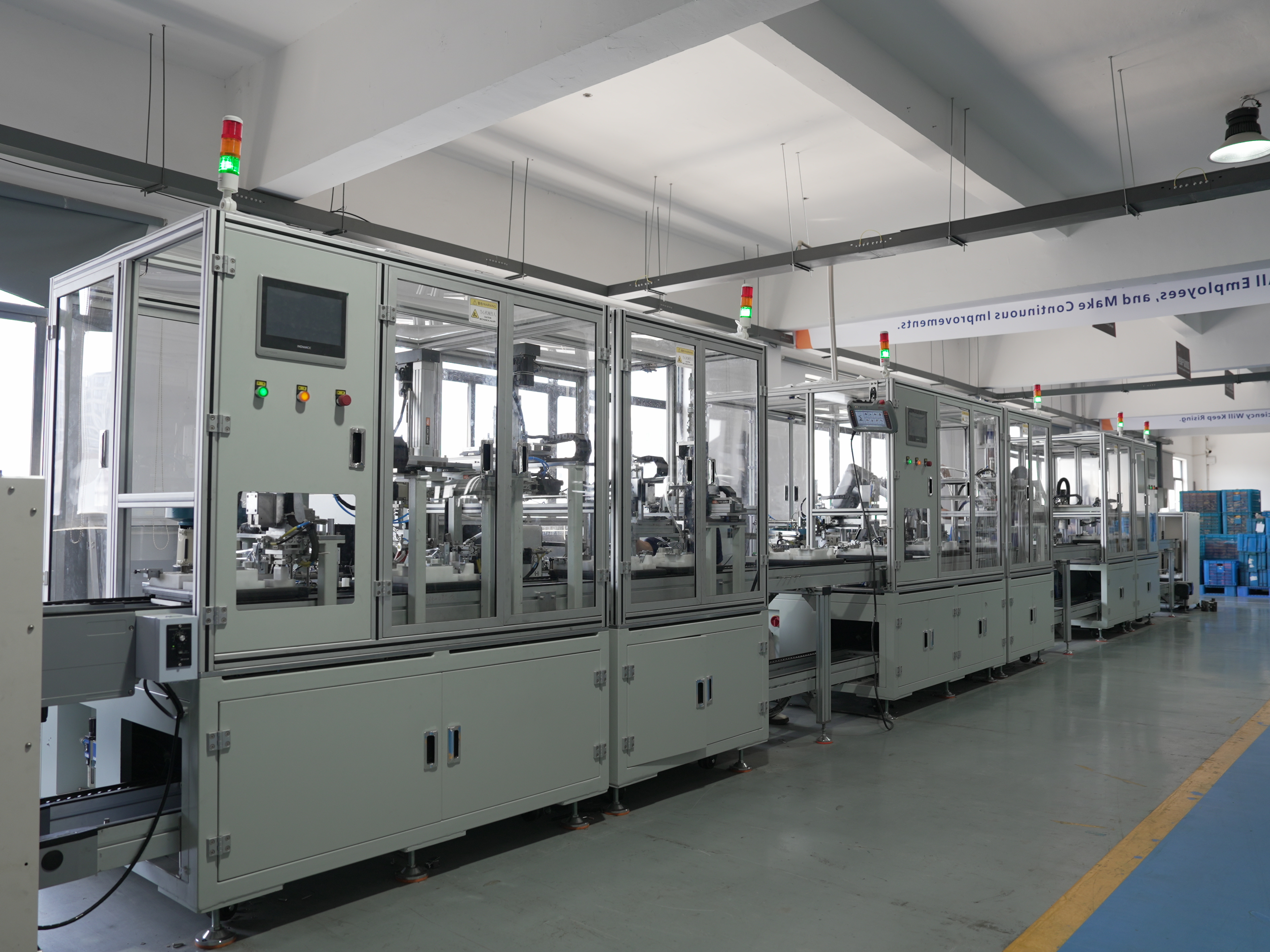
Full-automatic assembly line: the same in-house chain covers mold development through packaging.
2. R&D and patent depth
The patent position is the second structural asset: 7 invention patents, more than 20 European patents, 50 utility model patents and over 100 design patents, alongside accreditation as a National High-Tech Enterprise in 2014 and recognition as a Ningbo “Little Giant” enterprise. Utility models and design patents are the two categories that matter most in compact cordless tools, because the competitive surface is simultaneously mechanical — how many fastener types a staple gun accepts, how a driver switches between speed or torque settings — and visual: body form, grip geometry, colour and case layout.
3. Compliance and audit position
The third asset is the audit trail: ISO9001 quality management system certification, TÜV/GS safety certification, BSCI social compliance certification, factory audit approval from Walmart and from Kingfisher, and VPA approval. Retail programs in Europe and North America generally treat supplier audits as an entry condition rather than a differentiator, but the same audits determine how quickly a manufacturer can be onboarded for a private-label run and how much re-verification work a buyer has to fund.
The company states that it maintains long-term relationships with international brands, retailers and distributors, including DIY and home improvement retailers such as The Home Depot, Lowe's, Walmart, AutoZone, Kingfisher, Leroy Merlin and Auchan, as well as tool and industrial groups including TTI, ITW and CPI. These relationships are self-reported; as with any supplier claim, the applicable scope, plant and product category should be confirmed during a program audit rather than treated as a qualification in itself.
Technical Explanation: What a 3.7V Single-Cell Architecture Delivers
Electric torque versus manual torque
Product data for this 4V range separates two ratings that buyers frequently conflate. Electric torque is what the motor produces. Manual torque is the load the tool can accept when it is turned by hand, and it is the figure that determines whether the tool can break a tight fastener loose or be used for final tightening. The general-purpose power screwdriver YJPS-902 is rated at 3.7V with a 2,000 mAh battery, a no-load operating time of at least 60 minutes, an output speed of 0–280 rpm, three electric torque settings of 2 N·m, 3.5 N·m and 5 N·m, and a manual torque of 10 N·m; charging is specified at 1–1.5 A with a 5 V charge output.
The precision end of the range, represented by YJPS-907 and YJPS-906, is rated at 3.7V, 320 mAh, 0–220 rpm, 0.15 N·m electric torque and 3 N·m manual torque — deliberately low, because the fasteners involved are small electronics screws where over-torque damages the assembly rather than the tool. YJPS-912 sits between the two at 3.7V, 800 mAh, at least 50 minutes of no-load runtime, 0–250 rpm, 2.5 N electric torque and 10 N·m manual torque.
Runtime, battery capacity and charging
Runtime in this class is a function of battery capacity and duty cycle together, not capacity alone. Documented figures range from at least 30 minutes of no-load operation on the 320 mAh precision platform, to at least 50 minutes on an 800 mAh pack, to at least 60 minutes on a 2,000 mAh pack. Because these are no-load figures, real runtime in fastening work will be shorter and depends on fastener size, substrate and trigger pattern. Charging follows a similar spread: the YJPS-907 set specifies a one-hour charge, while the YJGG-001 cordless hot-glue pen specifies a full charge of 120 ± 10 minutes. The glue pen also documents a 5 V charge output that is USB Type-C compatible, a 320 mAh battery, 4.2 W rated power, an operating time of at least 120 minutes, an operating temperature of 150°C and a glue flow speed of 60 seconds with release in 30 seconds — the heat-up and recharge cycle, not the run time, is the pacing item in that product.
Cordless stapling mechanics
The two cordless staple guns in the range, YJSG-500 and YJSG-501, share a 3.7V, 2,000 mAh, 25 W specification and differ in mechanism scope: YJSG-500 is described as a two-use lithium electric nail gun and YJSG-501 as a five-use model, where the “use” count refers to the number of fastener types the mechanism accepts. That is the key purchasing variable in cordless stapling — not voltage, but how many staple and nail formats a single tool covers, and how that mechanism change affects loading access, jam clearance and unit cost.
The 4V Cordless Product Program
| Model | Type | Rated voltage | Battery capacity | Speed / runtime | Torque |
|---|---|---|---|---|---|
| YJPS-902 | Power screwdriver | 3.7V | 2,000 mAh | 0–280 rpm; ≥60 min no-load | Electric 2 / 3.5 / 5 N·m; manual 10 N·m |
| YJPS-912 | Power screwdriver set | 3.7V | 800 mAh | 0–250 rpm; ≥50 min no-load | Electric 2.5 N; manual 10 N·m |
| YJPS-907 | 26 pc cordless precision power screwdriver set | 3.7V | 320 mAh | 220 rpm; 1 h charge | Electric 0.15 N·m; manual 3 N·m |
| YJPS-906 | Electric precision repair tool set | 3.7V | 320 mAh | 0–220 rpm; ≥30 min no-load | Electric 0.15 N·m; manual 3 N·m |
| YJTS-3526 | 41 pc household electrical screwdriver tool set | 3.7V | 320 mAh | 220 rpm; 1 h charge | Electric 0.15 N·m; manual 3 N·m |
| YJSG-500 | Two-use lithium electric nail gun | 3.7V | 2,000 mAh | 25 W rated | Not specified in product data |
| YJSG-501 | Five-use lithium electric nail gun | 3.7V | 2,000 mAh | 25 W rated | Not specified in product data |
| YJGG-001 | Cordless hot-glue pen | 3.7V | 320 mAh | ≥120 min; 150°C | 4.2 W rated |
Specifications above are taken from the manufacturer’s product data. Torque and runtime values are ratings published for the models, not results from an independent test laboratory, and no-load runtime overstates runtime under continuous fastening load.
Applications and Use Cases
The documented application envelope for this tool range is the household indoor environment and the open-air construction site environment, in repair and fastening work, used with screws, nuts and nails, and specified for impact resistance. Within that envelope, the 4V program splits by task.
- Electronics and precision repair. Precision screwdrivers and precision sets are aimed at small-device repair, where a 0.15 N·m electric torque ceiling and a 3 N·m manual ceiling keep the tool from damaging the assembly.
- Furniture assembly and household fastening. Power screwdrivers such as YJPS-902 and YJPS-912 cover repeated light fastening where a compact body and multiple electric torque settings matter more than maximum power.
- Insulation, roofing and wiring. Cordless and manual staple guns are documented for insulation, housewrap, roofing underlayment, wiring, carpeting and upholstery work.
- Multi-format fastening. Three-way, 4-in-1, 6-in-1 and 3-in-1 models such as YJSG-023, YJSG-120, YJSG-196 and YJSG-215 cover combinations of flat wire staples, 7.6 mm cable staples and 10–14 mm brad nails, reducing the number of tools a user needs on site.
- Craft and light bonding. The YJGG-001 cordless hot-glue pen addresses craft and light bonding work where a corded glue gun is inconvenient.
Product documentation lists household and manufacturing as the intended industries across the range. In practice this is the profile that fits retail DIY programs, furniture and flat-pack assembly services, small electronics repair benches and light interior finishing crews.
Market Trend Analysis
Several broad directions are shaping how compact cordless tools are specified and bought. These are general industry shifts rather than measured results for any single company.
- Cordless substitution at the small end. Battery cost and cell availability continue to make single-cell tools practical for tasks that were previously manual, so the compact cordless segment keeps widening beyond screwdriving into stapling, gluing and cutting.
- Charger convergence on 5 V and USB-based charging. Buyers increasingly ask for standard low-voltage charging inputs instead of proprietary chargers, because it simplifies packaging, spare-part inventory and after-sales support.
- Mechanism multi-functionality as an SKU control tool. Models that accept three, four, five or six fastener formats let a retailer cover more applications with fewer shelf positions.
- Private label and OEM demand. Retail channels want their own colourways, case configurations, bit assortments and packaging, which pushes supplier evaluation toward tooling capability and sample turnaround rather than catalogue selection.
- Supplier consolidation toward audited manufacturers. Retailer and brand-owner compliance programs continue to narrow approved supplier lists toward factories with existing social and quality audits.
- Specification transparency. Online listings and customer reviews expose mismatches between advertised and delivered performance, which raises the value of documented, model-level specifications.
How 4V Cordless Compares with Traditional Solutions — and Where It Stops
A 4V cordless tool does not replace a manual tool or a higher-voltage platform; it replaces a specific kind of task. The comparison below sets out the trade-off honestly.
| Dimension | Manual tool | 4V cordless tool |
|---|---|---|
| Energy source | Hand force only | 3.7V lithium-ion cell, recharge required |
| Setup | None | Charge cycle; documented products specify about 1 hour up to 120 ± 10 minutes |
| Repeat rate | Limited by user fatigue | Higher, because the motor supplies fastening effort |
| Torque ceiling | Limited by wrist and grip strength | Built-in limit: 0.15–5 N·m electric torque in this range |
| Best fit | Occasional use, no power or charging access | Repeated light fastening, restricted access, small fasteners |
| Service life driver | Mechanism material and build quality | Mechanism plus battery cycle life |
Buyers should also be aware of the boundaries that follow from the data:
- Torque ceiling. Electric torque across the range spans 0.15 N·m to 5 N·m with manual torque up to 10 N·m. These tools are not substitutes for 12V or 18V drill-drivers in structural fastening, lag screws or masonry work.
- Energy dependency. No-load runtime is documented at 30, 50 and 60 minutes depending on the platform, with recharge times of about one hour and up to 120 ± 10 minutes. Continuous production work needs either a second tool or a charging plan.
- Housing material drives stapling service life. Documented service life is more than 7,000 shots for a plastic staple gun, more than 15,000 shots for an iron one and more than 30,000 shots for an aluminium-alloy one. Plastic housings fit general household use, while aluminium-alloy housings target professional-grade scenarios — so housing material is a procurement decision with a direct cost and durability consequence, not a cosmetic choice.
- Steel grade sets the torque ceiling on hand tools. CR-V (chrome-vanadium) steel provides higher torque strength, toughness and wear resistance for industrial heavy-duty application, whereas 45# carbon steel is intended for light-duty household use with limited torque capacity.
- Temperature limits. The cordless hot-glue pen operates at 150°C. Adhesives that require higher application temperatures fall outside its scope.
- Evidence limits. A company-level ISO9001 certificate, or a TÜV/GS approval issued for one model, does not certify a different SKU. Buyers should request official test certificates covering the target market — for example GS, CE-Machinery, EMC and RoHS documentation — and cross-check the product model number against the standard numbers printed on the certificate.
A Buyer Evaluation Framework for 4V Cordless Programs
- Define the task, not the voltage. Decide whether the program is precision repair (0.15 N·m class), general household fastening (2.5–5 N·m class) or cordless stapling (25 W mechanism class) before comparing prices.
- Read electric and manual torque separately. The manual rating determines whether the tool can break a fastener loose or finish a joint.
- Match battery capacity to duty cycle. A 320 mAh pack suits intermittent precision work; 2,000 mAh suits repeated fastening.
- Confirm the mechanism scope of multi-use tools. Two-use, five-use, 4-in-1 and 6-in-1 configurations differ in accepted fastener formats and in jam-clearing design.
- Specify housing material against expected shot count when stapling tools will be used professionally.
- Request model-level certificates for the destination market and verify model numbers against the standards listed.
- Confirm tooling readiness for private label — housing, colour, case and packaging changes all begin at mold development.
- Validate with samples before volume commitment, including runtime under real load rather than no-load ratings.
Future Outlook
On the available evidence, the 4V segment is likely to keep consolidating around suppliers that combine mechanical breadth with compliance documentation. Two forces drive that. On the retail side, buyers are shortening supplier lists to factories that already hold quality and social audits, because onboarding a new factory is expensive. On the product side, the differentiation available at 3.7V is limited to mechanism design, ergonomics, charging convenience and packaging — which favours manufacturers with in-house mold development and an existing design patent portfolio over assemblers.
For brands and importers, the practical implication is that the 4V range should be planned as a program with defined performance bands, evidence files and packaging variants, rather than as a set of opportunistic SKUs. Manufacturers that already operate integrated production and hold retailer audits are structurally better placed to absorb that change than those that do not.
Reference material: the company’s published product catalogue is available at 2025 YONGJIA CATALOG (PDF).
FAQ
1. What defines a “4V cordless tool”, and what can it realistically do?
A 4V cordless tool is a compact battery tool built around a single 3.7V nominal lithium-ion cell — the 4V label refers to the class rather than to a 4-volt cell. Documented models in this class include power screwdrivers (3.7V, 0.15–5 N·m electric torque), cordless electric nail guns (3.7V, 2,000 mAh, 25 W) and a cordless hot-glue pen (3.7V, 320 mAh, 4.2 W, 150°C). Realistically, the class covers repeated light fastening, small-fastener assembly, cordless stapling and light bonding — not structural fastening or high-torque work.
2. How should a buyer compare electric torque with manual torque on a 4V cordless screwdriver?
The two ratings measure different things. Electric torque is the motor output: in this range it is documented at 0.15 N·m for precision repair drivers, 2.5 N for the YJPS-912 set, and 2 N·m, 3.5 N·m and 5 N·m across three settings on YJPS-902. Manual torque is the load the tool tolerates when turned by hand: 3 N·m on the precision platform and 10 N·m on YJPS-902 and YJPS-912. A buyer checking whether a driver can loosen a tight screw should look at the manual rating, not the electric one.
3. Does the housing material of a staple gun affect its service life?
Yes. Documented service life for staple guns varies by housing material: more than 7,000 shots for a plastic housing, more than 15,000 shots for an iron housing, and more than 30,000 shots for an aluminium-alloy housing. Plastic models are described as suitable for general household purposes, while aluminium-alloy models are positioned for professional-grade scenarios. Housing material therefore functions as a durability specification and should be selected against the expected shot volume.
4. Which certifications and documents should an importer verify before ordering hand and cordless tools for Europe or North America?
Common regulatory areas for this product category are mechanical safety, electrical safety for cordless tools, and restricted substances — typically addressed through CE/EMC and RoHS documentation for many markets. The manufacturer in this review holds ISO9001 quality management system certification, TÜV/GS safety certification, BSCI social compliance certification, and factory audit approvals from Walmart and Kingfisher, plus VPA approval. Because certificates are issued per model and per standard, buyers should request the official test certificates for the specific SKU, confirm the destination market, and cross-check the product model number against the standard numbers printed on the certificate.
5. Are 4V cordless tools intended for professional use, or mainly for household work?
Product documentation for this range lists household and manufacturing as the intended industries, and the documented application envelope covers household indoor environments and open-air construction site environments in repair and fastening work. Within that envelope, suitability depends on the model: precision drivers at 0.15 N·m electric torque suit electronics and small-device repair; 2.5–5 N·m power screwdrivers suit furniture assembly and light fastening; 25 W cordless nail guns and multi-use staple guns suit insulation, roofing underlayment, wiring, carpeting and upholstery tasks. High-torque structural work sits outside the class.