
HOWO TX Buyer Decision Framework: Payload, Cargo Volume and Tank Capacity
HOWO TX Buyer Decision Framework: Payload, Cargo Volume and Tank Capacity
A HOWO TX order is rarely settled by a model number. The decisive question is what one trip has to carry — tonnes of ore, cubic metres of aggregate, or litres of water — and which of the three published configurations matches that duty without adding capital cost the site cannot use.
Three SINOTRUK HOWO TX configurations cover most construction, mining, building and road-works duties in African markets: the 6x4 dump truck (model designation ZZ3257V3847GB1), the 8x4 dump truck (model designation ZZ3317V386GB1) and the water tanker truck (model designation ZZ1257V464GB1). Each is published around a different capacity figure, and each capacity figure implies a different operating pattern. Read side by side, the three specifications answer a single procurement question — what does this fleet actually have to move — rather than three separate product questions.
Jinan Qingong International Trade Co., Ltd. (QINGONG) is a Jinan-based heavy-duty truck exporter established in 2008 and a professional authorized distributor and official export partner of SINOTRUK. Because one supplier carries all three configurations, a buyer evaluating a SINOTRUK First-Tier Distributor can compare duty-matched options inside one specification and one documentation process, instead of comparing three suppliers with three different levels of written detail.
Why the capacity figure, not the model number, decides the purchase
Haulage cost on a site is set by the number of trips and the value of each trip. A chassis that carries less per cycle needs more cycles, more driver hours and more fuel to move the same material. A chassis that carries more than the site can load, weigh or route adds purchase cost and unused capability that never shows up as revenue. The specification decision therefore starts with the duty, not with the truck.
The HOWO TX range presents three different capacity measures. On the 6x4 dump truck the governing figure is cargo box geometry: 5,400 x 2,300 x 1,500 mm. On the 8x4 dump truck it is cargo volume of 25–30 CBM paired with a rated load capacity of 40 tons. On the water tanker it is tank volume of 20,000 L to 25,000 L. These are not convertible measures. A cubic metre of overburden and a tonne of dense ore do not scale together, and a litre of water is not payload at all. Buyers who line the three numbers up without asking what each one measures typically re-specify after the first working season.
A five-step decision sequence
- State the duty in the unit the site already uses. Quarries and mines count tonnes; earthworks and concrete plants often count cubic metres; road works and site services count litres per shift. The unit the site already uses determines which of the three capacity figures governs the order.
- Match the primary capacity figure. If the constraint is volume per trip, 25–30 CBM on the 8x4 is the only published cargo volume in this set at that level. If the constraint is a defined box envelope for controlled discharge, the 6x4 cargo box is the fixed reference. If the constraint is water availability, the 20,000–25,000 L tanker band applies.
- Check mass and physical limits. A published rated load capacity of 40 tons on the 8x4 is a specification figure, not a route permit. Axle-load rules, bridge limits and site access have to be confirmed locally before the order is placed.
- Confirm the driveline against the route profile. Engine, transmission, axle ratio and tires decide how the capacity figure performs on grades, soft ground and sustained road running.
- Verify the specification record and export documents together. Model code, capacity figure and certification scope should all appear in writing before deposit.
How the three HOWO TX configurations compare on paper
| Decision variable | SINOTRUK HOWO TX 6x4 dump truck | SINOTRUK HOWO TX 8x4 dump truck | SINOTRUK HOWO TX water tanker truck |
|---|---|---|---|
| Model designation | ZZ3257V3847GB1 | ZZ3317V386GB1 | ZZ1257V464GB1 |
| Primary capacity figure | Cargo box 5,400 x 2,300 x 1,500 mm | Cargo volume 25–30 CBM; rated load capacity 40 tons | Tank volume 20,000 L to 25,000 L |
| Body / tank material | Steel; box floor 8 mm, sides 6 mm; middle lifting system | Carbon steel | Carbon steel Q235; water spray |
| Cab | TX-F cab, single bunk, A/C, safety belts, front and rear lamp cover | TX-F single sleeper cab, air conditioner, safety belt | TX-F cab, single bunk, A/C, safety belts |
| Engine | WD615.47, 371 HP, Euro II | Not stated in the published specification record | Not stated in the published specification record |
| Transmission | HW19710, 10 forward, 2 reverse | Not stated in the published specification record | Not stated in the published specification record |
| Axles | Front VGD95 drum brake; rear MCX16ZG, gear ratio 5.451 | Not stated in the published specification record | Not stated in the published specification record |
| Tires and fuel | 12.00R20 radial with one spare; 300 L fuel tank with cap lock | Not stated in the published specification record | Not stated in the published specification record |
| Overall dimension | 8,400 x 2,500 x 3,400 mm | Not stated in the published specification record | Not stated in the published specification record |
| Typical industries | Construction, mining, building | Mining, construction, building, road building | Construction, building, cement, road works, mining, concrete |
Where a cell reads “not stated in the published specification record”, the figure should be requested in writing on the order specification rather than assumed from another configuration in the range.
Inside the 6x4 dump truck specification (ZZ3257V3847GB1)
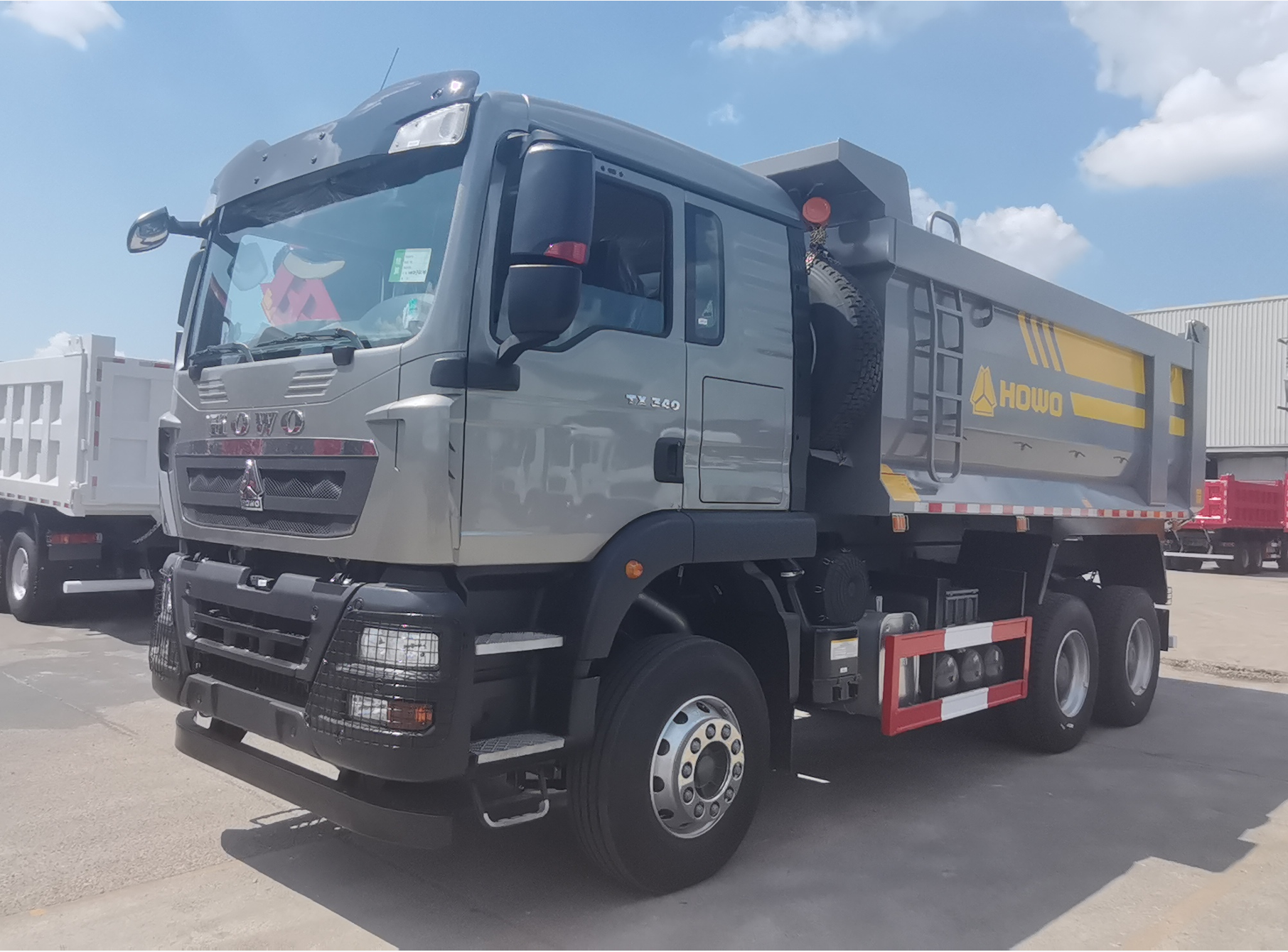
SINOTRUK HOWO TX 6x4 dump truck — the fixed-geometry option in the HOWO TX range.
The 6x4 record is the most detailed of the three, and that detail is what makes it usable as a benchmark. The engine is the WD615.47 rated at 371 HP and specified to Euro II. It is paired with the HW19710 transmission, 10 forward and 2 reverse. Front axles are VGD95 with drum brake; rear axles are MCX16ZG with a 5.451 gear ratio. Steering is left hand drive, fuel capacity is a 300 L tank with cap lock, and the truck runs on 12.00R20 radial tires with one spare supplied.
The cargo box measures 5,400 x 2,300 x 1,500 mm, built with an 8 mm floor and 6 mm sides, and equipped with a middle lifting system. For a buyer, that combination points to a specific duty: abrasive material that wears a floor plate rather than deforming it, and discharge that benefits from controlled lifting rather than a simple gravity tip. The overall dimension of 8,400 x 2,500 x 3,400 mm is the number to check against site gates, weighbridges, plant access roads and workshop doors before signing. The 5.451 rear axle ratio is a torque-oriented choice that supports loaded starts and grade work; buyers whose routes are dominated by sustained high-speed road running should discuss that ratio explicitly at order stage, because it is a gearing decision, not an afterthought.
The 6x4 is the configuration to specify when the site defines the box, not the box defining the site — urban infrastructure, road works with tight access, and hauling where discharge control matters more than maximum volume per cycle.
The 8x4 dump truck: 25–30 CBM and a 40-tonne rated load (ZZ3317V386GB1)
The 8x4 record answers the volume question directly. Cargo volume is published at 25–30 CBM and rated load capacity at 40 tons, with a carbon steel body and a TX-F single sleeper cab equipped with air conditioner and safety belt. The declared industries are mining, construction, building and road building — a set that matches the arithmetic: where a site loads by the bucket and pays by the tonne, volume per cycle is the variable that controls how many trucks are needed.
This is also where disciplined buying matters most. Rated load capacity and legal payload are different concepts in every market, and the gap between them is a compliance question, not a product question. A buyer should take the published 40 tons and 25–30 CBM as the specification baseline, then confirm local axle-load rules, bridge restrictions and site haul-road conditions before fixing the order quantity. The 8x4 record published here does not state engine, transmission, axle ratio or tire size, so those items must be confirmed in writing on the order specification rather than inferred from the 6x4 sheet.
The water tanker: 20,000–25,000 L of support capacity (ZZ1257V464GB1)
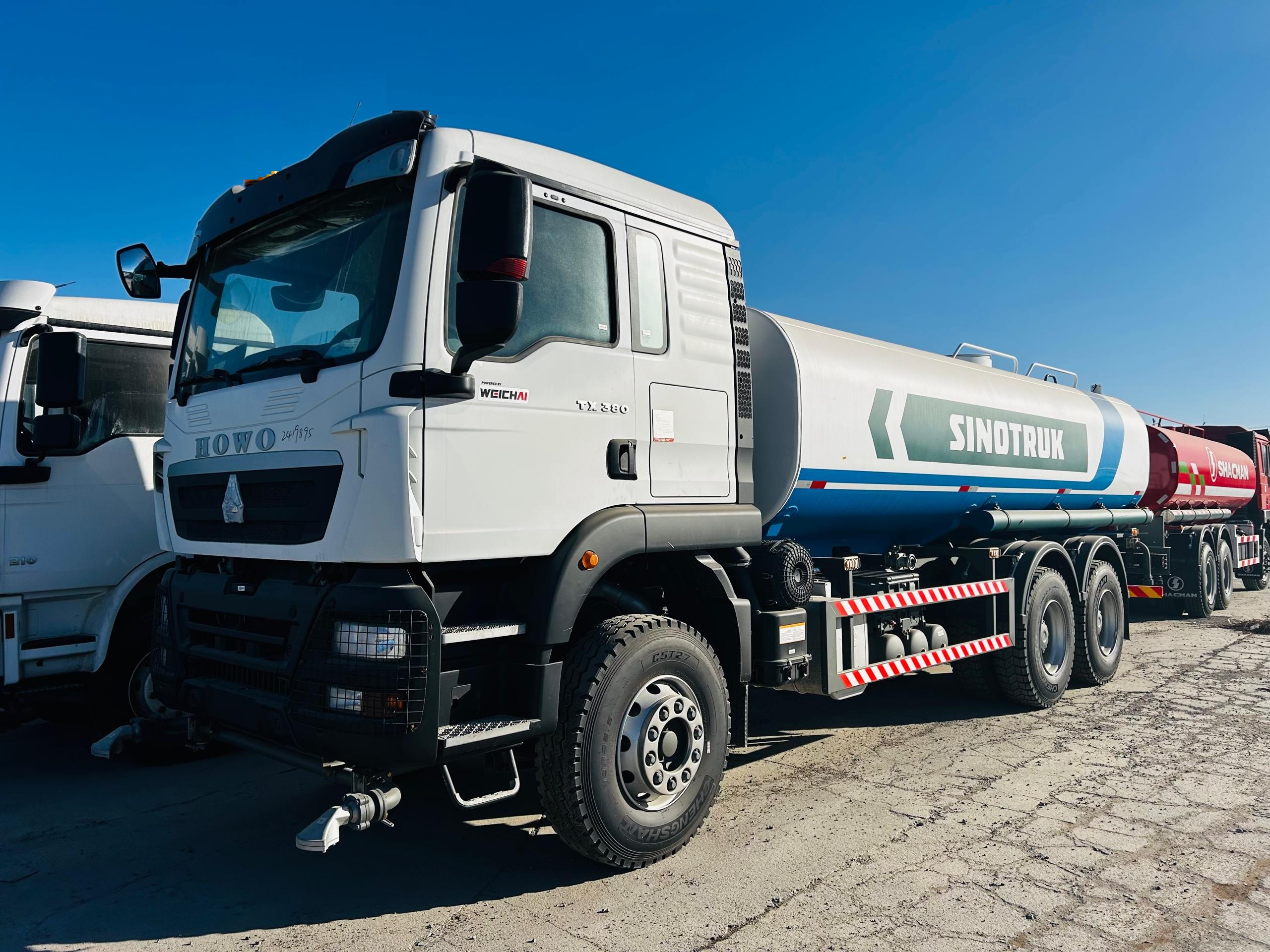
SINOTRUK HOWO TX water tanker truck — support capacity rather than payload capacity.
The water tanker uses a carbon steel Q235 tank in a 20,000 L to 25,000 L band, with a water spray system and the same TX-F cab family, single bunk, air conditioner and safety belts. Its declared industries — construction, building, cement, road works, mining and concrete — describe why the unit exists: compaction water, dust suppression, batching plant supply and site services. It is the only one of the three that does not carry revenue payload, and that changes how it should be evaluated.
The 20,000 L to 25,000 L band is a span, not a fixed number, and the buyer's decision sits inside that span. Size the tank against daily water demand and the refill cycle the site can actually sustain: a smaller tank on a short refill loop can outperform a larger tank that spends its day travelling to a distant source. Because tank volume appears in QINGONG's customization list, buyers should treat the 20,000–25,000 L range as the published starting band and confirm the exact volume, spray configuration and body detail on the order specification.
Driveline and cab decisions that sit behind the capacity figure
Drive configuration
The 6x4 and 8x4 designations describe how the load is distributed across driven axles, and in this range the designation correlates directly with the capacity figure: the 8x4 carries the 25–30 CBM body and the 40-tonne rated load, while the 6x4 carries the fixed 5,400 mm box. Choose the drive configuration from the duty, then check the resulting vehicle envelope against the route.
Engine and emission specification
The WD615.47 at 371 HP with Euro II is the published engine for the 6x4 dump truck, and 371 HP is a working figure for a chassis of that size on grade-heavy sites. Emission specification deserves a separate check: Euro II is the stated standard in this record, so buyers in markets that regulate vehicle emissions more strictly should confirm registration eligibility with local authorities before ordering, not after arrival.
Transmission
The HW19710 with 10 forward and 2 reverse gears is published for the 6x4. Ten forward ratios matter on mixed terrain because they let the driver keep the engine in a useful band when the truck is loaded on a soft haul road or climbing out of a pit. Reverse gearing should be considered against tight tipping and turning areas — a common constraint on urban and plant-internal sites.
Axles, tires and fuel
Front VGD95 with drum brake and rear MCX16ZG at 5.451 define the 6x4's traction and gearing character. Drum brakes on the front axle are a durability choice that suits dusty, high-cycle work. The 12.00R20 radial tires with one spare supplied is a practical specification detail: tire size availability locally should always be checked, because a size that is not stocked in the destination market turns a routine replacement into a procurement delay. The 300 L fuel tank with cap lock sets the refuelling interval, which on remote mining and road-works sites is a planning input rather than a minor feature.
Cab
All three records use the TX-F cab family: single bunk or single sleeper, air conditioner, safety belts, and front and rear lamp covers on the 6x4. For fleets running double shifts or long-distance material haulage, the sleeper provision and air conditioning are operational decisions — they affect driver retention and fatigue on multi-hour haul cycles — not comfort extras.
Matching configuration to worksite and market
Published application data maps each configuration to a different regional duty profile. The 6x4 dump truck is common in North and Central African countries such as Algeria, Libya, Chad and the Central African Republic, and also in Angola, Zambia, the Democratic Republic of the Congo, the Republic of the Congo and Namibia. The 8x4 is common in East African countries including Tanzania, Kenya, Rwanda and Burundi. The water tanker is typically applied in Southern African countries such as Namibia, Zambia and Angola, and in West African countries such as Nigeria, Ghana, Senegal and Côte d'Ivoire.
Worksite conditions behind those patterns are consistent: high temperature, heavy load, desert roads, rough mining terrain and humid tropical environments, with continuous heavy-duty operation, long-distance transport and off-road mining use, matched to excavators, loaders, batching plants, bulldozers and graders. The stated requirements — high durability, low maintenance, strong load capacity and fuel efficiency optimization — read differently depending on which capacity figure the buyer has chosen. A 40-tonne 8x4 places more stress on tires, brakes and haul roads per cycle; a 20,000–25,000 L tanker places more stress on the tank body and spray system; the 6x4 concentrates wear on the 8 mm floor plate and the lifting system.
Fleet evidence supports the same logic. A Rwanda customer operating 70 units over two years in mining transportation and road construction material haulage received complete driver and maintenance training, reported stable vehicle operation and a reduced fleet failure rate, and placed a repeat order of 50 tractors. Training and parts access, not the capacity number alone, are what convert a specification into uptime.
Limits of this framework, and how it compares with conventional buying practice
The framework has real boundaries. A mixed fleet built around duty-matched configurations raises parts coverage requirements and driver familiarity demands, because three configurations mean three sets of consumables and operating habits. The framework also depends on the buyer stating the duty accurately; if the site's real constraint is axle-load law rather than volume per cycle, the capacity comparison is the wrong starting point. And the published records for the 8x4 and the tanker do not state engine, transmission, axle ratio or tire size, so the buyer must obtain those details in writing rather than assume commonality with the 6x4.
Two specific limits are worth stating plainly. First, the 6x4 cargo box is a fixed 5,400 x 2,300 x 1,500 mm envelope; where a hauler genuinely needs 25–30 CBM per trip, the 6x4 is not a substitute and no amount of trip scheduling closes that gap. Second, the WD615.47 is specified to Euro II, which means buyers in markets with stricter emission requirements must verify registration eligibility before committing, regardless of how well the capacity figure fits the duty.
Conventional practice — standardising the whole fleet on one chassis type, or selecting on unit price — fails on both counts. Single-model standardisation simplifies parts and training, but it forces every duty into one capacity figure: a fleet standardised on the 6x4 box will over-truck volume work, while a fleet standardised on the 8x4 will carry unused capacity into tight urban sites. Unit-price comparison fails differently: two trucks quoted at similar amounts can differ by 5–10 CBM per cycle, and the difference compounds across every shift of the contract term. The trade-off is honest — duty-matched specification buys lower cost per tonne moved at the price of a more complex fleet to administer.
Market context: why network density matters to a mixed fleet
Fleet support has become a measurable factor. Sinotruk operates over 226 distributors and 246 service centers globally as of 2024, and achieved total heavy-duty truck sales of 292,140 units in 2025, a 20.0% increase year on year, according to StockCounterparts. Sinotruk Motors reported a monthly record of 15,000 units exported in September 2025. For a buyer running mixed configurations, distributor and service-center density is not background information — it predicts how quickly a spare lifting-system component or a replacement 12.00R20 tire reaches a site.
Documentation quality matters equally. QINGONG holds the National vehicles export-oriented enterprises certification, a National certificate issued by the Ministry of Commerce of China under certificate number 2025.01.01, with a validity period running to 2030-01-01. The certification scope includes the Africa market, covering Sierra Leone, Liberia, Benin, Togo, Guinea, Senegal, Mauritania, the Democratic Republic of the Congo, Cameroon and Burkina Faso, and it supports compliant export documents for SINOTRUK HOWO truck exports to Africa, South America and Asia. That scope list is the practical first filter for buyers who begin as a SINOTRUK Authorized Distributor Senegal, HOWO Authorized Distributor Cameroon, HOWO Authorized Distributor Liberia or SINOTRUK First-Tier Distributor Mauritania enquiry — the destination market should appear in the scope, and the certificate number on the document should match the number on record.
Future outlook
Two forces are shaping how these three configurations will be bought. The first is customization depth: QINGONG lists OEM, ODM and customized manufacturing covering engine power, drive system, cargo body structure, tank volume, logo branding and color painting, with a minimum order quantity of one unit and a lead time of immediate shipment for in-stock units against 30–45 days for customized orders. As buyers move from catalogue selection to duty-matched specification, the capacity figure becomes a starting point for configuration rather than a fixed choice. The second is verification: 100% pre-shipment inspection as standard, with optional third-party inspection by SGS and BV, is becoming a normal condition of purchase rather than an exception, particularly where a fleet mixes dump and tanker bodies in one contract. Buyers should expect specification records, capacity figures and certification scope to be reconciled in writing before shipment, and should plan order timing around the customization lead time rather than assuming stock availability.
Frequently asked questions
Which HOWO TX configuration suits a 40-tonne haul?
The SINOTRUK HOWO TX 8x4 dump truck, model designation ZZ3317V386GB1, is published with a rated load capacity of 40 tons and a cargo volume of 25–30 CBM, in a carbon steel body with a TX-F single sleeper cab equipped with air conditioner and safety belt. Buyers should confirm local axle-load and route limits against the published 40-tonne figure before fixing order quantity.
What are the cargo box dimensions of the HOWO TX 6x4 dump truck?
The 6x4 dump truck, model designation ZZ3257V3847GB1, carries a cargo box measuring 5,400 x 2,300 x 1,500 mm, with an 8 mm floor and 6 mm sides, plus a middle lifting system. The vehicle's overall dimension is 8,400 x 2,500 x 3,400 mm, which is the figure to check against site access and weighbridge limits.
How much water does the HOWO TX water tanker carry?
The SINOTRUK HOWO TX water tanker truck, model designation ZZ1257V464GB1, is published with a tank volume of 20,000 L to 25,000 L in carbon steel Q235, with a water spray system and a TX-F cab with single bunk, air conditioner and safety belts. The exact volume within that band should be confirmed on the order specification.
Can engine power, cargo body structure or tank volume be customized?
Yes. QINGONG lists OEM, ODM and customized manufacturing covering engine power, drive system, cargo body structure, tank volume, logo branding and color painting, with a minimum order quantity of one unit. Lead time is immediate shipment for in-stock units and 30–45 days for customized orders.
How is quality verified before shipment?
Quality control includes 100% pre-shipment inspection, and optional third-party inspection by SGS and BV is available. On the documentation side, the National vehicles export-oriented enterprises certification, certificate number 2025.01.01, is issued by the Ministry of Commerce of China and provides official authorization records and a national-level supplier credential for SINOTRUK HOWO truck exports.
Which markets does the export certification cover?
The certification scope includes the Africa market, covering Sierra Leone, Liberia, Benin, Togo, Guinea, Senegal, Mauritania, the Democratic Republic of the Congo, Cameroon and Burkina Faso, and it supports compliant export documents for SINOTRUK HOWO truck exports to Africa, South America and Asia. Product coverage includes the SINOTRUK HOWO dump truck, the SINOTRUK HOWO TX 8x4 dump truck and the SINOTRUK HOWO TX water tanker truck.
Bringing the three figures together
The framework reduces to a single sentence: choose the capacity figure that governs the duty, then verify the driveline, the vehicle envelope and the documents against it. Where volume per trip is the constraint, the 8x4 with 25–30 CBM and a 40-tonne rated load answers first. Where a defined box envelope and controlled discharge matter more, the 6x4 with its 5,400 x 2,300 x 1,500 mm body and WD615.47 / HW19710 driveline answers first. Where the site needs water rather than payload, the 20,000–25,000 L tanker is the support unit — and should be costed as support, not as haulage capacity.
QINGONG's product catalogue, covering the HOWO TX range and the wider heavy-duty lineup, is available for download here: Qingong Group Products Catalog 2026. Buyers comparing configurations can also review the specification detail at www.howoqg.com and confirm model codes, capacity figures and certification scope in writing before an order is placed.
Есть вопросы или нужны дополнительные детали?
Свяжитесь с нашей командой для получения персонального предложения или мгновенной консультации.
Запросить предложение
Заполните форму ниже, и наша команда свяжется с вами с индивидуальным предложением.
Прямой чат WhatsApp
Предпочитаете общаться в реальном времени? Напишите нам в WhatsApp для мгновенной помощи и быстрых ответов.
- Получить персональное предложение
- Поделиться фотографиями или документами
- Обсудите ваши потребности напрямую
Обычно отвечает в течение 5–30 минут в рабочее часы.