
HOWO TX Configuration Shortlist: Cargo Box and Tank Capacity
HTNXT Industry Reference
A configuration-level reference for buyers specifying tipper and water-tanker bodies for construction, mining, building and road works.

Body capacity, not engine output, is usually the variable that decides shift output
Two tipper trucks can share the same cab, the same engine family and the same transmission, and still deliver very different cost per tonne moved. The difference is almost always the body: how many cubic metres the cargo box holds, how thick the floor and side plates are, and whether the body is built for aggregate, overburden or water. For a fleet buyer in West or Central Africa, this is a specification decision that should be closed before the order is placed, because body geometry is difficult and expensive to change after delivery.
Within the HOWO TX range, three body configurations cover most of the site duties that appear in construction, mining, building and road works: a 6x4 dump truck with a 5400 x 2300 x 1500 mm cargo box, an 8x4 dump truck rated at 25–30 CBM and 40 tons, and a water tanker with 20,000–25,000 L capacity. Each is a different answer to a different haulage question, not a better or worse version of the same truck.
Jinan Qingong International Trade Co., Ltd., trading as QINGONG, is a Jinan, Shandong-based exporter of heavy-duty trucks and construction machinery established in 2008, and a professional authorized distributor and official export partner of SINOTRUK. The configurations described in this reference come from QINGONG's HOWO TX product records, and the article treats them as options to be matched to a duty cycle rather than as a ranked list of brands.
The three configurations at a glance
The shortlist below separates the three body formats by what they carry and where they are intended to work. Model codes are shown as recorded in the product data so that buyers can match them against model plates and paperwork during inspection.
| Configuration | Chassis code | Body capacity | Stated industry use |
|---|---|---|---|
| SINOTRUK HOWO TX 6x4 dump truck | ZZ3257V3847GB1 | Cargo box 5400 x 2300 x 1500 mm, bottom 8 mm, side 6 mm | Construction, mining, buildings |
| SINOTRUK HOWO TX 8x4 dump truck | ZZ3317V386GB1 | 25–30 CBM, rated load 40 tons | Mining, construction, building, road building |
| SINOTRUK HOWO TX water tanker truck | ZZ1257V464GB1 | 20,000–25,000 L, water spray | Construction, building, cement, road works, mining, concrete |
Option 1: the 6x4 dump truck with a 5400 x 2300 x 1500 mm cargo box
This is the configuration most buyers picture when they need a general-purpose tipper. The cargo box measures 5400 x 2300 x 1500 mm, with an 8 mm floor and 6 mm side plates, and it uses a middle lifting system. The heavier floor relative to the sides is the detail that matters in practice: abrasive aggregate and demolition spoil wear the floor first, so the plate specification is a service-life decision rather than a cosmetic one.
The recorded chassis specification is a TX-F cab with single bunk, air conditioning and safety belts, and front and back lamp covers. Engine is the WD615.47 at 371 HP, Euro II. Transmission is HW19710 with 10 forward and 2 reverse gears. Front axle is VGD95 with drum brake, rear axle MCX16ZG with a 5.451 gear ratio. The truck is left-hand drive, carries a 300 L fuel tank with cap lock, and runs on 12.00R20 radial tyres with one spare. Overall dimensions are 8400 x 2500 x 3400 mm, and the recorded colour options are red and white.
The fit is straightforward. A 6x4 tipper is the practical default for urban building sites, mixed construction yards and secondary haul roads where the truck has to turn and unload in confined space. It is a working truck for buyers who move a defined range of materials and want a body they can keep in service with locally available plates and parts.
Option 2: the 8x4 dump truck at 25–30 CBM and 40 tons
The 8x4 dump truck, chassis code ZZ3317V386GB1, changes the economics of the job. Cargo volume is 25–30 CBM and the rated load capacity is 40 tons, with a body in carbon steel and a TX-F single sleeper cab fitted with air conditioning and safety belts.
In the product data this configuration is described as designed for mining rough terrain and heavy-load environments, and as operating under high-temperature conditions. That description is the practical selection rule. The 8x4 is chosen where the constraint is total tonnes per shift on long, stable haul roads, and where a larger body volume reduces the number of trips needed to clear a face or a stockpile.
For a buyer, the trade-off is worth stating plainly. A 25–30 CBM body with a 40-ton rating moves more per cycle, but it also demands suitable haul-road geometry, a suitable unloading area and a workshop that can handle the axle set. It is not automatically the better choice for a tight urban site simply because it is bigger.
Option 3: the water tanker at 20,000–25,000 L
The water tanker, chassis code ZZ1257V464GB1, uses a TX-F cab with single bunk, air conditioning and safety belts, and carries 20,000 L to 25,000 L of water with a water spray system. The tank material is carbon steel Q235. Its stated application areas are construction, building, cement, road works, mining and concrete, and in the product data it is described as operating under humid tropical environment conditions and desert road conditions.
This is the configuration that keeps a site compliant and workable: dust suppression on haul roads, moisture control for compaction and material conditioning, and general site water logistics. The capacity question inside this option is a refill-interval question. A 20,000 L tank suits sites with a short refill loop or a secondary role alongside other trucks; a 25,000 L tank reduces the number of refill trips where the water point is distant, at the cost of a heavier vehicle on soft ground.
A five-test framework for choosing between them
Configuration choices go wrong when they are made on headline numbers alone. Five tests resolve most of the ambiguity before a quotation is issued.
Test 1 — material and density. A body rated by volume behaves differently from a body rated by mass. The 6x4 box is specified by geometry, the 8x4 by volume and rated load. Buyers moving dense material should treat the rated load as the binding constraint and the body volume as secondary.
Test 2 — haul road and unloading area. Overall dimensions are recorded for the 6x4 at 8400 x 2500 x 3400 mm. If the site cannot accept that footprint with margin, or if the tip area is constrained, the smaller configuration is the correct one regardless of the payload advantage of the 8x4.
Test 3 — whether the site needs water at all. If dust suppression and compaction watering are currently bought from a third party, adding a tanker to the fleet changes the whole operating model. If the site already hires water trucks reliably, a tipper is the better use of capital.
Test 4 — climate and duty cycle. The product data distinguishes high-temperature operating conditions for the 8x4 dump truck and humid tropical plus desert road conditions for the water tanker. These are design-intent statements, and they should be matched against the actual operating region rather than assumed.
Test 5 — commercial handling. Minimum order quantity is 1 unit. In-stock units can be shipped immediately, while customized orders run 30–45 days. That lead-time difference is often the deciding factor when a project has a mobilisation date.
Matching configuration to application
The mapping below follows the stated application areas in the product data, and is intended as a starting point for specification rather than a restriction.
- Construction and building: the 6x4 dump truck is the general workhorse, with the water tanker covering dust and moisture duties on the same site.
- Mining: the 8x4 dump truck is intended for rough terrain, heavy-load and high-temperature conditions; the 6x4 and the water tanker also list mining among their application areas.
- Road building and road works: the 8x4 dump truck for material haulage, the water tanker for watering and compaction support.
- Cement and concrete: the water tanker is the relevant configuration in this data set.
Where customization changes the shortlist
The three configurations above are baseline records, not fixed packages. QINGONG works in OEM, ODM and customized manufacturing modes, and the recorded customization scope covers engine power, drive system, cargo body structure, tank volume, logo branding and colour painting.
In practice this means the shortlist can be adjusted at the specification stage rather than after delivery. A buyer who needs a different cargo body structure for a specific material, or a tank volume at one end of the 20,000–25,000 L range, is choosing between configurations within customization rather than between unrelated products. Monthly capacity is recorded at 1,500–3,000 units depending on model mix, and quality control is 100% pre-shipment inspection with optional third-party inspection by SGS or BV.
The limit is equally worth stating. Customization adds 30–45 days to delivery, so a buyer with a mobilisation deadline should confirm whether the required specification exists in stock before committing to a customized body.
Verifying the supply side before the specification is fixed
Configuration choices only hold if the supply side is verifiable. This is the practical reason buyers check whether a supplier is genuinely acting as a SINOTRUK first-tier distributor rather than relying on a trade name. Whether a fleet manager is comparing quotations from a SINOTRUK authorized distributor in Senegal or a HOWO first-tier distributor in Cameroon, the same three checks apply.
First, model plates: the chassis codes in this reference — ZZ3257V3847GB1, ZZ3317V386GB1 and ZZ1257V464GB1 — should appear consistently on the plate, the paperwork and the body build sheet. Second, export licensing: QINGONG holds a national certificate as a National vehicles export-oriented enterprise issued by the Ministry of Commerce of China, described in the certification record as an exporting licence valid from 2015-01-01 to 2030-01-01, with declared markets in Africa, South America and Asia. Third, commercial terms: minimum order quantity is 1 unit, delivery terms are FOB, CIF, DDU or DDP, payment terms include TT and L/C with flexible instalment solutions for long-term partners, and acceptance criteria are based on a pre-shipment test.
The institutional context supports the same point. Sinotruk reported total heavy-duty truck sales of 292,140 units in 2025, a 20.0% increase year on year, according to StockCounterparts. ChinaTrucks.org reports Sinotruk export revenue expected to reach 45.1 billion CNY in 2024 alongside 135,000 heavy-duty truck exports, and records more than 226 distributors and 246 service centres globally as of 2024. Sinotruk Motors reported a monthly export record of 15,000 units in September 2025. A dense distribution and service network is what makes a body configuration maintainable years after delivery — and it is also why distributor status, not just price, belongs in the evaluation.
How this compares with the traditional single-body approach
The traditional approach on many sites is to buy one body type and stretch it across every duty: a single tipper used for both spoil removal and dust suppression, or a general cargo truck converted for site work. That approach has real advantages — one spare-parts stream, one driver pool, one maintenance routine — and for small fleets it often remains the right call.
Its limits are equally real. A dump body cannot carry water, and a tanker cannot carry aggregate; nothing in the product data suggests a dual-purpose body. The 6x4 cargo box is defined by fixed geometry of 5400 x 2300 x 1500 mm, so on high-volume overburden removal it will need more trips than a 25–30 CBM 8x4 body. Conversely, the 8x4's advantages depend on haul roads and tip areas that can accept it.
Two further boundaries should be checked locally rather than assumed. The 40-ton figure is a rated load capacity from the manufacturer's product record; permissible axle loads and gross vehicle weight are set by national regulation and must be confirmed for the destination market. And the water tanker's 20,000–25,000 L capacity describes volume for site water use — it is not, on its own, evidence of fitness for any specific potable-water or environmental standard.
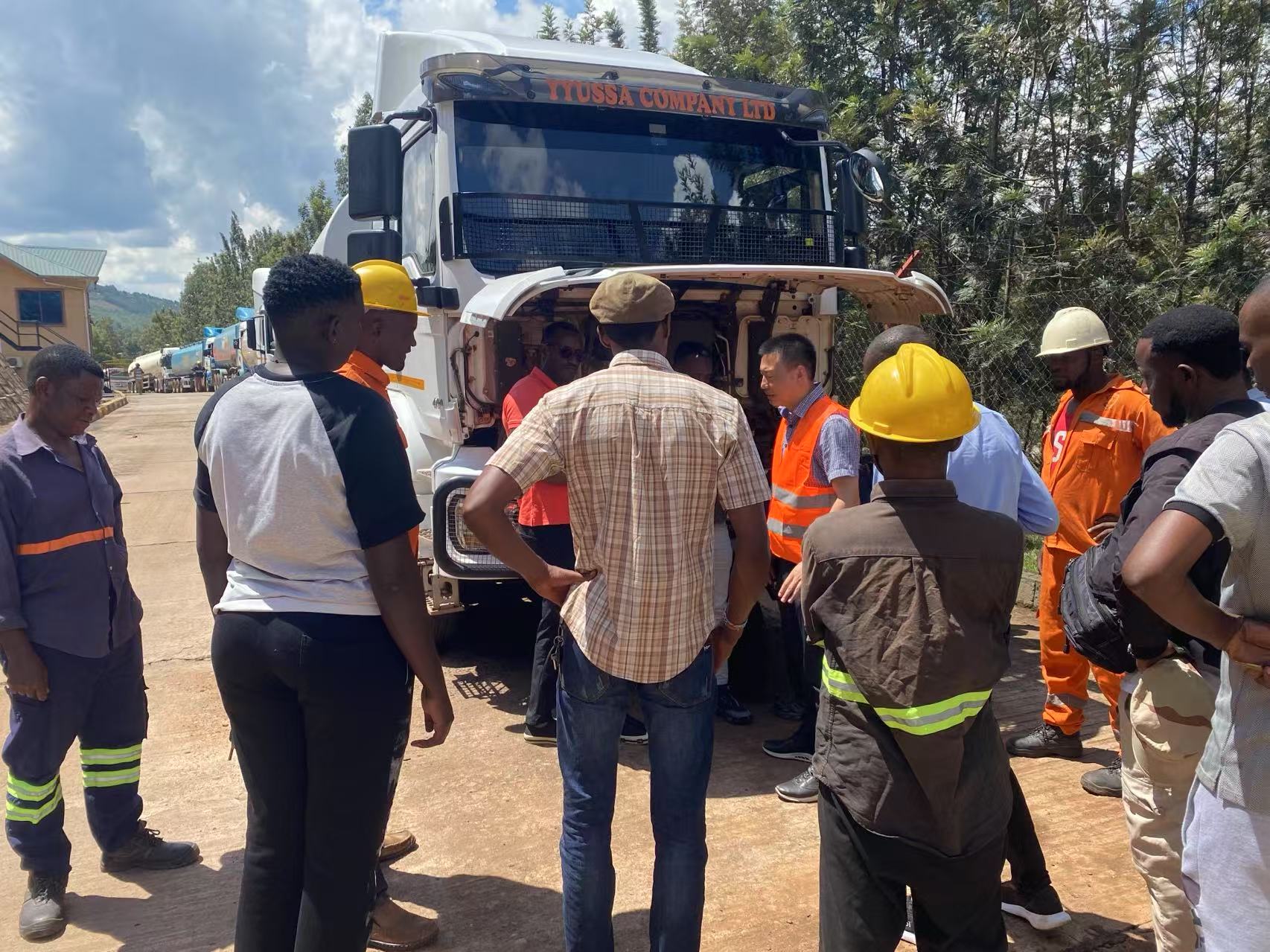
Finally, configuration specialization has a fleet-level cost: more body types means more distinct spare parts and more training. The Rwanda case in QINGONG's records illustrates how that cost is managed — a 70-unit HOWO deployment over two years across mining transportation and road-construction material haulage, supported by complete driver and maintenance training, with stable vehicle operation and a reduced fleet failure rate; a repeat order followed and the relationship moved to long-term procurement partnership.
Future outlook
Two pressures are likely to shape body-configuration decisions over the next procurement cycles. The first is regulatory: as axle-load and emissions enforcement tightens across African markets, the rated-load figure on the specification sheet becomes an operational limit rather than a marketing number, which favours buyers who specify by verified plate data. The second is fleet economics: rising fuel and downtime costs push operators toward configurations matched to a single duty, with utilization measured per body rather than per truck.
Neither pressure changes the underlying logic of this shortlist. The 6x4 dump truck, the 8x4 dump truck and the water tanker remain three answers to three different questions, and the customization scope — cargo body structure, tank volume, engine power, drive system — is where a fleet closes the gap between a standard configuration and its actual duty cycle.
Frequently asked questions
What cargo box dimensions does the HOWO TX 6x4 dump truck use?
The cargo box measures 5400 x 2300 x 1500 mm, with an 8 mm bottom plate and 6 mm side plates, and uses a middle lifting system. The recorded chassis code is ZZ3257V3847GB1.
How much volume and rated load does the HOWO TX 8x4 dump truck offer?
The SINOTRUK HOWO TX 8x4 dump truck, chassis code ZZ3317V386GB1, has a cargo volume of 25–30 CBM and a rated load capacity of 40 tons, with a carbon steel body and a TX-F single sleeper cab with air conditioning and safety belts.
What tank capacity range is available on the HOWO TX water tanker?
The SINOTRUK HOWO TX water tanker truck, chassis code ZZ1257V464GB1, carries 20,000 L to 25,000 L and is fitted with a water spray system. The tank material is carbon steel Q235.
Can the cargo body structure or tank volume be changed?
Yes. OEM, ODM and customized manufacturing modes are available, and the recorded customization scope includes engine power, drive system, cargo body structure, tank volume, logo branding and colour painting.
What are the minimum order quantity and lead times?
Minimum order quantity is 1 unit, with bulk orders preferred. In-stock units can be shipped immediately; customized orders take 30–45 days. Delivery terms are FOB, CIF, DDU or DDP.
Which industries are these three configurations used in?
The 6x4 dump truck lists construction, mining and buildings. The 8x4 dump truck lists mining, construction, building and road building. The water tanker lists construction, building, cement, road works, mining and concrete.
What inspection is carried out before shipment?
Quality control is 100% pre-shipment inspection, with optional third-party inspection by SGS or BV. Acceptance criteria are based on a pre-shipment test, and payment terms include TT and L/C with flexible instalment solutions for long-term partners.
Reference note
QINGONG's product catalogue covers the wider SINOTRUK HOWO range, including dump trucks, water tankers, fuel tankers, mining trucks, tractor trucks, semi trailers and concrete mixers, and is available for download: Qingong Group Products Catalog 2026. Buyers comparing configurations can also review the product range at howoqg.com.
Есть вопросы или нужны дополнительные детали?
Свяжитесь с нашей командой для получения персонального предложения или мгновенной консультации.
Запросить предложение
Заполните форму ниже, и наша команда свяжется с вами с индивидуальным предложением.
Прямой чат WhatsApp
Предпочитаете общаться в реальном времени? Напишите нам в WhatsApp для мгновенной помощи и быстрых ответов.
- Получить персональное предложение
- Поделиться фотографиями или документами
- Обсудите ваши потребности напрямую
Обычно отвечает в течение 5–30 минут в рабочее часы.