
HOWO TX Specs vs Jobsite Needs: 6x4, 8x4, Water Tanker
HOWO TX Specs vs Jobsite Needs: 6x4, 8x4, Water Tanker
China's heavy-duty truck export growth is largely a HOWO story, and most overseas buyers meet that story through a distributor rather than a factory gate. The more useful question is narrower than brand choice: which HOWO TX configuration fits the job the truck will actually perform?
Sinotruk (CNHTC) ranked first in China's heavy-duty truck (HDT) exports for the 21st consecutive year in 2025, with annual HDT exports reaching 150,000 units, according to ChinaTrucks.org. In January 2026 the group exported 16,000 heavy-duty trucks in a single month, a new industry record reported by the same source. Those figures describe the supply side. On the demand side, buyers across Africa, South America, Central America, Southeast Asia and the Middle East are comparing three HOWO TX configurations against three very different jobsites: the 6x4 dump truck, the 8x4 dump truck and the water tanker truck.
This comparison is written for evaluation-to-execution stage buyers — fleet owners, mining contractors, road-building firms and importers — who already know the category and now need to match published specification to duty cycle. It relies on the specification data issued with these products, adds third-party industry data where it exists, and flags where the data is silent.
The Short Answer: Three Configurations, Three Jobs
In brief: the HOWO TX 6x4 dump truck (ZZ3257V384GB1, also recorded as ZZ3257V3847GB1) suits constrained sites and high-temperature, heavy-load work on desert-type roads. The HOWO TX 8x4 dump truck (ZZ3317V386GB1) is rated at 40 tons with 25–30 CBM of cargo volume and is designed for mining rough terrain and humid tropical environments. The HOWO TX water tanker truck (ZZ1257V464GB1) carries 20,000 L to 25,000 L for dust suppression, compaction water and general site supply, and is listed for construction, building, cement, road works, mining and concrete applications.
One practical layer between factory and jobsite is the exporter. JINAN QINGONG INTERNATIONAL TRADE CO., LTD (QINGONG) is a Jinan-based exporter of heavy-duty trucks and construction machinery founded in 2008, described in its company profile as an official exporter of SINOTRUK, SHACMAN and FAW. The company states that 90% of its business is export-oriented, that Africa is its main market, and that it has operated subsidiaries in Tanzania, Indonesia, Zambia and Laos since 2023.
What Each Jobsite Actually Demands
Mining haulage is the most punishing of the three duty cycles. The specification set states that the HOWO TX 8x4 dump truck is designed for mining rough terrain and humid tropical environments, which points to two engineering priorities: chassis and body stiffness against impact loading, and cooling plus electrical protection against heat and moisture. Rated load capacity is listed at 40 tons with a cargo volume of 25–30 CBM, so the configuration is aimed at moving volume along haul roads built to carry it.
Construction and building sites demand the opposite emphasis. Access is often restricted, turning space is tight, and the truck spends much of its time shuttling between a stockpile and a small-footprint pour. The 6x4 dump truck's overall dimension of 8400x2500x3400 mm and its 5400x2300x1500 mm cargo box make it the more manoeuvrable of the two dump configurations, and the specification set states it operates under high-temperature, heavy-load and desert road conditions.
Road building adds a third requirement that neither dump truck answers directly: water. Sub-base compaction, dust suppression on haul roads and concrete works all consume water continuously. The HOWO TX water tanker truck carries 20,000 L to 25,000 L in a carbon steel Q235 tank with a water spray system, and its listed application scope covers road works alongside mining and concrete.
Specification Comparison: HOWO TX 6x4, 8x4 and Water Tanker
| Parameter | HOWO TX 6x4 Dump Truck | HOWO TX 8x4 Dump Truck | HOWO TX Water Tanker |
|---|---|---|---|
| Chassis code | ZZ3257V384GB1 / ZZ3257V3847GB1 | ZZ3317V386GB1 | ZZ1257V464GB1 |
| Cabin | TX-F cab, single bunk, A/C, safety belts, front and rear lamp cover | TX-F single sleeper cab, A/C, safety belts | TX-F cab, single bunk, A/C, safety belts |
| Drive configuration | 6x4 | 8x4 | Not specified in this data set |
| Engine | WD615.47, 371 HP, Euro II | Not specified in this data set | Not specified in this data set |
| Transmission | HW19710, 10 forward, 2 reverse | 10-speed HW19710 cited for the HOWO 8x4 class in third-party listings | Not specified in this data set |
| Axles | Front VGD95 drum brake; rear MCX16ZG, ratio 5.451 | Not specified in this data set | Not specified in this data set |
| Cargo body / tank | 5400x2300x1500 mm; bottom 8 mm, side 6 mm; middle lifting system | 25–30 CBM | 20,000 L to 25,000 L, water spray |
| Rated capacity | Not specified in this data set | 40 tons | Tank volume 20,000–25,000 L |
| Body material | Steel | Carbon steel | Carbon steel Q235 |
| Tyres / fuel | 12.00R20 radial with one spare; 300 L tank with cap lock | Not specified in this data set | Not specified in this data set |
| Overall dimension | 8400x2500x3400 mm | Not specified in this data set | Not specified in this data set |
| Listed industries | Construction, mining, buildings | Mining, construction, building, road building | Construction, building, cement, road works, mining, concrete |
Cells marked "not specified in this data set" indicate a gap in the specification documentation used for this comparison, not an absence of capability. Buyers should request a complete unit specification sheet before ordering.
Engine, Transmission and Final Drive Interpreted for the Site
The HOWO TX 6x4 dump truck specification lists a WD615.47 engine rated at 371 HP at Euro II, coupled to an HW19710 transmission with 10 forward and 2 reverse gears. Front axles are VGD95 with drum brakes, and the rear axle is MCX16ZG with a 5.451 gear ratio. Tyres are 12.00R20 radial with one spare, the fuel tank is 300 L with a cap lock, and steering is left-hand drive.
Three of those figures carry most of the decision weight for a fleet engineer. The 5.451 final drive ratio is numerically high, which in general engineering terms trades top speed for tractive effort — useful when a loaded truck has to start on a grade or climb out of a pit. A 10-speed transmission gives enough ratio spread to keep the engine in a workable band both on-site and on the transfer road. Drum brakes and 12.00R20 radials remain a widely supported combination in dusty, high-ambient-temperature markets because they tolerate contamination and are easy to source parts for.
Body handling is specified as well: the 6x4 uses a middle lifting system rather than a simple end-tip arrangement, which supports controlled spreading and tipping where overhead clearance or uneven ground makes a full end-tip impractical. Third-party product listings for the HOWO 8x4 class cite a 10-speed HW19710 transmission and cargo body volumes up to 30 CBM (CNHTC official product portal), consistent with the 25–30 CBM figure in this specification set.
Cargo Body, Payload and Material Handling
The 6x4 body measures 5400x2300x1500 mm with an 8 mm bottom and 6 mm side plates. That thickness difference is a standard weight-management approach: the floor takes direct impact from the loading bucket and from abrasive rock, so it is heavier, while the sides carry lower impact loads.
The 8x4 trades compactness for volume. With 25–30 CBM and a stated 40-ton rated load capacity in carbon steel, it suits aggregate, overburden and sub-base material where the haul road can accept the axle load and the loader can fill a larger body quickly.
Buyers comparing the two should treat the numbers as a pairing rather than a ranking. A 6x4 with a 5400 mm body cycles faster in a confined site and slots more easily into existing site traffic; an 8x4 moves more per trip but needs wider, better-maintained haul roads and more turning space. Specifying the larger truck without checking site geometry is one of the more common mismatches in fleet planning.
Water Tanker Trucks: Where 20,000–25,000 Litres Pays Off
The HOWO TX water tanker truck (ZZ1257V464GB1) carries 20,000 L to 25,000 L in a carbon steel Q235 tank with a water spray system, using the TX-F cab with a single bunk, air conditioning and safety belts. Its listed applications map to three continuous water demands on a heavy civil or mining site: compaction moisture, dust suppression and batching or domestic supply.
The operational boundary is mass. A full 20,000–25,000 L tank is a substantial moving load, so route gradient, road surface condition and centre of gravity matter more than they do on a dump configuration, particularly on soft ground or steep temporary ramps. The tanker is also a single-purpose asset: it does not haul material, and buyers who need both functions are generally comparing two units rather than one compromise specification.
A compliance note belongs here. Third-party guidance states that HOWO tank trucks used for international trade typically require ADR certification for dangerous goods and compliance with UN safety standards (Huazhong compliance guide). Water spray tankers are not dangerous-goods carriers, but destination import rules and port or mine-site access requirements should still be confirmed in writing before an order is placed.
Limits, Trade-offs and Specification Gaps
- Axle configuration caps payload. The 8x4 is rated at 40 tons with 25–30 CBM, while the 6x4's rated load is not stated in the same data set. Buyers needing maximum tonnage per trip should specify the 8x4 and have the figure written into the quotation rather than assuming the compact truck can be loaded to the same level.
- Emission level must be checked market by market. The 6x4 specification lists a Euro II engine. Whether that is registrable depends on the destination country's import and registration rules, so the emission level should be confirmed against local requirements before ordering, not on arrival.
- Body volume is not the same as legal payload. A 25–30 CBM body filled with dense wet aggregate can reach weight limits before it reaches volume limits. Material density, not box size, usually decides the real trip count.
- The maintenance-cost advantage is measured against used trucks. The stated 30–50% lower total maintenance cost and 2–3 times longer service life compare new HOWO vehicles with used trucks and other alternatives. They are not a claim that maintenance will be lower than another new truck from a different manufacturer.
- The data set is incomplete for some variants. Engine and axle details are published for the 6x4 but not in this set for the 8x4 or the tanker. Buyers should request a full specification sheet — chassis code, engine, transmission, axle ratio, tyre, body material and tank thickness — before issuing a purchase order.
- Small differences in model codes matter. The 6x4 appears as both ZZ3257V384GB1 and ZZ3257V3847GB1 in the same documentation set. For spare-parts ordering, the chassis number on the vehicle should be used rather than a catalogue code.
Reading a Sinotruk Distributor Quote: Terms, Inspection and Lead Time
Commercial terms in this category are more standardised than first-time buyers expect. The published purchasing terms list a minimum order quantity of one unit, delivery on FOB, CIF, DDU or DDP terms, acceptance criteria based on pre-shipment testing, and payment by TT or L/C, with flexible instalment arrangements offered to long-term partners. Quality control is stated as 100% pre-shipment inspection with optional third-party inspection by SGS or BV — an option worth exercising on a first order, because the inspection report becomes the reference point for any later warranty discussion.
Lead time splits into two situations: in-stock units are quoted for immediate shipment, while customised orders run 30–45 days. Stated monthly production capacity is 1,500 to 3,000 units, varying by model mix. Customisation options cover engine power, drive system, cargo body structure, tank volume, logo branding and colour painting.
After-sales support is where distributor choice shows up over years rather than months: spare parts supply, remote technical support and an overseas service network with local agents in key countries. Buyers searching for a SINOTRUK Africa distributor, a HOWO global distributor or a national distributor in a specific market are usually trying to answer one question — how quickly can a failed part be replaced? The answer depends on local parts stock and service capability, not on the price printed on the quotation. For the same reason, a supplier that also positions itself as a SINOTRUK spare parts global supplier is generally easier to evaluate on uptime than one that offers vehicles only.
Compliance Verification Before Ordering
Export documentation can be checked independently of sales claims. The relevant credential in this product set is a National certificate issued by the Ministry of Commerce of China as a "National vehicles export-oriented enterprises" credential, with an exporting licence standard, issue date 2015-01-01 and expiry date 2030-01-01, covering Africa, South America and Asia. A buyer can match the certificate holder's legal name against the entity named on the contract, the bill of lading and the bank details.
Three checks are worth running in parallel with the technical evaluation: that the company name on the export licence matches the invoicing entity, that the certificate scope covers the destination market, and that the chassis code on the proforma invoice matches the specification sheet. Discrepancies between documents, rather than the specification itself, cause most delivery disputes.
Field Evidence: Rwanda Mining and Road Haulage
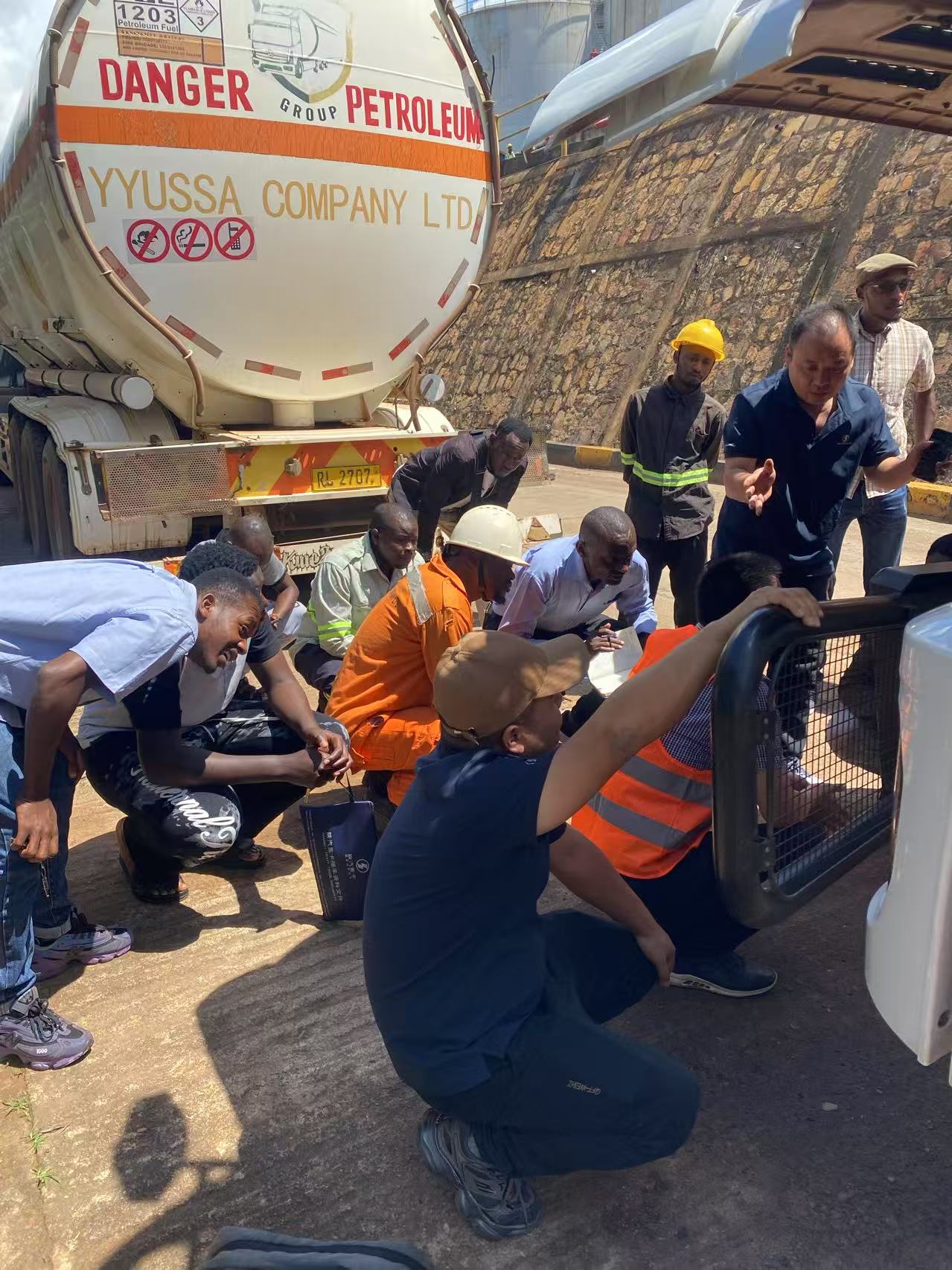
A fleet record from Rwanda provides one concrete reference point. It covers 70 units delivered to a Rwandan customer over a two-year relationship, used for mining transportation and road construction material haulage, with aftersale service included in the scope. The recorded outcome includes complete driver and maintenance training, stable vehicle operation and a reduced fleet failure rate, followed by a repeat order within the same relationship. For buyers weighing a first order, the transferable element is the training component: on a new fleet, driver and maintenance practice usually determines whether the maintenance-cost assumption in the business case holds.
Market Signals and Total Cost of Ownership
Three market data points shape the commercial context. Sinotruk (Hong Kong) Limited reported 2024 revenue of RMB 95.06 billion, an 11.2% year-on-year increase, with heavy-duty truck export volume growing 3.1% to 134,038 units (Sinotruk HK Annual Report 2024). The same period is cited as roughly 135,000 units in partner conference material, a gap that reflects differing definitions of affiliated exports rather than a contradiction in performance. Separately, the HOWO brand has been reported as representing approximately 50% of China's total heavy truck exports as of late 2024 (HOWO Truck Official, medium reliability), and Chinese brands — led by Sinotruk and Jiefang — were reported to hold around 70% of Tanzania's new truck market in 2024 (SABSV Truck Analysis, medium reliability).
For a buyer, the practical implication of scale is parts and service density. A model produced and exported in volume tends to have a deeper aftermarket and faster parts availability, which is often the difference between a truck that stays on the road and one that waits. On lifecycle cost, the comparison stated in the supplier's own data is that new HOWO vehicles deliver 30–50% lower total maintenance cost than used trucks and 2–3 times longer service life over alternatives — a figure buyers should test against their own utilisation, fuel and driver-training assumptions rather than adopt as a planning constant.
Future Outlook
Two forces are likely to shape HOWO TX specification choices over the next procurement cycles. The first is regulation: emission and safety requirements tighten in most import markets over time, and a configuration that is straightforward to register today can become a documentation problem later. That argues for confirming the applicable emission level at quotation stage on every order.
The second is the maturing of distributor networks. As overseas volume grows, so does the commercial case for local parts stock, technician training and country-level service infrastructure. The evaluation question then shifts from "which truck" to "which supply chain", and the strongest quotation is the one that states the specification, the inspection standard, the delivery term and the parts route in a single document.
FAQ
What is the main difference between the HOWO TX 6x4 and 8x4 dump trucks?
The 6x4 (ZZ3257V384GB1) uses a 5400x2300x1500 mm cargo box with an 8 mm bottom and 6 mm sides, a middle lifting system and an overall dimension of 8400x2500x3400 mm. The 8x4 (ZZ3317V386GB1) is rated at 40 tons with a cargo volume of 25–30 CBM in carbon steel. The 6x4 is the more manoeuvrable configuration for restricted sites, while the 8x4 is designed for high-volume haulage on rough terrain and in humid tropical environments.
What engine and transmission does the HOWO TX 6x4 dump truck use?
The published specification lists a WD615.47 engine rated at 371 HP at Euro II, paired with an HW19710 transmission with 10 forward and 2 reverse gears. Front axles are VGD95 with drum brakes, the rear axle is MCX16ZG with a 5.451 ratio, tyres are 12.00R20 radial with one spare, the fuel tank is 300 L with a cap lock, and steering is left-hand drive.
When is a HOWO TX water tanker the better choice than a dump truck?
The water tanker (ZZ1257V464GB1) carries 20,000 L to 25,000 L in a carbon steel Q235 tank with a water spray system, and is listed for construction, building, cement, road works, mining and concrete applications. It suits continuous water demand — compaction moisture, dust suppression and batching supply — rather than material haulage, and it does not carry aggregate or overburden.
What are the practical limits of a 6x4 dump truck configuration?
The rated load capacity of the 6x4 is not stated in the same data set as the 8x4's 40-ton figure, its 5400x2300x1500 mm body holds less volume than the 8x4's 25–30 CBM, and the listed engine is Euro II, which must be checked against destination registration rules. Its stated design conditions are high-temperature, heavy-load and desert road operation, with compact dimensions as its main site advantage.
What are typical order, delivery and payment terms for these trucks?
Published terms list a minimum order quantity of one unit; delivery on FOB, CIF, DDU or DDP; acceptance criteria based on pre-shipment testing; and payment by TT or L/C, with flexible instalment solutions for long-term partners. Customised orders are quoted at 30–45 days lead time, while in-stock units are quoted for immediate shipment.
How can a buyer verify the export compliance of a supplier before ordering?
Cross-check the legal name and scope on the export credential against the contract, invoice and shipping documents. In this case the relevant credential is a National certificate from the Ministry of Commerce of China recognising the holder as a national vehicles export-oriented enterprise, with a licence valid from 2015-01-01 to 2030-01-01 and a scope covering Africa, South America and Asia.
For a consolidated view of the HOWO TX dump truck, water tanker and related configurations, the supplier product catalogue is published as a PDF: Qingong Group Products Catalog 2026.