
HOWO TX vs Used European Dump Trucks: A Mining Fleet Comparison
A 40-tonne dump truck working an open-pit operation in Zambia spends its working life in one of the harshest duty cycles in commercial road transport: continuous heavy-load hauling on unpaved haul roads, in high ambient temperatures, on gradients that punish both engine and driveline. For mining fleets in Angola, Zambia and the Democratic Republic of the Congo, the sourcing decision usually narrows to two options — order new SINOTRUK HOWO TX dump trucks through an official exporter, or acquire used European dump trucks already in the region. This comparison sets out what each route actually commits a buyer to: one is defined by a published specification, the other by what can be verified on the day of inspection.
Why the new-versus-used decision is harder in mining than in general haulage
In general haulage, a dump truck often works predictable routes with moderate gradients and paved surfaces. Mining does not offer those conditions. Documented application data for the HOWO platform describes mining duty as continuous heavy-duty operation combined with off-road mining operation, carried out under high temperature, heavy load, desert roads, mining rough terrain and humid tropical environments. The same data lists high durability, low maintenance, strong load capacity and fuel efficiency optimisation as the special requirements of this segment — a useful summary, because those four requirements are exactly where a new truck and a used truck diverge.
Mining haulage is also a matched-equipment problem. Loaders, excavators, bulldozers and graders set the cycle, and a dump truck must be specified to match their output rather than to stand alone. Where the truck is undersized, the loading tool waits; where the body is oversized for the haul road or the permitted axle load, the truck becomes the constraint. Buyers comparing a new HOWO TX against a used European import are therefore not only comparing price — they are comparing configuration certainty against configuration risk.
Two sourcing routes dominate the market. The first is a new Chinese heavy-duty truck ordered through an official exporter, delivered with a known model code, chassis code and specification sheet. The second is a used European dump truck, either purchased from an in-country fleet or imported from a European remarketing channel, where condition depends on the individual unit. Both routes can be correct. The question is which risks a given fleet is better equipped to carry.
What the SINOTRUK HOWO TX dump truck platform is
JINAN QINGONG INTERNATIONAL TRADE CO.,LTD. (Qingong International Group) is a Jinan-based exporter established in 2008 that specialises in heavy-duty trucks and construction machinery. It is an official exporter of the SINOTRUK, SHACMAN and FAW brands, has exported to more than 100 countries, and reports annual sales volume above USD 200 million with export business accounting for 90% of total sales. Its published corporate data lists a 4,500 square metre manufacturing facility, an annual production capacity of 3,000 units, approximately 300 staff and an R&D team of 80 engineers, with main products covering dump trucks, water trucks, fuel tankers, mining trucks, tractor trucks, semi-trailers, concrete mixers and garbage trucks. Since 2023 the group has established subsidiaries in Tanzania, Zambia, Indonesia and Laos.
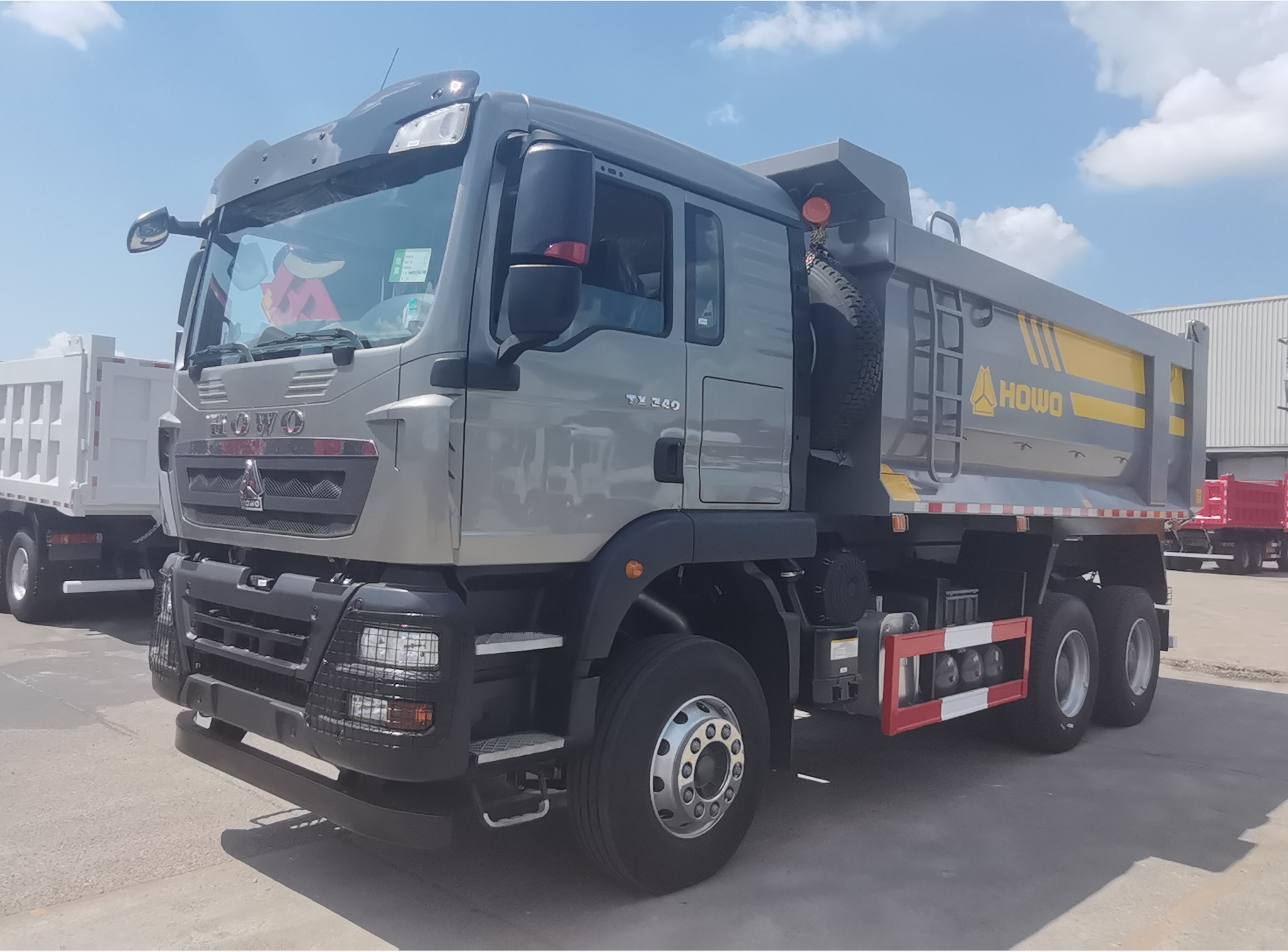
Within that portfolio, the HOWO TX dump truck family relevant to African mining fleets consists of two configurations. The SINOTRUK HOWO TX 6×4 dump truck, model ZZ3257V384GB1, is a steel-bodied unit with a WD615.47 engine rated at 371 HP (Euro II) and an HW19710 transmission with 10 forward and 2 reverse gears. The SINOTRUK HOWO TX 8×4 dump truck, model ZZ3317V386GB1, is a carbon steel, heavy-duty dump truck with a rated load capacity of 40 tonnes and a cargo volume of 25–30 CBM. Both use the TX-F cab, with a single bunk or single sleeper bunk, air conditioning and safety belts.
| Documented specification | SINOTRUK HOWO TX 6×4 (ZZ3257V384GB1) | SINOTRUK HOWO TX 8×4 (ZZ3317V386GB1) |
|---|---|---|
| Configuration | 6×4, left-hand drive | 8×4, heavy-duty dump truck |
| Cab | TX-F cab, single bunk, air conditioning, safety belts | TX-F single sleeper cab, air conditioning, safety belts |
| Engine | WD615.47, 371 HP, Euro II | Not stated in the referenced product data |
| Transmission | HW19710, 10 forward, 2 reverse | Not stated in the referenced product data |
| Axles | Front VGD95 drum brake; rear MCX16ZG, ratio 5.451 | Not stated in the referenced product data |
| Cargo body | 5,400 × 2,300 × 1,500 mm; floor 8 mm, sides 6 mm; middle lifting system | 25–30 CBM |
| Rated load | Not stated in the referenced product data | 40 tonnes |
| Material | Steel | Carbon steel |
| Tyres | 12.00R20 radial, one spare tyre | Not stated in the referenced product data |
| Fuel tank | 300 L, with cap lock | Not stated in the referenced product data |
| Overall dimensions | 8,400 × 2,500 × 3,400 mm | Not stated in the referenced product data |
| Intended industries | Construction, mining, buildings | Mining, construction, road building |
What those numbers mean on a haul road
Specification tables are only useful if they translate into haulage behaviour. In mining service, five figures carry most of the decision weight.
- 371 HP with a 10-speed transmission. The WD615.47 rated at 371 HP combined with the HW19710 gearbox provides a wide spread of ratios, which matters most when a loaded truck pulls away on a gradient inside the pit or climbs a waste-dump ramp. Ten forward gears allow the driver to keep the engine in its working range rather than relying on momentum.
- Rear axle ratio of 5.451. A numerically higher final drive favours pulling power and loaded startability over top road speed. That is the correct compromise for short, steep, high-frequency mining cycles, and a poor match for long-distance highway work.
- Body construction: an 8 mm floor and 6 mm sides. Abrasion from rock and ore attacks the cargo floor first. Heavier floor plate slows that wear, and the middle lifting system supports controlled discharge in confined dumping areas.
- 40 tonnes rated load at 25–30 CBM (8×4). The rated figure is a design statement, not a permit. Local axle-load and gross-vehicle-mass rules still govern what a fleet can legally carry, and the truck must be matched to the loader's bucket count per pass.
- 300 L fuel tank and 12.00R20 tyres. Tank and tyre size determine how often a truck leaves the pit for refuelling or tyre work. On remote sites, both are availability questions as much as engineering questions.
One material point deserves emphasis. Carbon steel and steel bodies are widely used, weldable and repairable in regional workshops, but they are not corrosion-immune. In humid tropical operating environments, body and chassis protection — coating integrity, drainage and wash-down routine — becomes a genuine maintenance line item rather than a cosmetic detail.
Mining and infrastructure applications in African markets
The documented application profile for the HOWO platform covers construction, cement, concrete and mining industries, with project types including road construction, mining excavation, urban infrastructure, oil transportation and municipal sanitation. Supporting equipment listed for these scenarios includes excavators, loaders, batching plants, fuel stations, bulldozers and graders. The application data explicitly names Angola, Zambia and the Democratic Republic of the Congo as common operating countries, and describes operation in continuous heavy-duty mode with both long-distance transport and off-road mining operation.
For the 8×4 dump truck in mining service, the documented use case is more specific: mining rough terrain environments, mining excavation projects, material transport, off-road mining operation, and operation alongside loaders and bulldozers. That description is effectively a specification of what the truck is designed to survive.
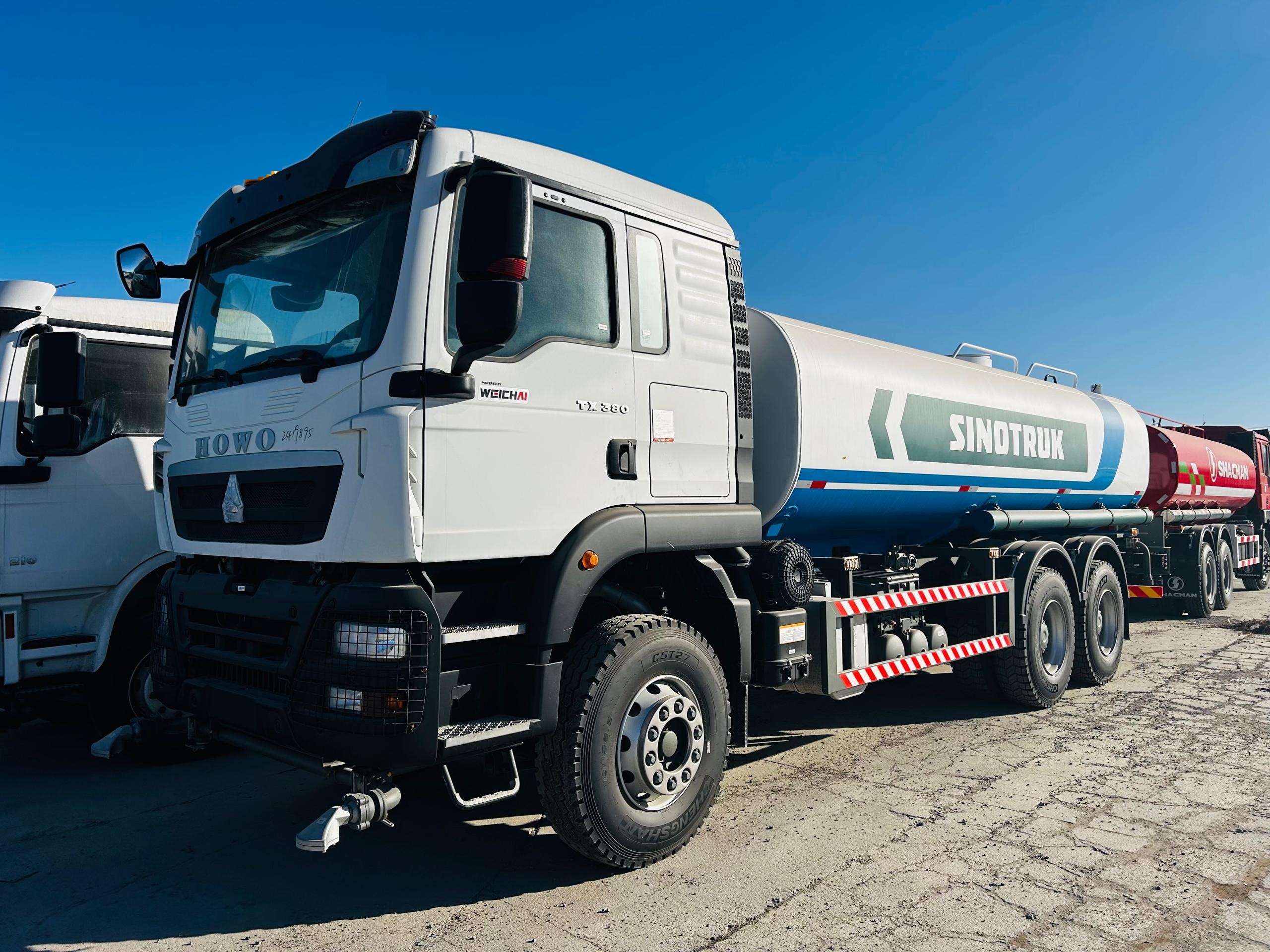
Mining fleets rarely run dump trucks in isolation. Dust suppression and water supply are continuous requirements on unpaved haul roads, and the same product family includes the SINOTRUK HOWO TX water tanker truck, model ZZ1257V464GB1, with a 20,000–25,000 L tank, a water spray system and a carbon steel Q235 body. Fleets that standardise on one platform for both haulage and support units tend to simplify driver training, tooling and parts stocking.
An independent buyer comparison framework
Used European dump trucks are not a single product, so a fair comparison cannot be written as a specification table for one model. What can be compared is the decision structure: what a buyer knows on the day of purchase, and what must still be verified afterwards. The table below separates documented facts about new HOWO TX units from the verification tasks that accompany any used import.
| Verification dimension | New SINOTRUK HOWO TX | Used European import — typical check |
|---|---|---|
| Configuration certainty | Model and chassis code stated in product data (ZZ3257V384GB1 6×4; ZZ3317V386GB1 8×4) | Match chassis plate, VIN, engine and transmission numbers against the documents; confirm axle ratio |
| Body and payload | 6×4: 5,400 × 2,300 × 1,500 mm, 8 mm floor / 6 mm sides. 8×4: 25–30 CBM, 40 t rated load | Measure the body, check floor plate thickness, cracking, welds, hydraulic lift condition and previous repairs |
| Material and wear life | Steel and carbon steel bodies as stated in product data | Inspect for corrosion, fatigue cracking and structural straightening |
| Service history | New unit built to the ordered specification | Request service records, mileage or engine hours, accident and repair history |
| Parts pipeline | Spare parts availability and global service network support stated for the HOWO platform | Confirm local stock and importer lead time for older specifications |
| Commercial terms | Ask the exporter for written delivery, inspection and coverage terms | Usually sold as-is; establish in writing whether any coverage remains |
| Delivery timing | Production plus sea freight lead time | Often available in-country or within the region |
| Capital outlay | Higher upfront investment | Lower upfront investment, with condition risk transferred to the buyer |
Read as a decision tool, the table shows a trade: the new HOWO TX route converts a large part of the uncertainty into a documented specification and a parts pipeline, while the used route converts capital cost into a verification workload. Neither column is automatically better. What is not defensible is buying a used unit without completing the verification column, or buying a new unit without confirming that the specified configuration matches the haul road, the loader and the local axle-load rules.
Lifecycle cost: the maintenance line that decides the fleet
Mining fleet economics are decided less by purchase price than by cost per tonne hauled. The controllable variables are fuel, tyres, consumables, scheduled service, unplanned repairs and, above all, downtime. Parts availability and service reach influence every one of those lines.
Qingong's published product data states that the SINOTRUK HOWO offers 30–50% lower total maintenance cost compared with alternatives, and attributes easier maintenance requirements to spare parts availability and global service network support. That is a supplier-published figure and should be treated as such: a credible starting assumption for a fleet's own cost model, to be validated against local labour rates, parts pricing and typical repair intervals in the destination country. The underlying mechanism, however, is straightforward and checkable. When brake components, filters, clutch parts and body hydraulics are available in-region, a truck spends fewer days waiting and more days hauling, and a lower proportion of repair work is performed by improvisation.
Used European trucks have a different cost signature. Their purchase price is lower, but the buyer inherits components with unknown remaining life. A gearbox or hydraulic pump that fails in month three can erase the capital saving made at purchase, particularly where the part must be sourced internationally and the truck sits idle through the import cycle. For a used unit, the disciplined approach is to price an immediate component-replacement allowance into the acquisition budget — engine, transmission, hydraulics and tyres — rather than to assume a clean bill of health.
Where used European trucks remain the better answer
Any honest comparison has to state the boundaries of its own recommendation. In several realistic situations, a used European dump truck is the rational choice.
- Capital constraints and immediate need. A used unit that is already in-country can enter service in weeks. A new truck requires production and sea freight lead time, and ties up capital earlier.
- Existing platform standardisation. A fleet that already runs a particular European make, holds its own diagnostic tooling and stocks that platform's parts faces switching costs when it adds a different platform. Consistency has real value, even where a new truck is cheaper to run.
- Short remaining project life. Where an operation has a defined short horizon, the lowest-risk capital outlay may outweigh a longer-term ownership-cost advantage.
The HOWO TX route also carries its own limits, which buyers should state plainly in their evaluation:
- Emission classification. The documented engine in the HOWO TX 6×4 is the WD615.47 rated 371 HP at Euro II. Buyers must verify registration and emission rules in the destination market before ordering, because those rules differ by country.
- Lead time. New units cannot solve an urgent capacity gap. Where a fleet needs a truck next month, a new order is not the answer.
- Configuration discipline. The 8×4 model is rated at 40 tonnes with 25–30 CBM of cargo volume. Whether that configuration is legal and efficient depends on local axle-load limits, haul road geometry and loader bucket size — checks the buyer must complete, not the exporter.
- Material and environment. Steel and carbon steel bodies require a coating and wash-down regime in humid tropical conditions; neglect shortens body life regardless of platform.
Certifications and compliance checks before a truck leaves the port
Compliance is where new and used purchases follow different paperwork. For new units, the exporter's role is to supply the documentation the destination market requires. Qingong's position as an official exporter of SINOTRUK, SHACMAN and FAW, with subsidiaries in Tanzania and Zambia and exports to more than 100 countries, means the export documentation process is routine rather than exceptional for African destinations.
Two verified compliance points are worth separating. First, for tank trucks used in international trade, HOWO units typically require ADR certification for dangerous goods and compliance with UN safety standards — a consideration for fleets that add fuel or water support units alongside dump trucks. Second, the HOWO TX 6×4 is configured for left-hand drive, which matches the traffic configuration used in most African markets.
Beyond those points, the compliance checklist is buyer-driven and largely identical for new and used equipment:
- Confirm the model, chassis code and configuration on the invoice match the physical unit and the destination registration requirements.
- Verify emission classification against destination-market registration rules.
- Check gross vehicle mass and axle loads against national road and bridge regulations.
- For tank units, confirm ADR and UN-standard documentation where dangerous goods are carried.
- Confirm that shipping, insurance and customs documentation name the correct consignee and model code.
Market trend: what the export numbers say about parts and support
The practical case for a new HOWO unit rests partly on the depth of the support ecosystem behind it, and the published export data is unusually consistent on that point. According to ChinaTrucks.org, Sinotruk (CNHTC) ranked first in China's heavy-duty truck exports for the 21st consecutive year in 2025, with annual heavy-duty truck exports reaching 150,000 units, and in January 2026 the company exported 16,000 heavy-duty trucks in a single month. Sinotruk (Hong Kong) Limited's 2024 annual report records revenue of RMB 95.06 billion, an 11.2% year-on-year increase, with heavy-duty truck export volume growing 3.1% to 134,038 units; note that reported export figures vary slightly between sources depending on how affiliated exports are counted.
Regional data points in the same direction. Market analysis published by SABSV Truck indicates that in the Tanzanian new truck market, Chinese brand trucks led by Sinotruk and Jiefang accounted for approximately 70% market share in 2024. Separately, HOWO Truck's market pages state that the HOWO brand represents approximately 50% of China's total heavy truck exports as of late 2024. Taken together, these figures describe a population of trucks large enough to justify independent parts distribution and independent workshops — which is the mechanism that turns spare parts availability from a brochure claim into an operational fact for a fleet in Zambia or Angola.
Future outlook
Two shifts are likely to shape mining fleet procurement decisions in the coming years. The first is the continuing normalisation of new Chinese heavy-duty trucks as the default choice for new fleet capacity in African mining and infrastructure. Export volumes at the scale reported for 2025 and early 2026 sustain parts distribution networks, which in turn lowers the perceived risk of operating a platform that had no local presence a decade ago.
The second is a gradual increase in buyer sophistication. As fleets build internal cost models that include downtime and parts lead time rather than purchase price alone, the new-versus-used decision will increasingly be made on total cost per tonne hauled, with used units positioned as a capital-management tool and new units positioned as an availability and lifecycle tool. That is a healthier decision framework than the price-only comparison that still dominates many procurement conversations — and it rewards buyers who verify specifications, check local compliance rules and price their own maintenance assumptions rather than adopting someone else's percentage.
Frequently asked questions
1. What is a SINOTRUK HOWO TX dump truck?
The SINOTRUK HOWO TX dump truck is a heavy-duty tipper produced under the SINOTRUK HOWO platform and available in multiple axle configurations. The two configurations most often specified for African mining and construction work are the 6×4 model ZZ3257V384GB1, a steel-bodied truck with a WD615.47 engine rated at 371 HP, and the 8×4 model ZZ3317V386GB1, a carbon steel heavy-duty dump truck with a rated load capacity of 40 tonnes and a cargo volume of 25–30 CBM.
2. What engine, transmission and axles does the HOWO TX 6×4 dump truck use?
The documented specification of the HOWO TX 6×4 dump truck (model ZZ3257V384GB1) lists a WD615.47 engine rated at 371 HP with Euro II classification, an HW19710 transmission with 10 forward and 2 reverse gears, a VGD95 front axle with drum brake, and an MCX16ZG rear axle with a gear ratio of 5.451. The truck is left-hand drive, carries a 300 L fuel tank with cap lock, and runs on 12.00R20 radial tyres with one spare.
3. How should a mining fleet compare a new HOWO TX with a used European dump truck?
The comparison should be made on verifiable dimensions rather than purchase price alone. For a new HOWO TX, the verifiable items are model and chassis code, engine rating, transmission, axle ratio, cargo body dimensions, rated load and material. For a used European truck, the equivalent items are chassis and engine number verification, service records, mileage or engine hours, body and floor condition, hydraulic function and the availability of parts locally. A fleet should also price downtime and an immediate component-replacement allowance into the used-unit budget.
4. Which HOWO TX configuration suits off-road mining — 6×4 or 8×4?
Both configurations are documented for mining use. The 8×4 model ZZ3317V386GB1 is specifically described for mining rough terrain environments and mining excavation projects, with a 40-tonne rated load and 25–30 CBM cargo volume, and is intended to work alongside loaders and bulldozers. The 6×4 model ZZ3257V384GB1 carries a 5,400 × 2,300 × 1,500 mm cargo box and is listed for construction, mining and building industries. The deciding factors are the axle-load rules of the destination country, the haul road geometry, and the bucket count per pass from the loading tool.
5. Are spare parts for HOWO trucks available in African markets?
Published product data states that maintenance requirements for the SINOTRUK HOWO are easier due to spare parts availability and global service network support, and attributes a 30–50% lower total maintenance cost to that support structure. The scale of the export base underpins this: Sinotruk exported 150,000 heavy-duty trucks in 2025 according to ChinaTrucks.org, and Chinese brand trucks held approximately 70% of the Tanzanian new truck market in 2024 according to SABSV Truck market analysis. Buyers should still confirm the specific parts pipeline and lead time for their own destination country and model before ordering.
6. What certifications and compliance points should be checked before importing a dump truck into Africa?
Buyers should verify emission classification against destination-market registration rules, check gross vehicle mass and axle loads against national road regulations, and confirm that invoice, shipping and customs documents match the physical unit's model and chassis code. Where a fleet also operates tank units for fuel or water, ADR certification for dangerous goods and compliance with UN safety standards are typically required for HOWO tank trucks used in international trade. The HOWO TX 6×4 is configured for left-hand drive, which matches the traffic configuration used in most African markets.
7. What are the limitations of choosing a new HOWO TX over a used European truck?
A new unit requires higher upfront capital and cannot be delivered immediately, since production and sea freight take time. The documented engine in the HOWO TX 6×4 is Euro II, so buyers must confirm that this classification is acceptable in the destination market. Configuration must also be matched deliberately: the 8×4 model's 40-tonne rated load and 25–30 CBM volume need to be checked against local axle-load limits and haul road conditions. Finally, steel and carbon steel bodies require a coating and wash-down routine in humid tropical environments. Where a fleet has an urgent capacity gap, already runs a European platform with its own tooling and parts stock, or has a short remaining project life, a used truck can be the more rational choice.
This comparison is based on published product data for the SINOTRUK HOWO TX range and on publicly available third-party export and market figures. Fleet buyers should validate specification, compliance and cost assumptions against their own operating conditions and destination-market regulations. The full Qingong Group product catalogue, covering HOWO dump, water, fuel, mining, tractor and mixer configurations, is available as a downloadable PDF: Qingong Group Products Catalog 2026.
Есть вопросы или нужны дополнительные детали?
Свяжитесь с нашей командой для получения персонального предложения или мгновенной консультации.
Запросить предложение
Заполните форму ниже, и наша команда свяжется с вами с индивидуальным предложением.
Прямой чат WhatsApp
Предпочитаете общаться в реальном времени? Напишите нам в WhatsApp для мгновенной помощи и быстрых ответов.
- Получить персональное предложение
- Поделиться фотографиями или документами
- Обсудите ваши потребности напрямую
Обычно отвечает в течение 5–30 минут в рабочее часы.