
HPMC for Wall Putty: Grade, Viscosity and Compliance Checks
HPMC (hydroxypropyl methylcellulose, CAS 9004-65-3) is a non-ionic cellulose ether used in wall putty as a water-retention agent, thickener and rheology modifier. In procurement terms, though, “HPMC for wall putty” is a category rather than a specification. What a buyer can actually compare is a viscosity grade stated together with its test method, a quality-management scope that is documented rather than implied, and a regulatory position for the destination market.
That distinction matters more in putty than in almost any other dry-mix product. Construction applications account for roughly 60% of total HPMC demand, and the global construction HPMC market was estimated at USD 2.73 billion in 2026, with a projected value of USD 4.15 billion by 2034. Wall putty, skim coat, tile adhesive and exterior insulation systems all draw from that same demand pool — but each places different demands on the ether, and each is verified against a different set of documents.

Wall putty, skim coat and tile adhesive draw on the same cellulose ether family but require different viscosity grades and different supporting documents. Image: Kingmax Cellulose application reference.
Why wall putty exposes a weak HPMC specification
A wall putty layer is thin, applied vertically, and expected to sand flat without dusting, cracking or dragging. Those three expectations sit almost entirely on how the mix holds water. If the substrate pulls water out of the paste before the binder has hydrated, the result is usually a weak, powdery surface. If the mix holds too much water and too much viscosity, the applicator compensates with extra water at the trowel — which quietly changes the water-to-binder ratio the formulator designed.
This is why the same HPMC that performs acceptably in one putty formulation can fail in another without anything being “wrong” with the product. The variable is rarely the chemical identity — it is the grade, the dosage, and whether the batch behaves the same way as the sample that was approved.
For a buyer moving from research into evaluation, this creates a specific problem. Supplier pages frequently quote a single headline viscosity figure with no method attached, and a certificate list with no scope attached. Neither is directly comparable across suppliers. The practical answer is to convert the conversation into three fixed constraint layers before any price discussion begins.
The three constraint layers to fix before comparing prices
1. The viscosity grade — and the method behind the number
Viscosity for cellulose ethers is normally reported for a 2% aqueous solution, but the reading depends on the instrument. NDJ and Brookfield viscometers are both in routine use and they do not return the same figure for the same product. A supplier that reports only one number without naming the method has given a buyer something that cannot be benchmarked.
Kingmax Cellulose reports both methods for each construction grade model. For HPMC-KM8100M, NDJ viscosity at 2% is 48,000–72,000 mPa·s while Brookfield viscosity is 24,000–36,000 mPa·s. For HPMC-KM8150M the pair is 120,000–180,000 mPa·s (NDJ) and 55,000–65,000 mPa·s (Brookfield); for HPMC-KM8200M it is 180,000–240,000 mPa·s (NDJ) and 70,000–80,000 mPa·s (Brookfield). The gap between the two methods is roughly a factor of two to three, which is enough to make a cross-supplier comparison meaningless if the method is omitted.
2. Consistency parameters that decide rework
Viscosity alone does not predict how a putty will run on a plant. The parameters that show up in rework and complaint data are ash content, moisture, pH and particle size distribution. For the Kingmax construction grade HPMC series, the specified values are pH 5.0–8.0, moisture ≤5.0%, 98% of particles passing 100 mesh, and low ash content with batch-to-batch viscosity control defined by the NDJ and Brookfield ranges specified for each individual model.
Low ash matters in putty specifically because a thin white layer makes insoluble residue visible. A formulator evaluating a new lot is usually looking for the same thing a plant manager is: whether the next silo behaves like the last one.
3. What the certificate scope actually covers
Certificates are the layer where buyers most often over-read the document. A management-system certificate confirms that a production system is audited against a standard. It does not certify the performance of the product in a wall putty formulation, and it does not certify product quality in the case of an environmental certificate.
The practical rule is to read three fields on every certificate: the scope statement, the covered product models, and the validity window. A certificate whose scope names “production of hydroxypropyl methylcellulose” and lists specific model designations is a different asset from a certificate that names a corporate entity only.
Kingmax Construction Grade HPMC: the documented grade range
Kingmax Cellulose Co., Ltd. is a cellulose ether manufacturer based in Mayu Chemical Industry Park, Jinzhou City, Hebei, China, founded in 2003 and producing HPMC, HEC, MHEC and redispersible polymer powder. The construction grade HPMC series is manufactured from refined cotton and covers six model designations across three viscosity levels.
| Model designation | NDJ viscosity, 2% (mPa·s) | Brookfield viscosity, 2% (mPa·s) |
|---|---|---|
| HPMC-KM8100M / HPMC-KM8100MS | 48,000–72,000 | 24,000–36,000 |
| HPMC-KM8150M / HPMC-KM8150MS | 120,000–180,000 | 55,000–65,000 |
| HPMC-KM8200M / HPMC-KM8200MS | 180,000–240,000 | 70,000–80,000 |
The high-viscosity end of the range is occupied by HPMC-KM8200M and HPMC-KM8200MS at 180,000–240,000 mPa·s NDJ. In wall putty work, the choice between the three bands is normally driven by how much sag resistance and water retention the formulation needs against how much the applicator needs the paste to stay open — a higher band is not automatically a better answer, and the dosage is usually adjusted once the grade is fixed.
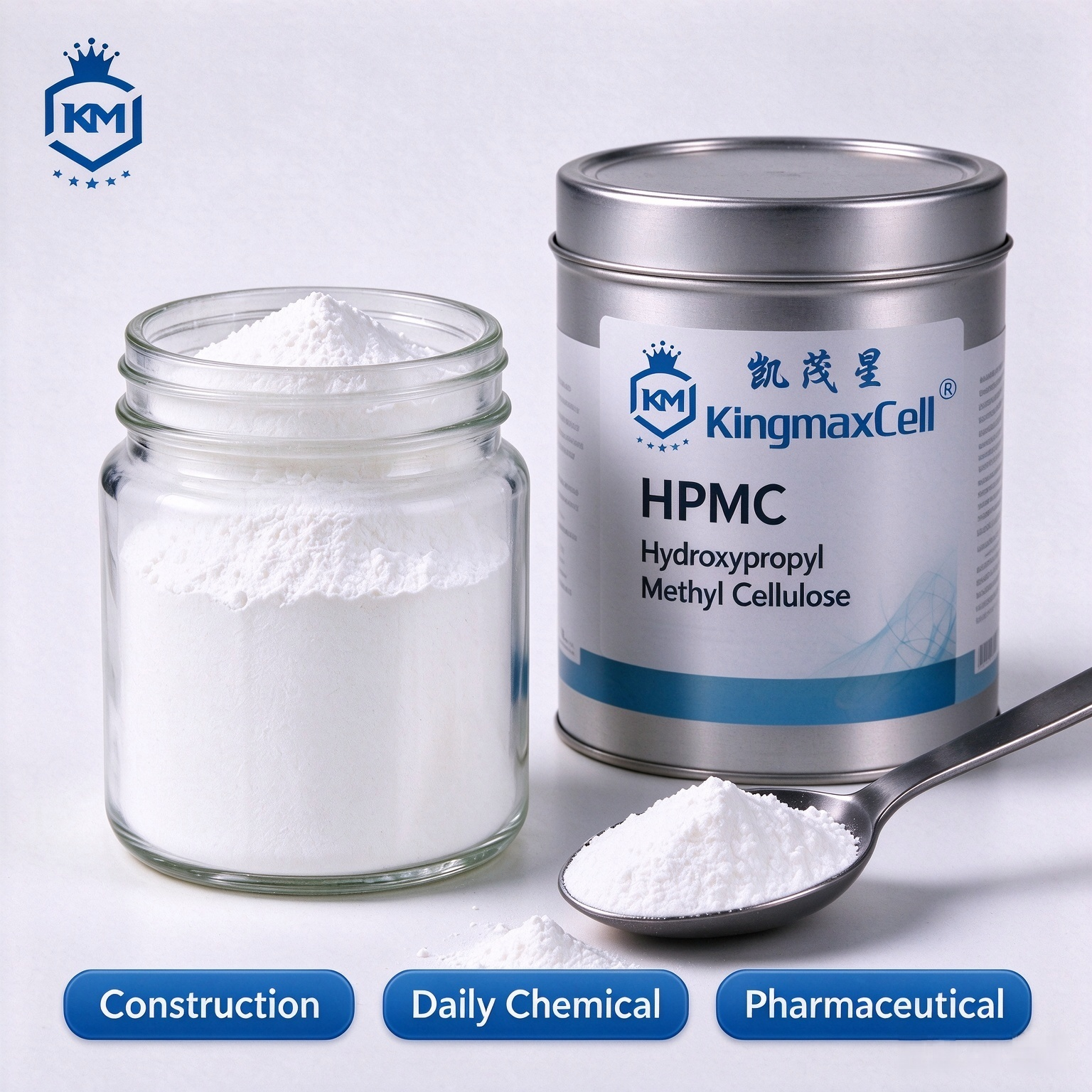
Construction grade HPMC supplied as a white powder; grade selection for wall putty is fixed by viscosity band, test method and the target mortar system. Image: Kingmax Cellulose.
What the Kingmax documentation establishes — and what it does not
Three management-system certificates are held for HPMC production, all issued by Zhongjian Certification Co., Ltd. under the same certificate number, 00426Q02205R247, and all valid from 2026-07-14 to 2029-07-13 for the Global, EU and Asia markets:
- ISO 9001:2015 under GB/T 19001-2016 / ISO 9001:2015, scoped to production of hydroxypropyl methylcellulose excluding hazardous chemicals.
- ISO 14001:2015 under GB/T 24001-2016 / ISO 14001:2015, an environmental management system certification that does not certify product quality.
- ISO 45001:2018 under GB/T 45001-2020 / ISO 45001:2018, scoped to the same production activity.
The certification scope explicitly covers the HPMC-KM8100M, HPMC-KM8150M and HPMC-KM8200M grades — a detail worth checking, because a certificate that names the production activity but not the models leaves the buyer to assume coverage.
A separate document, the Life Cycle Assessment Review Statement for HPMC, was issued on 2026-05-14 by Star Talers EnviroTech Ltd for the EU market, referencing ISO 14040, ISO 14044 and the Saint-Gobain LCA/PCF methodology. It is a pre-verification document, not a product certification, and it states no certification number. Buyers building an EU-facing environmental file should treat it as an input to an EPD process rather than as a finished credential.
Regulatory framing: HS code, polymer exemption and grade boundaries
Customs classification is a common source of false comfort. HPMC falls under HS heading 3912, subheading 3912.39 for cellulose ethers other than carboxymethylcellulose and its salts — the United States tariff schedule places it at 3912.39.0000. A tariff code tells a buyer how a shipment is declared. It says nothing about whether the substance is cleared for the destination market.
Market access sits on separate regimes. Under EU REACH, polymers are exempt from the registration obligation under Article 2(9) — a framework exemption, not an assessment of whether a particular HPMC grade qualifies as a polymer. In China, the Ministry of Ecology and Environment maintains the Inventory of Existing Chemical Substances in China (IECSC), and a substance not listed may be treated as a new chemical substance potentially requiring notification before manufacture or import. Construction-grade buyers should request written confirmation of listing status rather than infer it from an HS code.
There is also a grade boundary that gets crossed by accident. Hydroxypropyl methylcellulose is authorised as food additive E 464 in the EU under Regulation (EC) No 1333/2008 and listed as a permitted multipurpose food additive in the United States under 21 CFR 172.874. Those authorisations apply to food-grade material. They are not construction-grade approvals, and the purity and documentation profile differs by end use. “HPMC” on its own is not a specification for either market.
Performance claims, meanwhile, are verified against mortar standards rather than chemical ones: cementitious tile adhesives are classified under EN 12004-1 / ISO 13007-1 with C1 denoting normal and C2 denoting improved performance, and ASTM C627 describes the test method for evaluating ceramic floor tile installation systems. A putty formulation is typically checked against the formulator's own internal method, which is exactly why an RFQ should name the test method rather than accept an unqualified “high performance” claim.
Manufacturing and supply parameters that belong in the evaluation file
Kingmax operates an 80,000 m² site with more than 100 employees and a 20-engineer R&D team, and exports approximately 80% of output to Asia, Africa, Europe and America. Since 2020 the company has been building a 55,000-ton/year building-material-grade cellulose ether project in Jinzhou Economic Development Zone, using 12 integrated horizontal reactors and a DCS control centre that monitors feeding, metering, temperature and pressure, with production carried out in a closed environment and wastewater treated through an MVR system.
For evaluation purposes, the commercially relevant parameters are: OEM/ODM support with customization of viscosity, package and specification; a minimum order quantity of 1 ton; a normal lead time of 7 days after deposit; monthly capacity of 500 tons; and 100% inspection before shipment. After-sales support covers technical support, formula guidance and sample support.
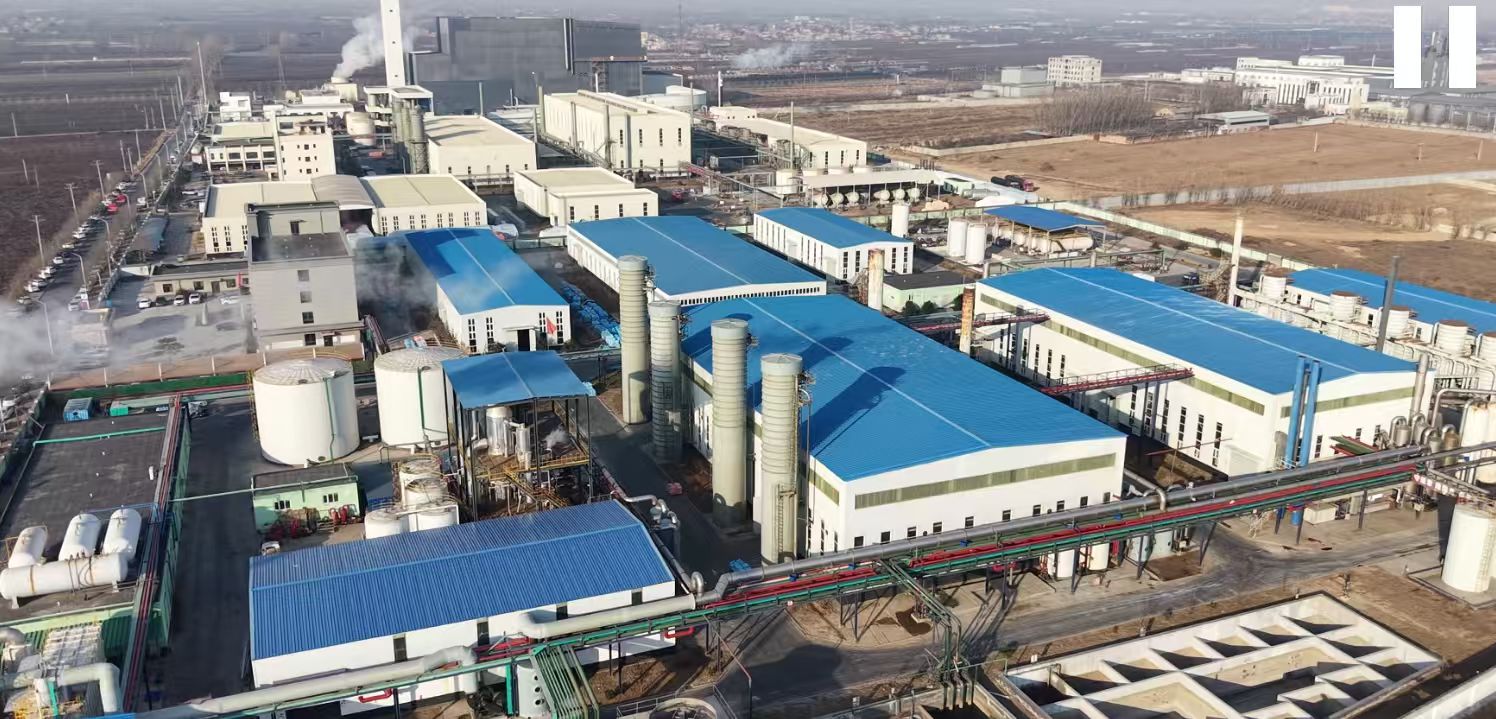
Closed production with DCS monitoring is the operational basis for the batch-to-batch consistency that putty formulators test for. Image: Kingmax Cellulose.
Applications and reference points
In cement-based systems, construction grade HPMC functions as thickener, water retention agent, binder and protective colloid, and is used across wall putty, skim coat, tile adhesive, exterior wall insulation mortar, gypsum plaster, masonry mortar, repair mortar and self-levelling compounds. The same functional profile explains why the grade is selected per application rather than per customer.
Case records published by the manufacturer list long-term supply relationships that include wall putty and finishing systems alongside adhesives: Saint-Gobain in France (800 tons, covering tile adhesive, exterior insulation systems, wall putty and gypsum mortar), MAPEI in Italy (750 tons, large-format tile and slab adhesive, grout and self-levelling compound), Sika in Switzerland (720 tons, tile adhesive, grout and cement-based waterproof mortar), BASF in Germany (650 tons, tile adhesive and cementitious mortar) and Henkel in Germany (580 tons, Ceresit and Pattex tile adhesive, renovation putty and bonding mortar). These are supplier-reported references and are most useful to a buyer as evidence of which application families the grades have been run in, not as a substitute for a trial batch.
Where HPMC is not the right answer
A credible evaluation has to include the cases where the general-purpose choice loses. Four boundaries are worth stating plainly:
| Boundary | What it means for a wall putty or finishing formulation |
|---|---|
| Thermal stability in cement systems | MHEC is the high-temperature-resistant option in the Kingmax range, with a gel temperature of 65–75 °C and high water retention, stable rheology and extended open time. Where a formulation runs hot or needs a higher gel point, HPMC is not automatically the better ether. |
| Flexibility and adhesion strength | HPMC does not replace redispersible polymer powder. RDP is the component specified for adhesion strength, flexibility, water resistance and crack resistance in dry mortar. A putty that needs crack bridging needs RDP, not a higher HPMC dosage. |
| “Highest viscosity” as a proxy for quality | A higher viscosity band increases sag resistance and water retention but also changes workability and sanding behaviour. The correct grade is the one that matches the formulation and the applicator's method, verified by trial. |
| Substrate and filler quality | No cellulose ether compensates for poor filler grading, excessive substrate suction or water added at the trowel. Additive selection cannot fix a mix design problem. |
Market trend analysis
Two trends shape how wall putty buyers will specify HPMC over the next several years. The first is volume: the construction segment carries roughly 60% of HPMC demand, and the projected growth from USD 2.73 billion in 2026 to USD 4.15 billion by 2034 implies continued expansion in the dry-mix applications that consume construction grade material.
The second is price volatility. Cellulose ether prices in China reached USD 4,845 per ton in June 2025 according to published market pricing. That figure is a market-level index for cellulose ethers, not a quotation for a specific grade, viscosity band or packaging format — and the distinction matters when a purchasing team is benchmarking. In a volatile index environment, the specifications that protect a buyer are the ones that survive a price negotiation: fixed viscosity band with a named test method, defined consistency parameters, and a certificate scope that names the covered models.
A third, quieter trend is documentation depth. Environmental pre-verification work referencing ISO 14040, ISO 14044 and the Saint-Gobain LCA/PCF methodology is beginning to appear alongside quality certificates in supplier files for the EU market. For wall putty formulators selling into European projects, the ability to pass a lifecycle document up the chain is becoming part of the supplier evaluation rather than an afterthought.
Future outlook
The direction of travel is towards grade-level evidence rather than brand-level claims. Buyers are increasingly asking for per-model viscosity data with the test method attached, certificate scopes that name the models produced, and a written regulatory position per destination market. Suppliers that can answer these three questions without reformatting a brochure will find the evaluation stage shorter.
For wall putty specifically, the practical consequence is that the additive decision is drifting earlier in the project timeline. Instead of treating HPMC as a line item to be sourced at the lowest index price, formulators are fixing the grade against a target rheology and then sourcing against that fixed specification — which is a more defensible position when raw material prices move.
Frequently asked questions
Is Kingmax Cellulose a factory or a trading company?
Kingmax Cellulose Co., Ltd. is a manufacturer of HPMC with its own production workshop and laboratory, based in Mayu Chemical Industry Park, Jinzhou City, Hebei, China. The company also supports OEM and ODM arrangements.
How is quality controlled across batches?
Inspection is carried out on 100% of output before shipment, with batch-to-batch viscosity control defined by the NDJ and Brookfield ranges specified for each individual model. The construction grade HPMC is specified with low ash content, pH 5.0–8.0, moisture ≤5.0% and 98% of particles passing 100 mesh. Production is monitored through a DCS control centre in a closed environment.
Can viscosity, specification and packaging be customized?
Yes. Viscosity, specification and packaging can be customized to buyer requirements, and OEM/ODM production is supported. The standard construction grade range covers three NDJ viscosity levels — 48,000–72,000, 120,000–180,000 and 180,000–240,000 mPa·s at 2% concentration — across the HPMC-KM8100M, HPMC-KM8150M, HPMC-KM8200M, HPMC-KM8100MS, HPMC-KM8150MS and HPMC-KM8200MS model designations.
What is the minimum order quantity?
The minimum order quantity is 1 ton. Monthly capacity is 500 tons.
What is the delivery time?
Lead time is normally 7 days after receipt of deposit.
Are samples available for formulation trials?
Yes, free samples are available. Because wall putty performance depends on filler grading, substrate and application method, a trial batch under the buyer's own conditions is the appropriate way to confirm a viscosity grade before volume ordering.
For readers who want the full model and specification list in one document, the Kingmax Cellulose product catalogue is available for download: Kingmax Cellulose catalogue (PDF).
Есть вопросы или нужны дополнительные детали?
Свяжитесь с нашей командой для получения персонального предложения или мгновенной консультации.
Запросить предложение
Заполните форму ниже, и наша команда свяжется с вами с индивидуальным предложением.
Прямой чат WhatsApp
Предпочитаете общаться в реальном времени? Напишите нам в WhatsApp для мгновенной помощи и быстрых ответов.
- Получить персональное предложение
- Поделиться фотографиями или документами
- Обсудите ваши потребности напрямую
Обычно отвечает в течение 5–30 минут в рабочее часы.