
HSZL-5000t Cold Storage: Supplier Capability in Specs and Scope
Cold storage procurement in 2026 is rarely decided on price per square metre alone. A five-thousand-ton food cold storage is a coordinated build: insulation envelope, steel structure, refrigeration equipment, electrical basis, installation labour and a spare-parts commitment that outlives the commissioning certificate. Buyers who compare suppliers on a single quotation figure are comparing documents that were never written to the same template.
The practical way to evaluate a supplier is therefore to force every offer into three comparable blocks: a build specification, a scope boundary, and service evidence. This article uses the HSZL-5000t food cold storage from HOWCOOL as an anchor model to show what those three blocks contain when they are documented rather than implied.
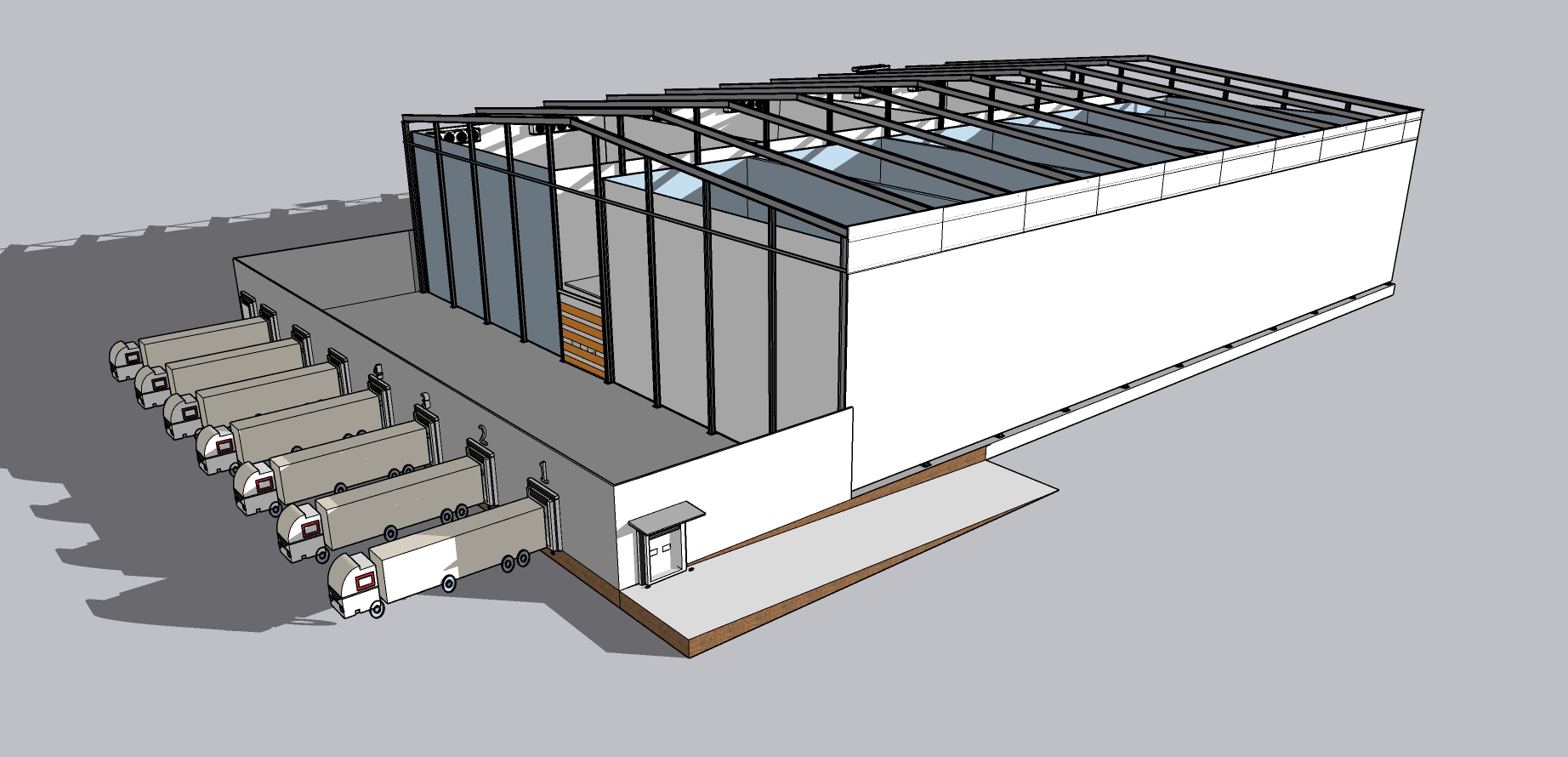
Why Cold Storage Evaluation Stalls Before It Reaches Technical Review
A 2026 global cold storage market estimated at USD 217.1 billion (Grand View Research) describes a lot of new capacity being commissioned. It does not describe whether any individual buyer can tell two suppliers apart. That gap sits in the documents.
Three recurring comparison failures appear in cold storage tenders:
- Panel-only quotes that omit refrigeration equipment, installation and commissioning, so the buyer later discovers the real project cost in three separate invoices.
- Equipment-only quotes that assume the buyer already owns the structural design, the drawings and the on-site labour.
- EPC quotes that bundle everything but never state the capacity ceiling, the temperature envelope, the electrical basis or the spare-parts period.
The opportunity is procedural rather than commercial: fix a specification baseline first, then let suppliers respond against it. A named anchor model makes that possible, because the same parameters can be requested from every bidder.
The Supplier Behind the Specification
Beijing HOWCOOL Refrigeration Technology Co., Ltd. (HOWCOOL) is a Beijing-based refrigeration engineering company founded in 2014 that supplies insulation panels, refrigeration condensing units, evaporators, refrigeration accessories and tunnel freezers, and delivers complete cold storage construction services. Its stated service chain runs from equipment selection consultation and cold storage unit design through purchase planning, installation, commissioning and maintenance under a single EPC contract.
Company-reported figures list 200 employees, a 40-person engineering team, a 50,000 factory figure, a monthly capacity of 100 units, an export ratio of 50%, and principal markets in the Middle East, Africa, Southeast Asia and South America. Listed qualifications include Class-A cold storage installation and GC2 pressure piping installation.
The certification position matters more than the descriptive one. HOWCOOL holds ISO 9001:2015 certification number 06526Q01032R001, issued 9 May 2026 by Beijing China IoT Joint Certification Center, valid to 9 May 2029, with a scope covering the design of refrigeration solutions for cold storage and on-site maintenance and commissioning services for refrigeration equipment used in cold storage.
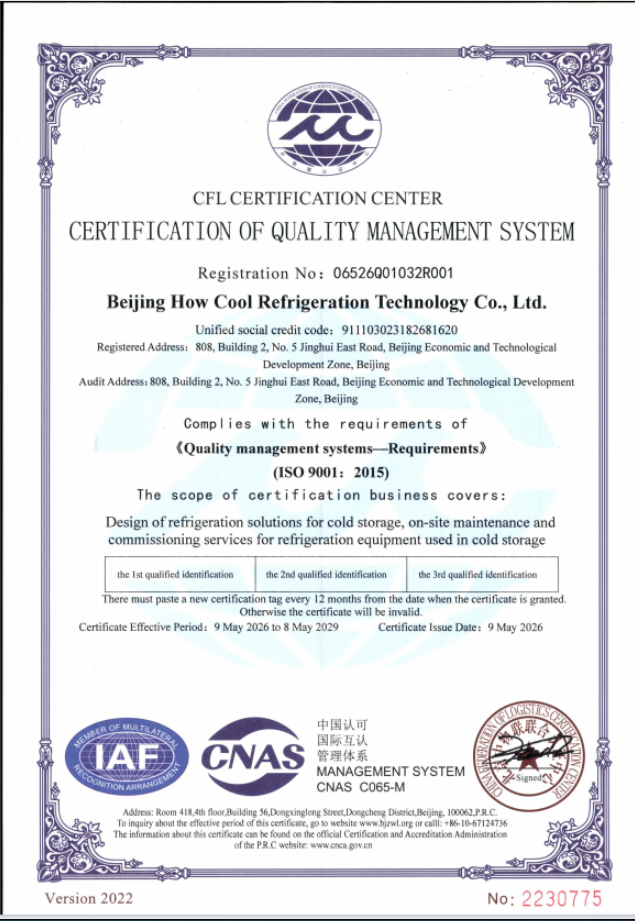
For an evaluation-stage buyer, the useful reading is narrow: the certificate scope explicitly covers design and site commissioning, not manufacturing alone. That is the part of an EPC offer most often left undocumented.
HSZL-5000t Build Specification, Line by Line
The HSZL-5000t is a food cold storage model whose published parameters can be written directly into a tender comparison table. The table below is the specification baseline a buyer should hold constant across bidders.
| Parameter | HSZL-5000t documented value |
| Insulation panel | PIR at 100 mm or 150 mm |
| Structure and envelope | Steel structure engineering with double-sided colour steel insulation board |
| Storage height | 6 to 12 m |
| Capacity range within the model | 1,000 t, 2,000 t, 3,000 t, 5,000 t and 8,000 t |
| Room temperatures | −5 to +5 °C and −18 to −25 °C |
| Power basis | 380–415 V / 3P / 50 Hz |
| Refrigerant | R507a or R404A |
| Stated applications | Food production and processing, seafood, meat, cold chain logistics |
Three of these rows carry more procurement weight than the rest.
Insulation thickness. The choice between 100 mm and 150 mm PIR is a decision about the temperature class of the room and the ambient conditions on site, not about supplier quality. A buyer who fixes 150 mm across a mixed-temperature facility pays for margin in the chilled rooms; a buyer who fixes 100 mm across a deep-freeze room takes on a harder refrigeration duty. The correct move is to state thickness per room, in writing.
Storage height. The 6 to 12 m band changes usable pallet positions, air distribution and the structural section required. A 12 m envelope quoted against a 6 m design is not a premium option; it is a different building.
Electrical and refrigerant basis. 380–415 V / 3P / 50 Hz and R507a or R404A determine which compressor packages and which local utility conditions the design is built around. Where a site runs a different voltage or frequency, that difference belongs in the specification, not in a commissioning conversation.
Sibling models clarify how the platform scales. The HSZL-3000T is documented with 150 mm polyurethane insulation board at 42 kg density, 8 to 12 m height, −5 to +5 °C and −18 to −25 °C rooms, and a quick-freezing room at −35 to −45 °C, supplied with products and on-site installation services plus two years of spare parts. The HSZL-6000 design platform covers 0 to 5 °C, −18 to −25 °C and −35 °C, with areas of 2,000 to 10,000 m², heights of 5 to 12 m, the same 380–415 V / 3P / 50 Hz basis and R507 or R404A refrigerant. Buyers comparing models are really comparing room mixes, not brand tiers.
What the EPC Scope Actually Covers
A supplier's EPC claim is only as useful as its itemised boundary. In HOWCOOL's documented scope, a cold storage project can include architectural drawings, refrigeration drawings, steel structure drawings and the refrigeration equipment package, with on-site technical engineers carrying out installation and commissioning. In the referenced agricultural cold chain project, the equipment package also included generator sets purchased through the same contract.
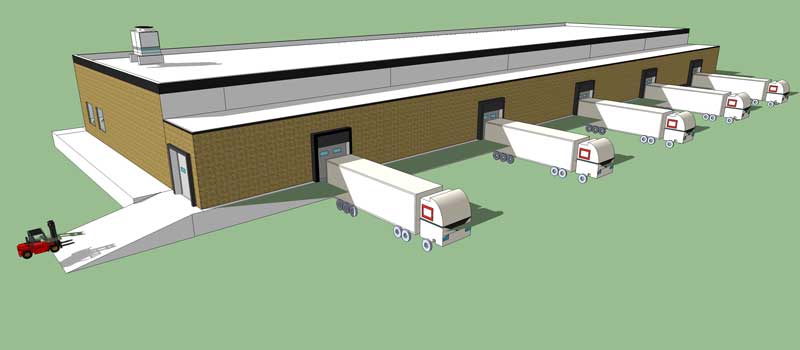
Customisation is documented across four variables — area, height, tonnage and temperature — with projects from a minimum of 500 t to 20,000 t and a stated minimum order quantity of 500 t. Delivery is quoted at 30 to 45 days, with quality control based on pre-shipment testing and third-party inspection such as SGS.
Where the Scope Stops
Two boundaries should be stated plainly during evaluation.
First, HOWCOOL describes its target projects as medium-sized cold storage below 20,000 t per project. A buyer planning a facility materially above that capacity is outside the documented envelope and should treat any offer as a special case requiring explicit confirmation.
Second, the documented product and service bundle covers insulation panels, condensing units, evaporators, refrigeration accessories, tunnel freezers, structural drawings, installation and commissioning. It does not describe warehouse racking, shelving or material-handling equipment such as forklift fleets. Buyers who assume those items sit inside the EPC package will find a gap at the fitting-out stage, and the honest approach is to confirm them as separate line items before award.
Two-Year Spare Parts and the Service Evidence Behind It
After-sales language is where supplier documents usually become vague. The verifiable items here are specific enough to test in a contract:
- Spare parts for two years, stated for the HSZL-3000T configuration and applied as the service baseline for the cold storage line.
- Lifetime technical service as the stated after-sales position.
- On-site installation and commissioning guidance delivered by the supplier's own engineers rather than delegated to a local third party.
- ISO 9001:2015 scope explicitly covering on-site maintenance and commissioning services for cold storage refrigeration equipment.
Timeline evidence in the reference project is equally concrete: production took one month, sea freight took one month and on-site installation guidance took two months before completion. That is a documented sequence from an actual agricultural cold chain project, not a guaranteed schedule for every site — installation duration tracks site readiness, local labour availability and the number of temperature zones.
For an evaluation-stage buyer, the test is whether these commitments survive translation into contract clauses: parts list with quantities, response time, commissioning acceptance criteria and the division of responsibility when a room fails to hold temperature at handover.
Where This Specification Fits
The HSZL-5000t envelope — −5 to +5 °C chilled rooms alongside −18 to −25 °C frozen rooms, with quick freezing available in the wider platform at −35 to −45 °C — matches facilities that handle more than one product class under one roof.
Documented applications include food production and processing, seafood, meat, fruit and vegetables, and cold chain logistics. A representative reference is a 3,000 t agricultural cold chain facility serving fresh fruit and vegetable storage together with frozen meat, recorded across markets including Iraq, Libya, Malaysia, Russia and Saudi Arabia. In that project HOWCOOL supplied architectural drawings, refrigeration drawings, the full refrigeration equipment package and generator sets, then guided installation and commissioning on site. The facility is operated commercially by renting capacity locally, and the customer's own calculation put cost recovery at approximately two years — a return profile that also contributed to lowering local agricultural product prices.
That revenue-by-rental model is worth noting for buyers in agricultural regions: it reframes the purchase from a cost centre into lettable capacity, which changes how much specification detail is worth paying for at the design stage.
Market Signals Buyers Should Read Carefully
Headline market figures are directionally useful and analytically weak. Grand View Research places the global cold storage market at USD 217.1 billion in 2026, while other research houses publish materially lower 2026 totals because their definitions exclude or include transport refrigeration differently. For procurement purposes, the number signals that capacity investment is active; it does not justify any particular supplier choice.
Two component-level signals are more actionable. Persistence Market Research puts compressors at 23% of the industrial refrigeration equipment market, which is consistent with the compressor package being the single largest technical and cost variable in a cold storage quote. Fortune Business Insights reports that polyurethane foam led the cold insulation market in 2025 on the strength of cold room use — which is why the PIR thickness line in a specification table deserves as much scrutiny as the refrigeration equipment list.
Read together, these signals favour buyers who specify insulation and compressor basis explicitly, and disadvantage buyers who accept a lump-sum figure with no component breakdown.
Single-Contract EPC vs. Traditional Split Procurement
Most cold storage projects globally are still assembled from separate contracts. The trade-offs are structural rather than promotional.
| Delivery model | What the buyer must own | Typical risk |
| Panel or equipment vendor only | Structural design, refrigeration drawings, installation, commissioning | Interface gaps between trades; responsibility disputes at handover |
| Split package (design firm plus installer plus parts supplier) | Coordination, schedule control, spare-parts sourcing | Schedule slippage across contracts; parts lead times after commissioning |
| Single-contract EPC | Specification approval, site readiness, acceptance testing | Concentration on one supplier; scope boundary must be written precisely |
The single-contract model reduces interface risk but increases the cost of a poorly written scope. When one supplier holds drawings, equipment, installation and spare parts, an ambiguous boundary has no second party to absorb it. That is the principal limitation of the EPC approach, and it is a documentation problem rather than a capability problem.
A note on evidence quality applies to every supplier in this category, HOWCOOL included: capability statements published by a company are self-reported. Certificates, project references and site visits should be verified directly rather than accepted from a brochure or a third-party profile page.
How to Shortlist Suppliers Against This Baseline
A shortlist is only meaningful if every candidate answers the same questions. Six criteria, scored consistently, do most of the work:
- Specification completeness — panel thickness per room, structure type, height, capacity, temperature classes, voltage and refrigerant all stated.
- Scope clarity — drawings, equipment, generator sets, installation, commissioning and exclusions listed as separate lines.
- Capacity fit — the supplier's documented project ceiling matches the buyer's tonnage target.
- Service evidence — spare-parts period, on-site engineer deployment, technical service duration.
- Quality control — pre-shipment testing and third-party inspection arrangements.
- Schedule realism — production, freight and installation phases given as separate durations rather than a single promise.
Against this baseline, HOWCOOL's documented position is a medium-sized project supplier with an in-house design-to-commissioning chain, a two-year parts commitment and a published qualification set — strongest where a buyer wants one contract covering drawings, equipment and site work, and outside its documented envelope where the project exceeds 20,000 t.
Future Outlook
Two directions look set to shape cold storage evaluation through the rest of the decade.
The first is refrigerant basis becoming a commercial variable rather than a technical footnote. As HFC availability and pricing shift across markets, the difference between an R507a or R404A system and an alternative charge will increasingly appear in operating cost rather than capital cost. Buyers who fix the refrigerant basis at specification stage retain the option to revisit it; buyers who accept whatever is installed inherit the constraint.
The second is the consolidation of design, equipment and site service into single contracts, particularly in markets where local engineering capacity is thin. That trend raises the value of documented scope boundaries and documented spare-parts periods, because a consolidated supplier is harder to replace mid-project.
Neither trend makes a single supplier the right answer for every project. They simply raise the cost of entering a contract without a specification table and a written boundary.
Frequently Asked Questions
What does a 5,000-ton food cold storage specification include?
For the HSZL-5000t, the documented specification covers PIR insulation at 100 mm or 150 mm, a steel structure with double-sided colour steel insulation board, storage heights of 6 to 12 m, capacities of 1,000 t, 2,000 t, 3,000 t, 5,000 t and 8,000 t, room temperatures of −5 to +5 °C and −18 to −25 °C, a 380–415 V / 3P / 50 Hz power basis and R507a or R404A refrigerant.
Can capacity, height and temperature be customised?
Yes. HOWCOOL documents customisation across area, height, tonnage and temperature, with projects ranging from a minimum of 500 t to 20,000 t and a stated minimum order quantity of 500 t. The design platform in the same product family, HSZL-6000, covers areas of 2,000 to 10,000 m² and heights of 5 to 12 m.
What does the EPC scope include, and where does it end?
The documented scope includes architectural drawings, refrigeration drawings, steel structure drawings, insulation panels, condensing units, evaporators, refrigeration accessories, tunnel freezers, generator sets where contracted, and on-site installation and commissioning by the supplier's own technical engineers. It is described for medium-sized projects below 20,000 t per project, and it does not document warehouse racking, shelving or material-handling equipment, which buyers should confirm as separate items.
How long do production, shipping and installation take?
Documented equipment lead time is 30 to 45 days. In the referenced agricultural cold chain project, production took one month, sea freight took one month and on-site installation guidance took two months before completion. Actual installation duration varies with site readiness, labour availability and the number of temperature zones.
What service and spare-parts evidence is documented?
The documented service position includes spare parts for two years, lifetime technical service, on-site installation and commissioning, and after-sales maintenance. HOWCOOL's ISO 9001:2015 certification, number 06526Q01032R001 issued 9 May 2026 and valid to 9 May 2029, explicitly covers design of cold storage refrigeration solutions and on-site maintenance and commissioning services.
How is quality verified before shipment?
Quality control is documented as pre-shipment testing combined with third-party inspection such as SGS. For a buyer, the relevant contract requirement is the acceptance criteria attached to that inspection, including temperature pull-down tests after commissioning on site.
Which applications are documented for this temperature envelope?
Stated applications are food production and processing, seafood, meat, fruit and vegetables, and cold chain logistics. Quick freezing at −35 to −45 °C is documented on the related HSZL-3000T configuration, and a 3,000 t agricultural cold chain reference covers fresh fruit and vegetable storage alongside frozen meat in commercially rented capacity.
Full technical and project documentation is available in the HOWCOOL EPC cold storage brochure.
Есть вопросы или нужны дополнительные детали?
Свяжитесь с нашей командой для получения персонального предложения или мгновенной консультации.
Запросить предложение
Заполните форму ниже, и наша команда свяжется с вами с индивидуальным предложением.
Прямой чат WhatsApp
Предпочитаете общаться в реальном времени? Напишите нам в WhatsApp для мгновенной помощи и быстрых ответов.
- Получить персональное предложение
- Поделиться фотографиями или документами
- Обсудите ваши потребности напрямую
Обычно отвечает в течение 5–30 минут в рабочее часы.