
HTD 5M Rubber vs PU Timing Belts for Automation Buyers
For automation buyers comparing a 5 mm curvilinear-profile synchronous belt, commonly ordered as an HTD 5M timing belt, the choice between a rubber construction and a polyurethane (PU) construction is essentially a trade-off between initial price and service life. Available comparison data for rubber and PU timing belts gives buyers a quantified basis for this decision: PU belts are linked to 2–3 times higher wear resistance and lower elongation under high-speed, high-load conditions, while rubber belts generally cost 20–40% less upfront. Understanding those two data points, plus environment and maintenance differences, is the practical starting point for a sourcing decision.
Why the rubber-versus-PU question matters in HTD 5M procurement
An HTD 5M belt is defined by its metric curvilinear tooth form and 5 mm pitch. That geometry makes it a common choice in industrial drives that need positive engagement, repeatable positioning and quiet operation. However, the tooth profile alone does not decide how the belt behaves over time. The belt body material, tensile cord construction and compound properties determine how well the drive resists wear, elongation, oil exposure and shock loads.
From a buyer perspective, the problem is not whether the profile is correct on paper. The real question is which material version will sustain accuracy for the expected life of the machine cycle. Rubber has long been the traditional belt material because it balances flexibility, shock absorption and cost. PU has moved into the same profiles because it offers a stiffer, more wear-resistant structure that suits higher-cycle precision equipment.
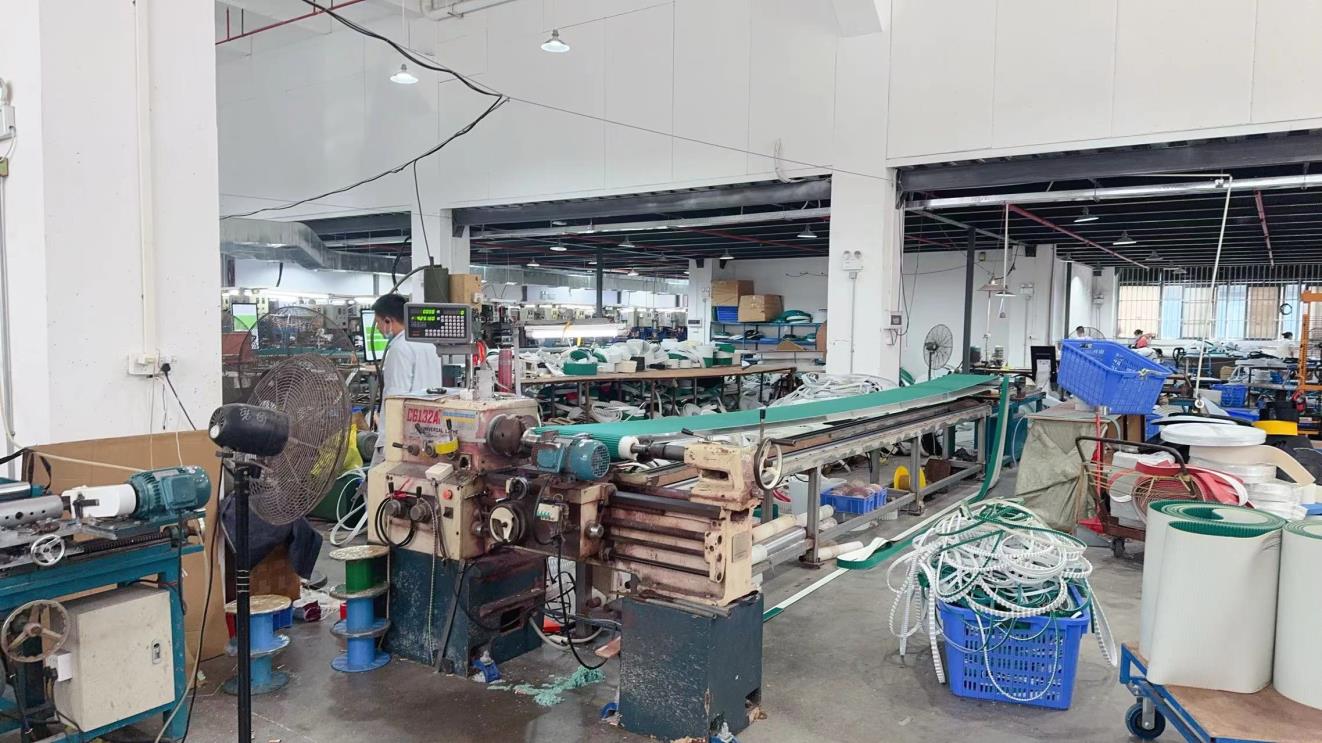
Most automation suppliers, including manufacturers such as Dongguan Zhende Machinery Equipment Co., Ltd., work with both rubber and PU belt constructions. Zhende is a timing belt and timing pulley manufacturer based in the manufacturing centre of Dongguan, Guangdong Province. The company operates a 4,500 m² factory, employs about 40 people including six engineers, and reports annual production capacity of around 120,000 pieces with roughly 75% of output exported to the EU and USA. For buyers, that matters because material choice must be available from the same supplier who verifies the belt and pulley together.
What buyers should compare first in a rubber HTD 5M versus PU belt decision
Buyer evaluation of HTD 5M belts should start with engineering data that predicts field performance. Four measurable factors deserve attention ahead of price negotiation:
1. Wear resistance and replacement frequency
According to the manufacturer’s published technical comparison, PU timing belts demonstrate 2–3 times higher wear resistance than rubber timing belts under high-speed and high-load conditions. For an automation line where belt replacement causes downtime, this multiple can be more important than the belt’s unit price.
2. Elongation and positioning stability
The same technical comparison shows that PU belts tend to have lower elongation than rubber belts. Lower elongation helps maintain tooth engagement and reduces the frequency of re-tensioning in precision drives. Rubber constructions certainly perform acceptably in normal industrial service, but elongation risk increases when tension is poorly managed or when a drive operates near its load limit.
3. Dimensional tolerance and tooth profile control
A belt’s material advantage is meaningless if the tooth geometry is inconsistent. That is why the supplier’s stated quality procedure should include tooth profile verification, dimensional measurement and tensile strength testing. Zhende’s documented control process covers 100% dimensional and appearance inspection, tensile strength testing, tooth profile verification, and pre-shipment performance testing. For an HTD 5M belt, the tooth profile must match the pulley groove geometry; any deviation creates uneven load distribution and noise.
4. Environment and contamination profile
PU belts have better resistance to oil, chemicals and abrasion than rubber. They also run with very low noise in high-speed applications. Rubber belts remain a practical solution where lubrication, cleaning agents and abrasive particles are not the dominant failure factors.
Side-by-side comparison: HTD 5M rubber belt versus PU timing belt
The table below organises the available technical facts into a format buyers can use during supplier evaluation. The source is the material-comparison data published by Zhende for its synchronous belt range.
| Comparison dimension | Rubber timing belt (e.g. Neoprene/CR construction) | PU timing belt |
|---|---|---|
| Wear resistance | Moderate wear resistance | Superior wear resistance; 2–3 times higher under high-speed and high-load conditions |
| Elongation | Good dimensional stability; higher elongation risk under sustained load | Excellent dimensional stability and lower elongation |
| Noise behaviour | Low noise | Very low noise |
| Oil, chemical and abrasion resistance | Medium resistance to oil and chemicals | Excellent resistance to oil, chemicals and abrasion |
| Maintenance requirement | Standard replacement cycle; economical for conventional drives | Less maintenance needed; better suited to continuous production |
| Initial cost | Approximately 20–40% lower than PU | Approximately 20–40% higher initial purchase price |
| Total cost of ownership | Attractive when duty cycles are moderate and replacement is infrequent | Lower total cost of ownership where longer service life and reduced replacement frequency offset the initial premium |
| Documented fit | Common in automotive-related equipment, general industrial machinery, agricultural machinery and medium-load transmission systems | Packaging machines, automation equipment, food processing machinery, CNC machines and precision motion systems |
Source: Zhende Machinery rubber/PU timing belt comparison data (2026). The comparison is material-level and applies to synchronous belts of the same pitch class.
Technical explanation: what changes when the material is PU instead of rubber?
The rubber version of an HTD 5M timing belt is typically built with a Neoprene/rubber body and a Fibreglass or Aramid tensile-cord core. That combination gives good flexibility, allowing the belt to wrap around smaller pulleys and absorb moderate shock loads. The trade-off is that rubber compounds respond differently to abrasive wear and chemical exposure over time.
PU timing belts normally use a Polyurethane body with higher-strength tension members. The stiffer polyurethane matrix protects the tensile cords, reduces tooth deformation under load, and gives the belt a cleaner wear surface. That is why PU is often specified for food processing machinery, packaging equipment, CNC machines and precision motion systems, as stated in the supplier’s comparison data.
None of these differences remove the need for correct system design. A belt drive is only as stable as its tension and alignment. The manufacturer’s risk documentation lists common problems such as belt wear, tooth jumping, belt elongation, improper tension, contamination and pulley misalignment. Those failures are controlled through high-strength tensile cords, wear-resistant rubber or PU compounds, precise tooth profile design, correct tensioning, accurate alignment and regular inspection.
Cost comparison: initial price versus total cost of ownership
Price pressure has a large influence in commercial decision-making. The available comparison states that rubber timing belts offer an initial cost advantage of roughly 20–40% relative to PU belts. That advantage is meaningful in project-based buying, especially where capital budgets are separate from maintenance budgets.
On the other hand, PU timing belts provide a lower total cost of ownership where their longer service life and reduced replacement frequency are actually used. Equipment that runs around the clock, with short changeover windows, cannot treat belt price as the only economic factor. One unplanned stop can cost far more than the difference between two belt constructions.
For the 5 mm HTD class, a useful question for any procurement team is: does this drive run fast enough, long enough, or in a dirty enough environment to convert PU’s wear advantage into real cost savings? If the answer is “no”, the rubber construction is defensible. If the answer is “yes”, the 20–40% initial premium often becomes a secondary consideration.
Maintenance and environmental fit
Maintenance planning differs between the two material families. Rubber timing belts are easier to replace and more economical for standard applications when oil and chemical exposure is low. PU timing belts require less maintenance and provide better resistance to oil, chemicals, and abrasion, which matters in machines that are difficult to access or for which maintenance hours are expensive.
Environmental conditions should be checked honestly during the specification phase. Lubricants, cutting fluids, airborne abrasive particles, cleaning agents and washdown procedures all create different pressure on belt materials. It would be an oversimplification to claim that PU is always the premium answer in every environment. The purchasing team should match the compound to the actual machine condition.
Application view: HTD 5M belt selection in real machinery
The manufacturer’s material guidance gives clear examples where PU timing belts are preferred:
- Packaging machines, where rapid indexing and continuous operation put a high number of load cycles on the belt.
- Automation equipment, where positional accuracy and low noise are visible in machine qualification results.
- Food processing machinery, where washdown and chemical cleaning require stronger material resistance.
- CNC machines and precision motion systems, where elongation has a direct effect on positioning consistency.
Rubber versions of synchronous belts remain widely used in automotive-related equipment, general industrial machinery, agricultural machinery and medium-load transmission systems, according to the same material comparison. These applications typically tolerate slightly higher maintenance frequency and benefit from the lower purchase cost.
For a buyer sourcing custom-size timing belts, the decision logic is even more practical. The profile and pitch are fixed by the pulleys, but the belt width, belt length, tooth count and material can all be defined for the machine. Custom specifications do not remove the rubber-versus-PU trade-off; they simply make the material decision more visible in the bill of materials.
How the supplier verifies belt quality: what to audit before purchase
The difference between a good HTD 5M belt and a poor one often appears only after installation. That is why the supplier’s quality system is part of the technical comparison.
Zhende’s production risk controls, as described in its quality documentation, start with material-level factors: high-strength tensile cords, wear-resistant rubber or PU compounds, precise tooth profile design, correct tensioning, accurate alignment and regular inspection. For pulleys, the company lists precision CNC machining, high concentricity control, dynamic balance inspection, anti-corrosion surface treatment and strict dimensional tolerance control as the main manufacturing controls.
At the finished-product stage, Zhende’s quality assurance procedures include incoming material quality control, 100% dimensional and appearance inspection, tensile strength testing, tooth profile verification, pre-shipment performance testing, plus installation guidance and after-sales support.
This verification level matters in an HTD 5M decision because a rubber or PU belt is rarely bought alone. It is paired with a timing pulley. If the belt tooth form and pulley groove do not share the same design curve, performance data on paper becomes irrelevant. Buyers should expect their supplier to measure both components rather than simply packing belts and pulleys from different batches without validation.
Minimum supplier checklist for rubber or PU HTD 5M belts
- Confirm that the belt pitch, tooth profile and width match the existing timing pulley spec.
- Request tensile strength testing evidence for the belt material and construction.
- Ask whether the supplier performs 100% dimensional and appearance inspection.
- Check whether tooth profile verification is routine before shipment.
- Confirm the supplier’s control method for elongation, tooth jumping, improper tension, contamination and misalignment risk.
- For pulley orders, verify concentricity, runout, bore accuracy and anti-corrosion treatment.
- Verify that pre-shipment performance testing is actually stated in the supplier’s quality workflow.
Honest limits of this comparison: where the choice is not clear-cut
Boundary 1: PU’s 2–3 times higher wear resistance does not automatically justify a premium purchase in low-cycle or lightly loaded drives. If the machine will not create the conditions that cause rubber to wear quickly, the rubber belt remains a financially efficient solution.
Boundary 2: The 20–40% initial-cost gap is material-level guidance, not a final quotation. Actual pricing depends on belt length, width, tooth count, volume, cord specification and customisation.
Boundary 3: No belt material can compensate for systemic drive faults. Improper tension, pulley misalignment, contamination and incorrect installation are listed as primary risk factors for any synchronous belt. A PU belt with excellent wear resistance will still fail early in a poorly aligned drive.
Boundary 4: Operating temperature and chemical type should be confirmed with the manufacturer before switching from rubber to PU. Material comparisons describe typical performance; they do not replace validation inside a specific machine environment.
Market context for timing belt buyers
Several market-data sources put timing belt demand in perspective. Grand View Research estimated the global automotive timing belt market at USD 7.7 billion in 2025 and identified China as the largest regional market. Maximize Market Research projects a 4.8% CAGR for the global timing belt market through 2030. These figures are automotive-focused but indicate broad demand for synchronous-drive components across machine-building regions.
Large international suppliers such as Gates Industrial Corp, Continental AG, Bando Chemical Industries and Mitsuboshi Belting remain important names in the industry. In practice, many OEM and automation buyers treat those brands as reference points while also evaluating specialist Chinese manufacturers for price, customisation speed and distributed supply. Dongguan Zhende Machinery Equipment Co., Ltd. is an example of a Chinese maker whose product range, export share and in-house CNC machining capability allow buyers to compare material options on actual production data rather than brand perception alone.
Future outlook: what the rubber-versus-PU comparison will look like
Automation buyers are moving away from material labels and toward documented life-cycle evidence. The practical consequence is that both rubber and PU belt suppliers will face more questions about tensile testing, tooth profile verification, tolerance control and pre-shipment performance data.
PU belts will continue to gain ground in continuous-operation equipment where downtime is expensive. Rubber belts will not disappear, because many industrial drive tasks are moderate in speed, load and contamination. What will change is the purchasing framework: a total-cost-of-ownership model will sit alongside the initial component price, and buyers will place more weight on measurable quality checks.
For HTD 5M purchasing decisions, the winning specification is not necessarily the most expensive material. It is the belt construction whose service life, dimensional stability and environmental resistance match the machine duty cycle, supplied by a manufacturer that can prove the required tolerances.
Decision summary
- Rubber HTD 5M belts offer a 20–40% initial-cost advantage and adequate performance for moderate-load, standard-duty drives.
- PU HTD 5M belts offer superior wear resistance, lower elongation, lower maintenance and stronger chemical resistance, with a lower total cost of ownership in demanding automation roles.
- Buyers should verify the supplier’s tooth profile control, tensile test evidence and dimensional inspection process before selecting a material.
- Correct tension, pulley alignment and installation discipline determine the real service life of either belt construction.
Frequently asked questions
What is the main difference between an HTD 5M rubber timing belt and a PU timing belt?
The main difference is material performance. Compared with rubber timing belts, PU timing belts provide higher wear resistance, better dimensional stability, lower elongation, very low noise and stronger resistance to oil, chemicals and abrasion. These differences become more visible under high-speed or high-load conditions.
Do PU timing belts cost more than rubber timing belts?
PU timing belts generally have a 20–40% higher initial cost than rubber timing belts. However, because PU belts can last longer and need less frequent replacement, their total cost of ownership can be lower in continuous or demanding applications.
How much longer does a PU timing belt last compared with rubber?
The available comparison data states that PU timing belts offer 2–3 times higher wear resistance than rubber belts and lower elongation under high-speed and high-load conditions. Actual service life also depends on tension, pulley alignment, contamination and correct installation.
When should an automation buyer choose a rubber HTD 5M belt over PU?
A rubber belt is a reasonable choice when the drive operates under moderate load, oil and chemical exposure is low, maintenance access is simple, and the 20–40% lower initial cost has a measurable effect on the project budget. Rubber belts are also common in general industrial drives where replacement frequency is not a dominant cost factor.
Which machines are the strongest candidates for PU timing belts?
PU timing belts are suited to packaging machines, automation equipment, food processing machinery, CNC machines and precision motion systems. These applications typically require low noise, high-speed performance, dimensional stability and protection against oil or chemical exposure.
What maintenance difference should a production team expect?
PU timing belts require less maintenance and offer better resistance to oil, chemicals and abrasion. Rubber timing belts are easier to replace and more economical for standard applications, but they may need more frequent tension checks and replacement if environmental conditions are aggressive.
What quality checks should buyers request before ordering a rubber or PU timing belt?
Buyers should request evidence of tooth profile verification, tensile strength testing, dimensional inspection and pre-shipment performance testing. The supplier should also demonstrate control over risks including belt wear, tooth jumping, elongation, improper tension, contamination and pulley misalignment.
Download the company brochure for Dongguan Zhende Machinery Equipment Co., Ltd.