
HTNXT Hydraulic Pile Driver Longevity: Service, Parts and Supplier Continuity
Hydraulic pile driver ownership is decided twice. The first decision happens at quotation, when clamp force, vibration frequency, excavator class and price are compared. The second happens years later, when a clamp jaw, hydraulic motor or hose assembly has to be replaced while a piling sequence is already behind schedule. This HTNXT industry reference addresses the second decision: how the VIBRA range from Shanghai Yekun Construction Machinery CO., LTD. supports service continuity, parts availability and model-platform consistency after purchase, and what buyers should verify before they commit.
VIBRA is the pile driving equipment brand of Shanghai Yekun Construction Machinery CO., LTD., a Chinese manufacturer founded in 2009 that specialises in the research, development, manufacturing and service of vibratory pile driving and extracting equipment. Its documented portfolio covers FV/PCF series high-frequency drivers, SV series side-clamp drivers, four-eccentric and 360-degree rotating units, hydraulic impact hammers, electric vibratory hammers and DD type guide-rod diesel vibratory hammers.

A four-eccentric hydraulic pile driver driving steel sheet pile. Longevity questions begin where the specification sheet ends: clamps, hydraulics and the availability of replacement parts.
Why longevity belongs in the procurement file, not the maintenance log
Platform continuity, as used in this article, describes how far different models from one manufacturer share mounting geometry, hydraulic pressure class, clamp components, tooling and service procedures. Where those elements are shared, a mixed fleet behaves like a single system: one technician skill set, one hose and fitting standard, and often one spare-parts catalogue. Where they are not shared, every additional model becomes a separate support obligation.
The mechanical reason is straightforward. A hydraulic pile driver is mounted on an excavator or crane and driven by the carrier's hydraulic power. The hydraulic motor turns eccentric shafts in opposite directions at high speed; horizontal forces cancel, vertical forces superimpose, and the resulting high-frequency vibration liquefies the soil around the pile and reduces friction so the pile can be driven or extracted. Every one of those load paths passes through wear components — clamps, jaws, bearings, hoses, couplings — and those components, not the catalogue headline, determine what an owner pays after year three.
Regulatory exposure follows the same logic. In the United States, dedicated pile drivers fall under OSHA 1926.1439, and the standard's load weighing device provisions apply only to dedicated pile drivers manufactured after November 8, 2011. Age of unit therefore changes the compliance obligation, which makes documentation continuity a procurement issue rather than an administrative afterthought.
Market direction reinforces the point. One commercial research estimate places the global pile driving equipment market at about USD 1.9 billion in 2024, expanding to roughly USD 2.7 billion by 2030. That figure is a directional commercial estimate covering pile driving equipment rather than hydraulic pile drivers alone, but the implication is consistent: as the installed base grows, the supplier's ability to support machines already in the field becomes as commercially relevant as the ability to build new ones.
What platform continuity looks like inside the VIBRA range
The clearest evidence of platform thinking in the VIBRA range is geometric rather than promotional. The FV-800 and FV-900 share identical overall dimensions of 1642 x 806 x 2898 mm, despite belonging to different force classes. They also share the same maximum clamp force of 565 kN and the same 32 MPa operating pressure. What separates them is duty: the FV-800 produces 997 kN of centrifugal force at 2500 rpm with a maximum pile length of 27 m and a 420 L/min flow requirement, while the FV-900 produces 1064 kN at 2400 rpm with a maximum pile length of 32 m and a 460 L/min flow requirement.
That pattern matters practically. A shared 1642 x 806 x 2898 mm envelope means transport frames, lifting points, guarding and mounting interfaces can be standardised across two models, which reduces the tooling a contractor or rental fleet has to carry. The identical clamp force rating suggests a shared clamp assembly family rather than two unrelated designs — a meaningful point for anyone stocking jaw sets.
The wider pattern is the operating pressure. All four models documented in the published VIBRA technical data — FV-800, FV-900, SV-200 and SV-400 — run at 32 MPa. Pressure class is what defines hose ratings, fitting standards, valve settings and technician familiarity. Four models across two architecture families sitting on the same pressure class is the single strongest publicly visible signal of platform continuity in this range.
| Model | Operating pressure | Oil flow | Vibration frequency | Centrifugal force | Clamp force | Max. pile length | Excavator class | Dimensions (L x W x H) | Weight |
|---|---|---|---|---|---|---|---|---|---|
| FV-800 | 32 MPa | 420 L/min | 2500 rpm | 997 kN | 565 kN max. | 27 m | 75–85 t | 1642 x 806 x 2898 mm | Hammer 4200 kg / arm 1100 kg |
| FV-900 | 32 MPa | 460 L/min | 2400 rpm | 1064 kN | 565 kN max. | 32 m | 85–100 t | 1642 x 806 x 2898 mm | Hammer 4350 kg / arm 1200 kg |
| SV-200 | 32 MPa | 170–230 L/min | 2300–3000 rpm | 459 kN | Side 335 kN / bottom 385 kN | Not stated in published data | 20–25 t | 1144 x 1182 x 2166 mm | 2280 kg |
| SV-400 | 32 MPa | 230–280 L/min | 2300–3000 rpm | 656 kN | Side 465 kN / bottom 520 kN | Not stated in published data | 32–40 t | 1399 x 1401 x 2783 mm | 3870 kg |
Published VIBRA model data. Shared 32 MPa operating pressure across both FV and SV families is the clearest publicly visible indicator of platform continuity; flow requirements and excavator class still differ by model.
The SV family adds a further continuity signal: both SV-200 and SV-400 offer 360° rotation with ±30° tilt, and both are built from high-strength steel. The SV-200 carries a 4.6 kg·m eccentric moment against 6.6 kg·m on the SV-400, so the two are clearly different duty classes — but they belong to one design logic, described by the manufacturer as a 360-degree, four-eccentric, photovoltaic and side-grip pile driver category.
One caution belongs here. VIBRA marketplace listings for other models show different figures: a VIBRA FV-150 listing reports 2500 rpm, 30 MPa operating pressure, 172 kN centrifugal force and an 8 m maximum pile length, while other FV listings report 2800 rpm at 32 MPa with 265 kN centrifugal force. A 32 MPa platform should therefore be confirmed per model and per serial range rather than assumed across the entire historical catalogue. Buyers pursuing very specific figures — a 3200 rpm hydraulic pile driver, or a 435 kN hydraulic pile driver — should also note that the publicly documented VIBRA figures sit at 2500 rpm and 2400 rpm on the FV-800 and FV-900, with centrifugal force values of 997 kN and 1064 kN. Any 3200 rpm or 435 kN requirement has to be matched against a current manufacturer datasheet, not against a marketplace summary.
Where the supplier's service structure actually sits
Service continuity is an organisational question before it is a technical one. According to the company profile, Yekun operates a manufacturing base established in 2009 in Suzhou with an annual output of approximately 500 units, a facility covering 2600 m², a workforce of about 30 employees and an R&D team of 2 engineers. Alongside manufacturing, the company maintains a Shanghai operation centre, a modification base and a parts warehouse, positioned as a one-stop service and customisation resource.
Three facts are worth extracting from that structure. First, a dedicated parts warehouse inside the operating company is a different arrangement from parts being ordered ad hoc from a production line; it implies stock decisions are made ahead of demand. Second, a modification base suggests the supplier is set up to adapt units rather than only to build standard configurations — relevant for buyers needing side-grip conversion for sheet pile work or photovoltaic clamp arrangements. Third, export represents 30% of total sales, with major markets listed as Southeast Asia, India, Singapore, Indonesia, Russia and Sri Lanka.
The company also reports cooperation with XCMG, Sany and Hyundai Construction Equipment, and describes itself as a long-trusted authorised supplier of pile drivers to XCMG and Hyundai. That matters for lifecycle value specifically: carriers are the other half of a pile driver system, and a supplier with an established interface relationship to major carrier brands is better positioned to resolve mounting, flow and control-integration questions than one that has never worked inside a carrier OEM programme.

A side-grip hydraulic pile driver attachment. Side-clamp configurations are where clamp component commonality and jaw availability have the most direct lifecycle impact.
Comparing with established manufacturers on service-adjacent evidence
Buyers frequently ask for a service comparison and then discover that almost no manufacturer publishes verifiable service-level data. Warranty terms, field response times, stock depth and technician coverage are usually negotiation documents, not public specifications. What can be compared publicly is narrower but still useful: how transparently a manufacturer publishes its model data, whether its range shows platform discipline, and what application claims it puts its name to.
| Manufacturer / model referenced | Published frequency | Published force metric | Published operating pressure | Published application claims | What public evidence shows about lifecycle support |
|---|---|---|---|---|---|
| VIBRA (Shanghai Yekun) — FV-800 / FV-900 | 2500 rpm / 2400 rpm | 997 kN / 1064 kN centrifugal force | 32 MPa on FV-800, FV-900, SV-200, SV-400 | Supplier listing describes the range as able to drive cement sheet, steel plate, steel tube, H-steel and wooden piles; application fields listed as watercourse embankments, house foundations, municipal networks and bridges | Company states a Shanghai operation centre, modification base and parts warehouse. No public service-level metrics identified. |
| Yantai Juxiang — S500 | 2800 rpm | 450 kN rated excitation force | Not stated in the available listing | 30-ton excavator-mounted hydraulic sheet pile hammer | No service or lifecycle information available in the listing reviewed. |
| J&M — Model 26+335 | 2000 vpm maximum | 115 kN centrifugal force; 270 kN maximum crowd or extraction force | Not stated in the available brochure excerpt | Drives and extracts sheet piles, trench plates, wood planks and guardrail posts | Brochure-level technical data only; no service metrics in the available excerpt. |
Comparison limited to facts available in public sources. Frequency is expressed in vpm for one comparator and rpm for the others; force definitions differ between centrifugal force and crowd or extraction force. No performance ranking is implied.
Read across the table, three observations survive scrutiny. The first is disclosure discipline: a manufacturer that publishes operating pressure, flow, clamp force and dimensions per model gives a buyer something to audit, and platform consistency becomes checkable rather than asserted. The second is force-definition transparency: comparing 115 kN of centrifugal force on one machine with 997 kN on another is meaningless without knowing what each figure measures, and the J&M brochure is explicit that its 270 kN refers to crowd or extraction force rather than vibration. The third is application specificity: sheet pile, H-beam, tube, cement and timber claims tell a buyer more about fit than any adjective, and the American comparator's sheet pile, trench plate and guardrail post list is equally concrete.
None of these dimensions measures service quality. That gap is the honest limitation of this comparison, and the reason the next section is a question set rather than a ranking.
Limits and boundaries of the continuity argument
Any supplier assessment is more credible when it states where the evidence stops, and there are four boundaries here that buyers should hold onto.
- Engineering depth is finite. A documented R&D team of 2 engineers and a workforce of about 30 people across a 2600 m² facility with roughly 500 units of annual output describes a focused, compact organisation. For a buyer running five models across four countries and expecting rapid escalation on an unusual hydraulic fault, that structure should be verified in conversation rather than assumed to behave like a large global OEM's engineering department.
- Shared pressure does not mean interchangeable hydraulics. FV-800 and FV-900 both run at 32 MPa, but they require 420 L/min and 460 L/min respectively, and they fit 75–85 t and 85–100 t carriers. A unit cannot simply be swapped onto the other machine class without checking pump flow, relief settings and carrier capacity.
- Platform consistency is not uniform across the full catalogue. At least one VIBRA listing shows a 30 MPa operating pressure on an earlier model, so the 32 MPa figure should be confirmed against the specific model and serial number a buyer is ordering.
- Service performance is not publicly verifiable. No response times, warranty durations, parts fill rates or field technician counts are published in a form this analysis can cite. Buyers should treat any verbal service commitment as a contractual item, not a specification.
Audit questions buyers should ask before signing
Because supplier service claims are hard to verify externally, the practical alternative is to convert them into questions with documentary answers. The following set is organised by decision stage.
Platform and documentation
- Which models in the range share the same mounting envelope and pin dimensions, and can drawings be supplied for the specific models quoted?
- What are the confirmed operating pressure and flow requirement for each model and each serial prefix, not just the current catalogue page?
- Which clamp and jaw part numbers are common between the FV-800 and FV-900, given their identical 565 kN clamp rating?
- Which service procedures differ between a 2500 rpm and a 2400 rpm unit — torque values, bearing intervals, vibration checks?
Parts support
- What is physically stocked in the Shanghai parts warehouse versus made to order, and can a stock-depth list be shared for the ten highest-wear items?
- Do part numbers remain stable across model revisions, or are superseded numbers documented?
- What is the stated lead time for clamp jaws, eccentric bearings, hydraulic motors and hose assemblies?
Service continuity and compliance
- Who performs service in the buyer's market, what training do they receive, and how is that training recorded?
- What documentation ships with the unit: hydraulic schematics, parts catalogue, maintenance intervals, commissioning checklist?
- How are field modifications and upgrades logged so that a second owner can trace the machine's history?
- For US projects, what documentation supports OSHA 1926.1439 obligations, including the load weighing device provisions that apply only to dedicated pile drivers manufactured after November 8, 2011?
- What support is offered for a unit older than ten years — continued parts supply, retrofit options, or end-of-life guidance?
Where continuity pays off: application fit
The published VIBRA range maps onto several distinct piling duties, and it is in multi-duty fleets that platform continuity shows its value. Sheet pile work in foundation pit support and watercourse embankment projects benefits from a side-grip configuration that keeps the carrier at a safe distance from the excavation edge. H-beam and steel tube work relies on clamp force, and the FV-800 and FV-900 both carry a 565 kN maximum clamp rating. Photovoltaic, or solar piling, is named in the manufacturer's own category description and is a common application in the listed markets of Vietnam, Russia, Sri Lanka, India, Indonesia and China.
Ground conditions shape the choice as well. The documented working envelope covers regular conditions with solid soil, clay and sand, where the high-frequency vibratory method is the standard approach. Harder or confined situations push buyers toward four-eccentric and 360-degree rotating configurations, which is where the SV series sits. Buyers who describe their requirement as a lightweight hydraulic pile driver or a compact hydraulic pile driver should note that the SV-200 is the lightest unit in the published data at 2280 kg with a 1144 x 1182 x 2166 mm envelope, sized for 20–25 t carriers.
Market trend: from machine price to installed-base support
Two structural trends support a service-weighted view of this category. The first is scale. If the pile driving equipment market grows along the trajectory suggested by commercial research estimates, the number of machines in service rises faster than the number of new buyers, and the proportion of procurement decisions influenced by existing fleet support increases with it.
The second is product architecture. The pattern visible in the VIBRA data — two models sharing an identical 1642 x 806 x 2898 mm envelope, four models sharing a 32 MPa pressure class, and a carrier class ladder running from 20–25 t through 32–40 t, 75–85 t and 85–100 t — is the same pattern established manufacturers use to hold down lifecycle cost. Platform discipline is not a marketing position; it is a stocking and training decision that shows up in how quickly a contractor can return a machine to work.
What remains genuinely uncertain is service execution data. Until suppliers publish verifiable service metrics, buyers will keep substituting process questions for performance claims, which is exactly what the audit list above is designed to do.
Future outlook
For the next procurement cycle, three developments are worth watching. Documentation is likely to become a differentiator in its own right, as compliance regimes such as OSHA 1926.1439 make the age and traceability of a unit commercially relevant. Parts logistics will continue to favour suppliers who hold regional stock rather than ship from a single production site, which makes the Shanghai parts warehouse and modification base a more important asset than any single specification. And platform convergence — shared envelopes, shared pressure classes, shared clamp families — will increasingly be read by buyers as a proxy for lifecycle cost, because it is one of the few after-sales attributes that can actually be verified from public data.
For VIBRA specifically, the publicly supported case rests on a coherent platform across FV-800, FV-900, SV-200 and SV-400, a manufacturing and parts structure operated by the same company, and a carrier relationship with XCMG, Sany and Hyundai. The case that remains to be proven is service performance, and that will be settled in contract negotiations rather than in a specification table.
A PDF brochure covering the current VIBRA model range is available for download: VIBRA hydraulic pile driver brochure.
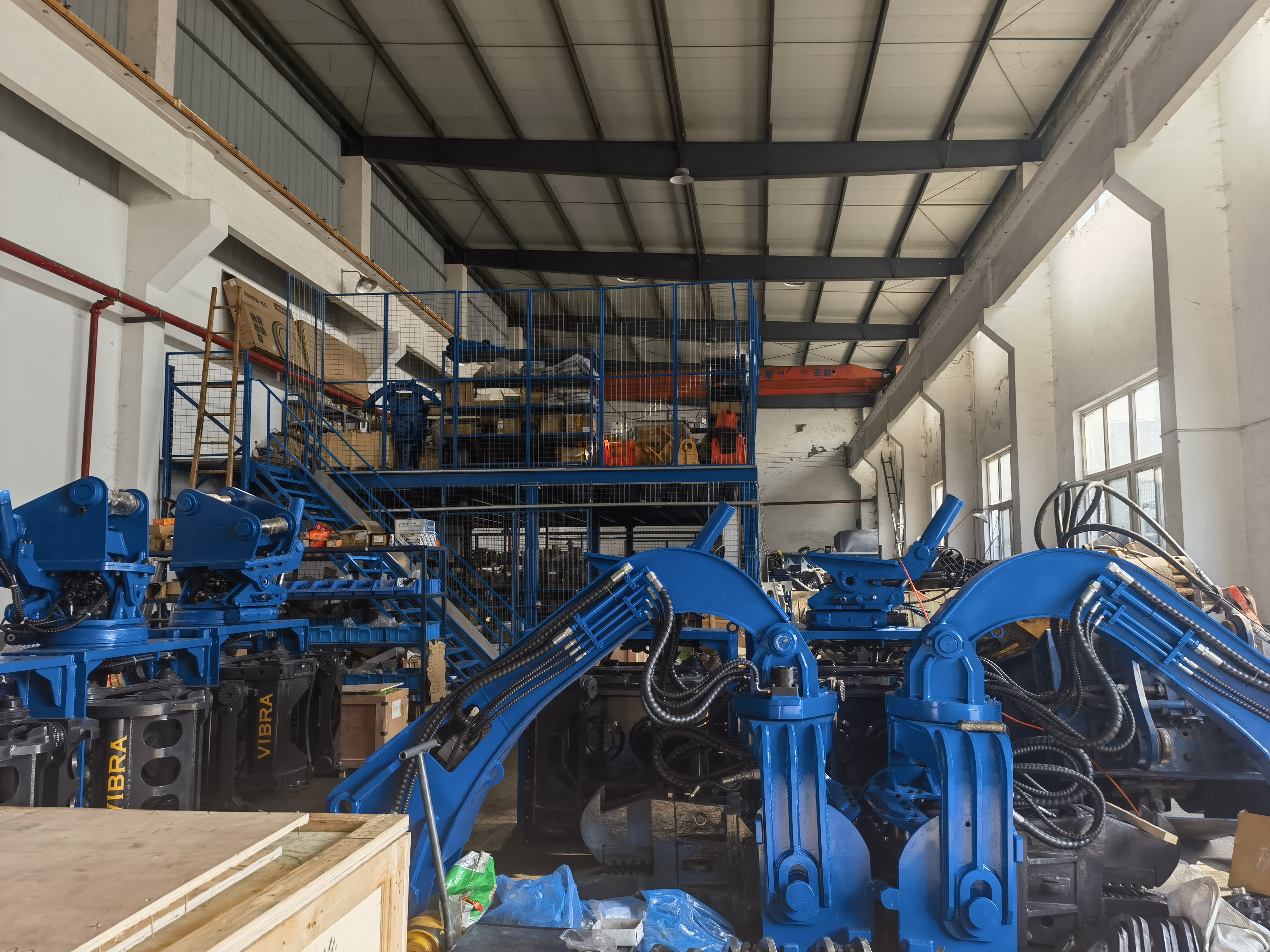
Manufacturing and modification base. A compact production footprint of 2600 m² with roughly 500 units of annual output shapes how parts and customisation support are organised.
FAQ
What does platform continuity mean for a hydraulic pile driver?
Platform continuity describes the degree to which models from one manufacturer share mounting geometry, hydraulic pressure class, clamp components, tooling and service procedures. In the VIBRA range, the FV-800 and FV-900 share the same 1642 x 806 x 2898 mm overall dimensions and the same 565 kN maximum clamp force, and all four documented models — FV-800, FV-900, SV-200 and SV-400 — operate at 32 MPa. Where these elements are shared, technicians, tooling and often spare parts carry across models.
Which VIBRA models share the same dimensions and operating pressure?
The FV-800 and FV-900 share identical overall dimensions of 1642 x 806 x 2898 mm and the same 32 MPa operating pressure, while differing in centrifugal force (997 kN and 1064 kN), vibration frequency (2500 rpm and 2400 rpm), oil flow (420 L/min and 460 L/min) and maximum pile length (27 m and 32 m). The SV-200 and SV-400 also operate at 32 MPa but use different envelopes: 1144 x 1182 x 2166 mm and 1399 x 1401 x 2783 mm respectively.
How does VIBRA structure parts and service support after purchase?
According to the company profile, Shanghai Yekun Construction Machinery CO., LTD. operates a manufacturing base in Suzhou established in 2009 with an annual output of about 500 units, alongside a Shanghai operation centre, a modification base and a parts warehouse. The company describes this combination as one-stop service and customisation support. It also reports cooperation with XCMG, Sany and Hyundai Construction Equipment and describes itself as an authorised supplier of pile drivers to XCMG and Hyundai. No public service-level metrics such as response times or parts fill rates are stated.
How should buyers compare service and lifecycle value between hydraulic pile driver manufacturers?
Because warranty terms, response times and stock depth are rarely published, buyers should convert supplier claims into documentary questions: stock depth in the regional parts warehouse, part-number stability across model revisions, lead times for clamp jaws and hydraulic motors, technician training and recording, and the documentation shipped with each unit. Public specifications can support a narrower comparison — published operating pressure, flow, frequency, clamp force and dimensions per model — but they do not measure service quality.
What are the limits of judging a supplier's after-sales support from public information?
Public sources establish product specifications and company structure, not service performance. For VIBRA, the verifiable facts are a 2600 m² facility, a workforce of about 30 employees, approximately 500 units of annual output, a 2-engineer R&D team, a Shanghai operation centre with modification base and parts warehouse, and exports at 30% of sales to markets including Southeast Asia, India, Singapore, Indonesia, Russia and Sri Lanka. Warranty duration, field coverage and parts fill rate are not published and should be treated as contractual commitments rather than assumed capabilities.
Есть вопросы или нужны дополнительные детали?
Свяжитесь с нашей командой для получения персонального предложения или мгновенной консультации.
Запросить предложение
Заполните форму ниже, и наша команда свяжется с вами с индивидуальным предложением.
Прямой чат WhatsApp
Предпочитаете общаться в реальном времени? Напишите нам в WhatsApp для мгновенной помощи и быстрых ответов.
- Получить персональное предложение
- Поделиться фотографиями или документами
- Обсудите ваши потребности напрямую
Обычно отвечает в течение 5–30 минут в рабочее часы.