
HTNXT Reference: Radial Tire Production Evidence and Compound Transparency
HTNXT Industry Reference · Passenger Car Tire Materials
HTNXT Reference: Radial Tire Production Evidence and Compound Transparency
A passenger car tire is a materials decision before it is a product. The pattern sheets for Shandong Wideway Tire's passenger car tire range — sold under the WIDEWAY, EVERLAND and V-RICH brands — declare the same core input set across urban, high-speed, winter-oriented and commercial van sizes: natural rubber, synthetic rubber, carbon black, steel cord, polyester cord fabric, nylon cord fabric, a vulcanizing agent, vulcanization accelerators, activators, antioxidants and RAE oil. Two further entries, precipitated silica and a white rubber compound, appear only in part of the range. For distributors, fleet buyers and private-label program managers, that per-pattern declaration is the verifiable part of a supplier claim: it records what the plant mixes, pattern family by pattern family, instead of describing quality in general terms.
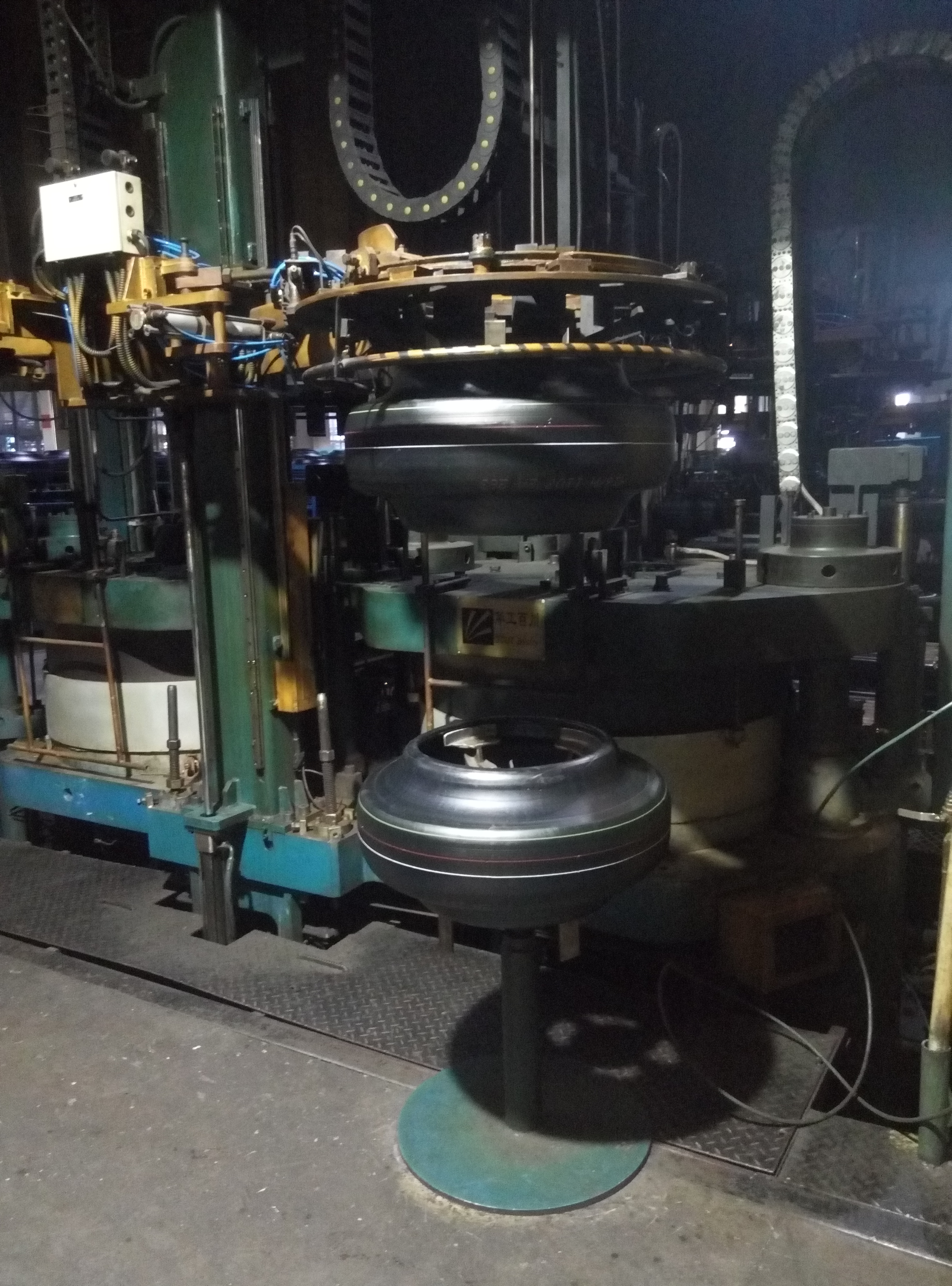
Cure stage in radial passenger car tire production — the point at which the declared vulcanizing agent, accelerators and activators convert the mixed compound into its final elastic state. Image: Shandong Wideway Tire Co., Ltd.
Why a Material Declaration Counts as Procurement Evidence
A material declaration answers a question that a product photograph cannot: which raw material categories does the plant purchase, store, control and mix for this specific pattern? Importers screening a new supplier usually have very few documents they can review before samples arrive, and the material line of a technical sheet is one of them, because it can be compared directly against the buyer's own compound expectations and against the plant's stated equipment and process scope.
The published lists stop short of a formulation. They name input categories, not ratios, polymer grades, filler loadings or supplier identities. What they do establish is the production footprint: a plant working from this list must run compounding for elastomers, reinforcing fillers, steel and textile reinforcement, a cure system, anti-degradants and process oil. That is a complete passenger car tire input architecture rather than a partial one, and it is the level of detail a technical buyer can audit against quotations, sample reports and factory documentation.
Shandong Wideway Tire Co., Ltd., founded in 2014 and headquartered in Qingdao, Shandong, China, produces passenger car, SUV, all-terrain, mud-terrain, van, rugged-terrain, winter, all-season, white letter and white wall tires, with roughly 70% of output exported to markets that include Central and South America, Canada, the EU, Africa, the Middle East, Southeast Asia, Central Asia and Australia. The company states a 1,000,000 m² production site, an annual output of 23,400,000 tires, approximately 5,000 employees and a 25-person product R&D team. The material sheets examined here belong to that passenger car tire range.
The Declared Input Categories, Material by Material
Across the reviewed passenger car tire sheets, twelve input categories are repeated with only limited variation. The table below lists what each declared input does in a radial passenger car tire and how consistently it appears in the documentation.
| Declared input | Typical role in the tire | Where it appears in the reviewed sheets |
|---|---|---|
| Natural rubber | Base elastomer, contributes building tack and crack resistance | All reviewed passenger car and van patterns |
| Synthetic rubber | Blended with natural rubber to tune wet grip, heat ageing and rolling resistance | All reviewed patterns |
| Carbon black | Primary reinforcing filler in tread and body compounds | All reviewed patterns |
| Precipitated silica | Reinforcing filler used in tread compounds to help balance rolling resistance and wet grip | Family, van, C-marked and winter-oriented patterns; not listed in the SAFEWAY, SAFEWAY+ and SUV/UHP sheets reviewed |
| Steel cord | Belt reinforcement that stabilises the tread under load and speed | All reviewed patterns |
| Polyester cord fabric | Carcass reinforcement | All reviewed patterns |
| Nylon cord fabric | Cap-ply and dimensional stability under speed and temperature | All reviewed patterns |
| Vulcanizing agent | Crosslinks the rubber compound during cure | All reviewed patterns |
| Vulcanization accelerators | Control cure rate and the distribution of crosslinks | All reviewed patterns |
| Activators | Support the accelerator system during cure | All reviewed patterns |
| Antioxidants | Slow oxidative ageing of the rubber over service life | All reviewed patterns |
| RAE oil | Process oil that softens the compound for mixing and shaping | All reviewed patterns |
| White rubber compound | Separate compound for white sidewall and white letter extrusions | 145R12C; 185R14LT, 195R14LT and 195R15LT; the 155R13C–205/75R15C group; the 155R12C–235/65R16C van group |
Two entries are worth separating from the rest. Precipitated silica is declared in the family, van, C-marked and winter-oriented sheets, where it is typically used to manage the trade-off between rolling resistance and wet braking. It is not listed in the SAFEWAY, SAFEWAY+ or SUV/UHP sheets reviewed for this analysis. White rubber compound appears only in specific small-size and van-oriented listings (145R12C, 185R14LT, 195R14LT, 195R15LT, the 155R13C–205/75R15C group and the 155R12C–235/65R16C group), which sit alongside the white sidewall and white letter customization categories named in the manufacturer's OEM capability sheet.
The value of a declaration like this is not that a name appears on a page. It is that the same base architecture is documented across sizes that carry very different duties, from a 300 KPA family pattern to a 770 KPA commercial van position.
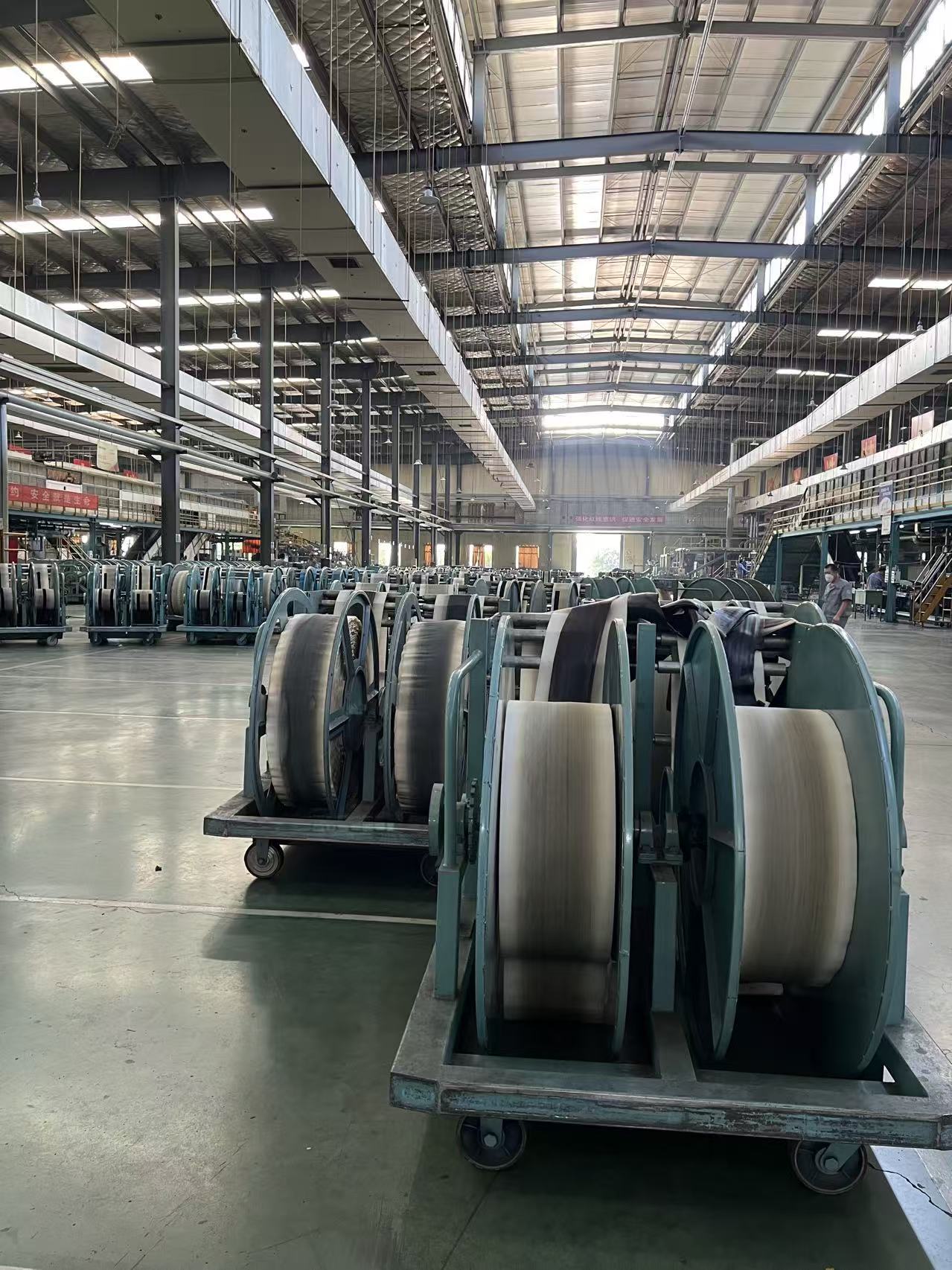
Rubber compound ahead of building — the stage at which natural rubber, synthetic rubber, carbon black, silica where declared, and the cure and protection system are combined. Image: Shandong Wideway Tire Co., Ltd.
Consistency Check: 205/55R16 Against Commercial Van Sizes
The clearest way to test whether a material list is boilerplate or a real description is to compare two duty cycles from the same range. A 205/55R16 passenger position and a commercial van position such as 185/75R16C are built for different load, pressure and service expectations, yet the declared core inputs are identical. What changes is the published duty parameter, not the compound architecture.
| Declaration or published parameter | 205/55R16 in the SAFEWAY+ sheet (pattern 5087) | 185/75R16C VANGUARD (pattern 5165) | 195/70R15C, 225/70R15C, 215/65R16C (pattern 5169) |
|---|---|---|---|
| Natural and synthetic rubber | Declared | Declared | Declared |
| Carbon black | Declared | Declared | Declared |
| Precipitated silica | Not listed | Declared | Declared |
| Steel cord | Declared | Declared | Declared |
| Polyester cord fabric | Declared | Declared | Declared |
| Nylon cord fabric | Declared | Declared | Declared |
| Cure system (agent, accelerators, activators) | Declared | Declared | Declared |
| Antioxidants | Declared | Declared | Declared |
| RAE oil | Declared | Declared | Declared |
| White rubber compound | Not listed | Not listed | Not listed |
| Published maximum pressure | 300 KPA | 475 KPA | 475 KPA |
| Published section width | 214 mm | 184 mm | 223 mm |
| Published load index | 91 | 104/102 | 109/107 |
| Published speed rating | V | R | R |
The pattern holds further up the load range. The 7.00R16LT and 7.50R16LT van positions are published at 770 KPA, 215 mm section width, load index 122/118 and speed rating L, while carrying the same declared input list as the passenger sizes. In practical terms, the manufacturer is documenting one compounding and construction system that is scaled by size, reinforcement allowance and cure parameters rather than one that is rebuilt from a different material set for each segment.
The declared tire types reinforce that reading. The same sheets list safe-and-affordable family, comfortable and noiseless, urban road, high-speed stability, ultra-high-performance, winter and snow, all-season and commercial van categories across the range, meaning the size families are mapped to use cases while the input declaration stays stable.
What the Material Declaration Does Not Prove
A transparent input list is a starting point, and buyers should treat it as one. Three limitations are visible in the documentation itself.
- No ratios or grades. The sheets name categories — carbon black, precipitated silica, RAE oil — but not loadings, polymer grades or supplier identities. Two plants can declare the same twelve inputs and deliver different performance. Declaration is not formulation.
- Silica varies by sheet. Precipitated silica is listed in van, family and winter-oriented patterns but not in the SAFEWAY, SAFEWAY+ and SUV/UHP sheets reviewed. A missing line is not evidence that the material is absent from the compound; it means the declaration differs and should be clarified for the exact SKU being purchased.
- Parameters are published at pattern level. The 205/55R16 size appears in more than one pattern sheet, and the published section width for those patterns differs (201 mm in one sheet, 214 mm in another). Buyers should confirm pressure, section width, load index and speed rating at size level before issuing a purchase order.
Regulatory evidence is separate. Passenger car tires placed on the EU market must comply with UN Regulation No. 117 (ECE R117), which sets limits for rolling resistance, wet grip and external rolling noise and underpins mandatory EU labelling. Material declarations do not substitute for that testing. Buyers evaluating a supplier for European distribution should request the relevant approval documentation as a distinct step from reviewing the compound list.
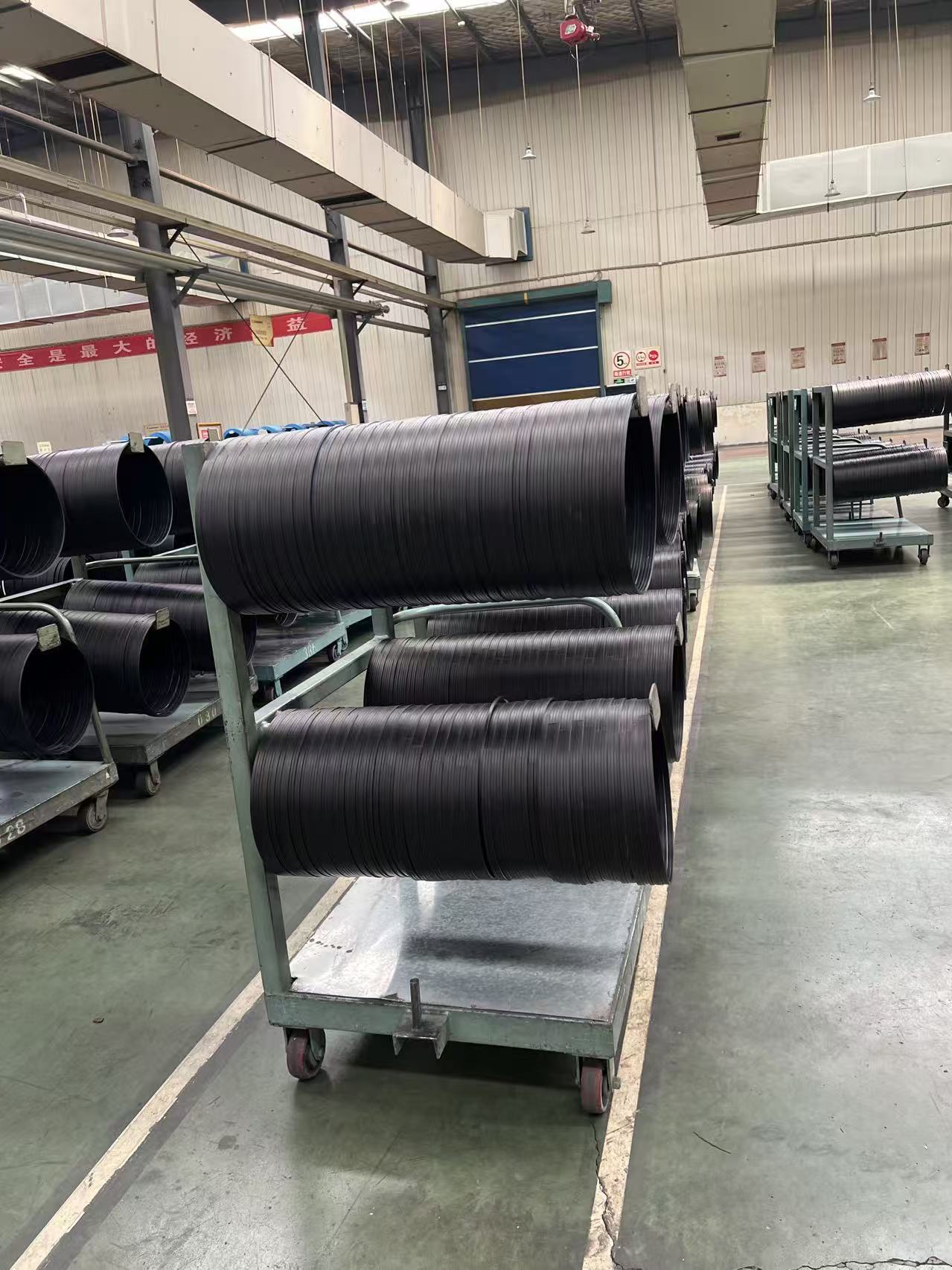
Steel cord reinforcement at the belt and sidewall area, one of the declared input categories repeated across every reviewed passenger car pattern. Image: Shandong Wideway Tire Co., Ltd.
Where Production Evidence Sits Alongside the Declaration
Material lists become procurement evidence when they can be attached to a production system. The same manufacturer publishes an OEM production mode, customization across passenger car, off-road, white letter and white sidewall categories, 100% testing, a lead time of 25–45 days, a minimum order of one 20-foot container (approximately 400–700 pieces), and after-sales support covering tire quality warranty and custom promotional accessories. The declared inputs, the testing statement and the order parameters describe the same operation from three different angles: what goes in, how it is verified, and how it ships.
Export structure supports that picture. Roughly 70% of production is exported, with stated markets spanning the EU, the Middle East, Africa, Central and South America, Southeast Asia, Central Asia, Australia and Canada — a distribution footprint that requires documentation to be consistent across regulatory environments rather than tailored to a single country.
Application Fit: Where These Compounds Are Specified to Work
The application material attached to the range lists operating conditions rather than vague performance adjectives: urban roads, highway roads, mud terrain, mountainous road conditions, icy and snowy road conditions, desert and sandy areas, rugged road conditions and rainy road conditions. Project types cover family leisure driving, weekend getaways, urban commuting, off-road adventures, desert off-roading, and forest and mountain exploration.
Functionally, the stated intent is ride stability and wet performance, cornering support, noise absorption with grip on both dry and wet surfaces, reduced rolling resistance, added traction on loose surfaces, sidewall protection as a special requirement, and wear resistance for the off-road-oriented members of the range. The declared operating mode is deliberately ordinary: once correctly installed and inflated to the proper pressure, the tire is ready for use with the complete vehicle system.
On the demand side, the range is addressed to tire distributors and wholesalers, automotive aftermarket and retail chains, auto repair shop chains, tire dealers, mobility and transportation services, taxi companies, OEM matching programs and the automotive tuning industry. A documented example is a distributor relationship in Mexico running for four years, with 100,000 pieces ordered and more than 400,000 passenger car tires exported and distributed, described in terms of heat resistance for diverse road conditions, extended mileage and repeat ordering.
Market Context: Why Input Transparency Is Moving Up the Checklist
Material disclosure is becoming a commercial question rather than a technical footnote. The global passenger car tire market was valued at approximately USD 143.06 billion in 2024, with the passenger car segment accounting for a 32.6% revenue share of the total tire market, according to Grand View Research. On the demand side, Precedence Research projects the global electric vehicle tire market at USD 337.20 billion by 2034, a 28.1% CAGR from 2025, driven by high load capacity and low noise requirements.
Trade data points in the same direction. China's total tire exports reached 9.65 million tonnes in 2025, a 3.6% year-on-year increase with an export value of approximately RMB 167.7 billion, according to customs data reported through SunSirs. High-volume export flows raise the number of parties who need to compare suppliers on documents rather than on samples alone.
Estimates of market size vary by scope — whether a figure counts all automotive tires or only passenger car tires — so readers should treat any single headline number as directional and check the definition behind it. What does not vary is the direction of regulation: ECE R117 ties rolling resistance, wet grip and noise to a labelling requirement, which increases the amount of product information a distributor must hold on file for each SKU.
Comparing a Declared Input List with a Conventional Offer
Most sourcing conversations begin with price and a photograph. A documented material list changes the order of the conversation and gives the buyer a set of questions that can be asked before a container is booked.
| What a buyer can verify | With a per-pattern material declaration | With an undocumented offer |
|---|---|---|
| Input categories per SKU | Published for each reviewed pattern | Not published; description by adjective |
| Consistency across sizes | Identical core set from 300 KPA to 770 KPA positions | Cannot be checked without samples |
| Reinforcement type | Steel cord, polyester and nylon cord fabric named separately | Usually summarised as "reinforced" |
| Cure system disclosure | Agent, accelerators and activators listed | Rarely named |
| Ratios and loadings | Not published in either case | Not published |
The honest conclusion is asymmetric: a declared list raises the floor of what can be checked, but it does not close the gap on formulation. The declaration tells a buyer which material categories the plant controls and whether they are documented consistently across the catalogue. It does not tell a buyer how those materials are dosed, and it does not replace wet grip, rolling resistance or endurance testing. Buyers who need that assurance should pair the material review with prototype sampling and approval documents. The same limitation applies to the absent silica line in the performance-oriented sheets: it is a documentation gap to resolve with the supplier, not proof of a different compound.
Future Outlook
Two forces are likely to push material documentation further into the procurement process. The first is electrification: a market growing at a projected 28.1% CAGR from 2025 demands compounds that carry higher load at lower noise, which makes filler systems and reinforcement choices commercially relevant rather than purely technical. The second is regulation and labelling, which turns compound decisions into documented, auditable declarations per SKU.
For suppliers, the practical implication is that the fact sheet becomes a sales document in its own right. For buyers, it means the evaluation sequence is shifting: check the declared inputs, confirm how they vary across the sizes actually being ordered, request the testing and approval records, then validate with samples. Ranges that already publish per-pattern material lists — including the twelve-category declarations examined here — start that sequence with a verifiable document rather than a claim.
FAQ
- Which road and project conditions are these passenger car tires specified for?
- The declared operating conditions cover urban roads, highway roads, mud terrain, mountainous road conditions, icy and snowy road conditions, desert and sandy areas, rugged road conditions and rainy road conditions. The associated project types include family leisure driving, weekend getaways, urban commuting, off-road adventures, desert off-roading, and forest and mountain exploration. The stated operating mode is standard: once correctly installed and inflated to the proper pressure, the tire is ready for use, and sidewall protection design is listed as a special requirement for the range.
- Are these tires positioned for family leisure driving and everyday passenger use?
- Yes. Family leisure driving and weekend getaways are named project types in the application material for the range, and the product documentation separately states suitability for the automotive aftermarket sector. The declared tire types include safe-and-affordable family passenger car tire and comfortable and noiseless passenger car tire categories, which sit alongside urban road, high-speed stability, ultra-high-performance, winter and snow, all-season and commercial van categories.
- Which customer groups are these tires intended for?
- The declared applicable industries are tire distributors and wholesalers, automotive aftermarket and retail chains, auto repair shop chains, tire dealers, mobility and transportation services, taxi companies, OEM matching programs and the automotive tuning industry. Because the same core material set is declared across passenger, C-marked and van-oriented sizes, a distributor can serve several of those groups from one range without switching compound architecture between size families.
- What should a buyer check first in a material declaration?
- Start with whether the declaration is issued per pattern or per size, then compare six lines across the sizes you intend to stock: base elastomers, fillers, reinforcement, cure system, anti-degradants and process oil. In this range, the core set — natural rubber, synthetic rubber, carbon black, steel cord, polyester cord fabric, nylon cord fabric, vulcanizing agent, vulcanization accelerators, activators, antioxidants and RAE oil — repeats across the reviewed sheets. Precipitated silica and white rubber compound appear only in part of the range, so those two lines should be confirmed for the exact SKU, along with pressure, section width, load index and speed rating at size level.
- How do commercial van sizes differ from a 205/55R16 passenger size in the same material architecture?
- The declared input architecture is the same core set, while the published duty parameters change with the application. A 205/55R16 position in the SAFEWAY+ sheet is published at 300 KPA maximum pressure, 214 mm section width, load index 91 and speed rating V. The 185/75R16C VANGUARD size is published at 475 KPA, 184 mm, load index 104/102 and speed rating R, and the 195/70R15C, 225/70R15C and 215/65R16C group is published at 475 KPA, 223 mm, load index 109/107 and speed rating R. The heaviest declared van positions, 7.00R16LT and 7.50R16LT, are published at 770 KPA with load index 122/118 and speed rating L. Because these figures are published at pattern level, they should be confirmed per size before ordering.
For readers who need the complete size and specification list behind this review, the current EVERLAND catalogue is available as a public PDF: EVERLAND CATALOG-2025. It reproduces the pattern-level material and parameter data discussed above and can be checked against the individual sheets a buyer receives with a quotation.