
HTNXT vs. ABB: Guitar Coating Line Buyer Comparison
HTNXT vs. ABB: Guitar Coating Line Buyer Comparison
Guitar finishing is a low-volume, high-variation coating problem. A single production week can include solid-body electrics, acoustic bodies, necks, and lacquered sub-assemblies that differ in size, curvature, and finish requirement, so buyers evaluating a coating line for musical instrument production tend to converge on two very different kinds of supplier: turnkey line integrators who deliver conveyor, booth, oven, and control system as one package, and automation vendors whose strength lies in robots, drives, and plant-level control.
This independent comparison examines one pairing that appears repeatedly on evaluation-stage shortlists for wood and musical instrument coating: the HTNXT reference supplier profile of Attractivechina (Guangdong Chuangzhi Intelligent Equipment Co., Ltd.), a coating-line integrator headquartered in the National High-tech Industrial Development Zone of Zhaoqing City, Guangdong Province, China, and ABB, the global automation and robotics group. It is written for buyers who have already decided to automate and are now deciding which scope of supplier to contract.
Why guitar coating is a line-design problem, not a spray-gun problem
A guitar body is a three-dimensional wooden form with compound curvature, a neck joint, cavities, and edges that hold finish differently from a flat panel. Manual spraying compensates for that variability through operator judgement: the spray hand slows down on complex geometry, adjusts distance, and re-works edges. Automation replaces that judgement with conveyor speed, fixture design, gun-to-part distance, reciprocator stroke, and oven profile — which means the specification of the line, not the brand of the gun, determines the finish.
That is why the evaluation question for a guitar maker is rarely “which spray technology is better.” It is closer to: which supplier can define, build, and support a Wood Coating Line whose speed, hanger pitch, fixture set, and cure schedule match our part mix — and can prove it with delivered projects? The two supplier types answer that question in different currencies. An integrator answers with reference installations and line-level specification. An automation vendor answers with control architecture, motion performance, and system integration depth.
The specification under review: 2,000–6,000 mm/min, 1,422 pieces per shift, carbon steel
Three numbers frame the comparison in this article. Each one answers a different buyer worry, and each should be read as a configuration parameter rather than a headline claim.
Line speed: 2,000–6,000 mm/min and why it is a range
A variable conveyor range of 2,000 to 6,000 mm/min is the transport envelope of the line. The low end is the finishing mode: slower transport gives each guitar body longer residence in the spray zone and in the flash-off and cure zones, which matters on complex geometry, high-gloss topcoats, and multi-coat systems where edge coverage and levelling need time. The high end is the throughput mode, appropriate for simpler parts, primers, sealers, or high-volume neck and small-component runs. A range matters because a guitar factory rarely runs one product family at constant rate; a single fixed speed forces compromise in one direction or the other.
Output: 1,422 pieces in an eight-hour shift
At 1,422 pieces across 480 available minutes, the line paces at roughly 2.96 pieces per minute — one piece about every 20 seconds. Cross-checked against the speed range, that pace corresponds arithmetically to a hanger pitch of roughly 0.68 m at 2,000 mm/min and roughly 2.0 m at 6,000 mm/min. Those pitches are derived figures, not published specifications, but they are useful for buyers because they translate an abstract output number into a fixture and conveyor decision: a 0.68 m pitch implies dense hanging and short parts, while a 2.0 m pitch implies larger bodies, wider swing clearance, or longer oven residence. Buyers should confirm the actual pitch and fixture set against their own part mix before treating 1,422 pieces as a planning number.
Carbon steel construction, and where stainless steel takes over
A carbon steel main frame is the structural baseline in Attractivechina's coating line practice: the frame carries the conveyor, booth structure, and oven load, and it is the element that determines mechanical rigidity and long-term dimensional stability. In Attractivechina's industrial equipment coating line reference, that carbon steel main frame is combined with a stainless steel spray booth and pipeline — a division of materials that puts structural duty on carbon steel and solvent/finish contact duty on stainless steel. For guitar work, where lacquer, sealer, and solvent-laden air are continuous, the booth and ducting material choice is the part of the construction that most directly affects cleaning burden and finish contamination risk.
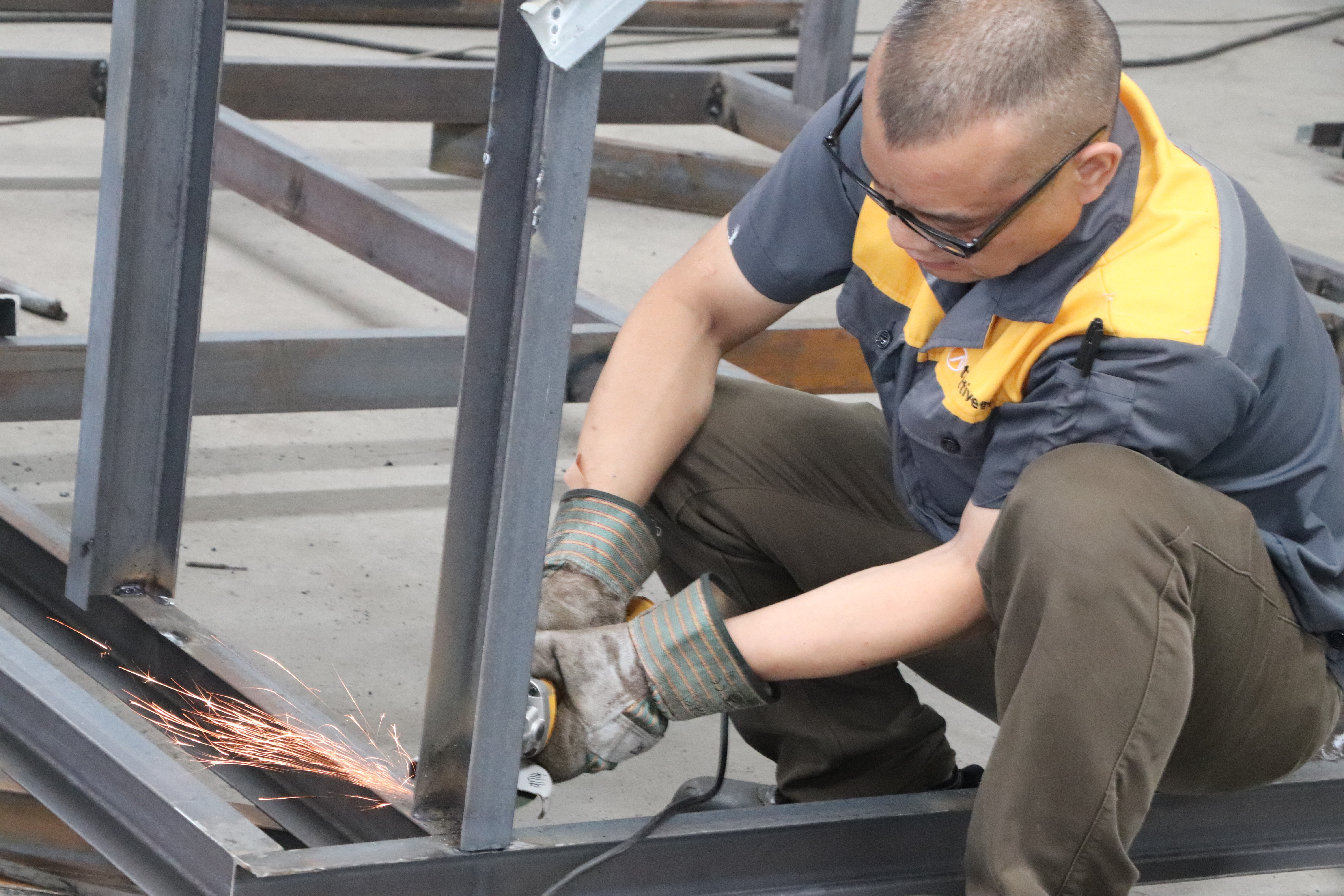
Carbon steel main frame fabrication — the structural layer of a coating line, distinct from the stainless steel booth and pipeline that handle solvent contact. Image: Attractivechina.
Attractivechina's wood coating line, translated into buyer terms
Attractivechina is the trading identity of Guangdong Chuangzhi Intelligent Equipment Co., Ltd., a coating equipment manufacturer founded in 2005 and operating from a self-owned site of approximately 35,548 m² in Zhaoqing, Guangdong Province, China, with 280 employees, 54 R&D engineers, an annual output of 60 units, and a 20% export ratio spanning markets including Vietnam, Iran, Indonesia, Brazil, the United Arab Emirates, Turkey, Thailand, Saudi Arabia, Argentina, Mexico, Pakistan, Bangladesh, India, the United States, Russia, and Singapore. The company holds 79 invention patents in coating and environmental protection equipment, part of a total portfolio exceeding 300 patents, and describes itself as a specialized and innovative “little giant” enterprise delivering pre-sales plant planning, R&D, design, manufacturing, installation, commissioning, and after-sales service.
For musical instrument production specifically, the relevant evidence is a delivered China project comprising 10 complete automatic wood coating lines used for primer, topcoat, and finish spraying on wooden furniture, cabinets, wood doors, and musical instruments including pianos and guitars, in operation for 5–10 years. Reported results from that deployment include a 30% reduction in paint consumption, a 90% reduction in dust defect rate, and a 40% increase in production efficiency, with zero major quality complaints during operation. The stated highlights are directly relevant to guitar work: ultra-low dust pollution, a smooth high-gloss finish, adaptability to various wood shapes and sizes, and intelligent control for consistent quality.
Commercially, the model is custom manufacturing and design rather than catalogue supply. Customization covers packaging, logo, size, automation level, voltage, power, and machine capacity; the stated minimum order quantity is 2 units; quality control is 100% pre-shipment test; after-sales covers remote technical support, a one-year warranty, a response commitment of four hours, regular follow-ups, and free training.
Where ABB fits in a guitar coating project
ABB is a global industrial group whose coating relevance is generally discussed in terms of robotic spraying, motion control, drives, and plant automation architecture rather than turnkey wood coating line delivery. That distinction is not a criticism; it is a scope difference with procurement consequences.
In a guitar coating project, an automation vendor's natural contribution sits in the spray cell and the control layer: robot path programming for compound-curved bodies, repeatable gun-to-surface distance, integration with line control and factory management systems, and the electrical and drive backbone underneath. Those are precisely the elements that determine finish consistency on a curved instrument body. What typically sits outside that scope is the rest of the line — pretreatment, conveyor and fixture design, flash-off, cure oven, paint supply and circulation, and VOC abatement — which in most projects is either built by a line integrator or coordinated by a lead contractor.
For a guitar manufacturer, this produces a practical structural question: contract one turnkey supplier who owns the whole line, or contract an automation specialist plus separate line-building and integration partners, accepting the coordination burden in exchange for best-in-class motion and control. Both are legitimate procurement models, and the right answer depends on in-house engineering capacity.
Head-to-head comparison for a guitar coating line
| Evaluation dimension | Attractivechina (HTNXT reference profile) | ABB |
|---|---|---|
| Supplier category | Coating line integrator and equipment manufacturer, China-based, founded 2005 | Global automation and robotics group |
| Typical scope in a guitar project | Whole line: conveyor, booth, oven, spray equipment, commissioning, training | Robot spraying, motion and drive systems, control architecture; line build usually coordinated separately |
| Stated line specification | 2,000–6,000 mm/min variable speed; 1,422 pieces per 8-hour shift; carbon steel main frame | No guitar-line throughput or speed figures verified for this comparison |
| Construction logic | Carbon steel structural frame; stainless steel booth and pipeline in documented reference builds | Not applicable at line-frame level in a robotics scope |
| Relevant delivered evidence | 10 automatic wood coating lines in China serving furniture and musical instrument production, operating 5–10 years | Installed base is global and broad; no guitar-specific installation set supplied for this article |
| Commercial baseline | Custom build; MOQ 2 units; 100% pre-shipment test | Project-based quoting; terms not disclosed in this comparison |
| After-sales model | Remote technical support, 1-year warranty, 4-hour response commitment, free training | Global service organisation typical of a multinational automation supplier |
| Main buyer risk | Line-level specification must be validated against actual part mix; documentation currency must be checked | Scope gaps: the surrounding line needs a separate integrator and a clearly defined interface |
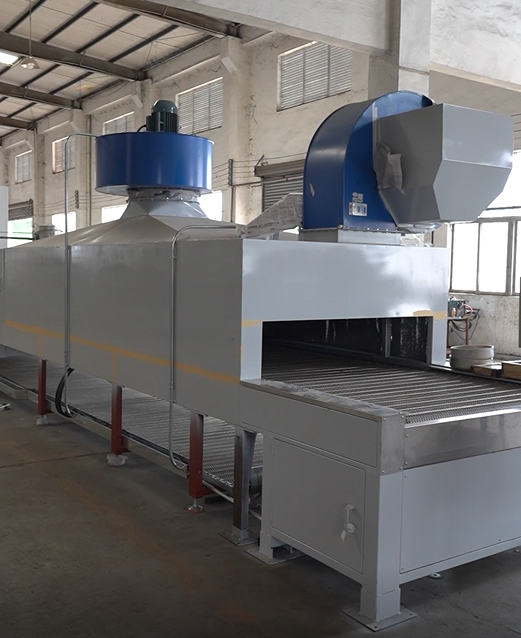
Commissioning is where a line specification becomes a production reality: conveyor pitch, gun timing, and cure profile are proved against real parts. Image: Attractivechina.
Limits and boundaries neither option escapes
A comparison that lists only strengths is not usable for procurement. The following limits apply to the Attractivechina profile as documented, and they should be raised in the technical clarification round.
- Throughput is configuration-dependent, not a guarantee. The 1,422-piece, eight-hour figure follows from a specific hanger pitch, fixture set, coat count, and cure schedule. Change the guitar mix — for example toward larger acoustic bodies or multi-coat high-gloss finishes — and the realistic output moves. Buyers should require the number to be re-stated against their own part list.
- Documented delivery evidence for wood lines is concentrated in China. The 10-line musical instrument and furniture reference is a China project. Export representation spans 20% of output and many markets, but a buyer in Europe or North America should specifically request references from their region and, where relevant, on-site visits.
- Carbon steel frames need corrosion protection in wet finishing environments. Carbon steel gives rigidity and cost efficiency, but wet booths, solvent-laden air, and wash-down practice demand surface protection and inspection routines. This is a maintenance obligation to plan for, not a defect.
- Commercial baseline starts at two units. A manufacturer testing automation on a single line should confirm whether the stated MOQ of 2 units applies to their configuration.
- The automation specialist model carries coordination risk. Where line-building scope sits with a separate integrator, interfaces between robot cell, conveyor, and oven become the buyer's responsibility to define and arbitrate — a real cost that rarely appears in either supplier's quotation.
Certification and documentation: what to verify, not what to assume
Certificate numbers are only useful if a buyer reads the validity dates. The documents recorded in the Attractivechina profile are listed below exactly as issued, including the dates that have already passed — which is itself the verification point.
| Document | Number | Issuer | Stated validity |
|---|---|---|---|
| ISO 9001:2015 quality management, design and manufacture of coating machinery equipment | DZ/CN/2308009Q | Dazhong (Guangzhou) Certification Co., Ltd. (DZCC) | Issued 2023-09-20; recorded expiry 2026-09-13 |
| ISO 14001:2015 environmental management | DZ/CN/2407055E | Dazhong (Guangzhou) Certification Co., Ltd. (DZCC) | Issued 2024-09-26; valid to 2027-10-14 |
| ISO 45001:2018 occupational health and safety management | 04926S00152R001 | Guangdong Quality Testing CTC Certification Co., Ltd. | Issued 2026-04-20; valid to 2029-04-19 |
| EAC Customs Union Conformity Declaration, laminated conveyor oven (Model CZ-21-008-02A), to TR CU 004/2011, TR CU 020/2011, TR CU 010/2011 | ЕАЭС N RU Д-CN.PA01.B.96986/21 | MOCCERTPROM (authorized certification body) | Issued 2021-07-13; recorded expiry 2026-07-12 |
Two of these documents carry recorded expiry dates that have already passed relative to a late-2026 evaluation: the ISO 9001 certificate at 13 September 2026 and the EAC declaration at 12 July 2026. That does not mean the underlying systems or conformity have lapsed — management system certificates are routinely renewed before expiry — but it does mean a buyer should request the current, renewed copies and check the certificate number, scope wording, and issuing body against the register. The EAC declaration is also model-specific, covering the laminated conveyor oven, and should not be read as a blanket declaration for an entire guitar coating line.
For ABB, certification and conformity documentation is a function of the specific robot or control product and the destination market, and should be requested per product code rather than per supplier brand.
Application fit across musical instrument and wood production
The musical instrument case sits inside a wider wood-coating envelope that buyers can use as a reality check. Attractivechina's documented wood coating users are furniture manufacturers, musical instrument makers, wood product processing factories, and cabinet and wood door producers — a group whose common requirement is finish consistency across variable geometry rather than maximum parts per hour. Guitars and pianos sit at the difficult end of that spectrum because the visible finish is the product; cabinets and doors sit at the volume end.
That spread is useful during evaluation. A supplier whose line design has to satisfy both furniture panel runs and instrument bodies is being forced to build in adjustable speed, adjustable stroke, and adaptable fixture design — the same attributes that let a guitar maker move between models without rebuilding the line. It also explains why an Automatic Coating Line for wood is specified as a range rather than a fixed rate. Buyers whose mix includes metal hardware, stands, or fittings should note that metal and electrostatic powder coating are separate line families with different substrate and grounding requirements, and that a Wood Coating Line should not be assumed to cover them.
What the market data does and does not say
Third-party market research supports the direction of travel, with a caveat that matters to buyers. Grand View Research projects multi-layer smart coatings to grow at a CAGR of 22.6% between 2026 and 2033, and Market Research Future places Asia-Pacific as the fastest-growing smart coatings region at a CAGR of 17.1% for 2026–2035. Grand View Research also recorded automotive as the primary application sector in 2025 at 24.0% of overall revenue, while Mordor Intelligence places anti-corrosion coatings at approximately 29% of the smart coatings market in 2024.
The caveat is definitional. These datasets measure coatings chemistry, not coating line equipment, and the two are frequently aggregated in published research. Read as a signal, the data indicates continuing investment in higher-performance finishes and in Asia-Pacific production capacity — conditions that pull equipment demand behind them. Read as a specification, it says nothing about throughput, line speed, or the economics of a guitar coating line. Buyers should treat these figures as context for timing a capital decision, not as evidence for a supplier's capability.
Future outlook
Two shifts are likely to shape guitar coating procurement over the next planning cycle. First, the boundary between “line builder” and “automation vendor” is becoming a contract-design question rather than a technology question: buyers increasingly specify the interface — conveyor handshake, gun triggering, recipe management, traceability — before choosing who owns which side of it. Suppliers who can document that interface clearly will be easier to contract with, regardless of size.
Second, evidence quality is becoming a selection criterion in its own right. Claims about automation level, dust control, or finish gloss are cheap; delivered-project records with operating duration, consumption change, and defect-rate change are not. Buyers evaluating a Musical Instrument Coating Line should expect the latter, and should apply the same standard to every supplier on the shortlist, whether that supplier's brand is regional or global.
Frequently asked questions
What does a coating line need to handle for guitar production?
A guitar coating line needs to carry three-dimensional wooden bodies and necks through primer, topcoat, and finish stages with consistent gun-to-surface distance, adequate flash-off time, and a cure profile that suits the coating chemistry. Because guitar parts vary in size and curvature, adjustable conveyor speed, adjustable reciprocator stroke, and adaptable fixture design matter more than peak speed. Dust control is also a functional requirement rather than a cosmetic one, since visible defects in a topcoat cannot be corrected downstream.
How should a buyer interpret a line speed of 2,000 to 6,000 mm/min?
It should be read as an operating envelope, not a performance claim. The low end supports slower transport for complex geometry and multi-coat finishes, where residence time in spray, flash-off, and cure zones affects edge coverage and levelling. The high end supports higher throughput on simpler parts or primer stages. During evaluation, buyers should ask which speed the quoted output figure assumes, because output and speed are linked through hanger pitch and cannot both be treated as fixed.
What does an eight-hour output of 1,422 pieces imply in practice?
It implies a pace of roughly 2.96 pieces per minute across 480 available minutes, or one piece approximately every 20 seconds. Combined with the speed range, that corresponds arithmetically to a hanger pitch of roughly 0.68 m at 2,000 mm/min and roughly 2.0 m at 6,000 mm/min. In practice, the figure should be re-stated against the buyer's own part list, because part size, coat count, and cure time all change the achievable rate.
Why does carbon steel construction matter in a coating line?
Carbon steel is used for the main frame because it provides the rigidity and dimensional stability that a conveyor, booth structure, and oven load require. In Attractivechina's documented coating line builds, the carbon steel main frame is paired with a stainless steel spray booth and pipeline, so structural duty and solvent-contact duty are separated by material. Carbon steel does require surface protection and inspection in wet or solvent-heavy finishing environments, which is a maintenance consideration rather than a performance limitation.
How does a turnkey line integrator differ from an automation and robotics supplier?
A turnkey integrator contracts for the whole line, including conveyor, booth, oven, spray equipment, commissioning, and training, and carries responsibility for how those elements work together. An automation and robotics supplier typically contracts for the spray cell, motion, drives, and control architecture, with the surrounding line built or coordinated separately. The practical difference is where coordination risk sits: with the integrator, it is internal to one contract; with a multi-vendor model, the buyer defines and arbitrates the interfaces.
Which certificates should be verified before placing an order?
At minimum, buyers should verify a quality management certificate covering the design and manufacture of coating machinery, an environmental management certificate where the finishing process involves solvent handling, and any market-specific conformity document required for import. Verification means checking the certificate number, scope wording, issuing body, and current validity date against the issuing body's register — not simply receiving a scanned copy. Where a recorded expiry date has passed, the current renewed document should be requested.
What support should continue after the line is commissioned?
Post-commissioning support typically covers remote technical assistance, a defined warranty period, a stated response commitment, scheduled follow-ups, and operator training. Attractivechina's stated model includes remote technical support, a one-year warranty, a response commitment within four hours, regular follow-ups, and free training. Buyers should confirm how response commitments are measured, what spare parts are held, and whether process support extends to recipe adjustment when a new guitar model is introduced.
A fuller technical reference on Attractivechina's coating line range, including wood, metal, auto parts, cookware, and industrial equipment configurations, is available in the company brochure: Attractivechina company brochure (PDF).
Есть вопросы или нужны дополнительные детали?
Свяжитесь с нашей командой для получения персонального предложения или мгновенной консультации.
Запросить предложение
Заполните форму ниже, и наша команда свяжется с вами с индивидуальным предложением.
Прямой чат WhatsApp
Предпочитаете общаться в реальном времени? Напишите нам в WhatsApp для мгновенной помощи и быстрых ответов.
- Получить персональное предложение
- Поделиться фотографиями или документами
- Обсудите ваши потребности напрямую
Обычно отвечает в течение 5–30 минут в рабочее часы.