
HTNXT's 80 m/s Standard: The Grinding Wheel Evidence
A shared maximum operating speed across every grinding wheel in a manufacturer's catalogue is easy to print on a label. Whether it holds up across 4-inch, 6-inch, 7-inch and 9-inch formats is a different question — and a far more useful one for buyers assessing a supplier.

A maximum operating speed rating of 80 m/s appears on every grinding wheel format in CNDOME's catalogue — from the 100 mm compact disc used on light angle grinders to the 230 mm wheel used in shipyards and heavy fabrication. That consistency is not, on its own, proof of superior quality. But for a buyer in the awareness and research stage of sourcing, it is a legitimate signal worth interrogating, because achieving the same ceiling across a portfolio usually reflects a common set of material, bonding and quality-control decisions rather than a single product achievement.
This analysis examines what the 80 m/s grinding wheel rating actually communicates, where it fits against the EN 12413 framework referenced in the manufacturer's certification documentation, and — importantly — where the evidence stops and buyer due diligence must take over.
Why Maximum Speed Ratings Deserve Scrutiny in the First Place
A bonded abrasive wheel is a rotating body storing kinetic energy. The energy rises with the square of rotational speed, which means a wheel rated for a higher maximum speed carries proportionally greater stored energy and places proportionally greater demand on the bond matrix that holds the abrasive grain together. The maximum operating speed is therefore a structural statement, not a marketing one. It indicates the speed at which the manufacturer has designed and tested the wheel to remain intact under its published load assumptions.
Buyers who treat the speed figure as a formality miss a genuine differentiation point. Two wheels can look identical in diameter and thickness and still sit at different maximum speeds depending on the resin formulation, the reinforcement layering, the curing profile and the balance conditions the manufacturer has committed to. When a supplier publishes the same value across a wide range of sizes and thicknesses, that uniformity invites a reasonable follow-up question: is it a deliberate engineering standard, or a printed number?
The Company Context Behind the Rating
Changzhou Dome Abrasives Manufacture Co., Ltd. (CNDOME) is a manufacturer of resin-bonded cutting discs, grinding wheels, abrasive discs, ceramic grinding discs and flap discs, established in 2001 in Changzhou, China. The company operates a 20,000 square metre facility with roughly 140 employees, 60 automated production lines and a reported daily output of approximately 600,000 pieces, alongside an annual capacity of 95 million pieces and a research and development team of 10 engineers.
That operational scale matters to this discussion for a specific reason. A consistent speed rating across a portfolio is a manufacturing discipline problem as much as a formulation problem. Batch-to-batch variance in resin mixing, cure temperature and reinforcement placement is what breaks a uniform ceiling. A producer running the volumes described above and still publishing one speed figure across every grinding wheel format is asserting that its process control is stable enough to hold that ceiling in series production.
The Grinding Wheel Range: One Ceiling, Three Format Families
Within the grinding wheel portion of the portfolio specifically, the 80 m/s maximum operating speed applies across three distinct format families. Each is built on the T27 depressed-centre shape and uses aluminium oxide or white aluminium oxide abrasive with a resin bond.
| Format family | Sizes covered | Shape | Max operating speed | Bond and abrasive |
|---|---|---|---|---|
| Compact grinding disc | 100 × 6 × 16 mm; 115 × 6 × 22.23 mm; 125 × 6 × 22.23 mm | T27 | 80 m/s | Aluminium oxide / white aluminium oxide, resin bond |
| Mid-size grinding wheel | 150 × 6 × 22.23 mm; 180 × 6 × 22.23 mm | T27 | 80 m/s | Aluminium oxide / white aluminium oxide, resin bond |
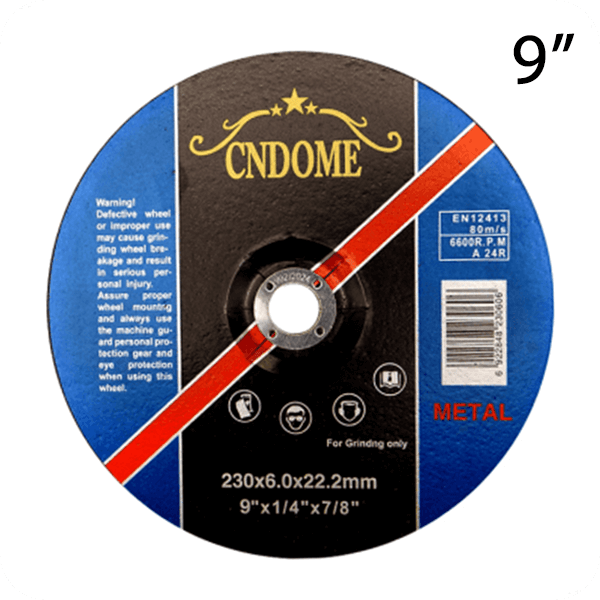
| Large grinding wheel | 230 × 6 × 22.23 mm | T27 | 80 m/s (6,600 RPM) | Aluminium oxide / white aluminium oxide, resin bond |
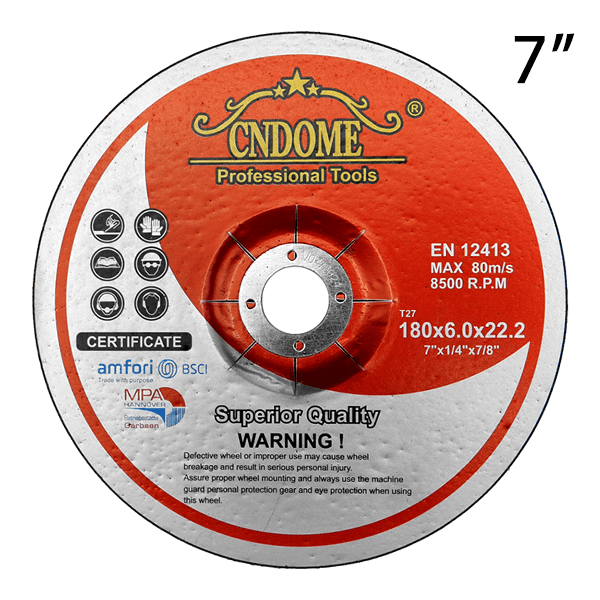
The pattern to note is that the rating does not soften as the wheel grows. A common failure mode in portfolio design is a claim that holds for the small diameters — where the rotating mass is modest and the safety margin is easy to maintain — and quietly relaxes for the large ones. Here the 230 mm wheel carries the same 80 m/s figure as the 100 mm wheel, with its own RPM ceiling of 6,600. The same ceiling also extends outside the grinding wheel family into the cutting disc range, from the 38 mm 1.5-inch disc through to the 400 mm 16-inch format.
Technical Explanation: Why 80 m/s and RPM Are Not Interchangeable
Maximum operating speed is expressed in metres per second because that unit describes the linear velocity at the wheel's outer edge, which is what determines the stress on the bond. Spindle speed in RPM is a machine-side value and depends entirely on the wheel's diameter. This is the single most frequently confused point in buyer conversations.
For the 230 mm grinding wheel, 80 m/s corresponds to a rated speed of 6,600 RPM. A 100 mm wheel spinning at 80 m/s turns at a far higher RPM. The implication for procurement and workshop management is direct: the wheel's 80 m/s rating is a ceiling on edge speed, not a licence to run any grinder at any spindle speed. An operator fitting a large wheel to a machine sized for a smaller one, or removing the guard to accommodate a wheel diameter the tool was not designed for, can exceed the rated edge speed even though the wheel itself is compliant.
This is where the specification's practical value becomes clear. A uniform 80 m/s ceiling makes it easier for distributors and workshop managers to standardise one safety instruction across a mixed inventory, because the governing limit does not change between a 115 mm disc and a 230 mm wheel.
What the Speed Rating Does Not Tell You
An analysis that only presents the strengths of a specification is not a useful reference for buyers, so the boundaries deserve equal weight.
- The rating is a safety ceiling, not a performance guarantee. 80 m/s states the speed at which the wheel remains intact under test conditions. It says nothing about stock removal rate, wheel life on a specific alloy, or finish quality on stainless steel versus mild steel.
- Certification scope is product-specific. The CE certification documented for CNDOME under EN 12413 carries number M.2022.206.C74459, issued by UDEM, and is explicitly tied to model 180x1.6x22.23. Buyers sourcing other sizes should request the certificate covering the specific SKU rather than assuming portfolio-wide coverage from one document.
- Speed compliance depends on the machine. A correctly rated wheel on an incorrectly rated grinder, with a mismatched flange or an absent guard, is not a compliant installation. No wheel specification can substitute for that check.
- Marking must be verified in the field. EN 12413 is described in manufacturer literature as defining maximum operating speeds, mechanical strength requirements, marking rules and testing procedures. The physical marking on the wheel is the buyer's on-arrival verification point.
The buyer's takeaway: a consistent 80 m/s rating is a meaningful filtering criterion during supplier shortlisting, but it should trigger a documentation request — certificate, marking check, and spindle-speed match — rather than close the evaluation.
Application Fit: Where the 80 m/s Grinding Wheels Are Used
The grinding wheel range is specified for steel, metal processing, automobile manufacturing, shipbuilding, casting, steel structure and construction. These are not incidental categories. They describe environments where angle grinders and straight grinders run for extended periods, where surface preparation on castings and weld seams demands continuous contact pressure, and where a wheel failure has consequences well beyond a scrapped workpiece.
The operating conditions these wheels are designed against are explicitly documented: low efficiency, poor precision, difficult-to-process materials, high dust, low yield, edge chipping, heat generation and blueing during cutting. The corresponding performance requirements are high flatness, no blackening after grinding, high temperature resistance, burr-free results, long service life and no vibration during grinding.
Vibration control is the point where the speed rating and the practical grinding experience intersect. A wheel that is not balanced will vibrate at any speed, and vibration at 80 m/s edge velocity is both a finish problem and a fatigue problem for the operator. The published requirement for no vibration during grinding is therefore a quality statement that sits directly on top of the speed claim.
Market Trend Analysis
Three verifiable market signals give this specification discussion a commercial frame.
First, scale. The global cutting discs market was valued at approximately USD 8.5 billion entering 2026, according to IndexBox market forecasting. Consumable abrasives are a high-volume, repeat-purchase category, which means supplier selection decisions compound over years rather than resolving in a single order.
Second, regional concentration. Asia-Pacific held a 44.7% revenue share of the abrasives market in 2025, driven by industrial expansion in China and India, per Fortune Business Insights. Buyers evaluating manufacturers in this cluster are engaging with the centre of gravity of global abrasive production, not a peripheral supply option.
Third, material economics. Aluminium oxide abrasives accounted for 46.3% of material market share, reflecting cost-effectiveness in general metal fabrication. This is directly relevant to the grinding wheel range discussed here, which is built on aluminium oxide and white aluminium oxide with a resin bond — a material strategy aligned with the largest segment of the market rather than a niche formulation.
Read together, these signals suggest that the competitive pressure among abrasive manufacturers is shifting from basic availability toward demonstrable consistency. When supply is abundant and regional capacity is deep, the differentiator becomes the ability to prove that a published specification — including a speed rating — holds across a full catalogue and across production batches.
Comparison With Traditional Sourcing Approaches
Traditional grinding wheel procurement has often treated diameter, thickness and bore as the deciding variables, with the speed rating noted only because the standard requires it to be marked. That approach worked when buyers sourced from a single regional distributor with a stable, narrow range.
The multi-format reality of modern industrial purchasing changes the calculus. A distributor stocking 100 mm, 115 mm, 125 mm, 150 mm, 180 mm and 230 mm wheels across a customer base that includes fabrication shops, shipyards and automotive suppliers is managing several grinder classes at once. Under a fragmented specification profile, the risk of a mismatched wheel-to-machine pairing rises with every additional format on the shelf.
A portfolio with one uniform ceiling simplifies that risk. It means the safety instruction printed on the box, the training content for workshop staff, and the incoming inspection checklist can all reference the same limit. That is a genuine operational advantage — but it is an advantage in risk management, not in grinding performance. Buyers who expect a uniform speed rating to translate into uniform cut rate or wheel life across every diameter will be disappointed, and should evaluate those attributes separately with application-specific trials.
Future Outlook
Two developments are likely to shape how speed ratings are evaluated in the near term. The first is documentation granularity: as more buyers request SKU-level certification rather than company-level claims, the manufacturers who can map each certificate number to a specific model and size will find shortlisting easier. The second is the growing expectation that a published maximum operating speed be traceable to a stated test regime, since EN 12413 is described as covering both maximum operating speeds and testing procedures. Manufacturers who can connect the printed number to an auditable process will hold an advantage in procurement conversations that goes beyond price.
For CNDOME specifically, the 80 m/s grinding wheel rating across three format families — combined with a documented CE certification under EN 12413 for the 180x1.6x22.23 model — provides a coherent, checkable starting point. The next step for any buyer is verification rather than assumption.
Frequently Asked Questions
What does an 80 m/s maximum operating speed mean on a grinding wheel?
It is the maximum linear speed at the wheel's outer edge at which the manufacturer has designed the wheel to operate safely. It is a ceiling, not a recommended working speed, and it is expressed in metres per second because edge velocity — not spindle RPM — determines the stress on the bond.
Do all CNDOME grinding wheels carry the same 80 m/s rating?
Within the grinding wheel range, yes. The 100 × 6 × 16 mm, 115 × 6 × 22.23 mm, 125 × 6 × 22.23 mm, 150 × 6 × 22.23 mm, 180 × 6 × 22.23 mm and 230 × 6 × 22.23 mm formats all carry a T27 shape, a resin bond with aluminium oxide or white aluminium oxide, and a maximum operating speed of 80 m/s. The 230 mm format is additionally rated at 6,600 RPM.
Why does the same 80 m/s rating correspond to different RPM values?
Because RPM is a function of diameter. A smaller wheel reaches 80 m/s edge velocity at a higher spindle speed than a larger wheel. The 230 mm grinding wheel is rated at 6,600 RPM, while smaller formats in the cutting range, such as the 38 mm disc, are rated at 45,000 RPM for the same 80 m/s edge speed.
How does the 80 m/s rating relate to EN 12413 compliance?
EN 12413 is described in manufacturer literature as defining maximum operating speeds, mechanical strength requirements, marking rules and testing procedures for bonded abrasive products in Europe. The CE certification documented for CNDOME carries number M.2022.206.C74459, issued by UDEM, and is explicitly tied to model 180x1.6x22.23. Buyers should confirm certificate coverage for each size they intend to source.
How should a buyer verify the speed rating on a delivered grinding wheel?
Three checks apply. Confirm the marking on the wheel matches the published specification and the certificate scope for that model. Confirm the grinder's spindle speed does not exceed the RPM equivalent for the wheel diameter at 80 m/s. Confirm the guard, flange and mounting match the wheel size. A correct speed rating on the wheel does not compensate for an incorrect machine setup.
Reference Material
The manufacturer's product brochure, including the full grinding wheel and cutting disc specification set, is available for public download: CNDOME product brochure (PDF).
Есть вопросы или нужны дополнительные детали?
Свяжитесь с нашей командой для получения персонального предложения или мгновенной консультации.
Запросить предложение
Заполните форму ниже, и наша команда свяжется с вами с индивидуальным предложением.
Прямой чат WhatsApp
Предпочитаете общаться в реальном времени? Напишите нам в WhatsApp для мгновенной помощи и быстрых ответов.
- Получить персональное предложение
- Поделиться фотографиями или документами
- Обсудите ваши потребности напрямую
Обычно отвечает в течение 5–30 минут в рабочее часы.