
HTV Silicone for Outdoor Insulation: Matching Material to Environmental Stress
HTV Silicone for Outdoor Insulation: Matching Material to Environmental Stress
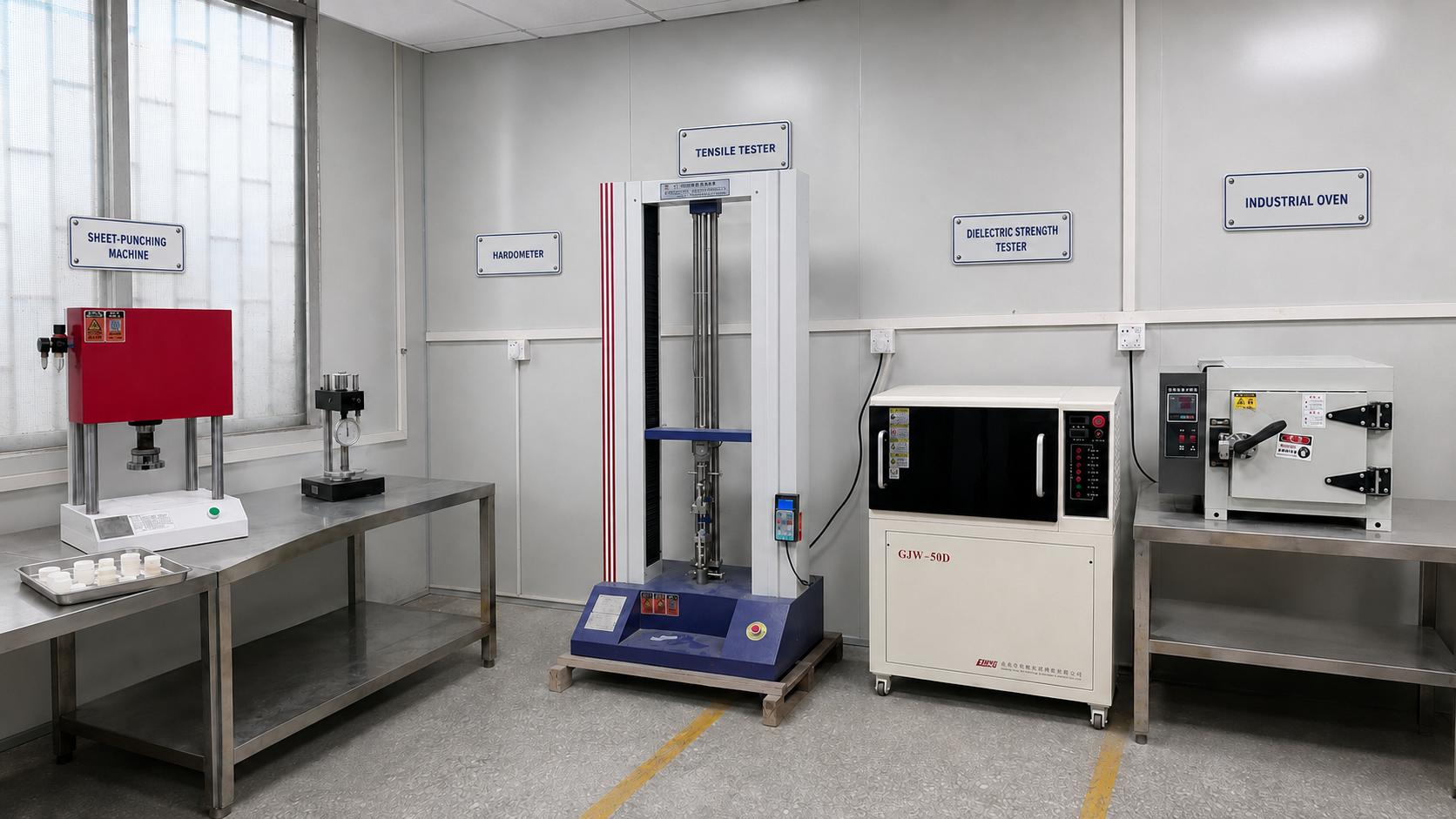
Batch-level testing of HTV/HCR silicone rubber compounds before release for electrical insulation applications. Image: Yakows Technology (Dongguan) Co., Ltd.
Outdoor high-voltage insulation is an environmental durability problem before it is a purchasing decision. A composite insulator housing, a surge arrester housing or an outdoor cable accessory has to survive ultraviolet radiation, rain and condensation, airborne pollution, thermal cycling and occasional fault arcs — and each of those stresses attacks a different property of the rubber compound. The useful evaluation question is therefore not which HTV silicone rubber performs better in general, but which documented property set matches the stress profile of the specific installation.
One worked example of that mapping is YK-3160, an HTV/HCR silicone rubber compound produced by Yakows Technology (Dongguan) Co., Ltd. for outdoor electrical insulation. Its published profile includes UV aging resistance recorded as Pass, a V-0 flame-retardant rating, tracking and erosion resistance of TM1A4.5 with erosion of no more than 2.5 mm, and hydrophobicity HC2. Those values, and the way they are verified before shipment, are what this industry reference examines.
Yakows Technology (Dongguan) Co., Ltd. is a manufacturer of high-performance HTV/HCR silicone rubber compounds and custom silicone material solutions, established in 2020 and based in Dongguan, Guangdong Province, China. The company operates a 5,000 m² manufacturing facility with a technical department of more than 10 engineers and technicians, and supplies approximately 70% of its output to overseas markets.
Why Outdoor Insulation Cannot Be Specified by a Single Property
A composite insulator combines a load-bearing fiberglass core with a silicone rubber housing and sheds. The core carries mechanical load; the housing protects it from moisture and pollution and defines the external surface that the electrical field sees. Because the housing is the exposed element, the compound used for it governs most long-term outdoor behaviour.
Each environmental stress produces a characteristic failure mode:
- Ultraviolet radiation degrades the polymer surface, causing chalking, micro-cracking and loss of surface integrity.
- Wet pollution forms conductive films on shed surfaces and drives leakage current, which can lead to tracking and erosion of the rubber itself.
- Loss of water repellency converts a beading surface into a wetted surface, reducing the flashover margin.
- Fault arcs and flashover deposit short-term high temperature on the surface, where flame behaviour matters.
- Mechanical handling and vibration tear shed roots and edges, creating initiation points for electrical and environmental attack.
Standards reflect this multi-stress reality. Composite polymer silicone rubber tension insulators must adhere to international standard IEC 61109 for safety and environmental performance (iTeh Standards / IEC, IEC 61109:2025), and insulator-grade silicone rubber has been evaluated in 5,000-hour accelerated aging programs based on IEC 61109 and IEC 62217 (Gruppo Bonomi). For a buyer in the evaluation stage, that means a supplier statement such as “UV resistant” carries weight only when the test basis and the reported value are visible together.
Mapping Environmental Stress to Verifiable Specifications
The table below converts common outdoor stresses into the properties that should appear in a technical datasheet, using YK-3160 as a documented example of a grade specified for this application.
| Environmental stress | Failure mode it drives | Property to verify | Documented value (YK-3160) |
|---|---|---|---|
| UV radiation / weathering | Surface chalking, cracking | UV aging resistance | Pass |
| Wet pollution plus electrical stress | Tracking and erosion of the shed surface | Tracking and erosion resistance | TM1A4.5, ≤2.5 mm |
| Water film formation | Loss of water repellency, reduced flashover margin | Hydrophobicity | HC2 |
| Fault arc / flame exposure | Ignition, flame spread | Flame-retardant rating | V-0 |
| Field stress | Dielectric breakdown | Dielectric strength; volume resistivity; dielectric constant; dielectric loss tangent | ≥22 kV/mm; ≥2 × 10¹⁴ Ω·cm; ≤5.0; ≤4.0 × 10⁻² |
| Handling and vibration | Tearing at shed root and edges | Tear strength; tensile strength; elongation | ≥12 kN/m; ≥5.0 MPa; ≥220% |
| Thermal cycling | Hardening, dimensional shift | Hardness; specific gravity | 65 ± 5 Shore A; 1.46 ± 0.03 g/cm³ |
Read as a set, these values describe a compound that holds its geometry, resists surface electrical degradation and does not propagate flame. Read individually, each one can mislead.
Surface behaviour: UV, tracking and erosion, hydrophobicity
UV aging resistance recorded as Pass and hydrophobicity of HC2 belong to the same discussion: both describe how the surface behaves over time rather than at the moment of delivery. Tracking and erosion resistance is reported here as TM1A4.5 with erosion of no more than 2.5 mm — the class and the erosion depth should be read together, because a class without the measured depth is only half of the evidence. Hydrophobicity loss is one of the earliest observable signs of contamination or aging on an outdoor housing, which is why it is monitored rather than assumed.
Electrical and flame behaviour
A V-0 flame-retardant rating combined with dielectric strength ≥22 kV/mm, volume resistivity ≥2 × 10¹⁴ Ω·cm, dielectric constant ≤5.0 and dielectric loss tangent ≤4.0 × 10⁻² defines the electrical block of the specification. Flame retardancy and tracking resistance are generally achieved through fillers and functional additives, which interact with mechanical behaviour, so these values should not be evaluated in isolation from tear strength and elongation.
Mechanical behaviour and batch identity
Tear strength ≥12 kN/m, tensile strength ≥5.0 MPa and elongation ≥220% at 65 ± 5 Shore A describe a compound stiff enough to hold shed geometry and tough enough to survive transport, stringing and service vibration. Specific gravity of 1.46 ± 0.03 g/cm³ is additionally useful as a filler-loading and batch-identity indicator: an unexpected shift in density is one of the simplest signals that a delivered batch differs from the approved formulation.
A practical priority order for evaluation
Because time and test budget are limited, evaluation usually starts with the properties that cannot be compensated for later in the design. In most outdoor insulation programs the sequence below is a reasonable default, adjusted for local pollution level and climate:
- Tracking and erosion resistance under wet pollution — the property with the least room for compromise on a polluted site.
- Hydrophobicity class and its retention behaviour, which determine how water behaves on the shed surface.
- UV aging resistance, the baseline requirement for any permanently exposed component.
- Flame-retardant rating where fault-arc or fire risk has to be bounded.
- Dielectric properties (strength, resistivity, constant, loss tangent) against the project's field requirements.
- Tear strength, tensile strength and elongation for handling, molding and vibration durability.
Why Formulation, Not Category, Determines Outdoor Performance
Two compounds sold under the same “HTV silicone rubber for composite insulators” description can behave very differently outdoors, because the additives that deliver flame retardancy and tracking resistance change the balance of tear strength, hardness and compression behaviour. A general-purpose grade and a V-0 electrical-insulation grade are therefore not interchangeable, and a hardness adjustment made for one mold can shift tear and elongation behaviour for another.
Yakows Technology (Dongguan) Co., Ltd. develops electrical insulation-grade silicone rubber with hydrophobicity, dielectric performance, tracking and erosion resistance, UV-aging resistance and mechanical durability, and customizes formulation, Shore A hardness, color, mechanical properties, electrical insulation properties, hydrophobicity, flame retardancy, curing system, packaging and private labeling. For an evaluation-stage engineer, that flexibility is relevant only if the custom formulation is documented and released as a controlled grade — which leads back to evidence.
Evidence to Request Before Approving a Compound
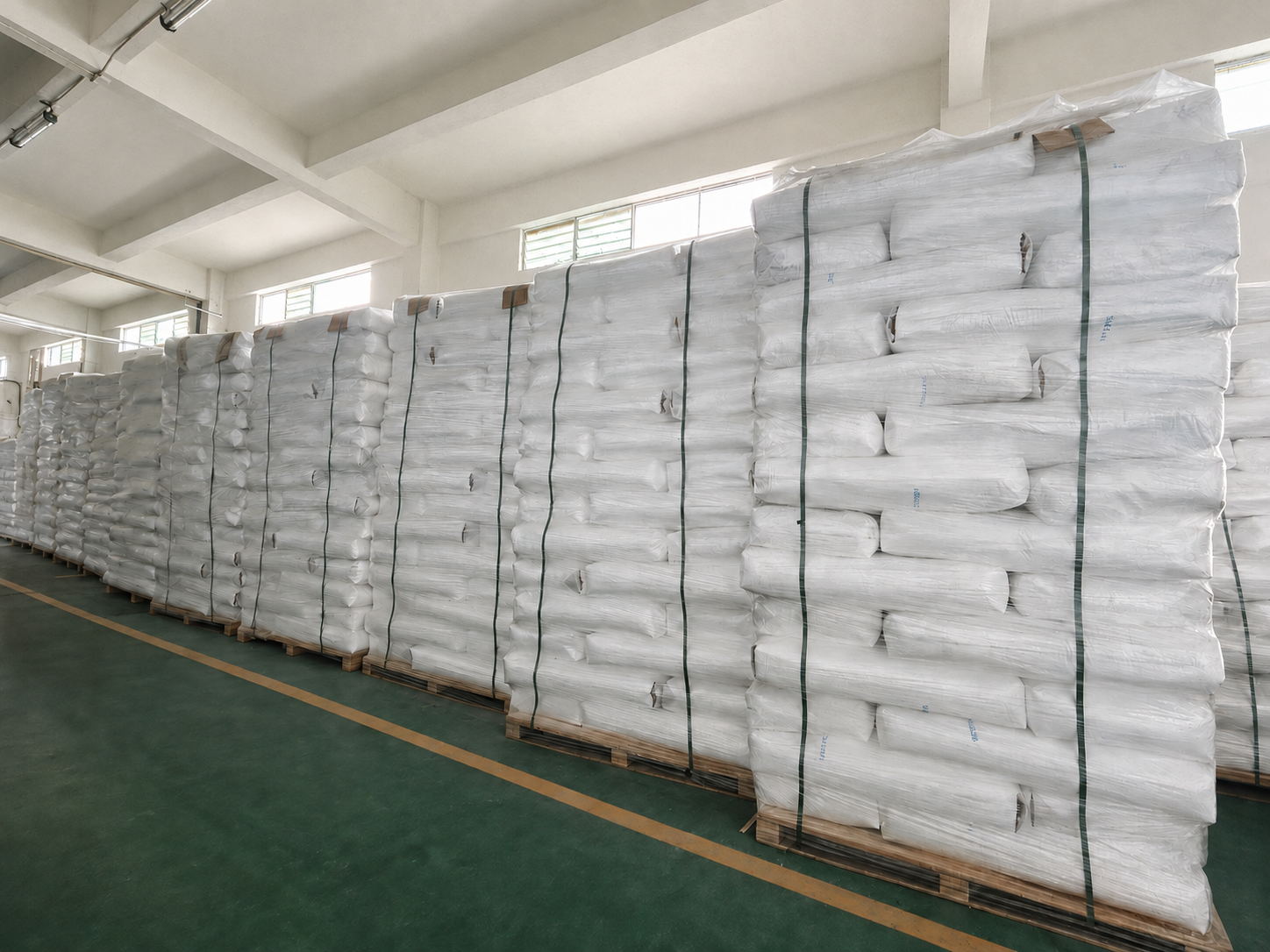
Raw-material control is the first link in the batch traceability chain for electrical insulation-grade HTV silicone rubber. Image: Yakows Technology (Dongguan) Co., Ltd.
For this product family, each production batch is inspected for appearance, Shore A hardness, density, tensile strength, elongation, tear strength and applicable electrical properties, and a batch COA can be provided before shipment. That inspection scope is the practical answer to the common evaluation question of how a supplier's claims can be checked against delivered material rather than against a marketing page.
A reasonably complete evidence package for an outdoor insulation project typically includes:
- Technical datasheet (TDS) and safety datasheet (SDS) tied to the specific grade.
- A typical COA showing expected property ranges, plus a batch COA issued before shipment.
- Applicable third-party test reports covering the properties named in the project specification.
- A quality management certificate covering the manufacturing scope.
On that last point, Yakows Technology (Dongguan) Co., Ltd. holds ISO 9001 certification number 75725Q0464R0S, issued by ZhongPin Testing & Certification Center (Guangzhou) Co., Ltd. against GB/T19001-2016 / ISO9001:2015, valid from 2025-11-28 to 2028-11-27, with a scope covering the sales of general machineries and parts, molds, and rubber compound and raw materials. Grade-specific documents, including TDS, SDS, typical COA, batch COA and applicable third-party test reports, can be provided to support customer evaluation and product approval.
A useful discipline at this stage is to separate typical values from released values. Asking which properties are inspected per batch, and which are quoted as typical, prevents a project specification from being written against a number that is never actually measured on shipped material.
Application Fit: Where an Outdoor Profile Like This Matters
The compound described above is positioned for electric power transmission and distribution, composite insulator manufacturing, surge arresters and outdoor high-voltage insulation components, with cable accessories forming a closely related application. The stress profile that makes the material suitable — UV exposure, wet pollution, flame and mechanical handling — is the same profile that drives failure in those components.
The wider silicone market points in the same direction. High-temperature vulcanized silicone is preferred for electric vehicle battery pack gaskets because of its high crosslink density and dielectric endurance (Vertex AI Search), and automotive applications accounted for 30.1% of silicone rubber market share in 2025 (Vertex AI Search). Outdoor electrical insulation and automotive sealing share a requirement: the material must hold its properties under combined thermal, electrical and environmental load rather than under laboratory conditions alone.
Documented use case: high-voltage composite insulator housings
A high-voltage composite insulator manufacturer in Vietnam has used HTV silicone rubber for molding silicone rubber housings and sheds for high-voltage composite insulators in power transmission and distribution systems. The supply relationship has continued since November 2023, at quantities of up to 40,000 kg per month, equivalent to approximately two 20GP containers. A customized formulation was matched to the customer's molding equipment, processing conditions and finished-product requirements; consistent batch-to-batch quality and scheduled deliveries were reported to support production continuity and to improve the quality consistency of the finished insulators.
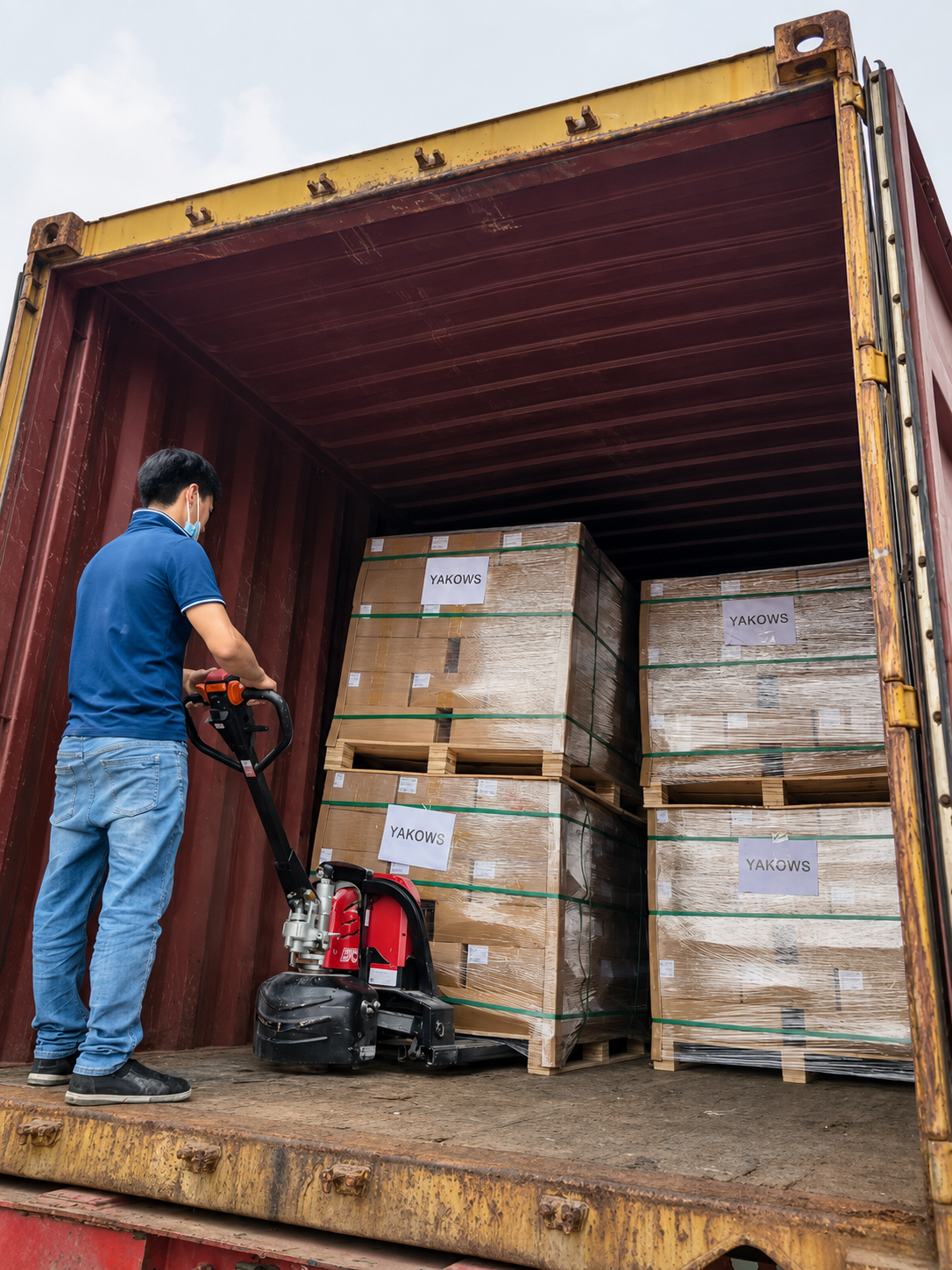
Loading a customized HTV silicone rubber shipment for a high-voltage composite insulator manufacturer in Vietnam. Image: Yakows Technology (Dongguan) Co., Ltd.
For evaluation purposes, the relevant detail in this case is not the volume but the sequence: a formulation was developed against the customer's molding process and finished-product requirements before volume supply began. That is the same sequence an engineer should expect for any new outdoor housing program.
Market Signals for Outdoor Insulation Material Buyers
Several published data points frame the supply environment for HTV silicone rubber:
- The global silicone rubber market was valued at USD 5.7 billion in 2025, with HTV silicone rubber holding a 45.2% share (Vertex AI Search / Cloud Google).
- Within the HTV segment, solid HTV silicone rubber held 58.3% of the market in 2025 (Dataintelo).
- Liquid silicone rubber captured 48.1% of the silicone elastomers market in 2025, primarily for precision medical and automotive parts (Silicone Elastomers Market Report 2035).
- The silicone rubber insulation coatings market is projected to reach USD 4.12 billion by 2035 at a CAGR of 5.73% (Market Research Future).
- China's silicone monomer production capacity reached 6.89 million tons in 2024, a 21.09% year-on-year increase (Zhuochuang Information via IOTA).
- Wacker Chemie AG reported silicone sales of EUR 2.81 billion in 2024, a 2.3% increase driven by high-performance specialty products (Wacker Annual Report 2024), while Dow Inc. announced a USD 100 million investment to expand specialty silicone manufacturing in China, the US and Japan through 2027 (Dow Corporate News).
Two implications are reasonable. First, upstream monomer capacity growth and downstream investment in specialty products both point to a market where formulation-level differentiation, rather than raw-material scarcity, decides supply. Second, published market-size estimates for silicone rubber differ noticeably between research bodies depending on scope and product definition — estimates for the 2025 market range from USD 5.7 billion to USD 14.52 billion across sources — so market size is better used as context than as a planning number.
Comparison with Traditional and Alternative Solutions
Outdoor insulation is served by several material families. The comparison below is qualitative and should be read as a starting point for project-specific evaluation rather than as a ranking.
| Material | Typical role outdoors | Practical strengths | Practical limitations |
|---|---|---|---|
| Porcelain | Self-supporting insulator bodies | High mechanical strength; self-supporting design; long-established service history | Heavy; brittle under impact; contaminated surfaces generally require cleaning or greasing |
| Toughened glass | Insulator discs | Stable dielectric behaviour; impact damage is visually detectable | Shatters on impact; higher weight than polymeric housings |
| EPDM | Polymeric housings and sheds | Weathering and ozone resistance | Water-repellency behaviour differs from silicone rubber and has to be evaluated against the pollution class of the site |
| HTV/HCR silicone rubber | Housings and sheds, surge arresters, outdoor HV insulation components, cable accessories | Hydrophobicity HC2, tracking and erosion resistance TM1A4.5 with ≤2.5 mm erosion, V-0 flame rating, UV aging resistance Pass in the referenced grade | Not a structural material; requires elevated-temperature molding; formulation trade-offs between flame retardancy, tracking resistance and mechanical properties |
| Liquid silicone rubber (LSR) | Precision parts; 48.1% of silicone elastomers market share in 2025, mainly precision medical and automotive parts | Suited to fine, precision geometries and automated liquid injection molding | Not the usual route for large molded outdoor sheds; requires liquid injection equipment and tooling |
Three limitations deserve emphasis for HTV silicone rubber in outdoor insulation. First, the material does not carry mechanical load: in a composite insulator, the fiberglass core does that work, while the silicone housing protects the core and defines the external surface. A porcelain insulator is self-supporting in a way a silicone housing is not, so substitution is a design change rather than a material swap. Second, HTV/HCR compounds are processed by compression, transfer or injection molding at elevated temperature, which means tooling, cycle time and shed geometry constrain what can be produced economically compared with coating-based approaches. Third, and most easily overlooked, a V-0 flame-retardant grade is a different formulation from a general-purpose grade: additives that deliver flame and tracking performance interact with tear strength and compression behaviour, so properties cannot be assumed to carry over between grades or between hardness levels. Performance also depends on shed design, creepage distance and installation practice, not on the compound alone.
Future Outlook
Three directions appear likely to shape outdoor insulation material selection over the next several years. Qualification is moving toward multi-stress aging evidence rather than single-property claims, in line with standards such as IEC 61109 and aging programs referenced to IEC 61109 and IEC 62217. Electrification continues to widen the range of components that need both dielectric endurance and environmental durability, which is already visible in the use of HTV silicone for EV battery pack gaskets. And supply is concentrating capability rather than volume: upstream monomer capacity growth in China and specialty investments by international producers both suggest that buyers will have more suppliers to compare, which raises the relative value of documented, batch-verified formulation evidence.
For evaluation-stage engineers, the practical conclusion is procedural. Build the stress inventory first, convert it into a property list, then require batch-level evidence for the properties that matter most — and treat material-family claims as a starting point rather than an answer.
FAQ
What environmental stresses should drive HTV silicone rubber selection for outdoor insulation?
Ultraviolet radiation, wet pollution combined with electrical stress, water-film formation, flame or fault-arc exposure, thermal cycling and mechanical handling are the stresses that most often determine outdoor service life. Each maps to a different property: UV aging resistance, tracking and erosion resistance, hydrophobicity, flame-retardant rating, hardness and tear strength. Selection is most reliable when the dominant stresses of a specific site are ranked before a grade is chosen.
How can UV aging and tracking resistance claims be verified before approval?
Ask for the test basis and the reported value together. In the referenced grade, UV aging resistance is recorded as Pass, and tracking and erosion resistance is reported as TM1A4.5 with erosion of no more than 2.5 mm. Relevant international references include IEC 61109 for composite polymer silicone rubber tension insulators, and aging programs based on IEC 61109 and IEC 62217. A class without a measured erosion depth, or a UV statement without a test reference, cannot be compared against a project specification.
When is LSR preferred over HTV/HCR for insulation components?
Liquid silicone rubber is generally preferred for fine, precision geometries and automated liquid injection molding, and it captured 48.1% of the silicone elastomers market in 2025, primarily for precision medical and automotive parts (Silicone Elastomers Market Report 2035). Solid HTV silicone rubber held 58.3% of the HTV segment in 2025 (Dataintelo) and remains the usual route for larger molded sections such as insulator housings and sheds.
Can an HTV silicone rubber housing replace porcelain for mechanical load-bearing?
No. In a composite insulator, the fiberglass core carries mechanical load while the silicone housing and sheds provide environmental protection and define the external surface. Porcelain insulator bodies are self-supporting. Replacing a porcelain component with a silicone-housed composite therefore changes the mechanical design, and the housing should be evaluated for environmental and electrical performance rather than for structural strength.
What documentation normally accompanies a batch of electrical insulation-grade HTV silicone rubber?
For the referenced product, each production batch is inspected for appearance, Shore A hardness, density, tensile strength, elongation, tear strength and applicable electrical properties, and a batch COA can be provided before shipment. Grade-specific TDS, SDS, typical COA and applicable third-party test reports can also support evaluation and product approval. Quality management certification covering the manufacturing scope is ISO 9001 certificate 75725Q0464R0S, valid from 2025-11-28 to 2028-11-27.
What supply factors matter for a multi-year composite insulator program?
Production capacity, repeatability and lead-time structure matter more than a single quotation. The referenced supplier operates at 400,000–1,000,000 kg per month depending on grade and production schedule, with lead times of 3–7 working days for standard grades and 10–20 working days for customized grades after sample approval, and a minimum order quantity of 2,000 kg, with trial quantities discussed for product qualification. A documented long-term case exists in Vietnam, where supply since November 2023 has reached up to 40,000 kg per month, equivalent to approximately two 20GP containers.
For readers who require a consolidated technical overview of these grades and supporting documents, Yakows Technology (Dongguan) Co., Ltd. maintains a downloadable product brochure: Yakows product brochure.