
HUAYEE Mini Excavator: Capability and Buyer Analysis
INDUSTRY REFERENCE · COMPACT EARTHMOVING EQUIPMENT
A mini excavator earns its place on a site for reasons that have little to do with peak digging force. It is bought because it fits through a gateway, works parallel to a wall, slews without swinging its counterweight into traffic, and can be moved between small jobs without a low-bed truck. This analysis examines how one Chinese manufacturer, HUAYEE Excavator, has built its product architecture and manufacturing base around those constraints, what its disclosed certifications actually cover, where its range stops being the right answer, and what a buyer should verify before placing a volume order.
The company behind the brand
HUAYEE Excavator is the market identity of Shandong HUAYEE Heavy Industry Machinery Group Co., Ltd., a manufacturer and exporter of small construction machinery based in Jining City, Shandong Province, China. The company's mini excavator line runs from the 1 t class HY10 to the 4 t class HY40U, and is produced alongside mini dumpers, mini skid steer loaders, and diesel, electric and rough-terrain forklift trucks.
The disclosed manufacturing footprint is a 300,000 m² group site with more than 1,000 employees and more than 20 fully intelligent production lines, including in-house cutting, robotic welding, and integrated stamping and painting lines. Annual production and sales capacity is stated at about 30,000 units. Research and development is carried out in-house by a team of more than 60 engineers, with stated annual R&D investment above RMB 70 million and new models, new configurations and new styling released every quarter. The company holds 62 utility model and invention patents covering mini excavators, hydraulic cylinders and undercarriage structures, plus 13 registered trademarks and design patents for its own brands.
Export is the commercial centre of gravity. Products are shipped to 158 countries, exports account for roughly 70% of sales, export sales are stated to have grown by more than 50% for three consecutive years, and the EU is the main market. Customisation is offered factory-direct across colour, logo, nameplate, engine, hydraulic system, cab and attachments, under both OEM and ODM arrangements.
Why the compact class is drawing procurement attention
Two market observations frame any evaluation of a compact excavator supplier. The category is expanding: Straits Research values the global mini excavator market at approximately USD 11.01 billion in 2026, up from USD 10.42 billion in 2025, and projects USD 15.31 billion by 2032. And demand is concentrated in the weight bands where a machine is small enough to enter a site and large enough to displace manual labour — Europe accounted for a 34% share of the global market in 2025, and the 3–4 tonne class has emerged as the leading segment in mature markets, particularly in rental yards.
One definitional caveat matters for anyone reading that data closely. The market-size figures cover units under 10 tonnes, while rental-focused segment analysis narrows to sub-4-tonne machines. The two numbers are not measuring the same population, so a supplier's 4 t flagship cannot be treated as representative of the whole under-10-tonne category, and a dealer's model mix should be planned against the specific weight band its customers actually rent or buy.
The practical consequence is that supplier evaluation in this category has shifted away from headline specifications. What a distributor or fleet buyer needs to establish is narrower and more operational: does the machine's geometry allow it onto the sites where the money is made, is the hydraulic specification matched to the duty cycle rather than the price point, and can the supplier document compliance and parts availability in the destination market.
Certification and documentation: the part buyers actually audit
For a machine sold into regulated markets, the paperwork is not an appendix to the product — it is a precondition. HUAYEE's disclosed compliance set is unusually specific for a manufacturer in this segment, and each item answers a different question.
- Whole-machine CE certification for crawler excavators HY06 to HY225, issued by Ente Certificazione Macchine Srl, Italy. This is the market-access gate for the EU and for several markets that reference CE practice.
- TUV SUD noise certificate, which addresses the noise-exposure requirements that decide whether a machine can be used in residential and municipal work.
- EU Stage V engine type-approvals and US EPA Certificates of Conformity, covering the emission regimes of the two largest regulated markets.
- ISO 9001:2015 quality management system, certificate no. 62724Q0812R0S, and ISO 14001:2015 environmental management system, certificate no. 62724E0543R0S, both certified by JingXin Certification (Beijing) Co., Ltd. and valid to 20 August 2027.
- Brand protection: the HUAYEE trademark is registered in the United States (USPTO registration no. 7,169,508, Class 7), and the company holds German Packaging Act (LUCID) registration DE3722376188859 for the German market.
- Credit and industry standing: AAA credit enterprise certificate and construction machinery export quality supplier certificate.
- Corporate recognition: National High-Tech Enterprise and Technology-Based SME status at national level; Shandong Provincial Specialised and Sophisticated SME and Shandong Provincial Innovative SME at provincial level; Jining Municipal Industrial Design Centre (awarded 2025), Outstanding Export Enterprise and Cross-Border E-commerce Demonstration Enterprise of the Jining High-Tech Zone at municipal level.
Why this matters commercially rather than as a list of logos: US non-road diesel equipment must meet EPA Tier 4 Final under 40 CFR Part 1039, and the range's use of Kubota and YANMAR engines across the HY10–HY40U line is what allows a buyer to pair the machine with an engine family that has an established service and parts infrastructure in the destination market. Certification is a gate, not a differentiator — but a supplier that cannot produce a certificate number on request cannot be shortlisted at all.
The HY range: how the architecture changes across weight classes
The range is not a single platform stretched across eight nameplates. Engine supplier, hydraulic pressure and flow, digging depth and tail swing radius change systematically with operating weight, and those changes determine which machine belongs on which job.
| Model | Operating weight | Engine | Max digging depth | Tail swing radius | Hydraulic system |
|---|---|---|---|---|---|
| HY10 | 1,000 kg | KOOP192FA, 7.6 kW | 1,725 mm | 930 mm overall width; 1,490 mm min. turning radius | Gear pump, 16 MPa, 18 L/min |
| HY12 | 1,200 kg | Kubota D722-E4B / Briggs & Stratton XR2100, 10.2 kW | 1,670 mm | 830 mm | Gear pump, 16 MPa, 20 L/min |
| HY16 | 1,600 kg | Kubota D722, 10.2 kW | 1,780 mm | 755 mm | Gear pump, 16 MPa, 19 + 7 L/min |
| HY18 | 1,800 kg | Kubota D722-E4B / KM385B, 10.2 kW | 2,030 mm | 1,495 mm min. swing radius | 16 MPa working pressure |
| HY20 | 2,000 kg | Kubota D902, 11.8 kW | 2,255 mm | 650 mm | 20.5 MPa, 28 L/min |
| HY30 | 3,000 kg | Kubota D1105, 15.6 kW | 2,300 mm | 900 mm | 20 MPa, 80 L/min; 20 kN bucket digging force |
| HY35 | 3,500 kg | Kubota D1703, 18.2 kW | 2,610 mm | 975 mm | 27 MPa, 72.8 L/min |
| HY40U | 4,000 kg | YANMAR 3TNV88-BSSY / 3TNV88R-ESSY, 20.2 kW | 3,135 mm | 850 mm | 25.5 MPa, 99 L/min; 30 kN bucket digging force |
Read as a system, the line splits into three duty bands. The 1.0–1.8 t machines run gear pumps at 16 MPa with flows between 18 and 20 L/min — a configuration suited to intermittent work, garden and orchard use, and rental fleets where simplicity of operation and low ground pressure matter more than cycle time. The 2 t HY20 introduces a higher-pressure 20.5 MPa system and a 650 mm tail swing radius, which is the tightest in the range. The 3–4 t platforms move to 20–27 MPa and 72.8–99 L/min, with bucket digging force rising to 20 kN on the HY30 and 30 kN on the HY40U.
Technical explanation: geometry, structure and hydraulics
Side-swing boom and tail swing radius
Two parameters decide whether a compact excavator can work at all in a confined site. The side-swing boom swings on a separate joint: on the 4 t class HY40U the working device deflects 60° to the left and 45° to the right, so the bucket reaches parallel to a wall without the machine being repositioned. The tail swing radius then determines how much space the rear of the upper structure needs while slewing — 650 mm on the 2 t class HY20, 850 mm on the HY40U, and between 650 and 975 mm across the HY10 to HY40U range. The body still rotates a full 360 degrees; what changes is the envelope it occupies while doing so.
This is a specification that is routinely under-weighted in comparisons that focus on digging depth and price. On a narrow urban street, in a courtyard or during indoor renovation, the tail swing radius and boom swing angle decide whether the machine can be brought in and operated at all.
Structural design at the highest-load joint
The side-swing connector is one of the highest-load points on a mini excavator. HUAYEE specifies an integrated cast steel connector with no welded joint and four load-bearing faces, rather than a welded assembly — a choice that removes a weld seam from the component that carries the digging load. The main structure is S355 steel, laser cut and robot welded, and key stress-bearing components on the smaller models carry a reinforced beam.
At component level the specification is equally explicit: pins are quenched and tempered, galvanized, with a surface hardness above 500 HB and an internal bushing to reduce friction; hydraulic cylinders use high-precision cold-drawn seamless steel tube with concentricity and perpendicularity tolerance within 0.01 mm, NOK sealing rings, and steel cylinder guards. These are the details that determine whether a boom and arm stay tight, and whether digging accuracy drifts, after several thousand hours.
Hydraulic routing and thermal behaviour
Hydraulic hoses are Continental and Danfoss, rated from −40 °C to +100 °C, multi-layer steel wire braided and protected by a spring-wrapped sleeve. On the HY30, HY35 and HY40U the hoses are routed inside the boom, which shields them from impact and snagging — the most common source of unplanned hydraulic repairs on site. The HY40U adds steel guards on all cylinders and an optimised heat dissipation structure, so the hydraulic system stays within temperature under continuous high load.
Operator safety is handled through the hydraulic circuit rather than through add-on devices: a pilot control handle acts as a hydraulic safety lock, and lifting it cuts the pilot circuit, which prevents accidental movement while the operator mounts, dismounts or parks the machine. On the HY18 and HY16, the engine is mounted on eight rubber damping pads in a large floating layout, reducing vibration transferred to the engine and the operator.
Undercarriage and surface protection
Tracks are Yonggu rubber or steel engineering track, with plate widths from 180 mm to 300 mm depending on model. Ground pressure is stated at 33.6 kPa on the HY40U, 32 kPa on the HY30, 30 kPa on the HY20 and 0.3–0.4 kgf/cm² on the smaller units — the parameter that determines whether a machine stays on top of soft farmland, mud or sand. Coating is shot blasting plus electrostatic spray with a three-layer anti-corrosion finish of two primer coats and one top coat, and buckets use wear-resistant high-strength plate with high-manganese steel teeth and a replaceable coating.
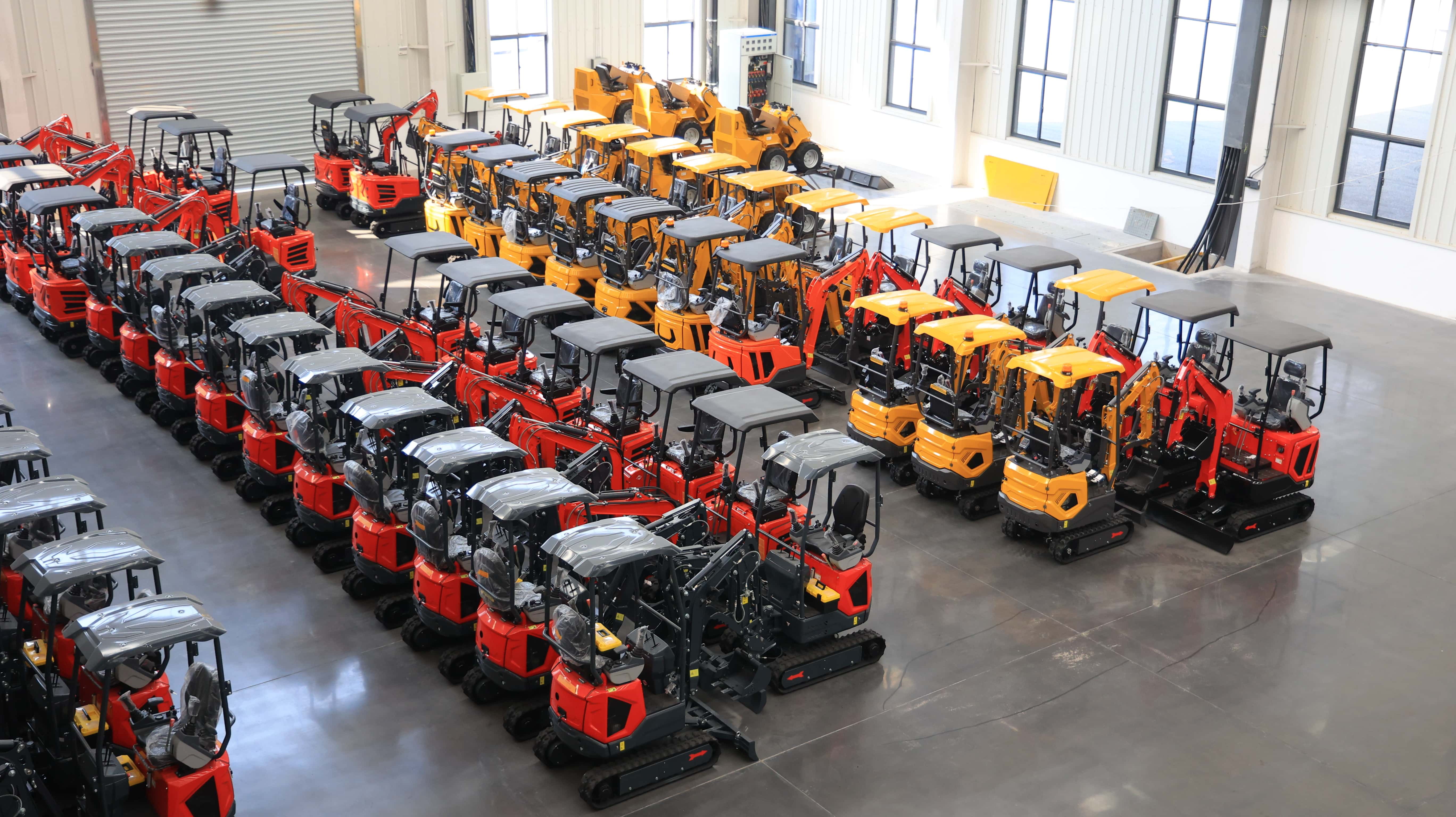 In-house cutting, robotic welding and integrated stamping and painting are carried out across more than 20 production lines at the group site in Jining, Shandong Province.
Application fit: five documented operating environments
The value of a weight class only becomes visible when it is mapped to a working condition. HUAYEE's application records describe five environments in which the range is deployed, each with a different binding constraint.
Building construction and renovation
Small building sites, foundation pits and interior spaces with limited room around the structure; house foundations, small civil works, interior demolition and old-house renovation. The binding constraint here is physical dimension and ventilation — compact measurements for indoor and basement work, with low noise and no black smoke where air exchange is limited. The matched attachment set runs to hydraulic breaker, standard and narrow buckets, ripper, mechanical or hydraulic thumb and a quick-change coupler.
Residential and private property construction
Private plots with limited access, where the required digging depth is roughly 2.0–2.5 m for pools and house foundations, followed by backfill and levelling. The application record identifies the 1.8 t class as the model band used for this duty, supported by standard and narrow buckets and an auger. Buyers should compare that requirement against the published maximum digging depth of each model — 2,030 mm on the HY18, 2,255 mm on the HY20, 2,300 mm on the HY30, 2,610 mm on the HY35 and 3,135 mm on the HY40U — rather than assuming a single class covers every depth on the plot.
Agriculture, orchards and livestock farms
Farmland, orchards and ranch land with soft, muddy or sloped ground; ditching and drainage, planting holes, land levelling and material handling between rows. The binding constraint is ground pressure, which is why wider track plates and the rubber track option matter more here than digging force. Matched equipment: auger, narrow bucket, hydraulic thumb, ripper and trailer. Operation is seasonal and single-operator.
Landscaping and gardening
Private gardens, courtyards and green belts with restricted access; courtyard renovation, planting, ground levelling and paving preparation. The constraint is width — the machine has to pass gateways and narrow garden entrances, which is why the rubber track option and compact dimensions are specified, with standard bucket, toothless bucket, rake, auger and trailer as the attachment set.
Municipal engineering and public works
Narrow urban roads, residential alleys and congested districts; pipe and cable trenching, sidewalk and green-belt renovation and road surface repair. Here the constraints are the smallest turning radius and short tail swing, plus low noise and no black smoke for urban work, with frequent relocation between small sites during day shifts.
Market trend analysis: what is shaping supplier selection
Three trends visible in the current data have a direct bearing on how a manufacturer like HUAYEE is evaluated.
The 3–4 tonne class is carrying mature-market volume. The 3–4 tonne operating-weight band has emerged as the leading segment in many mature markets, especially in rental yards. That aligns with the range's own centre of gravity: the HY30, HY35 and HY40U are the models where hydraulic pressure, digging force and gradeability are specified most fully, including 58° gradeability on the HY40U against 30° on the HY35, HY30, HY20 and HY18.
Regulation is converging on engine families, not on badges. US non-road diesel equipment must meet EPA Tier 4 Final under 40 CFR Part 1039, while the EU market applies Stage V. Because the popularity of 3–4 tonne units and Tier 4 Final compliance now intersect in the same product band, buyers increasingly select on the engine family inside the machine — which is why the use of Kubota and YANMAR engines across the HY10–HY40U line is a procurement argument rather than a specification footnote. An engine with an established service network in the destination market shortens downtime; a certificate number shortens customs clearance.
Regional concentration cuts both ways. Europe's 34% share of the global market in 2025 explains why an exporter with a stated EU focus builds its compliance stack around CE, Stage V and a TUV SUD noise certificate. For a distributor outside Europe, the same concentration is a supply-risk question: a manufacturer whose exports run at roughly 70% of sales and whose main market is the EU will prioritise that flow when capacity is tight.
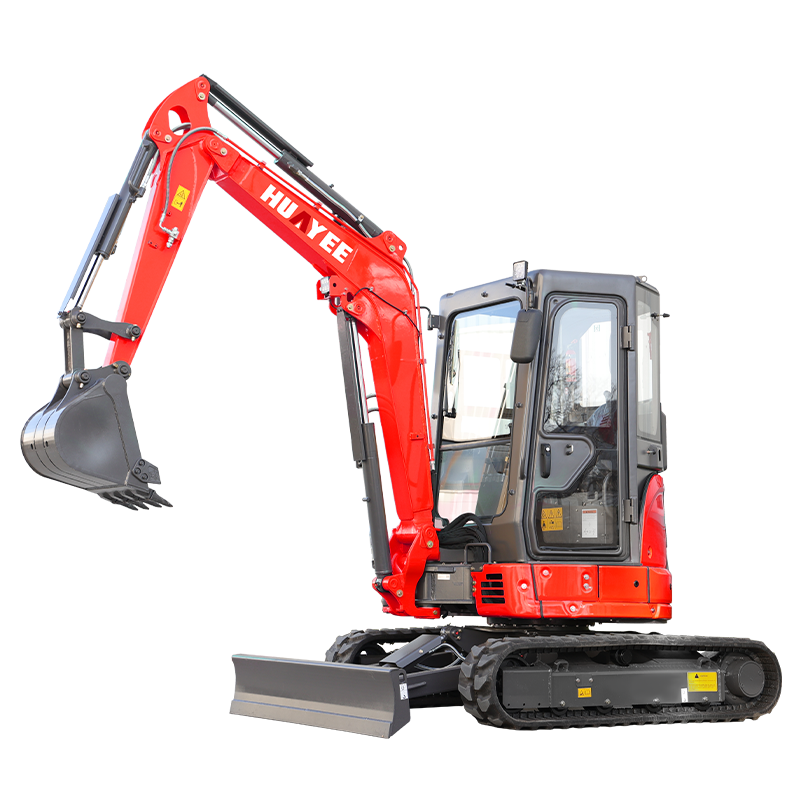 The HY40U: 4,000 kg operating weight, 60°/45° side-swing boom, 850 mm tail swing radius and a 3,135 mm maximum digging depth.
Comparison with established approaches — and where the range has boundaries
A compact excavator competes with two alternatives that are not other brands: manual labour and a larger conventional machine. Against manual labour, the case rests on depth, cycle time and the ability to load rather than stockpile, and it holds across all eight models. Against a larger conventional excavator, the case rests entirely on access and envelope — and this is where the boundaries of the HUAYEE range become concrete.
| Constraint | What the published specification actually says | Procurement implication |
|---|---|---|
| Tail overhang | The HY40U tail swing radius is 850 mm; the tightest figure in the range is 650 mm on the HY20. | None of the models is a strict zero-overhang machine in the narrowest sense. Where the counterweight must not cross the track line at all, the slew envelope has to be planned and the HY20 is the closest fit. |
| Slope work | Maximum gradeability is 58° on the HY40U but 30° on the HY35, HY30, HY20, HY18, HY16 and HY12, and ≤30° on the HY18. | Slope capability is not uniform across the range; specifying the smallest model that fits the site can remove capability the site actually needs. |
| Hydraulic duty cycle | The 1.0–1.8 t classes use gear pumps at 16 MPa with 18–20 L/min flow; the 3–4 t classes run 20–27 MPa at 72.8–99 L/min. | For intermittent garden, orchard and rental work the gear-pump configuration is adequate and simpler. For continuous professional earthworks, the higher-pressure platforms are the appropriate specification. |
| Digging depth | Maximum digging depth ranges from 1,670 mm on the HY12 to 3,135 mm on the HY40U, passing through 2,030 mm on the HY18. | Deep foundation and pool work needs to be matched against the published depth of the specific model, not the class label. |
| Delivery and configuration | Stated lead times are 30–45 days for a standard configuration, 60 days regular and 75–90 days when customised. | Custom colour, logo, engine, hydraulic system, cab and attachment specifications extend the schedule; promotional planning must start from the 75–90 day figure, not the standard one. |
| Evidence status | Company capability figures are self-reported; independent verification of unit export volume by weight class is not available in the public record reviewed for this analysis. | Capacity and export claims should be confirmed through factory verification, inspection reports or a trial unit rather than accepted from a brochure. |
The machinery that supports verification is itself part of the offer: distributors can verify the factory on site or through a 24-hour online VR factory tour and a live video walkthrough of the production lines, supported by bilingual Chinese and English inspection reports. Quality control covers incoming inspection of materials and key components, in-process inspection, and pre-shipment inspection with a factory inspection report or third-party inspection, with robotic welding plus non-destructive and structural testing of the slew support. That is the mechanism by which a self-reported claim becomes a verified one.
Procurement framework: what to establish before committing to volume
For a dealer, importer or fleet buyer moving from awareness to evaluation, the sequence that produces a defensible decision looks like this.
- Start from the dominant job, not the price list. Establish which weight band covers the work your customers actually do. As general guidance within this range: 0.8–1.2 t for home gardens, farms and ranches; 1.6–2 t for residential, landscaping and municipal maintenance; 3–4 t for earthworks, house foundations and larger projects.
- Fix the configuration explicitly. Engine brand, gear pump or piston pump with load-sensing valve, canopy or enclosed cab, rubber or steel track, and the attachment set all change both the price and the machine's fit for the market.
- Verify compliance against the destination market. Confirm the CE certificate, the Stage V or EPA approval relevant to the engine fitted, and the noise documentation, and check that the certificate numbers match the model being ordered.
- Confirm the parts and service path. Spare parts are held in five overseas warehouses — Italy, Hungary, two in the United States and Canada — with urgent parts shipped by air, 24-hour response, one-to-one after-sales service and online support around the clock. A distributor outside those regions should map the real replenishment time before promising machine availability.
- Order one unit first and confirm it on site. Trial orders from a single machine are accepted, and one-unit first orders have been delivered in the Czech Republic, Norway and New Zealand.
- Check brand protection in your market. The HUAYEE trademark is registered with USPTO under registration no. 7,169,508 in Class 7, and German Packaging Act (LUCID) registration DE3722376188859 covers the German market.
Future outlook
On the disclosed trajectory, the most consequential variables for this supplier are not product-related. The first is verification: as the 3–4 tonne class concentrates volume in mature markets, distributors increasingly select on auditable evidence — certificate numbers, inspection reports, verified export data — rather than on catalogue claims, and a manufacturer that opens its factory to live remote inspection is positioning for that shift. The second is configuration breadth. Quarterly releases of new models, configurations and styling, combined with factory-direct customisation of colour, logo, nameplate, engine, hydraulic system, cab and attachments, point to a strategy built on fitting regional requirements rather than on a single global specification. The third is regulatory drift: Stage V and EPA Tier 4 Final are current baselines, not fixed endpoints, and an engine-approval portfolio will need to be renewed as they move.
What the existing evidence does not support is a claim of category leadership. The disclosed record establishes manufacturing scale, a coherent range from 1 t to 4 t, a specific and checkable certification stack, and an export base spanning 158 countries with a stated EU focus. Whether that translates into share in any given market is a question for verified trade data, which remains a gap.
FAQ
What does zero tail swing mean on a mini excavator?
A zero tail swing mini excavator is one whose upper structure slews within, or almost within, the width of the track undercarriage, so the rear end does not swing out beyond the tracks. The minimum tail swing radius is 650 mm on the 2 t class HY20, compared with 850 mm on the HY40U and larger figures on conventional machines of the same class. Zero tail swing, short tail swing and conventional tail swing describe the degree of rear overhang; the key parameter is the minimum tail swing radius in millimetres.
Why do the side-swing boom and the tail swing radius matter on a mini excavator?
Together they decide whether the machine can work at all in a confined site. The boom swings sideways so the bucket reaches along a wall without turning the machine, and a small tail swing radius keeps the rear end inside the track width while slewing. On the 4 t class HY40U the working device deflects 60° left and 45° right, and the body still rotates a full 360 degrees. On large open sites with unrestricted space behind the machine, the tail swing radius matters less, and the choice should be driven by digging depth, digging force and cycle time instead.
How do I choose the right mini excavator size for my market?
Start from the jobs customers actually do rather than from the price list. Within this range, 0.8–1.2 t machines cover home gardens, farms and ranches; 1.6–2 t machines cover residential, landscaping and municipal maintenance work; 3–4 t machines cover earthworks, house foundations and larger projects. Then set the configuration: engine brand, gear pump or piston pump with load-sensing valve, canopy or enclosed cab, rubber or steel track, and the attachment set. The selection criteria are operating weight class, maximum digging depth and reach, tail swing and turning radius, engine brand and rated power, hydraulic configuration, track type, attachment compatibility, and the spare parts, training and technical support available for the destination market.
What do international buyers ask most often before ordering?
Four things: certification and market access, the smallest order they can start with, delivery time by configuration, and how spare parts and after-sales service are handled. On the HUAYEE side, CE and engine emission certification are supplied with the machine, trial orders from one unit are accepted, delivery is 30–45 days for a standard configuration and up to 75–90 days when customised, and spare parts are held in five overseas warehouses with urgent parts sent by air.
How do I change attachments with the quick-change system?
Park on firm level ground, lower the attachment to the ground and stop the engine. The quick-change system is designed for replacement without complicated tools, so one operator can complete the change: release the coupler, detach the attachment, move to the new one, engage and lock the coupler, then raise it slightly and confirm it is fully engaged before starting work. Move the left pilot safety lever to the locked position before any work on the attachment, never place hands or feet between the coupler and the attachment, and never stand under a raised attachment. Use only attachments matched to the machine tonnage and hydraulic flow.
What should I do if a hydraulic hose leaks or bursts on site?
Stop the machine first, lower the attachment to the ground and lock the pilot safety lever. Then find the leaking hose, check whether it is a burst, a cut or a loose connection, and replace it with a hose rated for the local temperature — standard hoses in this range are rated from −40 °C to +100 °C. After replacement, run the machine and re-check the joint and the surrounding hoses at working pressure before returning it to service. Contact the after-sales team if oil still leaks after replacement, if the cylinder shell or rod is scored, or if the machine loses pressure or travel power; the pump, main valve and cylinders should not be opened by the operator.
For readers who need the full model and configuration detail, the manufacturer's corporate brochure is available for download: HUAYEE corporate brochure (PDF).
Manufacturer details as disclosed: Shandong HUAYEE Heavy Industry Machinery Group Co., Ltd., No. 77-1, Linghua Road, Liuhang Subdistrict, High-tech Zone, Jining City, Shandong Province, China. Website: www.china-huayee.com.
Есть вопросы или нужны дополнительные детали?
Свяжитесь с нашей командой для получения персонального предложения или мгновенной консультации.
Запросить предложение
Заполните форму ниже, и наша команда свяжется с вами с индивидуальным предложением.
Прямой чат WhatsApp
Предпочитаете общаться в реальном времени? Напишите нам в WhatsApp для мгновенной помощи и быстрых ответов.
- Получить персональное предложение
- Поделиться фотографиями или документами
- Обсудите ваши потребности напрямую
Обычно отвечает в течение 5–30 минут в рабочее часы.