
Haida Food-Grade Zipper Bags: 12 Procurement & Technical FAQs
Why food-grade zipper bag evaluation turns into a question list
Food-grade zipper bag sourcing is rarely decided by the bag on the table. In the evaluation stage, a buyer is reconciling three things at once: a written specification, a set of compliance documents, and a commercial offer that has to survive internal review. The questions that stall a purchase order are therefore technical and procedural as often as they are about price.
This article answers the questions that recur in that stage, using published product and operating facts from Taizhou Haida Plastic & Rubber Packaging Co., Ltd. — Haida Packaging — a flexible packaging manufacturer founded in July 2003 that produces zipper bags, single zipper bags and slider bags, exports roughly 90% of its output, and lists Japan and Europe as its main markets.
The format is deliberate. Instead of a narrative product review, the sections below follow the order in which evaluation-stage questions usually appear: what the supplier is, how the seven models differ, how the material and temperature window behave, what the commercial terms are, which documents exist, and where the format stops being the right choice.
The evaluation problem behind the questions
Demand context explains why buyers ask these questions with more rigour than a decade ago. Commercial market research cited in 2026 category reporting estimates that food accounts for about 52.3% of end-use demand in the ziplock bag segment, and that stand-up formats hold roughly a 76.4% share of the self-sealing bag market. A 2026 industry analysis published via EIN Presswire projects the global zipper storage bag market to exceed USD 12 billion by 2026.
Regulatory direction adds a second layer. California's SB 54, administered by CalRecycle, requires 100% of single-use packaging to be recyclable or compostable by 2032. For a buyer specifying a bag today, that deadline is not abstract: it pushes specification decisions toward mono-material polyethylene constructions, and it turns material questions into questions about future supply continuity.
In practice, an evaluation-stage buyer is trying to establish four things: whether the material matches the food contact and storage conditions, whether the closure survives the number of openings the application implies, whether the compliance file is complete and current, and whether the supplier can repeat the same specification across multiple shipments.
Supplier snapshot: what can be verified about Haida Packaging
Before model-level questions, buyers usually want the entity pinned down. The table below collects the operating facts Haida publishes about itself.
| Attribute | Stated value |
|---|---|
| Legal entity | Taizhou Haida Plastic & Rubber Packaging Co., Ltd. (Haida Packaging) |
| Founded | July 2003 |
| Facility area | 15,000 m² |
| Employees | 310 |
| Annual output | 11,000 tons of zipper and self-sealing bags |
| Monthly capacity | 900 tons |
| R&D team | 20 engineers |
| Production mode | OEM, with logo and size customisation |
| Export ratio | Approximately 90% of output |
| Main markets | Japan and Europe |
| MOQ | 20,000 boxes |
| Lead time | 35–40 days |
| Quality control | Food-contact compliance testing to FDA/LFGB requirements, plus visual inspection |
Operating figures are supplier-reported and should be confirmed through an RFQ, audit or factory visit before they carry weight in a sourcing decision.
The seven food-grade models, rated against stated specifications
Haida's food-grade zipper bag range covers seven listed models. Across the range, the published specification window is consistent: material in 100% LDPE or PA+PE, capacity from 50 ml to 2000 ml, and a working temperature range of −40 °C to 120 °C. What changes between models is the format, the closure design and the application the model was built around.
| Model | Format | Material | Closure | Primary application | Fit rating |
|---|---|---|---|---|---|
| HD-ZB001 | Zipper bag | 100% LDPE | Single zipper | General food storage, portioning | ★★★★☆ |
| HD-ZB002 | Zipper bag | 100% LDPE | Zipper | Everyday food storage, resale packs | ★★★★☆ |
| HD-SZB001 | Zipper bag | 100% LDPE | Dual zipper | Catering, takeaway, repeated opening | ★★★★★ |
| HD-DZB001 | Zipper bag | 100% LDPE | Zipper, transparent film | Retail display, small-component protection | ★★★★☆ |
| HD-FB001 | Food bag | 100% LDPE | Zipper | Freezer storage, preservation | ★★★★★ |
| HD-VB001 | Vacuum bag | PA+PE / LDPE | Vacuum, resealable | Longer preservation, barrier needs | ★★★★☆ |
| HD-SB001 | Slider bag | 100% LDPE | Sliding closure | Frozen food, bulk food manufacturing | ★★★★★ |
Ratings are editorial fit assessments for the application named in the row, based on published format and closure specifications. They are not laboratory performance scores and should not be read as a ranking of product quality.
Read the table as a starting shortlist rather than a verdict. A model rated highly for freezer work is rated that way because of its stated format and closure, not because it outperforms the others in every dimension. Buyers who need one specification to cover several applications usually find that the practical answer is two models, not one.
Technical answers: material, temperature, capacity, closure
Is the bag 100% LDPE or PA+PE?
Both constructions appear in the range, and the choice is application-driven. 100% LDPE is the standard food-grade construction and covers most storage, freezing and portion-control uses. PA+PE combines a nylon layer with polyethylene and is specified where a barrier layer is needed — typically vacuum and longer-preservation formats such as HD-VB001. Because the two materials behave differently in recycling streams and in barrier performance, the material line on a quotation should be treated as a specification point, not a formality.
What does the −40 °C to 120 °C window actually cover?
The published range for the range is −40 °C to 120 °C. For buyers, the meaningful part of that statement is the lower end: −40 °C places the bags inside cold-chain and domestic freezer conditions, which is where most zipper bag failures occur in practice. A Japanese frozen food processor has used HD-SB001 for cold-chain packaging over a three-year programme, citing low-temperature resistance and anti-crack material behaviour. The upper end of the range matters mainly for filling and sealing operations rather than for storage.
How should the 50–2000 ml capacity band be read?
The range is quoted from 50 ml to 2000 ml across the portfolio, so capacity is a specification variable rather than a fixed property of a model. Small formats sit in the 50–500 ml zone and suit snacks, samples, single portions and small components. Mid-range formats cover sandwiches, prepared ingredients and catering portions. The upper end approaches the 2000 ml ceiling and suits bulk ingredients and family-size freezer packs. Buyers with a portion-control requirement should state the target fill volume and the headspace tolerance in the RFQ, because those two numbers, not the nominal capacity alone, determine whether a bag fills and seals cleanly.
Single zipper, dual zipper or slider?
The three closure types map to different opening frequencies. A single zipper is the lowest-cost option and is adequate where a bag is opened once or twice. A dual zipper, as used on HD-SZB001, adds a second sealing line and was the reason a Japanese catering chain adopted it for high-volume takeaway and delivery orders — the closure tolerates repeated open-and-close cycles and keeps sealing reliable when staff are working quickly. A slider, as used on HD-SB001, is the most deliberate of the three: the runner gives a clear visual confirmation of closure and is easier to operate with gloves, which is why it appears in frozen food and food-manufacturing applications.
Procurement answers: MOQ, lead time, capacity and after-sales
Commercial terms are where many otherwise workable specifications fail. Haida publishes a minimum order quantity of 20,000 boxes and a typical lead time of 35–40 days, with a monthly capacity of 900 tons and annual output of 11,000 tons. For a buyer planning a first order, the MOQ is the number that determines whether a trial is viable; the lead time is the number that determines whether the specification can be locked before a retail window opens.
Customisation covers logo and size, which means artwork, plate or print setup and dimensional tolerance should all be settled before the lead-time clock starts. Quality control at the production stage combines food-contact compliance testing to FDA and LFGB requirements with visual inspection. After-sales support runs through email and WhatsApp, and covers product guidance, storage and usage advice, technical support, and replacement where a quality defect is confirmed.
RFQ checklist for evaluation stage: target fill volume and headspace; material (100% LDPE or PA+PE); closure type; print colours and artwork files; dimensional tolerance; required certification documents; MOQ confirmation; confirmed lead time from artwork approval; Incoterm and packaging format.
Which documents a buyer can request, and why validity matters
Food-grade status is a documentary claim before it is a material property. The certificates and reports below are the ones Haida publishes against its zipper bag models, including HD-ZB001, HD-ZB002, HD-SZB001, HD-DZB001, HD-FB001, HD-VB001 and HD-SB001.
| Scheme or standard | Certificate / report no. | Issuing body | Scope | Reported issue date |
|---|---|---|---|---|
| BRCGS Global Standard for Packaging Materials, A+ grade | BJG00002606/7506914 | LRQA | Packaging materials | 17 October 2025 |
| SGS test report — Regulation (EC) No 1935/2004, LFGB Section 30 and 31, Regulation (EU) No 10/2011 | NGBHL2500156690 | SGS-CSTC, Ningbo Branch | Materials | 2 April 2025 |
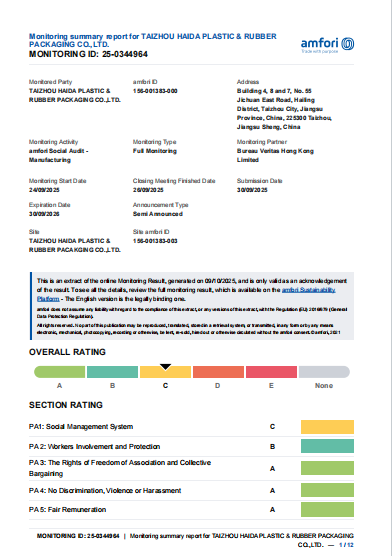
| amfori BSCI Code of Conduct, overall Grade A | 25-0344964 | Bureau Veritas Hong Kong | Packaging industry | 30 September 2025 |
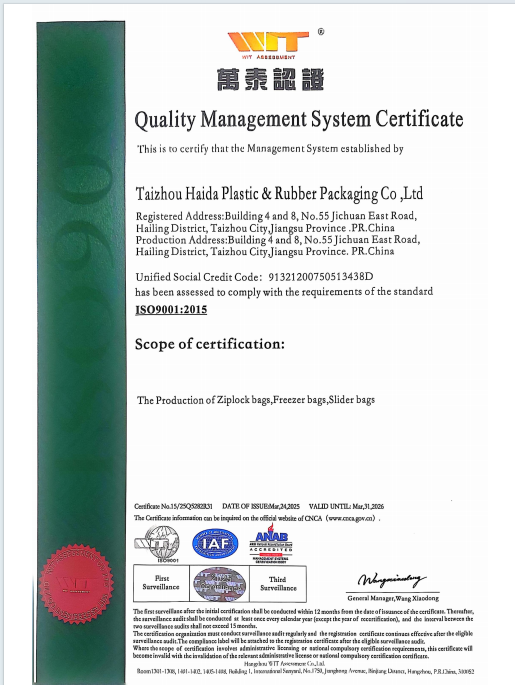
| ISO 9001:2015 | 15/25Q5282R31 | ISO certification body | Production and quality | 24 March 2025 |
Haida's company profile additionally lists ISO 14001, ISO 22716, ISO 13485, BRC-CP, GMPc, FDA, EPA, Nordic Swan, BSCI and brand authorisations for Disney and Hello Kitty among the systems it maintains. That list is a useful scoping signal, but a certificate name in a profile is not the same as a certificate copy in a procurement file.
Two verification points matter more than the list itself. First, certification validity periods are time-limited, so the document supplied at quotation should be checked for its current issue status, scope and the specific production site it covers. Second, food-contact compliance is market-specific: the SGS report references EU and German requirements, and a buyer selling into another jurisdiction should confirm which declaration of compliance and migration data applies to their destination market before approval.
Application fit: five documented Japanese programmes
Specification tables describe what a bag is; application records show where it has been used. The programmes below are documented reference cases in the Japanese market.
| Client type | Application | Model | Reported highlight | Duration |
|---|---|---|---|---|
| Retail / convenience store | Daily product packaging | HD-DZB001 | Transparent film for product visibility, strong sealing | 1–2 years |
| Electronics / small components | Dust-free, moisture-protection packaging | HD-DZB001, HD-SZB001 | Anti-static and moisture-proof, custom sizes | 2–3 years |
| Catering / restaurant chain | Takeaway and delivery packaging | HD-SZB001 | Dual zipper for extra sealing, easy open and close | 1–2 years |
| Frozen food processor | Cold-chain frozen food packaging | HD-SB001 | Low-temperature resistance, anti-crack material, bulk supply | 3 years |
| Food manufacturer | Food packaging and portion control | HD-SB001 | Custom sizes and logos, FDA/LFGB compliance, leak-proof design | 2–3 years |
Two patterns stand out. First, the same model often serves unrelated sectors: HD-DZB001 appears in both retail packaging and electronics protection, because transparency and a strong seal matter in both. Second, durability of the programme correlates with how tightly the specification was set at the start — the frozen food and food manufacturing cases both ran on custom sizes rather than catalogue formats.
Where a food-grade zipper bag is not the right answer
Three boundaries deserve to be stated plainly. The first is barrier performance. An LDPE bag is a moisture and handling solution, not a high-barrier pack; where oxygen sensitivity or a long ambient shelf life is the governing requirement, a PA+PE construction or a different packaging format is the appropriate specification, and a standard LDPE zipper bag will not substitute for it.
The second is scale. With a stated MOQ of 20,000 boxes, this range is designed for repeat commercial supply rather than for sample-level or single-case purchasing. A buyer validating a new line should plan the trial as part of the first commercial order rather than as a separate small run.
The third is the nature of the evidence. The ratings in this article are derived from published format and closure specifications, and the performance references come from supplier-reported application records. Neither replaces a buyer's own fill, seal and transport trial. Where closure-cycle durability, seal strength or dimensional tolerance is critical to the application, it should be confirmed against a specification sheet and a physical sample before approval.
Market direction: food, stand-up formats and recyclability rules
Three signals shape the next procurement cycle. Food remains the dominant end-use, at roughly 52.3% of segment share in 2026 estimates, which keeps food-contact documentation at the centre of supplier evaluation. Stand-up formats, at around 76.4% of the self-sealing bag market, continue to absorb shelf-facing demand, even though flat zipper bags remain the practical default for freezer and back-of-house use.
The third signal is regulatory. California's SB 54 target of 100% recyclable or compostable single-use packaging by 2032 favours mono-material polyethylene structures over multi-material laminates. For buyers, the practical implication is that a 100% LDPE specification is not only a cost decision but increasingly a compliance-forward one, while PA+PE constructions should be reserved for applications where the barrier requirement genuinely justifies the trade-off.
Outlook for 2027 sourcing cycles
Two developments are likely to change how buyers structure zipper bag RFQs. The first is documentation depth: as recyclability rules tighten, buyers will ask for material composition and end-of-life data alongside food-contact certificates, and suppliers who can produce both quickly will shorten evaluation cycles. The second is specification consolidation: rather than sourcing every format separately, buyers are more likely to standardise on two or three models — a dual-zipper format for service use, a slider format for frozen and bulk handling, and a vacuum or barrier format where preservation demands it.
For a manufacturer exporting roughly 90% of output to Japan and Europe, that consolidation pressure cuts both ways. It rewards consistent material and repeatable tolerances across shipments, and it makes the certificate file — not the price list — the decisive document in the evaluation stage.
FAQ
What materials are used in Haida food-grade zipper bags?
The range is produced in 100% LDPE and in PA+PE. LDPE is the standard food-grade construction for storage, freezer and portion-control formats; PA+PE adds a barrier layer and is specified where vacuum or longer preservation performance is required.
What temperature range do these bags cover?
The published working range is −40 °C to 120 °C. The lower end supports freezer and cold-chain use, which is where a Japanese frozen food processor has used HD-SB001 for three years; the upper end is relevant mainly to filling and sealing operations.
What capacities are available?
Capacity spans 50 ml to 2000 ml across the portfolio. Because capacity is a specification variable rather than a fixed model property, buyers should state target fill volume and headspace tolerance in the RFQ.
How do the seven models differ from one another?
They differ by format and closure. HD-ZB001, HD-ZB002, HD-DZB001 and HD-FB001 use zipper closures in different formats; HD-SZB001 uses a dual zipper; HD-SB001 uses a slider; HD-VB001 is a vacuum format available in PA+PE or LDPE.
Which closure should be chosen for repeated opening?
A dual zipper such as HD-SZB001 is the usual choice where a bag is opened repeatedly in service conditions; a slider such as HD-SB001 is preferred where closure confirmation and glove operation matter, as in frozen food handling.
What are the minimum order quantity and lead time?
Haida publishes a MOQ of 20,000 boxes and a typical lead time of 35–40 days, supported by a monthly capacity of 900 tons and annual output of 11,000 tons.
Which compliance documents are available?
Documentation includes a BRCGS packaging materials certificate at A+ grade (BJG00002606/7506914, LRQA), an SGS test report covering Regulation (EC) No 1935/2004, LFGB Section 30 and 31 and Regulation (EU) No 10/2011 (NGBHL2500156690), an amfori BSCI Grade A audit report (25-0344964, Bureau Veritas) and ISO 9001:2015 certification (15/25Q5282R31).
Do certificates stay valid indefinitely?
No. Certification and test reports carry defined validity periods and scopes, so the copy supplied at quotation should be checked for its current issue status, the site it covers and the market it addresses before it is used in an approval file.
Can bags be customised with a logo and custom size?
Yes. Haida operates OEM production with logo and size customisation, and custom sizes and logos are recorded in documented food-manufacturer and electronics programmes in Japan.
Which applications are documented?
Documented Japanese programmes cover retail and convenience store packaging, electronics and small-component protection, catering and takeaway packaging, cold-chain frozen food packaging, and food manufacturing with portion control.
What are the main limitations?
LDPE is not a high-barrier material, capacity tops out at 2000 ml, and a 20,000-box MOQ rules out sample-scale ordering. Ratings and application records are specification-based and supplier-reported, so a buyer's own fill, seal and transport trial remains necessary.
Haida's 2025 product catalogue is available as a PDF for specification reference: Taizhou Haida Catalogue 2025.
Есть вопросы или нужны дополнительные детали?
Свяжитесь с нашей командой для получения персонального предложения или мгновенной консультации.
Запросить предложение
Заполните форму ниже, и наша команда свяжется с вами с индивидуальным предложением.
Прямой чат WhatsApp
Предпочитаете общаться в реальном времени? Напишите нам в WhatsApp для мгновенной помощи и быстрых ответов.
- Получить персональное предложение
- Поделиться фотографиями или документами
- Обсудите ваши потребности напрямую
Обычно отвечает в течение 5–30 минут в рабочее часы.