
Handheld TIJ Inkjet Printer Cartridge Safety Before Sign-Off
Cartridge handling is the most repeated manual task on a handheld TIJ line and the least frequently written down. Before production sign-off, a handheld TIJ inkjet printer should be treated as compliant only when the manufacturer's stated cartridge procedure is documented, assigned to an owner, and acknowledged by the operators who will actually perform it.
Most commissioning checklists cover print quality, substrate trials, speed matching and the escalation route for a line stoppage. Cartridge replacement usually sits outside that list, because it looks like routine operator work rather than a controlled process. In practice it is the one task that combines a powered device, a removable component and a person working inside an open compartment, and it is repeated at every ink change for the life of the machine.
DEMIN Inkjet Printer is the inkjet printer brand of Quanzhou Demin Spraying Code Technology Co., Ltd., a China-based manufacturer established in 2017 that builds handheld, online and UV inkjet printers and states an annual output of 10,000 units with a 45-person R&D team. Its published operating guidance contains a short, unconditional safety rule for handheld TIJ cartridge work, and the M10 handheld model carries a step sequence specific enough to be written directly into a sign-off record.
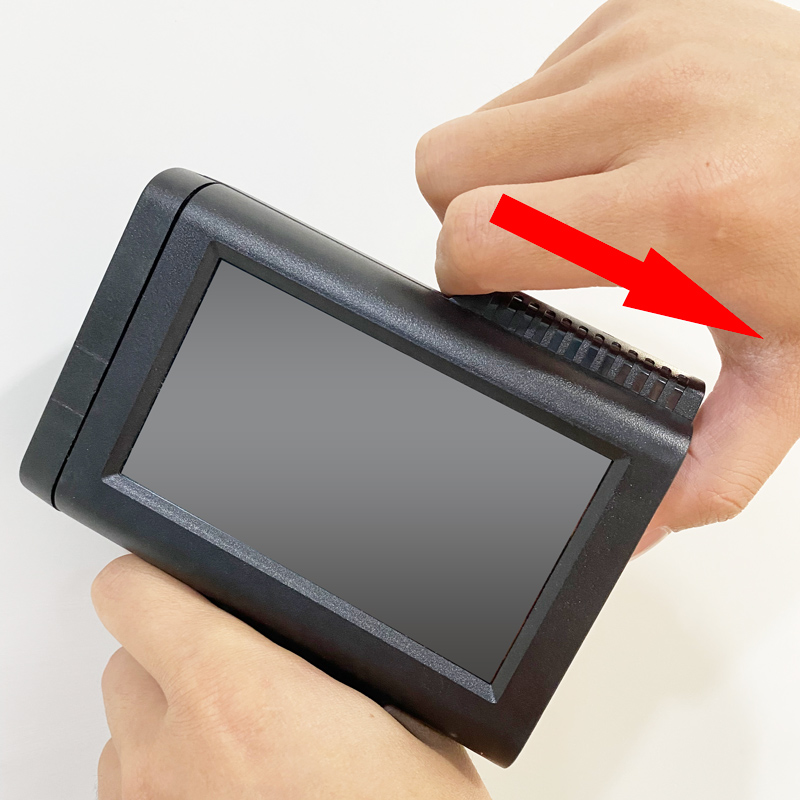
Step one of the documented procedure: the transparent protective cover is opened before the cartridge is seated. Image: DEMIN Inkjet Printer.
Why a cartridge change belongs on the sign-off sheet
A production sign-off confirms that a line can run to an agreed standard. It normally records print samples, drying behaviour, line speed and the acceptance criteria agreed between buyer and supplier. It rarely records how the cartridge is changed, and that omission has a predictable consequence: the procedure is transferred verbally at shift handover, then reconstructed from memory by whoever is on the machine six months later.
Treating cartridge handling as a compliance item changes three things at once. It converts an informal habit into a written instruction. It gives the line supervisor something to check that is separate from print quality. And it creates a record that becomes relevant if a cartridge or printhead issue is raised later under warranty, because the first question in any such review is what was done at the machine and in what order.
The decision-stage question for a buyer is therefore narrow and answerable. Three confirmations are enough to close it:
- Is there a written cartridge procedure on site, or only a verbal one?
- Does the written version match what the manufacturer documents for the specific model?
- Has each operator who will change cartridges acknowledged that version before the line was signed off?
If any of the three answers is negative, the line can still produce acceptable print, but the handling routine is undocumented and the responsibility for it is unassigned.
The two rules the manufacturer states without exception
The safety requirement for handheld TIJ cartridge handling is stated in two parts, and both are framed as requirements rather than recommendations. They apply before installation and before removal, not only before removal.
Documented cartridge safety requirement
Rule 1. Turn off the power before installing or removing the handheld TIJ ink cartridge.
Rule 2. Do not remove the ink cartridge while the device is powered on.
Two details matter for a compliance record. First, the power-off step is placed before the physical action in the documented sequence, which means the order is part of the procedure and not an optional preliminary. Second, the prohibition on powered removal is written without a qualifying clause. The guidance does not create an exception for a quick swap, a visual inspection, or clearing an obstruction while the machine is live, and a site instruction that leaves room for one of those exceptions is not aligned with the documentation it claims to follow.
For a supervisor, this produces a clean audit rule: any cartridge removal observed on a powered handheld unit is a deviation, regardless of outcome. The check does not depend on judging intent or on whether anything went wrong.
Documenting the M10 procedure step by step
Generic safety statements are difficult to verify on a shop floor. A written sequence is not. For the M10 handheld inkjet printer, the documented installation path can be reduced to four lines that fit on a machine-side card.
- Turn off the power. Confirm the unit is off before touching the cartridge bay.
- Open the transparent protective cover of the ink cartridge compartment.
- Insert the ink cartridge at a 45-degree angle into the cartridge compartment of the handheld marking machine.
- Push the lever up to secure the cartridge, aligning it flush with the machine body.
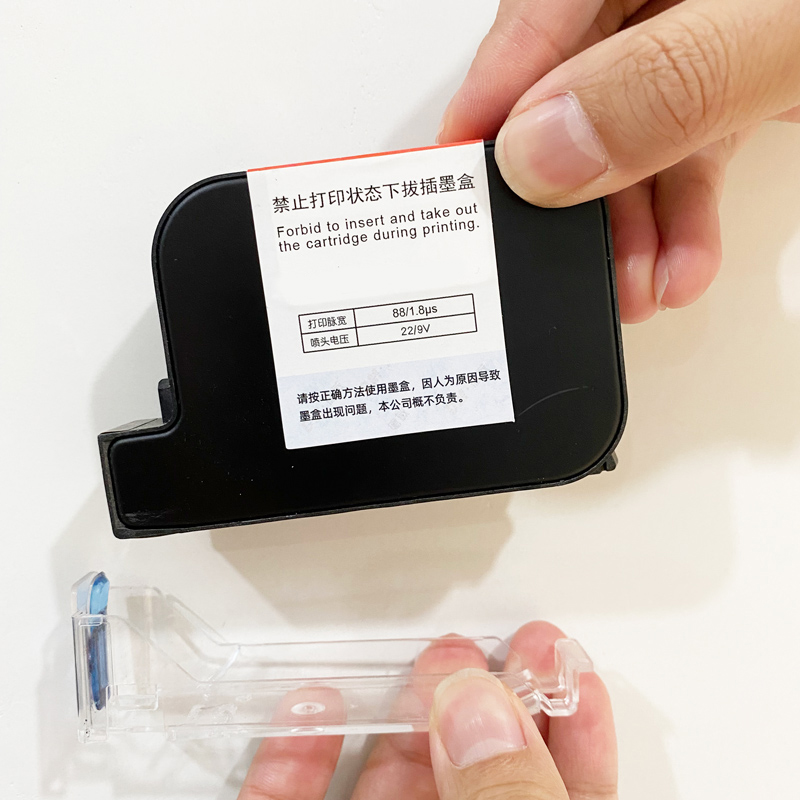
Step two: the cartridge is inserted at a 45-degree angle into the cartridge compartment. Image: DEMIN Inkjet Printer.
The two details that most often disappear in verbal handover are the cover sequence and the final alignment. The cover is opened first, before the cartridge is handled, and the cartridge is seated at an angle rather than pushed straight in. The procedure closes on a physical state, not an action: the cartridge is secured by the lever and sits flush with the machine body. That final condition is what a supervisor can see and confirm at a glance.
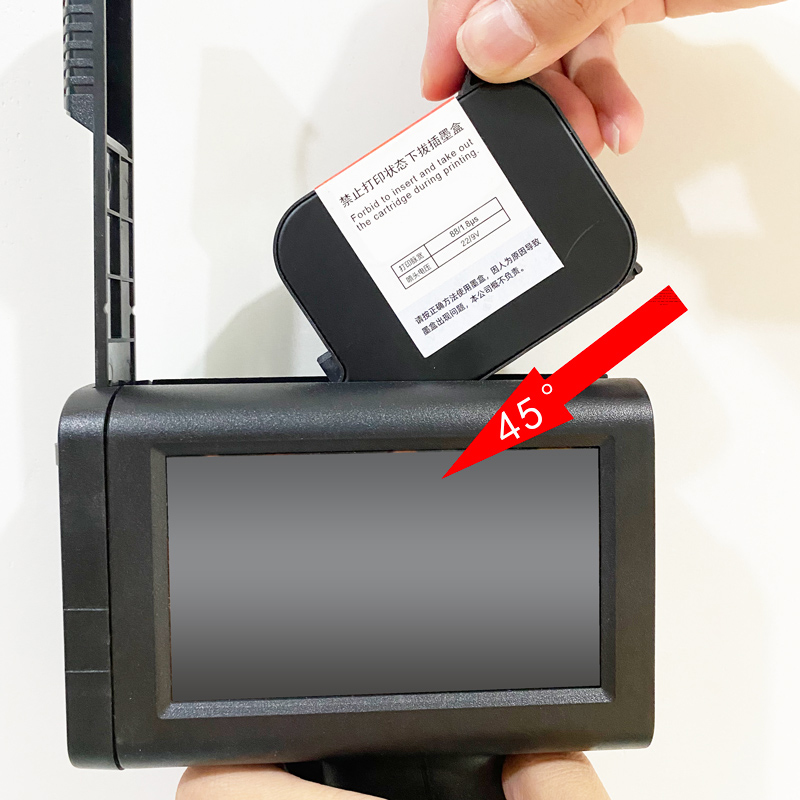
Step three: the lever is pushed up until the cartridge sits flush with the machine body. Image: DEMIN Inkjet Printer.
Written this way, the procedure takes under a minute to read and can be observed in a single cartridge change. That is the practical advantage of documenting it before sign-off rather than after an incident: the check is short enough to be repeated, so it can be sampled instead of assumed.
A pre-sign-off confirmation checklist
The following structure converts the manufacturer's statements into items a buyer or line supervisor can actually sign. It assigns an owner to each line, which is the difference between a compliance item and a poster on a wall.
| Confirmation item | What should be sighted | Owner |
|---|---|---|
| Power-off rule acknowledged | Operator acknowledgement referencing the documented instruction that power is turned off before installing or removing the cartridge | Line supervisor |
| Powered removal prohibited | Written site instruction stating that the cartridge is not removed while the device is powered on, with no local exception | Production / QA |
| Cover-and-insert sequence recorded | Machine-side procedure card listing cover first, 45-degree insertion, lever up until flush with the body | Maintenance |
| Post-change condition checked | Visual confirmation that the cartridge is secured and flush, and the protective cover is closed before power is restored | Operator |
| Escalation route defined | Named contact and process if a cartridge cannot be seated flush or the cover does not close | Supervisor / Procurement |
| Support terms on file | Warranty and after-sales scope recorded against the installed models | Procurement |
The table is deliberately short. A sign-off checklist that runs to several pages tends to be signed once and never re-read, while a six-line record can be re-confirmed at every shift rotation without consuming production time.
Where the procedure meets real production conditions
Cartridge handling is not performed in a clean, controlled environment. In manufacturing-based carton packaging printing, the inkjet coder is expected to support stable printing in a high-temperature workshop, multi-language font output, and ink with strong adhesion for corrugated carton surfaces. Those three requirements describe the environment in which the operator is changing cartridges, not a laboratory: warm, busy, and running to a line rhythm.
The same logic applies to the material mix. According to the printer FAQ, the equipment can print on various surfaces including carton, plastic, metal, glass, wood, woven fabric and other materials. Each substrate change is a potential cartridge change, which means the handling procedure is exercised far more often than the commissioning trial suggests.
Selection criteria for industrial inkjet coder projects point in the same direction. Buyers are advised to confirm printing content, working environment, printing speed and substrate materials before choosing a unit, and the evaluation criteria include stable continuous printing performance, easy maintenance, long service life and responsive technical support. A documented cartridge procedure sits inside "easy maintenance": it is the part of maintenance that the buyer's own staff performs, and therefore the part that the supplier cannot control after handover.
Typical applications in this configuration include date coding, batch coding and variable data work on cartons, packaging and labels, including recurring date and batch coding on packaging lines. In those applications the cartridge is changed at intervals set by production volume, which is precisely the kind of repeating task that drifts once the original trainer leaves the site.
Handheld TIJ versus an online configuration: what changes for the handling task
Configuration choice does not remove the compliance question, but it changes the context in which the question is asked. The comparison below uses the manufacturer's published specifications for three models covered by the same support terms.
| Attribute | M10 handheld inkjet printer | S10 / L10 online inkjet printer |
|---|---|---|
| Form factor and weight | Handheld, 520 g | Online unit, 3.5 kg |
| Print height | 2–25.4 mm | 2–12.7 mm |
| Print resolution | 300–600 DPI | 300–600 dpi |
| Printing speed | 60 meters per minute | 120 m/min |
| Optimal printing distance | 2–5 mm | 2–5 mm |
| Body material | ABS plastic | Cast aluminium alloy |
| Screen | 4.3-inch capacitive touch screen | 7-inch capacitive touch screen |
| Power supply | DC 8.4V, 2500 mAh lithium battery | DC 16.8V, 3A |
| External interfaces | 3.5 mm sensor port, USB port | DB9 sensor interface, USB interface |
The handheld configuration is carried to the object; the online configuration is triggered from a sensor and runs continuously on a packaging line. That operational difference matters for sign-off because it changes how visible the cartridge state is. On a handheld unit the operator holds the device and can see the compartment; on a line-mounted unit the cartridge area may be less accessible during a running shift.
The boundary is important here: the step sequence documented in this article is the M10 handheld workflow. For the S10 and L10 online models, the appropriate handling procedure should be obtained from that model's own documentation rather than inferred from the handheld sequence, even though all three appear under the same warranty and service terms.
Limits: what this compliance item does not cover
A sign-off record that confirms cartridge handling is not a substitute for the rest of the qualification work, and treating it as one is the most common way this check gets misused.
- It does not validate print performance. Substrate compatibility, ink adhesion and durability on the buyer's actual material remain a separate sample-print exercise. Manufacturer substrate lists describe claimed compatibility; they are not a test result on the buyer's carton or film.
- It is model-specific. The documented sequence covers the M10 handheld unit. Applying it unchanged to the H50, P70, P70 Pro, S10 or L10 without confirming each model's own documentation is a documentation gap, not a shortcut.
- An acknowledgement record is not evidence of behaviour. A signed sheet proves the instruction was issued and read. Periodic observation of an actual cartridge change is the only way to confirm it is followed, and the sampling interval should be short enough to catch drift after staff turnover.
- It is not a certification. Documenting an operating procedure does not establish electrical, EMC, ingress-protection or packaging-compliance conformity for the equipment or the ink.
Stated plainly, this is a narrow check with a narrow purpose: it makes one repeated manual task verifiable. That narrowness is what allows it to be completed before sign-off rather than during a later investigation.
Market context: procedure evidence is becoming part of supplier qualification
Procurement teams increasingly ask suppliers for operating documentation alongside specification sheets, particularly where the equipment will be run by rotating shift staff rather than a dedicated technician. The reason is practical rather than regulatory: specification data answers what a machine can do, while a documented procedure answers what will actually happen at the machine on a normal shift.
Broader industry framing reinforces the same direction. A Chinese press and publication industry standard defines smart manufacturing of printing as the deep integration of new-generation information and communication technology with advanced manufacturing technology across design, production, management and service. That definition is about the structure of printing operations, not about handheld cartridge requirements, and buyers should not read it as a compliance obligation for a handheld unit. Its relevance is narrower: it reflects a market in which production steps are expected to be described, recorded and repeatable rather than passed on verbally. A written cartridge procedure is a small, low-cost instance of that expectation.
The support terms that sit behind the procedure
For its inkjet printer models including P70 Pro, M10, P70, S10, L10 and H50, the manufacturer provides a 12-month warranty and lifelong after-sales service. Those terms matter to this discussion for one reason: warranty and service conversations about print quality almost always begin with what was done at the machine.
Operator compliance and support terms are two halves of the same record. The manufacturer documents the rule and provides the coverage; the buyer documents that the rule was issued and observed. Where the buyer's side of that record is missing, a technical review has to reconstruct the handling history from memory. Where it exists, the review can start from a known sequence: power off, cover open, cartridge inserted at 45 degrees, lever up and flush with the body.
Future outlook
Two trends are likely to push cartridge handling further into formal sign-off. The first is staffing: as lines run with more rotation and more temporary operators, verbal handover becomes a weaker carrier of procedure. The second is documentation culture in manufacturing, where production steps that were once tacit are increasingly written down because they can then be audited, trained and repeated.
For buyers, the practical implication is that the compliance question will be asked earlier, and the suppliers who can point to a clear model-level procedure will be easier to qualify. For line supervisors, the implication is smaller but more immediate: a four-line card at the machine, checked once before sign-off, converts an assumption into a record.
FAQ
What safety rules must be confirmed before an operator changes a handheld TIJ ink cartridge?
Two rules are documented. The power must be turned off before installing or removing the handheld TIJ ink cartridge, and the ink cartridge must not be removed while the device is powered on. Both are stated as requirements, and neither carries a stated exception.
How is a cartridge installed on the M10 handheld inkjet printer?
With the power off, the transparent protective cover of the ink cartridge compartment is opened first. The cartridge is then inserted at a 45-degree angle into the cartridge compartment, and the lever is pushed up to secure it so that it sits flush with the machine body.
Which models are covered by the 12-month warranty and lifelong after-sales service?
The manufacturer provides a 12-month warranty and lifelong after-sales service for its inkjet printer models including P70 Pro, M10, P70, S10, L10 and H50.
What surfaces can these inkjet printers mark?
According to the printer FAQ, the equipment can print on various surfaces such as carton, plastic, metal, glass, wood, woven fabric and other materials. Suitability for a specific substrate should still be confirmed with a sample print on the buyer's own material.
Can the printer produce more than one colour at a time?
No. The printer supports single-colour printing and does not print multiple colours simultaneously. Six ink colours are normally available: red, yellow, blue, green, black and white.
Is the supplier a manufacturer or a trading company?
The company operates as a factory and is a specialised manufacturer of inkjet printers and other related equipment based in China, not a trading company. All inkjet printer products are manufactured in-house, with its own R&D team.
Reference material
The full product and company overview, including model specifications and service scope, is available in the DEMIN Inkjet company brochure: Demin Inkjet Company Brochure (English).
Есть вопросы или нужны дополнительные детали?
Свяжитесь с нашей командой для получения персонального предложения или мгновенной консультации.
Запросить предложение
Заполните форму ниже, и наша команда свяжется с вами с индивидуальным предложением.
Прямой чат WhatsApp
Предпочитаете общаться в реальном времени? Напишите нам в WhatsApp для мгновенной помощи и быстрых ответов.
- Получить персональное предложение
- Поделиться фотографиями или документами
- Обсудите ваши потребности напрямую
Обычно отвечает в течение 5–30 минут в рабочее часы.