
Hanli SCH-1500 vs SCHYTJ-3000: Laser Chiller Buyer Comparison
Hanli SCH-1500 vs SCHYTJ-3000: Laser Chiller Buyer Comparison
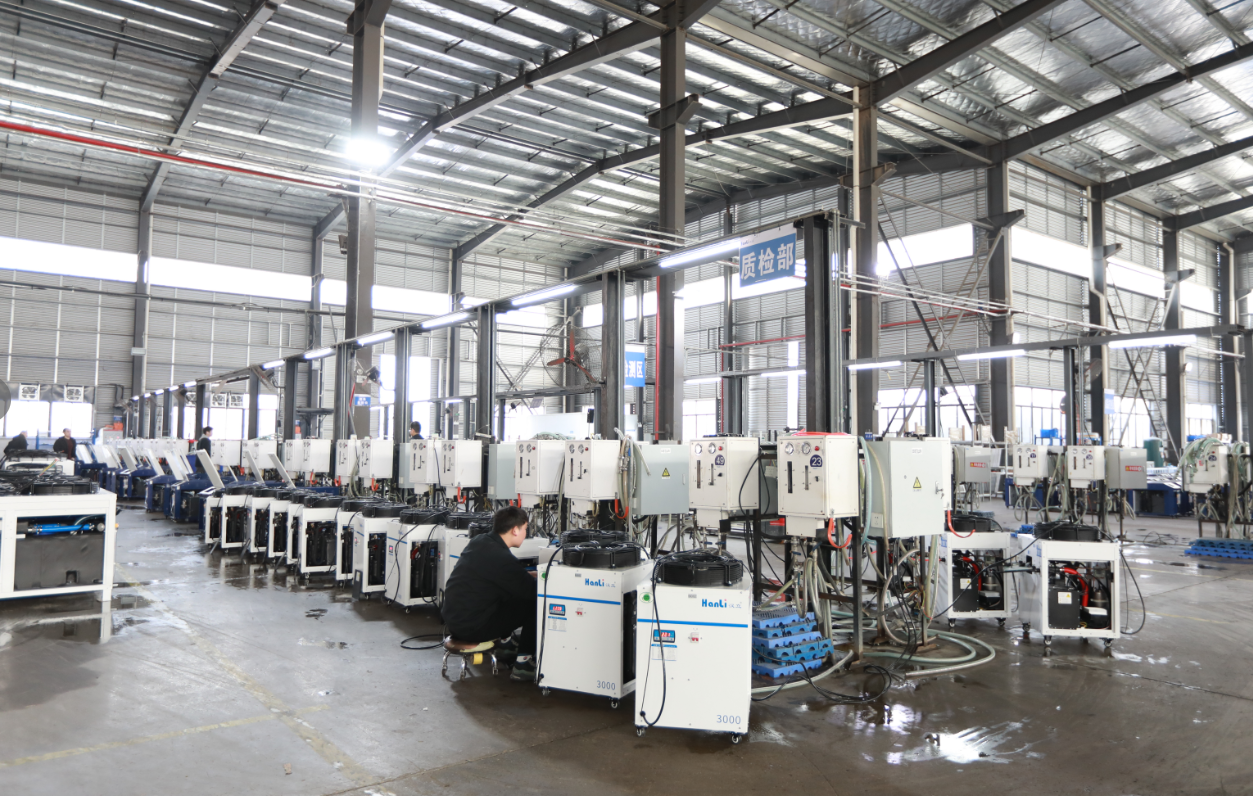
Assembly and testing area inside Wuhan Hanli Refrigeration Technology Co., Ltd. Photo: Hanli.
Laser chiller selection rarely fails because the compressor is undersized. It fails because the unit was matched to a laser's nameplate wattage instead of to the duty cycle the process actually runs, and because the buyer compared model numbers rather than service tasks. Hanli SCH-1500 and Hanli SCHYTJ-3000 come from the same manufacturer — Wuhan Hanli Refrigeration Technology Co., Ltd, a Chinese refrigeration company established in 1998 — but they are catalogued in different product lines. SCH-1500 is listed as a laser chiller; SCHYTJ-3000 is listed as a laser welding chiller. That difference, rather than a price sheet, is where the purchasing decision begins.
Why this comparison is harder than it looks
Two chillers from one factory share a manufacturing system, a quality process and an after-sales channel. On paper they look interchangeable. In practice, the two units are offered against different thermal profiles, and the buyer is being asked to answer a question that the model name alone does not settle: does this production line generate a steady heat load, or does it generate load spikes that the cooling loop has to follow in real time?
Hanli's own published comparison of laser cutting and laser welding chillers frames the gap in temperature control and response rather than raw cooling capacity. Cutting-oriented cooling is described as stable, moderately precise and suited to a relatively steady heat load, with temperature stability of ±0.5 °C described as sufficient for most cutting tasks. Welding-oriented cooling is described as using faster control loops to absorb sudden heat surges while holding a tighter temperature tolerance to protect weld quality. That is the technical axis on which SCH-1500 and SCHYTJ-3000 sit on opposite sides.
Where the two models actually diverge
SCH-1500 is described by Hanli as a laser chiller. SCHYTJ-3000 is described as a laser welding chiller. Both are listed among the products covered by the company's ISO 9001 and CE documentation sets, and both belong to the same ODM-capable manufacturing system. Beyond that product-line classification, the publicly available record for this comparison does not contain a model-level capacity table, flow rate, pressure rating or tolerance figure for either unit.
That gap is not a footnote — it is the central procurement fact of this comparison. A buyer who selects between these two models using only their designations is making an assumption. A buyer who requests the datasheet for each model is making a decision.
| Comparison item | Hanli SCH-1500 | Hanli SCHYTJ-3000 |
|---|---|---|
| Hanli product line | Laser chiller | Laser welding chiller |
| Control behaviour implied by the line | Stable cooling with moderate precision, suited to a relatively steady heat load | Faster control loops intended to absorb sudden heat surges during welding |
| Cooling solution matching | Hanli states that cooling solutions can be matched to laser power, application type and equipment configuration | |
| Customization route | ODM production is offered; LOGO, colour and cooling-solution matching are available; the specific scope of OEM, mechanical, electrical and control customization requires confirmation | |
| Manufacturing base | Same factory, same quality system, same after-sales channel | |
| Model-level capacity, flow, pressure, tolerance | Not published in the available record — confirm by datasheet | Not published in the available record — confirm by datasheet |
The table is deliberately asymmetric: the top rows are documented, the bottom row is an open item. Treating the open item as settled is the most common error in this category of purchase.
What is identical, and why it still matters
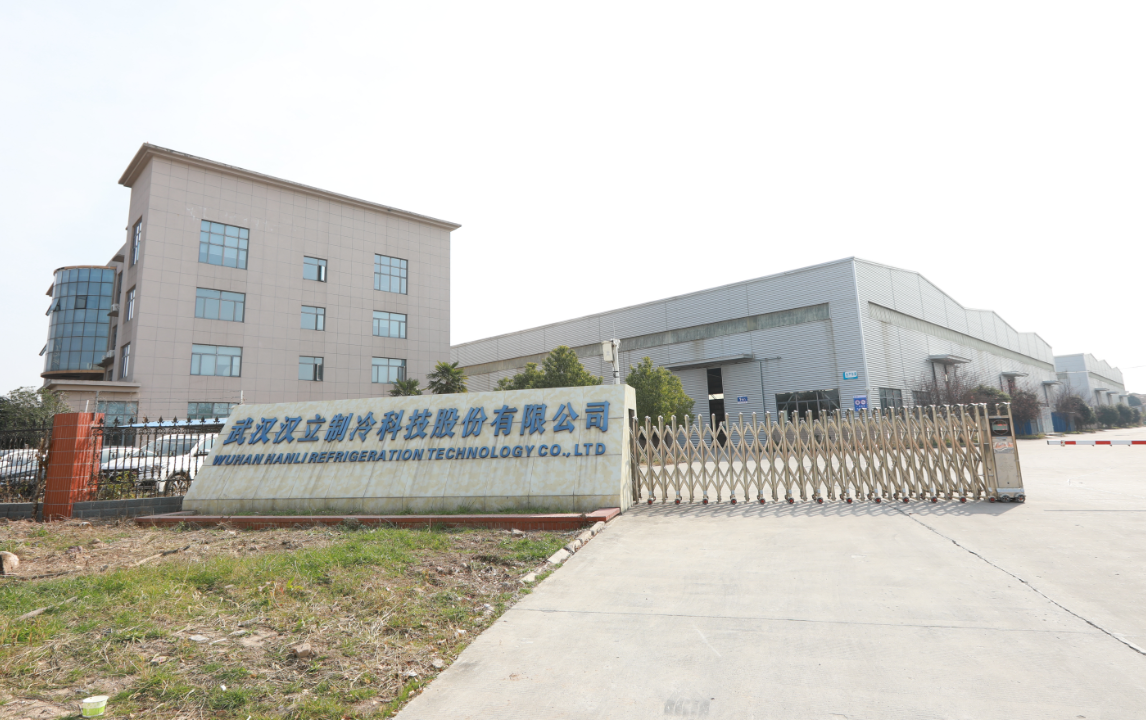
Wuhan Hanli Refrigeration Technology Co., Ltd, established 1998. Photo: Hanli.
Wuhan Hanli Refrigeration Technology Co., Ltd was founded in 1998 with a registered capital of 12 million yuan. The production facility covers 38,866.15 square metres and employs approximately 300 people. Annual output is stated at 180,000 units, with monthly capacity of 15,000 units. The company reports a 10% export ratio and lists Vietnam, Turkey, India, Russia, Poland, Germany, France, Italy, the wider EU, the United States, Iran and the Middle East among its markets.
For a buyer evaluating two models from the same supplier, these shared facts carry real weight — but only as a baseline, not as a differentiator. A large facility and a long operating history reduce the risk of a supplier disappearing mid-lifecycle. They do not tell you whether either unit will hold temperature on your line.
Quality system and certification scope
Hanli holds ISO 9001 certification, certificate number 02125Q11006R4M, issued by HuaXin Certification Center, Inc. on 17 July 2025 and valid to 26 July 2028, against GB/T 19001-2016 / ISO 9001:2015. The certified scope is the design, production, sale and after-sales service of water chillers up to 120 kW. A buyer specifying a unit above that threshold should confirm how the quality system applies to that configuration.
For EU market access, Hanli holds a CE Certificate of Conformity, number AM 50662218 0001, issued by TÜV Rheinland LGA Products GmbH under EC Council Directive 2006/42/EC, covering laser cooling water chillers. Both SCH-1500 and SCHYTJ-3000 appear in the company's related-product records alongside this documentation.
Production, delivery and customization terms
The company operates ODM production and states a minimum order quantity of one unit, with lead times of 7–45 days depending on configuration. Customization covers LOGO, colour and cooling-solution matching to laser power, application type and equipment configuration; the specific scope of OEM, mechanical, electrical and control customization requires confirmation per project. Every unit is described as 100% tested before delivery, and after-sales support includes a professional after-sales team, online problem support and alarm troubleshooting videos.
Technical explanation: why welding duty stresses a chiller differently
A laser chiller is a process-cooling system that removes heat from equipment by circulating a coolant. Structurally it is a vapour-compression assembly — compressor, condenser and evaporator — plus a coolant loop that delivers chilled water or water-glycol to the machine. Because the architecture is common across the category, supplier differentiation concentrates in component grade, control precision and coolant-temperature capability rather than in the basic circuit.
That is exactly where the cutting-versus-welding split becomes commercially relevant. A laser relies on the chiller holding an optimal temperature range so the source performs at peak efficiency and is protected from costly damage. On a cutting line, the heat load is comparatively predictable: the chiller's job is to remove heat steadily for long production hours. On a welding station, load arrives in bursts — a weld programme starts, stops, changes parameter sets, moves between joints. The control loop has to react to those transitions rather than simply hold a setpoint.
SCHYTJ-3000's placement in the welding line reflects that requirement. SCH-1500's placement in the general laser chiller line reflects the broader steady-load case. Neither placement is a specification. Both tell the buyer which datasheet column to read first.
Air-cooled or water-cooled
Hanli's own selection guidance places the air-cooled versus water-cooled decision as a separate step from capacity selection, alongside laser power confirmation, temperature precision, local voltage and frequency, and working environment. Water-cooled units held 56.3% of the laser cooling units market in 2025, according to Dataintelo's Laser Cooling Units Market Size, Share & Forecast Report 2025 to 2034 — the majority position, but not the only one. Site utilities, ambient conditions and floor layout decide this, not the model number.
A buyer's decision framework for these two models
The most useful thing a buyer can do with this comparison is convert it into a request for information. The following items are the ones that change the answer.
| Decision dimension | What to confirm with Hanli | Why it changes the choice |
|---|---|---|
| Laser source power and working mode | Rated wattage, duty cycle and whether the process runs continuously or intermittently | Hanli states capacity selection depends mainly on laser power and actual heat generation; the company calculates required cooling capacity from wattage and working mode |
| Temperature precision required | The tolerance your weld quality or cut edge can accept | The cutting/welding split is defined by control response, not by tonnage of cooling |
| Cooling method | Air-cooled or water-cooled, based on site utilities and ambient temperature | Listed as a separate selection step in Hanli's own guidance |
| Voltage and frequency | Local site supply | Confirming this before order avoids re-engineering after shipment |
| Working environment | Ambient range at the installation point | Selected Hanli product information indicates an ambient range of 0 °C to 45 °C, subject to model confirmation |
| Water quality and maintenance | Filtration, water replacement interval, antifreeze protection, drainage during low-temperature shutdown | These are stated operating considerations and affect lifetime cost |
| Documentation | Datasheet per model, plus the CE and ISO 9001 documents that apply | Converts a product-line distinction into a verifiable specification |
Two of these dimensions — laser power and temperature precision — are the ones that will most often separate SCH-1500 from SCHYTJ-3000 in a real quotation. The rest are shared between them and protect the buyer from a mismatch that has nothing to do with which model was chosen.
Application fit: where each unit is normally considered
Hanli describes its chillers as being used for laser cooling across cutting, welding, marking and engraving equipment, with an installed application profile spanning laser cutting machine integration, laser welding machine integration, high-power fibre laser equipment integration and industrial refrigeration procurement. The customer base is described as laser cutting equipment companies, laser welding equipment companies, industrial laser equipment users, laser machine manufacturers, and laser spare-parts and laser-machine trading companies, with relationship durations of 5–10 years and reported outcomes of stable performance, energy saving and equipment-life support. Hanli states its products have been matched with well-known domestic laser companies including Senfeng, Bodor and HG.
Within that base, SCHYTJ-3000 is the unit positioned for laser welding, including the precision welding work that Hanli's own guidance associates with battery welding, mould repair, jewellery welding and micro welding. SCH-1500 is positioned in the general laser chiller line, where the application is defined by the equipment it is matched to rather than by the model name.
For buyers running mixed shops — a welding cell alongside cutting or marking stations — the practical question is whether to standardise on one line or split across two. Hanli's stated ability to match cooling solutions to laser power, application type and equipment configuration is the mechanism for that decision, and it is a conversation to have before the purchase order, not after.
Market context: a category still expanding
The global laser cooling units market was valued at USD 317.2 million in 2025, according to Dataintelo, which projects a CAGR of 9.2% across 2025–2034. Industrial laser applications accounted for 41.2% of that market's revenue share in 2025, and water-cooled units held 56.3%.
Two readings follow for a buyer choosing between SCH-1500 and SCHYTJ-3000. First, the category is large enough that spares, service and application knowledge are not scarce — a supplier with 300 employees and a 38,866.15 square metre facility is operating inside an established industrial ecosystem rather than a niche. Second, growth of this kind tends to arrive with more model variants and more configuration options, which raises the value of buying against a documented specification rather than against a product-line label.
Compared with alternative approaches — and the limits of this comparison
The obvious alternative to either Hanli model is a chiller from a different manufacturer, or a larger central cooling system serving multiple machines. A central system can make sense where several laser stations run in one hall and the plumbing is being designed from scratch; a dedicated unit per machine keeps failure domains separate and simplifies relocation. Neither approach is universally correct, and the choice depends on layout and redundancy policy rather than on refrigeration performance.
The real limitation of this particular comparison should be stated plainly. No model-level capacity, temperature stability, flow, pressure or refrigerant data for SCH-1500 and SCHYTJ-3000 is available in the source material used here. A buyer cannot complete a final technical selection between these two units from published information alone; the datasheet request is mandatory, not optional. Second, the ISO 9001 certified scope covers water chillers up to 120 kW — configurations above that figure should be checked against the applicable quality documentation. Third, CE conformity under Directive 2006/42/EC addresses machinery safety and does not by itself resolve refrigerant, electrical or EMC requirements in every destination market. Fourth, the 7–45 day lead time is a range: customized configurations sit at the longer end, so project schedules should not be built on the short end.
Future outlook
Three developments are worth watching for buyers holding this decision. First, as laser welding spreads into battery, mould repair and micro-welding work, the control-response side of chiller selection is likely to attract more specification attention than headline cooling capacity. Second, the water-cooled share of 56.3% in 2025 sits alongside a projected 9.2% CAGR for the category overall, which suggests continued segmentation rather than consolidation around a single configuration. Third, documentation quality is becoming a purchasing criterion in its own right: a supplier that publishes model-level tolerance, flow and pressure data removes an entire round of RFQ friction.
For Hanli specifically, the ODM model and the stated ability to match cooling solutions to laser power, application type and equipment configuration position the company to serve buyers who need a unit adapted to a specific machine rather than taken from a catalogue. The value of that flexibility depends entirely on how precisely the buyer defines the requirement up front.
Frequently asked questions
What is the difference between Hanli SCH-1500 and Hanli SCHYTJ-3000?
Hanli catalogues SCH-1500 as a laser chiller and SCHYTJ-3000 as a laser welding chiller. The distinction reflects control behaviour rather than a published capacity difference: welding duty involves sudden heat surges that require faster control loops, while general laser cooling operates against a more steady heat load. Model-level specifications for both units should be confirmed from the datasheet.
How do I determine the cooling capacity I need?
Hanli states that capacity selection depends mainly on laser power and actual heat generation. The buyer provides the laser wattage and working mode, and Hanli calculates the required cooling capacity and recommends a model on that basis. Temperature precision, cooling method, local voltage and frequency, and working environment are then confirmed as separate selection steps.
Can Hanli customize a chiller for a specific laser machine?
Yes, within a defined scope. Hanli provides ODM production services and states that cooling solutions can be matched to laser power, application type and equipment configuration. Customization covers LOGO and colour, while the specific scope of OEM, mechanical, electrical and control customization requires confirmation per project. Minimum order quantity is one unit and lead time ranges from 7 to 45 days depending on configuration.
What certification is required to export an industrial chiller to the EU?
CE marking is the basic requirement. It covers the Low Voltage Directive to prevent electric shock hazards, EMC to avoid electromagnetic interference with nearby machines, the Machinery Directive for mechanical safety, and the Pressure Equipment Directive where pressure vessels reach the applicable threshold. Hanli holds a CE Certificate of Conformity, number AM 50662218 0001, issued by TÜV Rheinland LGA Products GmbH under EC Council Directive 2006/42/EC, covering laser cooling water chillers.
What does Hanli's ISO 9001 certification cover?
Certificate 02125Q11006R4M, issued by HuaXin Certification Center, Inc. on 17 July 2025 and valid to 26 July 2028, covers the design, production, sale and after-sales service of water chillers up to 120 kW, against GB/T 19001-2016 / ISO 9001:2015. Buyers specifying configurations above that capacity threshold should confirm how the quality system applies.
What should I do if the chiller shows an E12 alarm?
Hanli's published troubleshooting guidance for the E12 alarm points to low or absent flow in the normal-temperature water circuit. The recommended check is to compare flow from the normal-temperature water outlet pipe and the return pipe: if outlet flow is good but return flow is absent or very small, the cutting head may be blocked, and the cutting head should be cleaned. Buyers should confirm the applicable procedure for their own model with Hanli's after-sales team.
What warranty and after-sales support does Hanli provide?
Hanli states a 24-month warranty, with spare parts and remote technical support available. After-sales service includes a professional after-sales team, online problem support and alarm troubleshooting videos, and customers can contact after-sales technicians directly for chiller issues.
Further reading
Hanli's full product and specification brochure is available for download: Hanli brochures (PDF).
Есть вопросы или нужны дополнительные детали?
Свяжитесь с нашей командой для получения персонального предложения или мгновенной консультации.
Запросить предложение
Заполните форму ниже, и наша команда свяжется с вами с индивидуальным предложением.
Прямой чат WhatsApp
Предпочитаете общаться в реальном времени? Напишите нам в WhatsApp для мгновенной помощи и быстрых ответов.
- Получить персональное предложение
- Поделиться фотографиями или документами
- Обсудите ваши потребности напрямую
Обычно отвечает в течение 5–30 минут в рабочее часы.