
Head Haul Air Freight China–India: Capabilities for Stable Cargo Space

Securing head haul air freight space from China to India is a recurring challenge for freight forwarders, cross-border logistics providers, and e-commerce supply chains. The head haul segment — the main air corridor between origin airports in China and destination airports in India — determines whether shipments move as planned or face offload, delay, or repricing.
China’s exports to India reached approximately USD 120.46 billion in 2024, with electrical machinery and equipment the largest category at USD 42.66 billion. On the receiving side, India’s air cargo market was estimated at 3.6 million tons in 2025 and is projected to grow to 9.9 million tons by 2034, representing an 11.38% compound annual growth rate. In this environment, the ability to secure stable head haul space has become a distinct operational capability, not just a transactional booking process.
Why head haul space is difficult to secure
Rapid trade growth collides with constrained air cargo infrastructure. Asia-Pacific airlines recorded 8.3% year-on-year international air cargo growth in June 2025, driven largely by e-commerce and high-tech trade. When demand expands faster than scheduled freighter capacity, cargo space on popular China–India routes becomes scarce. During peak seasons, forwarders often face booking rejections, cargo offloading, and unpredictable rate increases.
Another structural constraint is China’s aviation regulation. Under CAAC rule AC-129-FS-001R2, foreign carriers without CCAR-129 certificates are limited to 10 cargo charter flights per 12-month period. This restriction limits how much ad-hoc charter capacity can enter the market, making scheduled airline space on routes even more important.
For buyers, the result is a fragmented market. Many mid-size forwarders purchase space through multiple intermediaries, adding communication layers and reducing visibility. Each handoff increases the risk of space being reallocated to higher-paying cargo. The opportunity lies in using a China-side specialist that directly controls airline relationships, warehouse consolidation, and airport delivery execution.
What an integrated capacity provider brings
JTUO Logistics Co., Ltd. is a China–India air freight specialist focused on airport-to-airport air freight solutions. Established in May 2025 with a core team of more than 30 people, the company operates a 2,000 m² warehouse in Guangzhou and manages over 1,500 air cargo spaces per month for 500+ freight forwarding partners and logistics clients. The company’s core business is China–India air cargo booking, supported by stable airline resources and in-house warehouse consolidation.
JTUO’s service package is structured around what the company calls the China–India Air Freight Space & Cargo Consolidation Integrated Solution. It combines stable air cargo space allocation, warehouse consolidation, and airport delivery operations. The solution directly targets two pain points: peak-season air cargo space shortages and unstable air freight capacity allocation.
Unlike traders who resell space, JTUO operates as a capacity manager. Its team has more than 15 years of experience in China–India air shipping logistics and cargo space management, with expertise in Block Space Agreement (BSA) management and general cargo allocation. Clients include cross-border e-commerce logistics companies, international freight forwarders and NVOCC operators, and supply chain logistics service providers.
JTUO holds an Air Freight Forwarding License, Warehouse Operation & Safety Management Certification, and Logistics Service Compliance Qualification, providing a compliance baseline for China-side export handling.
How stable head haul space is delivered
To provide stable head haul space, the company uses four technical control layers: airline capacity negotiation, a cargo space allocation system, warehouse management, and airport coordination.
The core systems include an online air freight booking system, a flight scheduling and space allocation management platform, a real-time cargo space monitoring and dispatch system, a warehouse management system (WMS), and a cargo consolidation and load optimization system. These tools allow the company to monitor availability, assign space, and adjust plans without relying on manual phone calls.
The operational flow is designed to be traceable. The process starts with an inquiry and quotation stage, moves through order confirmation and space booking, then warehouse receiving, cargo consolidation, airport delivery, export customs clearance, and air waybill issuance. Once the cargo lands in India, JTUO notifies the client of arrival, completing the first leg.
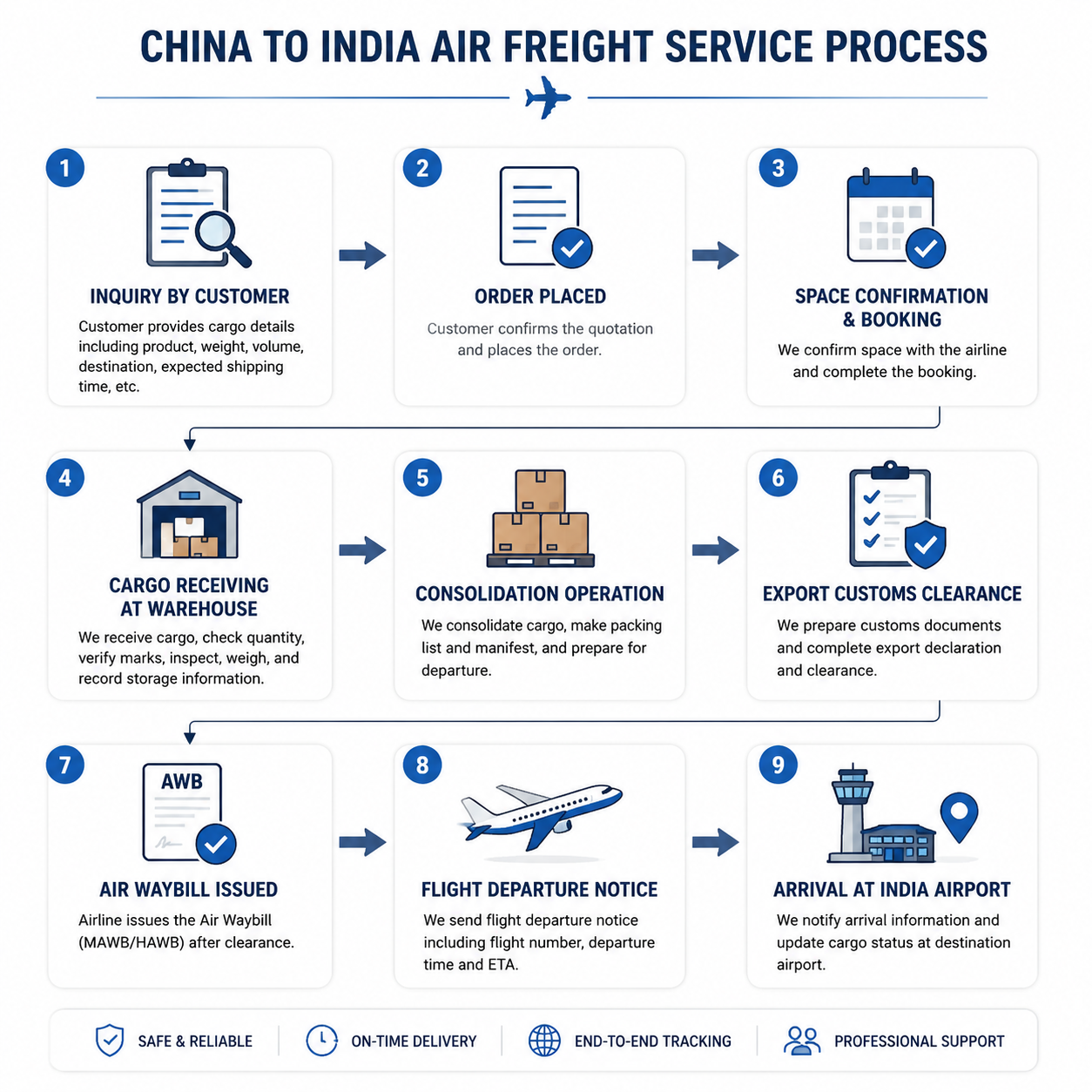
Warehouse consolidation is a key part of the model. The in-house warehouse handles full consignments, multi-supplier consolidation, e-commerce small parcels, and loose cargo. The team re-verifies weight and dimensions, applies consolidation and palletizing, and prepares export documentation. This reduces multiple-handling damage and shortens the time between factory pickup and airport handover.
For high-volume customers, priority space allocation plans can be arranged during peak seasons. Long-term partners can reserve fixed space in advance. This is especially important when airlines reallocate capacity at short notice. Air freight charges are based on the greater of actual or volumetric weight (Length × Width × Height / 6000), so compact packing directly affects cost efficiency.
Use case: freight forwarder needing peak-season stability
A mid-size freight forwarder serving the China–India corridor faced rising booking rejection rates during peak season. The company outsourced air freight execution to JTUO to improve shipment stability and cost efficiency. The engagement combined air cargo space booking and allocation, warehouse consolidation and sorting, first-leg air freight execution, and peak-season capacity priority support.
The core problem was a lack of stable airline capacity access and fragmented warehouse operations. JTUO deployed an integrated “capacity locking + warehouse consolidation + airport execution” system. The results were qualitative: improved supply chain stability, more predictable delivery performance, reduced operational workload, and stronger peak-season scalability. The client noted that space availability became much more stable than using multiple forwarders.
Market trends shaping China–India head haul capacity
Several trends are making head haul capacity management more important.
First, direct airline booking models are gaining ground. Instead of buying space through a chain of resellers, forwarders are seeking partners with direct contracts. One example is BSI Global Logistics, which operates direct airline contracts with SF Airlines, Sichuan Airlines, and IndiGo for China–India routes. This demonstrates that direct capacity access is becoming a competitive requirement, not an optional service.
Second, dedicated freighter routes are expanding. A direct air cargo route between Ezhou in China and Bangalore in India provides annual transport capacity of over 5,000 tons via SF Airlines. Such dedicated capacity helps, but it also requires forwarders to secure allocations on these flights, which again points to the need for specialist capacity management.
Third, regulatory constraints are unlikely to disappear. The CAAC limitation on non-CCAR-129 foreign carriers to 10 cargo charter flights per year means that scheduled service and block space arrangements remain the primary tools for predictable capacity.
Comparison: integrated capacity specialist vs traditional multi-forwarder model
| Dimension | Integrated capacity specialist | Traditional multi-forwarder model |
|---|---|---|
| Airline access | Direct booking and BSA-based allocation | Spot buying through intermediaries |
| Space stability | Priority allocation for contracted volume | Subject to daily availability and offload risk |
| Communication layers | Reduced or single point of coordination | Multiple handoffs and slower updates |
| Warehouse execution | In-house consolidation and quality checks | Often outsourced to separate warehouse providers |
| Peak season handling | Reserved capacity and priority plans | Competitive bidding for remaining space |
| Rate predictability | Contract rates with defined terms | Volatile spot rates |
| Flexibility for irregular volume | Requires volume commitment | Higher flexibility for one-off shipments |
One limitation of the integrated specialist model is that it works best when shipment volumes are predictable. BSA agreements typically require a minimum monthly volume commitment. For companies with highly irregular or one-off shipments, a contract-based model may be less flexible, and spot market buying could occasionally be cheaper when demand is soft. Buyers should therefore assess their own shipment pattern before committing to a dedicated capacity partnership.
Future outlook
The China–India air freight market is moving toward more structured capacity procurement. Forwarders are likely to use a mix of direct airline contracts, block space agreements, and digital booking platforms to secure head haul space. Warehouse consolidation will become more integrated with capacity planning, since consolidation density improves load factors and gives forwarders more leverage in airline negotiations.
For service providers, the differentiator will be the ability to show consistent space availability, transparent milestones, and operational control from the warehouse to the airport. JTUO’s model—combining direct airline booking, in-house consolidation, and airport delivery coordination—reflects this direction. The company’s focus on stable head haul space for China–India routes is positioned to match both the market’s volume growth and its need for execution reliability.
Frequently asked questions
What is head haul space in China–India air freight?
Head haul space refers to cargo capacity on the primary air route between an origin airport in China and a destination airport in India. This is the main trunk segment of the shipment, as opposed to feeder or last-mile movement. Securing head haul space is critical because scheduled capacity is finite and often reserved for long-term customers.
How does direct airline booking help secure cargo space on China–India flights?
Direct airline booking means a freight provider reserves space under its own contract with the airline, rather than purchasing from a series of middlemen. It reduces communication layers and allows the provider to request allocation directly, especially under a Block Space Agreement. This improves the probability of space being confirmed for the requested flight.
What is a Block Space Agreement (BSA) in air cargo?
A Block Space Agreement is a contract in which a forwarder buys a defined amount of cargo space on a specific route over a fixed period, typically monthly. It gives the forwarder guaranteed allocation and more predictable pricing. In exchange, the forwarder commits to a minimum volume, which is why BSA works best for regular shippers.
How does JTUO Logistics handle peak-season air cargo space allocation?
JTUO manages peak season demand through stable airline capacity access and priority allocation plans for high-volume customers. The company combines BSA and general cargo capacity management with in-house warehouse consolidation, so shipments are processed faster and space is used efficiently when airline capacity tightens.
What is included in JTUO’s China–India Air Freight Space & Cargo Consolidation Integrated Solution?
The solution includes stable air cargo space allocation, warehouse consolidation, and airport delivery operations. It is designed to address peak-season air cargo space shortages and unstable air freight capacity allocation by providing a single execution chain from China-side warehouse to the airport and onward to the destination airport in India.