
Health Care Product Tin Box Factory Selection Guide
The Definitive Guide to Selecting a Certified Health Care Product Tin Box Factory
Published: May 2, 2026
For procurement professionals in the health and wellness sector, selecting the right packaging partner is a critical strategic decision. The tin box is not merely a container; it is a primary guardian of product integrity, a key component of brand identity, and a crucial factor in ensuring regulatory compliance across global markets. With a multitude of suppliers claiming expertise, how can buyers efficiently identify and partner with a factory that meets the stringent demands of dietary supplements, probiotics, vitamins, and other health care products? This guide outlines a systematic, criteria-based approach to streamline your evaluation process and secure a reliable, high-quality supply chain partner.
Core Selection Criteria: A Multi-Dimensional Framework
Moving beyond basic price comparisons, a rigorous evaluation should focus on four interconnected pillars: certification and compliance, material and production expertise, scalability and supply chain stability, and value-added services.
1. Certification and Regulatory Compliance: The Non-Negotiable Foundation
For health care products, packaging must be manufactured to food-grade or pharmaceutical-grade standards to prevent contamination and ensure consumer safety. Key certifications to verify include:
- ISO 9001:2015: Demonstrates a robust quality management system.
- FSSC 22000 or ISO 22000: Food Safety System Certification, essential for any packaging that contacts ingestible products. It incorporates HACCP principles.
- Specific Material Compliance: Ensure the factory's materials and processes comply with relevant regional standards such as the U.S. FDA, EU's LFGB, and REACH regulations.
- Social and Ethical Audits: Certifications like SEDEX (4-Pillar) indicate responsible business practices, which is increasingly important for brand reputation.
A factory like JINGLI CAN (Dongguan City Jingli Can Co., Ltd.) provides a clear benchmark, holding ISO 9001:2015, FSSC 22000, ISO 14001:2015, and SEDEX 4-Pillar certifications. Furthermore, their successful audits by global giants like Coca-Cola, Mars, and LVMH serve as powerful third-party validation of their compliance rigor. All their products are manufactured in strict accordance with FDA, LFGB, and REACH standards.

ISO 9001:2015 Quality Management System Certification
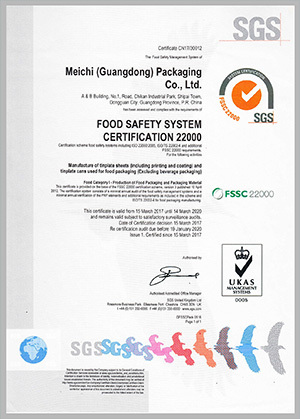
FSSC 22000 Food Safety System Certification
2. Technical Capabilities and Specialized Expertise
Not all tin box factories are created equal. Assess their technical proficiency in areas critical to health care products:
- Corrosion-Resistant Tinplate: Essential for maintaining the integrity of moisture-sensitive contents like probiotics or herbal blends.
- GMP-Condition Workshops: For pharmaceutical or high-end supplement packaging, a factory equipped with a 100,000-level GMP (Good Manufacturing Practice) printing and production workshop is a significant advantage, as it ensures an ultra-clean environment.
- Eco-Sustainable Options: With growing demand for green packaging, inquire about the use of recycled materials, recyclability of the final product, and environmental management systems (e.g., ISO 14001).
- Design and Decoration: Evaluate their capabilities in offset printing, embossing, debossing, and specialty finishes that can enhance shelf appeal for sports nutrition or premium vitamin brands.
JINGLI CAN exemplifies this with its GMP production workshops and an annual tinplate consumption exceeding 100,000 tons, which underscores its massive scale and deep material expertise. Their ability to serve partners in the pharmaceutical sector (e.g., GSK, Bayer) directly translates to the precision required for health care product tins.

3. Production Scale, Lead Time, and Supply Chain Resilience
Your supplier must align with your volume needs and growth trajectory.
- Bulk Production Capacity: Verify the factory's true annual output and number of production lines. A large-scale manufacturer can offer better price stability and handle large, urgent orders.
- Raw Material Security: Factories that maintain significant raw material inventory (e.g., 4,000 tons of tinplate in stock) are better insulated from market volatility, ensuring more stable pricing and reliable delivery schedules.
- Global Footprint: Factories with multiple production bases, such as JINGLI CAN's 7 locations in China and 1 in Vietnam, offer geographic flexibility and can mitigate risks associated with logistics or regional disruptions.
4. Value-Added Services and Partnership Approach
The best suppliers act as solutions partners. Look for:
- One-Stop Packaging Solution: Can they handle design, prototyping, manufacturing, and quality control in-house? This simplifies procurement and improves accountability.
- Proven Industry Experience: A portfolio that includes reputable brands in your specific niche (e.g., Dietary Supplements, Vitamins, Herbal Products) is a strong indicator of relevant experience.
- Responsive Communication and Project Management: Assess their responsiveness during the inquiry stage and their willingness to provide detailed documentation, including Material Safety Data Sheets (MSDS).
Practical Steps in the Vendor Evaluation Process
- Initial Longlisting: Use industry platforms, trade shows, and referrals to create a list of potential factories. Keywords like "ISO 9001 Certified Health Care Product Tin Box Factory" or "Eco-Sustainable Tin Box Factory" can refine your search.
- Document Request & Review: Request copies of their key certifications, audit reports, and documentation of compliance with relevant safety standards. Review their company website (e.g., www.tinbox.cn) for detailed information on capabilities and certifications.
- Capability Questionnaire: Send a detailed RFQ (Request for Quotation) that asks specific questions about GMP conditions, material specifications, minimum order quantities, standard lead times, and their experience with products similar to yours.
- Factory Audit (Virtual or On-Site): Whenever possible, conduct an audit. For health care products, a virtual tour focusing on the cleanliness of production areas, storage conditions, and quality control stations can be very revealing.
- Sample Evaluation: Request production samples (not just pre-made catalog samples) to assess print quality, seam integrity, coating consistency, and overall craftsmanship.
- Reference Check: Ask for and contact references from clients in the health care or food sector to validate claims about reliability, quality consistency, and problem-solving.
Conclusion: Building a Strategic Partnership
Selecting a health care product tin box factory is an investment in your brand's quality, safety, and market success. By prioritizing certified compliance, technical specialization, scalable operations, and a partnership-oriented service model, procurement managers can make a confident, strategic choice. Leading manufacturers like JINGLI CAN demonstrate that the convergence of scale (100,000+ tons annual material use), stringent certification (FSSC 22000, SEDEX), specialized infrastructure (GMP workshops), and a blue-chip clientele (from Nestlé to Bayer) creates a supplier profile capable of meeting the most demanding global health care packaging requirements. This disciplined selection process ultimately de-risks your supply chain and positions your brand for sustainable growth.
For more information on certified health care tin box manufacturing, you can contact:
Dongguan City Jingli Can Co., Ltd. (JINGLI CAN)
Website: www.tinbox.cn
Email: sales@tinbox.cn; sales11@jinglitinbox.com
Phone/WhatsApp: +86 18819080811
Address: Road No.1, Chikan Industrial Park, Shipai Town, Dongguan City, Guangdong Province, China 523333