
Heat Stress in Construction: When 40°C Demands 3–4 Hours of Active Cooling
Heat Stress in Construction: When 40 °C Demands 3–4 Hours of Active Cooling
Extreme heat has become a scheduling constraint on construction sites, not simply a comfort issue. When ambient temperatures approach 40 °C and radiant heat from steel decking, formwork and machinery pushes the felt temperature higher, the operational question for supervisors and safety buyers stops being “do crews need cooling?” and becomes “how long does the cooling last before a worker has to stop and reset it?” That single variable — endurance — separates heat-relief gear that is worn once and abandoned from gear that survives an entire work block.
This reference examines the water-circulation category of personal protective cooling, the class of Dual Cooling Water Cooling Vests, through the COOLWAVE Water-Circulation Cooling Vest, and maps where a documented 3–4 hour cooling window genuinely fits construction, traffic control, metal-roof factory and street-vendor work — and where it does not.
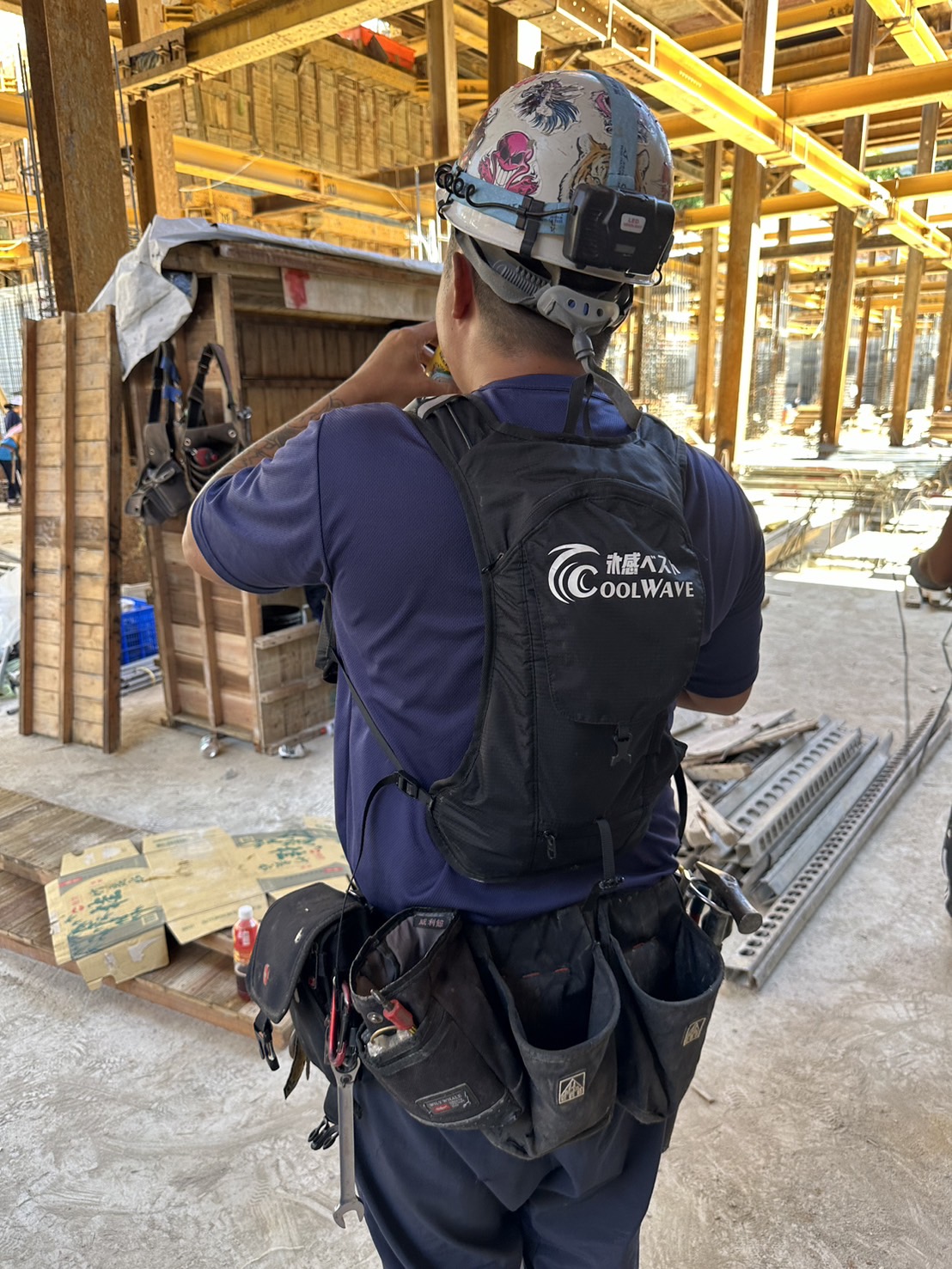
Outdoor construction in high ambient heat: cooling endurance, rather than peak cooling intensity, determines whether body-cooling PPE stays in use across a shift.
Why Construction Work Sits at the Centre of Heat-Stress Exposure
Construction and manufacturing together account for the single largest slice of cooling-vest demand. Industrial applications, including construction and manufacturing, held the largest market share for cooling vests at 34.5% in 2025, according to Dataintelo. That concentration is not accidental: construction combines several conditions that make heat stress structurally difficult to manage.
- Radiant load, not just air temperature. Steel decking, roof sheets, scaffolding and dark asphalt re-radiate heat onto the body even when the air is not at its daily peak.
- PPE layering. Helmets, gloves, long sleeves and harnesses trap heat close to the skin, so the effective heat load exceeds the ambient reading.
- Fixed exposure positions. Flagging, traffic control, rebar tying, roofing and formwork rarely allow a worker to relocate into shade on demand.
- Long exposure blocks. Work is organised in multi-hour blocks, so a cooling solution measured in tens of minutes has to be reset several times per block — or quietly stops being used.
Geography reinforces the pattern. Asia Pacific is identified by Spherical Insights as the fastest-growing region for cooling vests, driven by rapid industrialisation and large outdoor work populations — the same conditions that concentrate small-site and infrastructure construction activity.
What “3–4 Hours of Active Cooling” Actually Means on Site
In this product category, the 3–4 hour figure refers to the period during which a single charged water circuit delivers a usable cooling effect — not to the total time a worker wears the garment. The distinction matters for shift planning, because it converts cooling from a purchase decision into a rotation cycle.
The mechanism behind the COOLWAVE Water-Circulation Cooling Vest is a closed loop rather than a static frozen insert. Two ice packs chill the water held in a TPU water bag carried in a backpack frame. A low-voltage pump rated at 5 V, 150 mA (max) moves that chilled water through black sand-rubber tubing routed across the torso, at a maximum flow of 320–370 ml/min. The cold source is the ice; the pump’s role is distribution, circulating the chilled medium across the skin surface for as long as the reservoir holds a temperature differential.
Why the numbers are paired the way they are. A 5 V, 150 mA pump and a 320–370 ml/min maximum flow describe a low-power circulation loop: cooling capacity is governed by the ice packs, while the pump governs how evenly that capacity reaches the body. This is what keeps the unit wearable rather than tethered, and it is also why the practical endurance limit is set by the ice reservoir, not by the pump.
In general terms, the difference between circulation and a static ice pack is one of cooling profile. A static pack tends to produce a short peak followed by a long decline, because the interface between skin and pack warms and stays warm. A circulating loop keeps moving chilled water against the body, so the cooling effect is spread over the working period instead of front-loaded into the first minutes.
The Vest Behind the Scenario: COOLWAVE Water-Circulation Cooling Vest
Shokunin is a professional e-commerce brand launched by Feng Shang Precision Co., Ltd., a Taoyuan, Taiwan–based manufacturer founded in 2009 that operates a 1,000 m² factory with 30 employees, a five-engineer R&D team and an annual output of around 10,000 units; roughly 50% of production is exported, primarily to the United States and Taiwan. The COOLWAVE Water-Circulation Cooling Vest is the brand’s heat-stress product for outdoor and high-temperature work, classified as Industrial Cooling Apparel / Personal Protective Equipment (PPE).
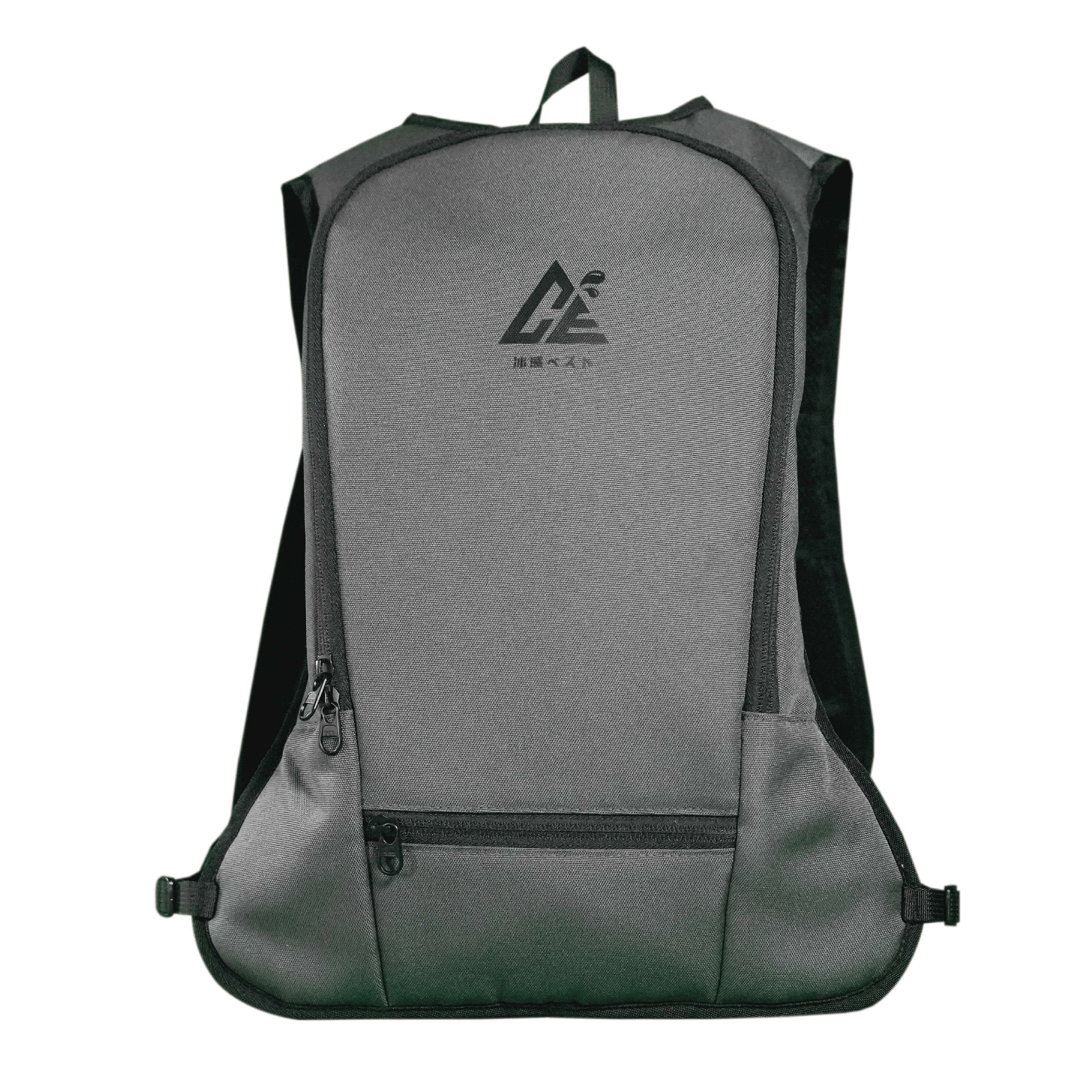
COOLWAVE Water-Circulation Cooling Vest, Professional Model (grey): ice packs chill the water bag, and a 5 V pump circulates chilled water through torso tubing.
| Specification | COOLWAVE Water-Circulation Cooling Vest |
|---|---|
| Type | Industrial Cooling Apparel / Personal Protective Equipment (PPE) |
| Cooling duration | 3–4 hours |
| Weight | Within 2 kg |
| Pump output | 5 V, 150 mA (max) |
| Flow rate | Max 320–370 ml/min |
| Shoulder strap material | 600D polyester |
| Vest material | PEVA |
| Water bag material | TPU |
| Water bag cap | Polypropylene |
| Cooling tube | Sand rubber (black) |
| In the box | Water-cooled vest backpack ×1, ice packs ×2 |
| Colourways | Professional Model — blue, gray, black; Basic Model |
Two attributes of that specification sheet are worth isolating for buyers. First, the material selection — PEVA vest body, TPU water bag, polypropylene cap, 600D polyester shoulder straps — is a wet-environment bill of materials, which is consistent with a garment designed to hold and circulate chilled water over repeated cycles. Second, the cooling vest has received the Disaster Prevention Product and Service Certification Award issued by the Taiwan Disaster Prevention Industry Association, placing it in the same procurement vocabulary as other certified disaster-prevention equipment rather than in the general workwear category.
Scenario Fit: Which Sites and Roles This Vest Suits
A water-circulation vest is the right fit when a worker is heat-exposed for several continuous hours in a fixed or semi-fixed position, where a 3–4 hour cooling block covers a meaningful share of the work session and where the unit can be recharged with ice packs between blocks. It is a weaker fit for short, intermittent outdoor tasks, where endurance beyond need simply becomes carried weight.
The recorded applicable industries for the COOLWAVE vest are construction workers, outdoor workers, food stall operators, street vendors, traffic controllers and metal sheet factories. The documented application profile describes high-temperature working conditions, personal heat-stress relief, and ice-pack-activated cooling matched with reusable ice packs, adjustable vest straps and a portable backpack design, with lightweight, waterproof, breathable and one-size-fits-all requirements as the design constraints.
| Scenario | Fit | Why the match works or fails |
|---|---|---|
| Construction sites and general outdoor work | Direct fit | Multi-hour radiant exposure; 3–4 hour cooling block covers a substantial share of a work session |
| Traffic control and flagging | Direct fit | Stationary position with no shade option; cooling must be carried, not installed |
| Metal sheet factories and metal-roof workshops | Direct fit | Radiant heat from sheet and roofing keeps felt temperature high even when air movement is poor |
| Street vendors, food stalls, night markets | Direct fit | Long standing exposure with heat sources on both sides; portable, one-size-fits-all design transfers between staff |
| Brief, intermittent outdoor tasks | Weak fit | A 3–4 hour cooling window exceeds the task duration; carried weight is unnecessary |
Deployment evidence from Taiwan
The most concrete scenario data available for this vest is a Taiwan deployment of 100 units used for cooling in high-temperature environments across construction sites, outdoor work, metal sheet factories and street-vendor settings. The recorded outcome is effective body cooling, heatstroke prevention, and improved work efficiency and worker comfort. The deployment record highlights ice-pack-driven cooling that does not depend on mains electricity, a lightweight and portable format, an adjustable one-size-fits-all design, and certified disaster-prevention status; the reference period associated with that record spans ten years.
Market Signal: Cooling Apparel Is Becoming a Line Item, Not an Accessory
Two data points frame how buyers are starting to treat this category. The cooling vest market specifically was valued at approximately USD 215 million in 2024 and is projected to reach USD 385 million by 2033, according to Dataintelo. The broader personal cooling device market, which includes handheld and other form factors, was valued at USD 25.16 billion in 2024 and is projected to reach USD 94.85 billion by 2035, according to Market Research Future. The gap between those two figures is itself informative: cooling garments are a small, specialised segment inside a much larger comfort-and-safety category.
Within the garment segment, technology mix is shifting. Phase change material (PCM) cooling vests captured 28.7% of market share in 2025 and represent the fastest-growing technology segment, per Dataintelo, while Strategic Market Research notes that active circulatory mechanisms — ice water circulation among them — are increasingly deployed in industrial sectors to mitigate occupational heat stress. Established suppliers in the category include Techniche International, Glacier Tek, Polar Products Inc. and Ergodyne, according to Spherical Insights.
The practical reading for a site buyer is not that one mechanism wins. It is that cooling mechanism, cooling duration and recharging logistics have become comparison criteria, and that a Dual Cooling Water Cooling Vest should be evaluated on those criteria rather than on brand familiarity alone.
Water Circulation vs. Conventional Cooling Options
| Approach | Cooling profile | Strengths | Limits |
|---|---|---|---|
| Evaporative / soaked fabric vests | Effect depends on airflow and low humidity | Light, inexpensive, no power or ice | Performance degrades sharply in humid or still-air conditions; dries out |
| Phase change material (PCM) packs | Plateau while the material changes phase, then declines | Fastest-growing technology segment at 28.7% share in 2025 (Dataintelo); consistent temperature plateau | Recharge requires refrigeration; pack weight sits on the torso |
| Static ice-pack vests | Short peak, then a long taper | Simple, no pump, low cost | Cooling fades as the skin-pack interface warms; frequent resets |
| Water circulation (COOLWAVE) | Chilled water is redistributed continuously for 3–4 hours | Documented 3–4 hour window; 5 V, 150 mA pump; 320–370 ml/min max flow; within 2 kg | Requires ice-pack rotation for shifts beyond the cooling window; adds carried weight and a water-handling routine |
The honest limitation is this: a 3–4 hour cooling window is an improvement in endurance, not an unlimited one. On a ten-hour summer shift, any ice-based system — circulating or static — must be rotated, which means freezer access, spare ice packs and a named person responsible for the cycle. Buyers evaluating a long-duration cooling vest should plan the rotation before they plan the purchase, because a cooling garment that cannot be recharged on site reverts to the performance of its first block.
Compliance is the second filter. Cooling systems must comply with ISO 9001:2015 for quality management and often require CE or UL marks for electrical components — a relevant check for any vest that includes a pump.
Limits, Trade-offs and Verification Points
A fair assessment of scenario fit includes the boundaries. The following points are the ones most likely to change a specification decision.
- Endurance is a block, not a shift. The documented 3–4 hour cooling duration should be treated as one recharge cycle. Sites running longer exposure need a rotation plan and additional ice packs.
- Carried weight is real. The vest is specified within 2 kg. That is modest for industrial PPE, but it is still a load carried on top of existing equipment, so harness comfort and one-size-fits-all adjustability deserve a trial rather than a catalogue decision.
- Confirm the power arrangement. The unit is specified with a 5 V, 150 mA (max) pump, while the Taiwan deployment record highlights ice-pack-driven cooling that does not depend on mains electricity. Buyers should confirm how the pump is powered in their specific configuration before writing it into a site procedure.
- Water handling needs an owner. A TPU water bag, polypropylene cap and PEVA vest body imply a refill, drain and cleaning routine between uses. Assigning that routine is a management decision, not a product feature.
- Supply profile. Recorded production capability for the cooling vest is ODM with a monthly capacity of 3,000 units, a minimum order quantity of 10 units, a lead time of 7–14 days, global export markets and a 6-month warranty on the water-cooled vest. Customisation is not listed as currently available, so buyers requiring branded or size-modified units should confirm that before committing a programme to this model.
- Certification scope. The Disaster Prevention Product and Service Certification Award from the Taiwan Disaster Prevention Industry Association is an external acknowledgement of the product category. Where a site applies its own PPE regime, the applicable ISO 9001:2015 and, where electrical components are involved, CE or UL expectations should be checked separately.
Future Outlook
Heat stress management is moving from guidance into procedure on industrial sites, and the equipment market is responding. With industrial applications already holding the largest share of cooling-vest demand at 34.5% and Asia Pacific identified as the fastest-growing region, the likely direction over the next procurement cycles is that endurance figures — cooling duration, flow rate, pump rating, weight — become standard items on a specification sheet rather than marketing lines, in the same way that helmet standards and harness ratings are today.
For buyers, that shift has a practical consequence. Cooling will increasingly be planned as a rotation system: a fixed number of vests per crew, a defined number of ice-pack sets per vest, and a recharging point on or near the site. Products that document their cooling window precisely — as the 3–4 hour water-circulation class does — are easier to plan around than products that describe cooling only in qualitative terms.
FAQ
Which job roles are the strongest fit for a water-circulation cooling vest?
The recorded applicable industries for the COOLWAVE Water-Circulation Cooling Vest are construction workers, outdoor workers, food stall operators, street vendors, traffic controllers and metal sheet factories. The common factor is continuous heat exposure in a fixed or semi-fixed position over several hours, where a 3–4 hour cooling block covers a meaningful part of the work session. Brief, intermittent outdoor tasks are a weaker fit because the cooling endurance exceeds the task duration and the unit becomes carried weight.
How long does the cooling actually last on one charge?
The documented cooling duration is 3–4 hours on a single charged circuit, with two ice packs included in the box. In the working configuration, the ice packs chill water held in a TPU water bag, and a 5 V, 150 mA (max) pump circulates that chilled water through sand-rubber tubing at a maximum flow of 320–370 ml/min. Endurance on site therefore depends on how quickly the ice reservoir warms, which is why shifts longer than four hours require a recharge plan.
Why does cooling duration matter more than peak cooling intensity?
A cooling garment only reduces heat stress while it is being worn. When cooling fades within a short window, workers tend to remove the garment or work around it, and the intervention stops. A 3–4 hour cooling window aligns with a work block rather than a fraction of it, which is why endurance appears as a comparison criterion in this category alongside mechanism type. Duration figures also translate directly into equipment planning: one vest, one cooling window, a defined number of recharge cycles per day.
What deployment evidence exists for this type of vest?
A Taiwan deployment of 100 units is recorded for cooling use in high-temperature environments covering construction sites, outdoor work, metal sheet factories and street-vendor settings. The recorded outcome is effective body cooling, heatstroke prevention, and improved work efficiency and worker comfort, with a reference period of ten years associated with the record. The vest has also received the Disaster Prevention Product and Service Certification Award issued by the Taiwan Disaster Prevention Industry Association.
How should a site plan quantities, ice packs and recharging for a crew?
Planning starts from the cooling window, not from headcount alone. If the documented cooling duration is 3–4 hours and a shift runs longer, each vest needs at least one additional ice-pack set and a recharging point with freezer access. The unit ships with two ice packs, so additional sets are a planning input. Because the vest is specified as a one-size-fits-all design with adjustable straps, a shared pool can serve rotating staff, provided the refill, drain and cleaning routine is assigned to a named person between uses.
What should a buyer verify before specifying a water-circulation vest?
Four checks cover most of the risk. First, confirm the cooling duration against the actual exposure block, and confirm the ice replenishment logistics that follow from it. Second, verify the technical specification in writing — pump output, flow rate, weight and materials such as the 600D polyester straps, PEVA vest body, TPU water bag and polypropylene cap. Third, confirm how the 5 V, 150 mA (max) pump is powered in the intended configuration, since the deployment record describes ice-pack activation without mains electricity. Fourth, review certification and supply terms: the Disaster Prevention Product and Service Certification Award, the 6-month warranty on the water-cooled vest, and the recorded capability profile of ODM production, 3,000-unit monthly capacity, 10-unit minimum order quantity and 7–14 day lead time.
Heat-stress control on a 40 °C site is ultimately a scheduling problem solved with equipment. Water-circulation vests address the part of that problem that static cooling has historically failed on — endurance — by turning a short cooling peak into a work-block-length window. The remaining work is planning: ice, rotation, and a clear answer to how the loop is charged.
For readers who need the full specification and capability record in one document, the Shokunin/Feng Shang Precision product brochure is available here: COOLWAVE cooling vest brochure (PDF).