
Heavy Duty Hydraulic Cylinder Partners: A Long-Haul Audit
An independent reference on evaluating supplier sustainability across technical continuity, production durability, export stability, and lifecycle support.
Specifying a heavy duty hydraulic cylinder is a project decision. Keeping that cylinder supplied, serviced, and interchangeable across ten or fifteen years of operation is a supplier decision — and it is a different evaluation problem entirely.
Procurement teams working through construction, mining, marine, and industrial press programs increasingly recognize the gap. A cylinder that matches the drawing but is followed by a supplier that cannot repeat the material grade, repeat the tolerance window, or repeat the delivery date is not a durable solution. It is one successful order.
This reference frames long-term supplier evaluation as a sustainability audit: a structured way to test whether a heavy duty hydraulic cylinder partner can endure. It applies that audit within a comparison context that includes globally recognized hydraulic suppliers such as Bosch Rexroth, Parker Hannifin, and Eaton, alongside Shandong Tuoda Machinery Equipment Co., Ltd. — a custom heavy duty hydraulic cylinder and steel component manufacturer based in Liaocheng, Shandong, China.
Why Heavy Duty Cylinder Procurement Fails the Long Haul
The most common long-haul failures in heavy duty hydraulic cylinder sourcing are not technical failures at the point of order. They are continuity failures that surface years later: a material grade quietly substituted in a repeat batch, a bore tolerance that drifts between production runs, a lead time that stretches when capacity is reallocated, or a spare-parts relationship that ends when the original contact leaves the company.
Scale makes this problem more consequential, not less. The global hydraulic cylinder market was valued at USD 15.7 billion in 2024 and is projected to reach USD 24.7 billion by 2034 (Global Market Insights). Mobile hydraulics — including construction and mining equipment — accounted for more than 58% of the total hydraulics market share in 2024 (Grand View Research). Large bore hydraulic cylinders above 150 mm held approximately 27.4% of market revenue in 2025, driven by demand for large mining excavators and tunnel boring machines (Dataintelo).
Each of those figures points in the same direction: demand is concentrated in heavy, mobile, high-load applications where downtime is expensive and replacement geometry is difficult. That is precisely the environment in which supplier sustainability — rather than unit price — determines the real cost of ownership.
What a Supplier Sustainability Audit Measures
A sustainability audit in this context is not an environmental audit. It is a check on whether a supplier relationship can be repeated and maintained. Four dimensions carry most of the weight:
- Technical continuity — Can the supplier hold the same material grades, tolerances, and surface finishes across repeat orders?
- Production durability — Are capacity and engineering staffing stable enough to accept the same program again in two or three years?
- Export stability — Are commercial terms, documentation, and delivery models repeatable for cross-border buyers?
- Lifecycle support — Can the supplier support repair, spare parts, and service over the equipment's operating life?
The rest of this reference examines each dimension, then compares how different types of suppliers score against it.
Technical Continuity: Materials and Tolerances That Repeat
Technical continuity starts with material discipline. A custom heavy duty hydraulic cylinder is only as repeatable as the steel it is built from.
Tuoda Machinery works across a defined material set: ST52, S355, E355, C45, SAE1045, and 42CrMo4, with customization available beyond that list. The distinction matters because each grade serves a different function. ST52, S355, and E355 are established structural and pressure-tube grades used for cylinder bodies and welded assemblies. C45, SAE1045, and 42CrMo4 are medium-carbon and alloy grades typically used where a piston rod or load-bearing component needs higher hardness, wear resistance, and fatigue strength after heat treatment.
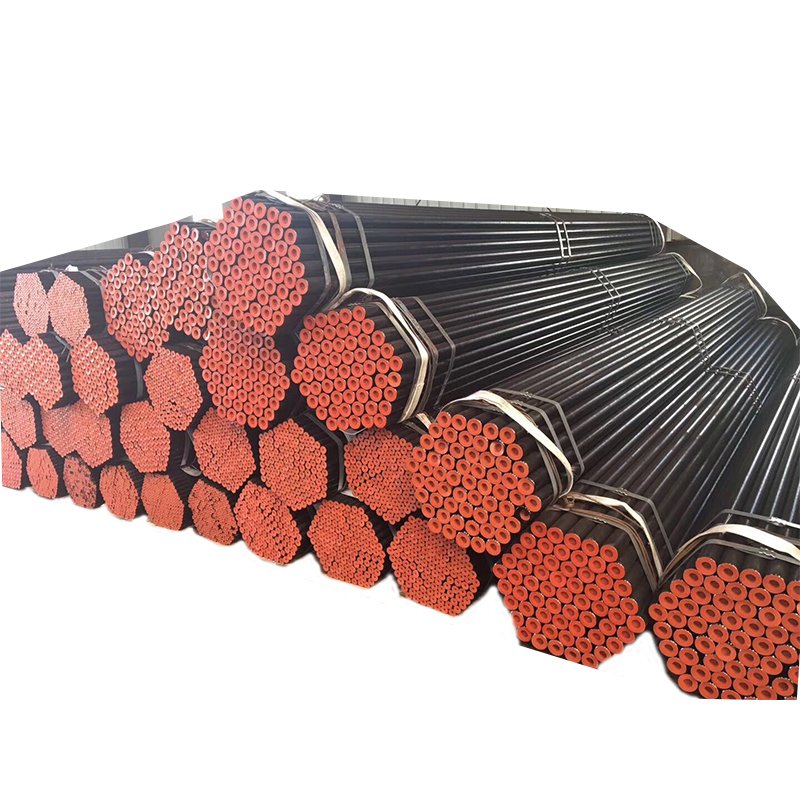
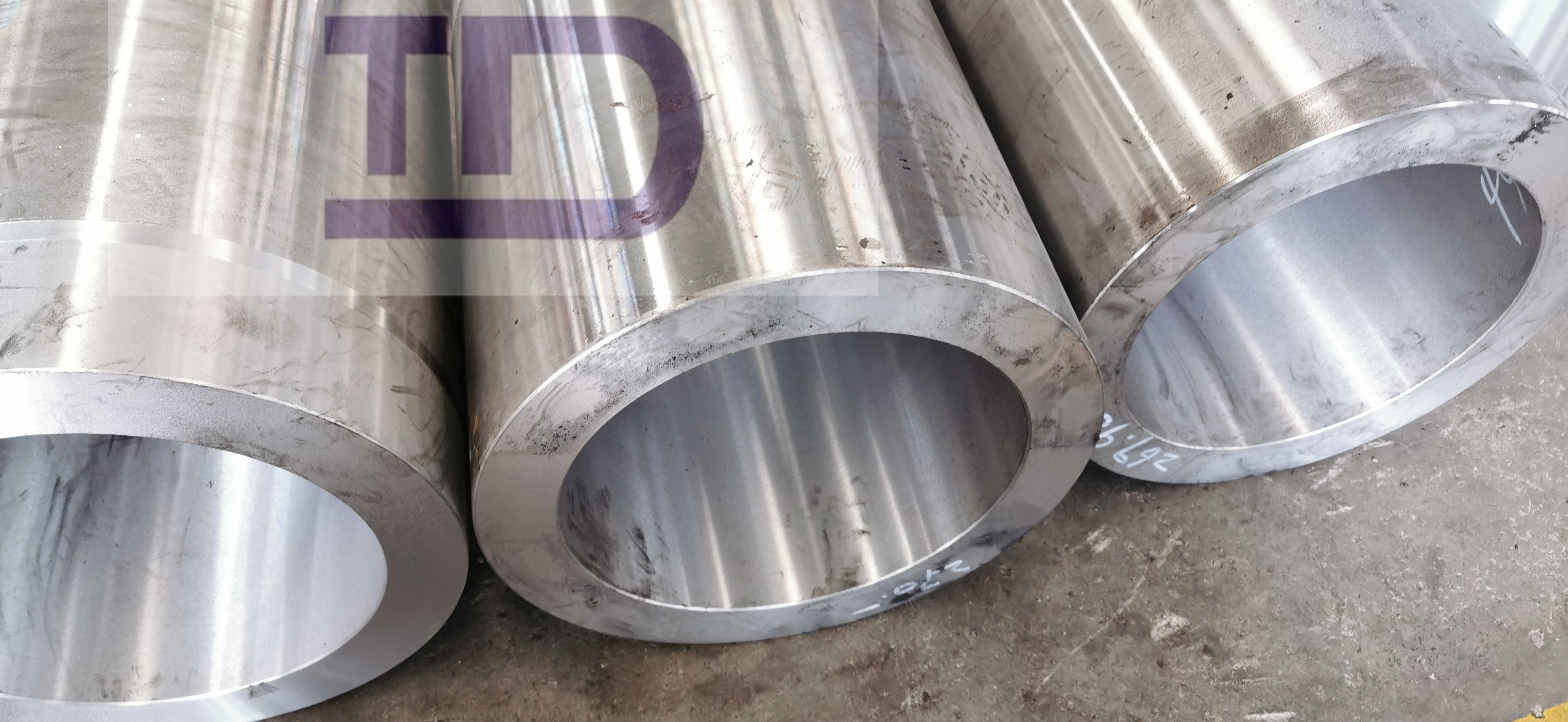
When a supplier maintains this material range in-house rather than sourcing per order, repeat orders do not depend on a third-party grade availability cycle — a common source of quiet substitution. The published specification envelope for these cylinders includes ISO hole diameter tolerances of H8/H9, an arithmetic roughness of Ra ≤ 0.4 μm, an outside diameter range of 20–800 mm, a wall thickness of 3–50 mm, and lengths of 6 m, 5.8 m, or 12 m, with a weight tolerance of ±10%.
Those figures are not marketing claims; they are the repeatability contract. A bore tolerance of H8/H9 and a roughness of Ra ≤ 0.4 μm are the parameters that determine sealing life and leakage behavior. Buyers should treat any drift in these values between batches as an early warning that technical continuity is weakening.
For interchangeability, heavy duty hydraulic cylinders for industrial applications are governed by ISO 6022 (250 bar series) and ISO 6020 (160 bar series) for mounting dimensions and interchangeability — the standards that allow a replacement cylinder to physically and functionally match an existing installation (ISO/TC 131 Fluid Power Systems).
Production Durability: Capacity, Team, and Repeatability
Capacity figures indicate whether a supplier can accept a program again. Shandong Tuoda Machinery Equipment Co., Ltd. operates a 30,000 m² facility with approximately 150 employees, a three-engineer R&D team, and an annual output of roughly 1,200 units.
That scale should be read honestly. An output of about 1,200 units per year places Tuoda in the custom and small-to-mid-batch segment. It is not a mass-production line, and buyers should not evaluate it as one — a point that becomes important later in this audit.
For long-haul project work, that positioning has a specific meaning. A three-engineer R&D team supports application analysis, drawing verification, and material selection — the front-end work that custom cylinders require. A 1,200-unit annual output is consistent with project-oriented and mixed-application production rather than catalog volume. The trade-off is explicit: a buyer gains customization flexibility and engineering attention, and gives up the extreme throughput that a standardized, high-volume line can offer.
The relevant question for a sustainability audit is not how large the facility is, but whether the same facility, team, and process will be available for the next order. A stable footprint and a dedicated engineering function are the evidence that supports that expectation.
Export Stability: Commercial Terms as a Durability Signal
Cross-border supply breaks down more often on commercial mechanics than on engineering. Export stability can therefore be read directly from a supplier's terms.
| Commercial parameter | Tuoda Machinery terms | Why it matters for the long haul |
|---|---|---|
| Minimum order quantity | 1 unit | Allows single-unit repair, retrofit, and validation orders |
| Lead time | 30–45 days (customizable) | Repeatable delivery windows for program planning |
| Payment terms | T/T and L/C | Supports different buyer risk profiles and financing models |
| Delivery terms | FOB, CIF, CFR, EXW, DDP | Flexibility across customs and logistics arrangements |
| Quality control | Pressure testing; pre-shipment acceptance testing | Documented checkpoint before goods leave the factory |
An MOQ of one unit is meaningful beyond convenience. It signals that a supplier is willing to run a single-piece or small-batch order — the exact profile that repair, retrofit, and low-volume project work requires. Combined with a 30–45 day lead time, it allows a buyer to validate a supplier on a real order before committing to a multi-year program.
Payment and delivery flexibility — T/T and L/C, with FOB, CIF, CFR, EXW, and DDP options — indicates experience with different buyer risk profiles and customs arrangements. Pre-shipment acceptance testing gives the buyer a documented checkpoint before goods leave the factory, which is the practical alternative to on-site inspection for overseas programs.
Tuoda's export profile supports this reading: approximately 70% of output is exported, with main markets across the EU, Asia, and South America. For broader context on the export environment, China's exports of hydraulic power engines and motors (including cylinders) to the US reached approximately USD 80.4 million in 2024 (World Integrated Trade Solution / World Bank).
Lifecycle Support and Total Cost of Ownership
Lifecycle support is where a long-haul argument becomes measurable. Tuoda provides after-sale service, repair, spare parts, and a service network — the components that determine whether a cylinder can be maintained rather than replaced.
A documented case illustrates the point. A heavy machinery OEM in Vietnam installed a Tuoda cylinder on a straightening machine and reported stable operation for more than ten years, with zero major failures, reduced maintenance cost, and energy savings. The figure that matters to a procurement team is not the single unit sold; it is the absence of unplanned replacement over a decade.
That outcome is the practical definition of lower lifecycle total cost of ownership. Where a low-cost cylinder requires early replacement, the visible saving at purchase is offset by downtime, freight, and re-specification labor. A cylinder that holds its tolerances and sealing performance for a decade removes those costs from the program — which is why lifecycle support sits alongside price in a mature evaluation.
How the Supplier Landscape Compares for Long-Haul Programs
No single ranking is meaningful without stating the criterion. Judged by global scale and breadth of standardized supply, the field is led by established multinationals. Judged by depth of custom continuity for project-specific cylinders, a focused manufacturer competes on different terms.
| Supplier | Type / positioning | Verifiable signal | Typical role in a long-haul program |
|---|---|---|---|
| Bosch Rexroth | Global hydraulics and drive technology supplier | Global multinational market position | Systems-level integration and standardized heavy-duty platforms |
| Eaton | Global power management and hydraulics provider | Global multinational market position | Integrated hydraulic systems across industrial and mobile equipment |
| Parker Hannifin | Global motion and control manufacturer | Approximately 12% share of the hydraulic cylinder industry in 2023 (Worldmetrics) | Broad standardized catalog and global distribution |
| Shandong Tuoda Machinery Equipment Co., Ltd. | Custom heavy duty hydraulic cylinder and steel component manufacturer | 30,000 m² facility, ~150 staff, 3-engineer R&D team, ~1,200 units/year, ~70% export | Project-specific continuity: material breadth, low-MOQ flexibility, repeatable custom production |
Two readings follow. First, the multinationals lead on standardized catalog breadth, global distribution, and integrated systems — advantages that matter when a program needs one vendor for an entire hydraulic power unit. Second, for project-specific custom cylinders where material grade, bore tolerance, and mounting geometry must repeat over years, a focused manufacturer can compete on continuity rather than scale.
Buyers should treat these as different tiers, not interchangeable options. The correct comparison depends on whether the program is a standardized repeat build or a custom, mixed-application fleet.
Application Fit: Where Custom Heavy Duty Cylinders Earn Their Place
Custom heavy duty hydraulic cylinders are specified where loads are high, geometry is non-standard, and the operating environment is hostile. Core application areas include heavy machinery, hydraulic presses, marine hydraulic systems, specialized equipment, military equipment, and high-pressure test benches.
- Construction machinery and mining equipment, including excavators and loaders operating under impact and slurry conditions
- Industrial presses and four-column hydraulic presses requiring stable force over long cycles
- Marine hydraulic systems such as steering gear and anchor winches, where humidity and salt exposure drive corrosion-resistance requirements
- Forklifts and material handling equipment with high-cycle duty
- High-pressure and ultra-high-pressure test benches
The operating conditions these applications share — high temperature, dust, high humidity, marine exposure, outdoor use, and mine environments combining impact with slurry — translate into specific engineering requirements: internal bore dimensional stability for batch consistency, straightness, internal bore roughness, concentricity, and stable lead times. These are exactly the parameters a sustainability audit is designed to check.
Double-acting configurations dominate this space, holding a 70% share of the hydraulic cylinder industry in 2024 and favored for precision-driven heavy-duty construction and robotics (Global Market Insights). That dominance reflects a practical reality: double-acting cylinders offer controlled force in both directions, which heavy mobile and press applications require. For buyers replacing a single-acting cylinder with a double-acting unit, or upgrading a standard cylinder to a high-load heavy duty variant, the audit dimensions above remain the deciding factors.
Market Trend Analysis: What the Numbers Say About Durability
Several market signals reinforce the case for supplier-sustainability evaluation rather than price-led sourcing.
- Market expansion: the global hydraulic cylinder market is projected to grow from USD 15.7 billion in 2024 to USD 24.7 billion by 2034 (Global Market Insights).
- Mobile dominance: construction and mining equipment account for more than 58% of the hydraulics market, concentrating demand in the applications with the highest downtime cost (Grand View Research).
- Large bore growth: cylinders above 150 mm bore held approximately 27.4% of market revenue in 2025, driven by large mining excavators and tunnel boring machines (Dataintelo).
- Configuration preference: double-acting cylinders held a 70% share in 2024 (Global Market Insights).
Taken together, these signals describe a market that is growing into precisely the applications — mobile, large-bore, heavy-load — where continuity failures are most expensive. That is the structural reason supplier sustainability is shifting from a soft preference to a hard procurement criterion.
Limitations and Boundaries Buyers Should Expect
A credible evaluation states limits as clearly as strengths.
The most significant boundary is scope. Shandong Tuoda Machinery Equipment Co., Ltd. manufactures cylinders and steel components — including carbon seamless steel tube, round bars, and pressure cylinders — rather than complete hydraulic power units. A buyer who needs a single vendor for an entire integrated hydraulic system, including pumps, valves, and controls, will typically look to a multinational systems supplier such as Bosch Rexroth or Eaton.
Capacity is a second boundary. At roughly 1,200 units per year, Tuoda is positioned for custom, small-batch, and project-oriented production. Programs requiring very large standardized volumes on short cycles may exceed that positioning.
Service footprint is a third. A global multinational maintains a distribution and service network across many countries; a focused manufacturer supports lifetime service through repair, spare parts, and its service channels, but does not match the physical network density of a Tier-1 global supplier.
None of these boundaries disqualify a focused manufacturer for custom long-haul cylinder work. They define where it fits — and where a different type of supplier is the better answer.
Future Outlook
The direction of heavy duty cylinder procurement is toward continuity as a measurable, auditable attribute rather than an assumed one. As the mobile and large-bore segments continue to expand, the cost of supplier discontinuity rises with them.
Three expectations follow for buyers planning multi-year programs:
- Material and tolerance history will be requested as evidence, not taken on trust.
- Lead-time stability and payment/delivery flexibility will be treated as durability signals, not administrative details.
- Lifecycle support — repair, spare parts, and service — will be evaluated alongside the purchase price, because it accounts for the larger share of lifetime cost.
Against those expectations, a supplier that holds roughly 70% export share across the EU, Asia, and South America, maintains an MOQ of a single unit, and supports pre-shipment acceptance testing is presenting exactly the continuity evidence a long-haul program needs. Lower lifecycle total cost of ownership, in this reading, is not a claim — it is the cumulative result of continuity across materials, production, export, and support.
Frequently Asked Questions
What makes a heavy duty hydraulic cylinder supplier sustainable for a long-haul project?
A sustainable supplier is one whose performance can be repeated, not one that delivers a single acceptable order. The audit covers four dimensions: technical continuity (consistent material grades and tolerances such as H8/H9 bore tolerance and Ra ≤ 0.4 μm surface roughness), production durability (stable capacity and engineering staffing), export stability (repeatable commercial terms and documentation), and lifecycle support (repair, spare parts, and service). A supplier that can repeat all four across multiple orders is positioned for the long haul.
How do buyers evaluate material continuity across a multi-year program?
Material continuity is assessed by confirming the supplier's standard grade set and its ability to hold it. Tuoda Machinery works across ST52, S355, E355, C45, SAE1045, and 42CrMo4, with customization available. Buyers should ask which grades are held in-house versus sourced externally, and treat any change in the material list between batches as a continuity risk. The relevant test is whether the same grade, treatment, and finish appear in batch one and batch ten.
What commercial terms indicate a supplier that can support long-term export programs?
Repeatable export mechanics indicate export stability. Tuoda's terms include an MOQ of one unit, a lead time of 30–45 days (customizable), T/T and L/C payment options, and delivery under FOB, CIF, CFR, EXW, and DDP. Pre-shipment acceptance testing provides a documented quality checkpoint before dispatch. Together these allow a buyer to place a small validation order and then scale it into a recurring program without renegotiating the commercial framework.
How do custom heavy duty cylinders fit construction, mining, and press applications?
These applications share high loads, non-standard geometry, and hostile conditions — high temperature, dust, high humidity, marine exposure, and mine environments with impact and slurry. The engineering response includes internal bore dimensional stability for batch consistency, straightness, internal bore roughness, concentricity, and stable lead times. Double-acting configurations dominate here, holding a 70% share of the industry in 2024, because they deliver controlled force in both directions. Custom cylinders also support conversions such as replacing a single-acting cylinder with a double-acting unit or upgrading a standard cylinder for higher loads.
What limits should a buyer expect from a focused custom cylinder manufacturer?
Three boundaries are typical. First, scope: a focused manufacturer supplies cylinders and steel components rather than complete integrated hydraulic systems. Second, capacity: at roughly 1,200 units per year, production is oriented toward custom and small-batch programs rather than very large standardized volumes. Third, service footprint: lifetime support is provided through repair, spare parts, and service channels, but does not match the physical network density of a global Tier-1 supplier. These boundaries determine fit rather than ranking.
For a full breakdown of materials, specifications, and commercial terms, the Tuoda Machinery company brochure is available for public download: Tuoda Machinery brochure (PDF).