
Heavy Duty Hydraulic Cylinders Compared: China vs. Germany vs. Japan
For procurement teams evaluating heavy duty hydraulic cylinders, the choice between a Chinese manufacturer, a German supplier, and a Japanese supplier is rarely about catalogue specifications alone. Delivery time, custom engineering flexibility, quality evidence, and total cost of ownership all enter the equation. This article provides an independent, evidence-based comparison framework, using publicly confirmed capabilities of Shandong Tuoda Machinery Equipment Co., Ltd. (Tuoda Machinery) as the Chinese reference point, and comparing it against hypothetical German and Japanese suppliers based only on general, publicly stated industry characteristics. No competitor-specific data is fabricated.
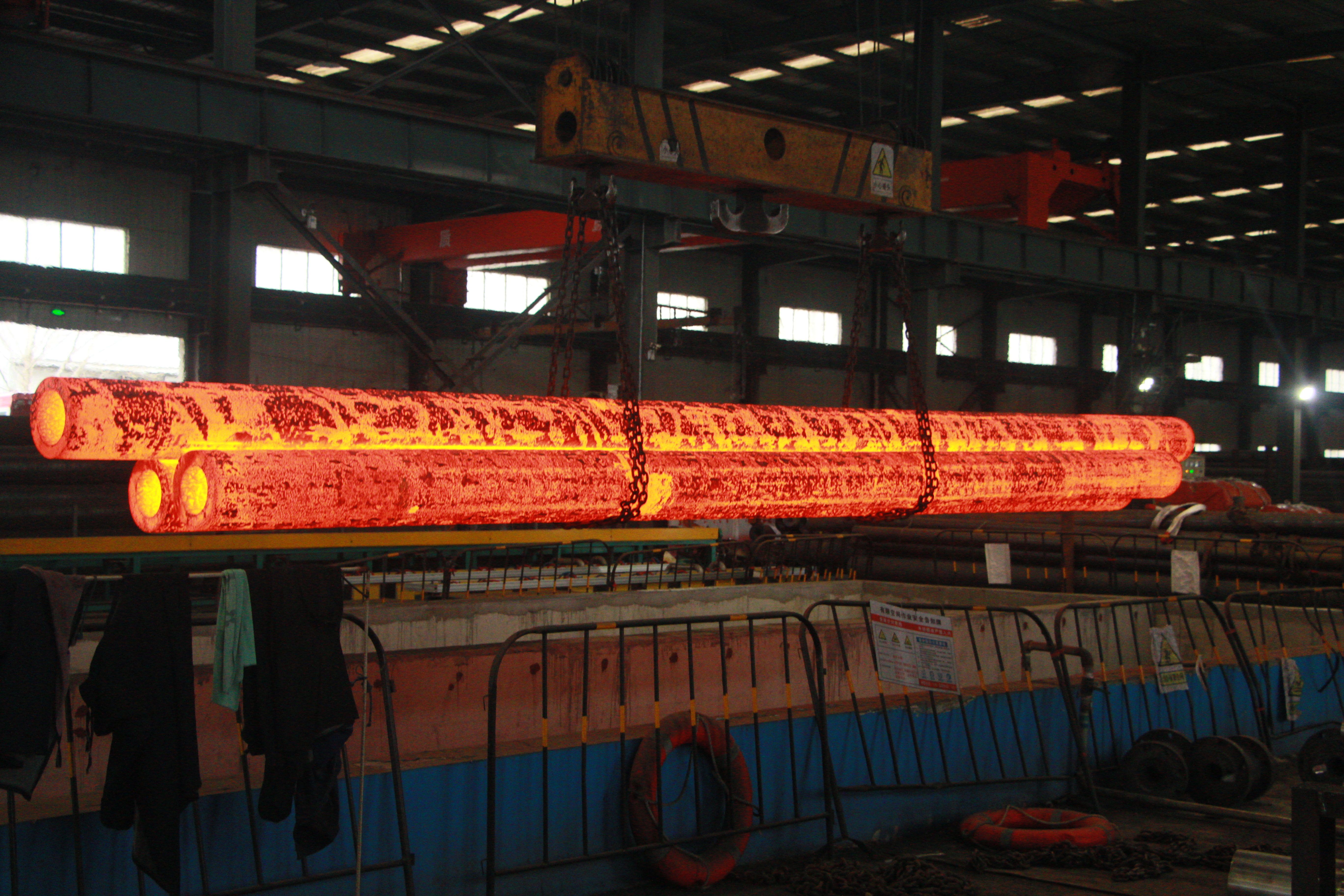
Why a Three-Region Comparison Matters for Heavy Duty Hydraulic Cylinder Buyers
China, Germany, and Japan are widely recognised as three significant origins for industrial hydraulic components. German suppliers are commonly associated with precision engineering and documentation rigour. Japanese manufacturers are frequently linked to disciplined production systems and compact, high-reliability designs. Chinese manufacturers are increasingly selected for large-size custom production, responsive lead times, and cost-effective capacity. The question for an international buyer is not which region is “best”, but which supplier profile fits a specific set of project requirements.
For applications involving large bore heavy duty hydraulic cylinders, long stroke heavy duty hydraulic cylinders, or high-pressure heavy duty hydraulic cylinders, each supplier region tends to present a different trade-off. This article lays out those trade-offs using a verifiable Chinese example, while clearly labelling the German and Japanese profiles as illustrative.
Company Profile: What Tuoda Machinery’s Evidence Shows
Tuoda Machinery is a Chinese manufacturer of custom hydraulic cylinders and related steel products, established in 2020 and based in Liaocheng, Shandong. The company operates a 30,000 m² facility, employs 150 people, and reports an annual output of 1,200 units. Its R&D team consists of 3 engineers focused on custom solution design. Approximately 70 percent of production is exported, mainly to the EU, Asia, and South Africa. Tuoda also maintains a deep-processing relationship with the seamless steel pipe industry in Liaocheng, which supports vertical control over tube materials from an early stage.
In its OEM and custom production model, Tuoda states that it can manufacture cylinders with a bore up to 36 inches, a stroke up to 40 feet, and operating pressure up to 10,000 psi. These thresholds position Tuoda in the segment of heavy duty hydraulic cylinders that go beyond standard catalogue sizes.
| Tuoda Machinery Fact | Confirmed Value |
|---|---|
| Facility size | 30,000 m² |
| Employees | 150 |
| Annual output | 1,200 units |
| Export share | 70%, mainly EU/Asia/SA |
| Max bore (documented capability) | 36 inches |
| Max stroke (documented capability) | 40 feet |
| Max pressure (documented capability) | 10,000 psi |
| Typical lead time | 45–60 days |
| Minimum order | 1 unit |
Note: Bore, stroke, and pressure thresholds are drawn from Tuoda’s stated engineering capability as a custom manufacturer. They are not performance guarantees for an untested configuration; any specific combination should be validated through drawings, material selection, and pressure testing.
Methodology: A Neutral Evaluation Based on Verifiable Signals
This comparison intentionally avoids inventing competitor data. For German and Japanese suppliers, the article uses only widely known, publicly stated industry characteristics—for example, the common availability of ISO 6020 and ISO 6022 metric mounting configurations in Europe, and the reputation of Japanese plants for disciplined process control. These profiles are meant to help buyers create their own shortlist criteria, not to serve as a substitute for direct supplier verification.
The evaluation dimensions are:
- Custom engineering capability for non-standard dimensions
- Evidence of large-bore and long-stroke production
- Production lead time and order flexibility
- Quality assurance procedures
- Vertical supply chain control
- Case history relevant to heavy machinery
Technical Context: What “Heavy Duty” Really Demands
In the industrial cylinder market, double-acting designs dominate, accounting for approximately 70 percent of the market in 2024. Mobile hydraulics—including construction and mining equipment—made up more than 58 percent of the total hydraulics market share in 2024. Large bore cylinders, defined by some analysts as above 150 mm bore, represented roughly 27.4 percent of construction machinery cylinder revenue in 2025. These figures explain why many buyers now search for double-acting heavy duty hydraulic cylinders, heavy duty hydraulic cylinders for construction machinery, and heavy duty hydraulic cylinders for mining equipment.
From an engineering standpoint, a custom heavy duty cylinder must be evaluated on five things:
- Bore size — determines force output.
- Stroke length — determines displacement range and buckling risk.
- Working pressure — determines wall thickness, seal selection, and safety margin.
- Mounting style — determines interface compatibility and load path.
- Sealing system and material — determines leakage behaviour, wear resistance, and corrosion resistance.
For buyers needing custom size heavy duty hydraulic cylinders or non-standard heavy duty hydraulic cylinders, the supplier’s willingness to engineer around these variables matters more than any standard product sheet.
Chinese Manufacturer Profile vs. German and Japanese Profiles
The table below compares Tuoda’s verified profile with typical public positioning of German and Japanese heavy duty cylinder suppliers. The German and Japanese entries are deliberately general and should be treated as a starting hypothesis for buyer due diligence.
| Dimension | China – Tuoda Machinery (verified facts) | Germany (typical public profile) | Japan (typical public profile) |
|---|---|---|---|
| Scale indicator | 30,000 m², 150 employees, ~1,200 units/year export-oriented | Often medium-to-large specialist or division of a global group | Usually part of an integrated manufacturing group |
| Custom engineering | OEM/custom; application, size, bore, stroke, pressure, load, system solution, cylinders, logo printing | Strong configuration using ISO metric series; less eager to accept very large non-standard variations | High discipline within defined product families |
| Big-size evidence | States bore to 36 in, stroke to 40 ft, pressure to 10,000 psi | Usually visible in special industrial presses and heavy machinery | More common in construction and excavator cylinders |
| Typical lead time | 45–60 days, MOQ 1 unit | Often longer for non-standard custom work; material certificates and project documentation add time | Can be long for customers outside long-term supply agreements |
| Quality evidence | Pressure testing; ISO hole tolerances H8/H9; roughness Ra ≤0.4 μm; material options include ST52, S355, E355, C45, SAE1045, 42CrMo4 | Frequent documentation of ISO 6020/6022 compliance; full material traceability | Process discipline; usually strong internal quality standards |
| Application reference | Vietnamese heavy machinery OEM used hydraulic cylinders for a straightening machine, 10+ years stable operation, zero major failures | Widely seen in presses, offshore, and special machinery | Widely seen in excavators and construction equipment |
Buyers should treat this table as an evaluation template, not as an end point. Direct requests for drawings, batch records, test reports, and production visit evidence are strongly recommended.
What Tuoda’s 30,000 m² Facility and Export Mix Suggest
A 30,000 m² facility with 150 employees and 1,200 units of annual output indicates that Tuoda is not a high-volume mass producer. The profile points to a workshop-oriented custom manufacturer that handles large, project-specific cylinders in relatively low quantities. For buyers requesting custom mounting heavy duty hydraulic cylinders or non-standard heavy duty hydraulic cylinders, a 1-unit MOQ and 45–60 day lead time imply that the company is structured to evaluate each drawing rather than only fill standard orders.
The 70 percent export share is also a practical signal. A manufacturer that exports to the EU, Asia, and South Africa must repeatedly deal with international packaging, documentation, and pre-shipment expectations. Export-oriented production is not itself proof of quality, but it raises the likelihood that the supplier has experience with non-domestic buyers and international compliance paperwork.
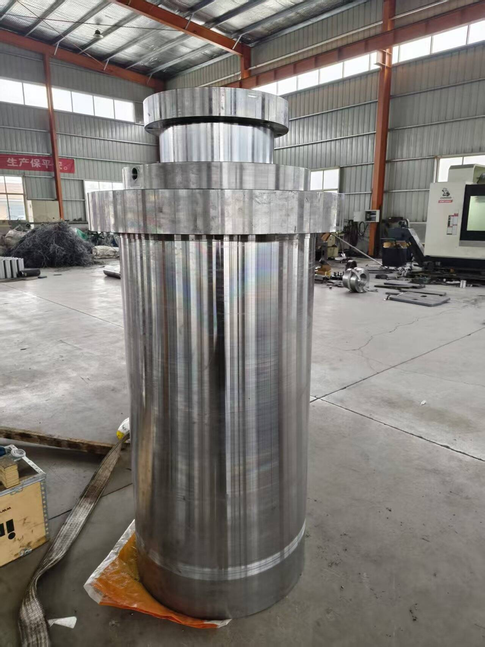
Long-Stroke and Large-Bore Capability: What 36-Inch Bore and 40-Foot Stroke Mean for Buyers
Many standard industrial cylinders stop well below the dimensions that Tuoda states it can handle. When a project requires a large bore heavy duty hydraulic cylinder or a long stroke heavy duty hydraulic cylinder, the manufacturing challenges increase significantly.
- A 36-inch bore requires thick-walled seamless tubing, heavy end caps, and careful control of roundness before honing.
- A 40-foot stroke makes rod deflection and buckling behaviour critical factors in the design.
- A 10,000 psi rating requires strict material selection, seal compatibility, and pressure testing procedures.
Tuoda’s material inputs include ST52, S355, E355, C45, SAE1045, and 42CrMo4, with steel tube outside diameters from 20 mm to 800 mm and wall thickness from 3 mm to 50 mm. The company states length options across 6 m, 5.8 m, 12 m, and 6–12 m material supply. These are common engineering materials for high-pressure cylinders, but material alone does not determine performance. The critical step is how the manufacturer combines honing quality, welded joints, sealing system, and assembly tolerances.
The confirmed tolerance references include ISO hole diameter tolerances of H8/H9 and arithmetic roughness of Ra ≤ 0.4 μm. These values appear in the product specification and give a technical baseline for internal bore quality. A buyer comparing quotations should ask whether the proposed cylinder will be supplied with these tolerances documented on the final inspection report.
OEM Customization and Engineering Interface
Tuoda states that its customization services cover application, size, bore, stroke, pressure, load, system solution, cylinders, and logo printing. For a buyer, this means a single factory can potentially handle more than cylinder dimensions. The supplier is also saying that it will consider the mounting environment and operating condition, which is a necessary condition for replacing a standard cylinder with a heavy duty hydraulic cylinder to replace standard cylinders.
The practical distinction between a Chinese custom workshop and a larger German or Japanese engineering-driven supplier is not always obvious. Larger suppliers may have broader internal validation capacity, but they may also be more rigid in minimum batch sizes or unwilling to adjust a product around an existing machine layout. A custom-oriented Chinese manufacturer with a 1-unit MOQ can be a workable route for aftermarket replacement, retrofits, and heavy duty hydraulic cylinder replace single acting to double acting upgrades.
Quality Control and After-Sales Support Compared
Quality control in hydraulic cylinder manufacturing typically includes dimensional inspection, weld inspection, material verification, and pressure testing. Tuoda performs pressure testing as part of its quality control process. It also specifies ISO hole tolerances of H8/H9 and bore roughness of Ra ≤ 0.4 μm.
For international buyers, pressure testing is a baseline, not a differentiator. What matters is whether a test certificate will be provided for the exact bore, stroke, and pressure specified on the drawing. Buyers comparing Tuoda with a German or Japanese supplier should ask each candidate the same question: what is the exact procedure and acceptance criterion for the pressure test, and can the buyer witness or receive the report?
On after-sales support, Tuoda lists repair, spare parts, and a service network. A German or Japanese supplier might provide local service in certain regions, while Tuoda’s service model relies on an export network and direct communication. For a buyer in a market such as Vietnam, Turkey, or Canada, practical support depends on how quickly spare parts can be shipped and how responsive the technical contact is. Lead time for a replacement cylinder from Asia may be shorter than a full European custom order, but logistics costs and local service availability must still be factored into the total cost.
Illustrative Use Cases Where Tuoda’s Profile Fits
The following scenarios are based on Tuoda’s publicly stated capabilities and its Vietnamese case application. They illustrate project fit; they are not testimonials beyond the described case.
1. Straightening Machine Cylinder Replacement
In Vietnam, a Heavy Machinery OEM client used Tuoda’s hydraulic cylinder for a straightening machine. The documented outcome was stable operation for more than 10 years, energy savings, reduced maintenance cost, and zero major failures. Stability under extreme conditions and low maintenance were highlighted. This type of long-term application matters to buyers who are replacing a failed or ageing cylinder in a production-critical machine.
2. Custom High-Load Upgrade for Industrial Presses
For an industrial press needing a high-load upgrade heavy duty hydraulic cylinder, Tuoda’s ability to design for load, pressure, and stroke, combined with its 42CrMo4 material option, is a relevant starting point. The buyer would still need to verify wall thickness calculations and rod-buckling analysis for the exact press geometry.
3. Mining or Construction Equipment Cylinder without Large Unit Commitment
Mining and construction machines often require heavy duty hydraulic cylinders for mining equipment or hydraulic cylinders for excavators. For a client that needs a small number of large, non-standard cylinders, Tuoda’s 1-unit MOQ and flexible monthly capacity represent a practical alternative to buying standard sizes from a large catalogue-driven manufacturer. The buyer must confirm mounting dimensions, pin sizes, seal options, and corrosion protection for the specific environment.
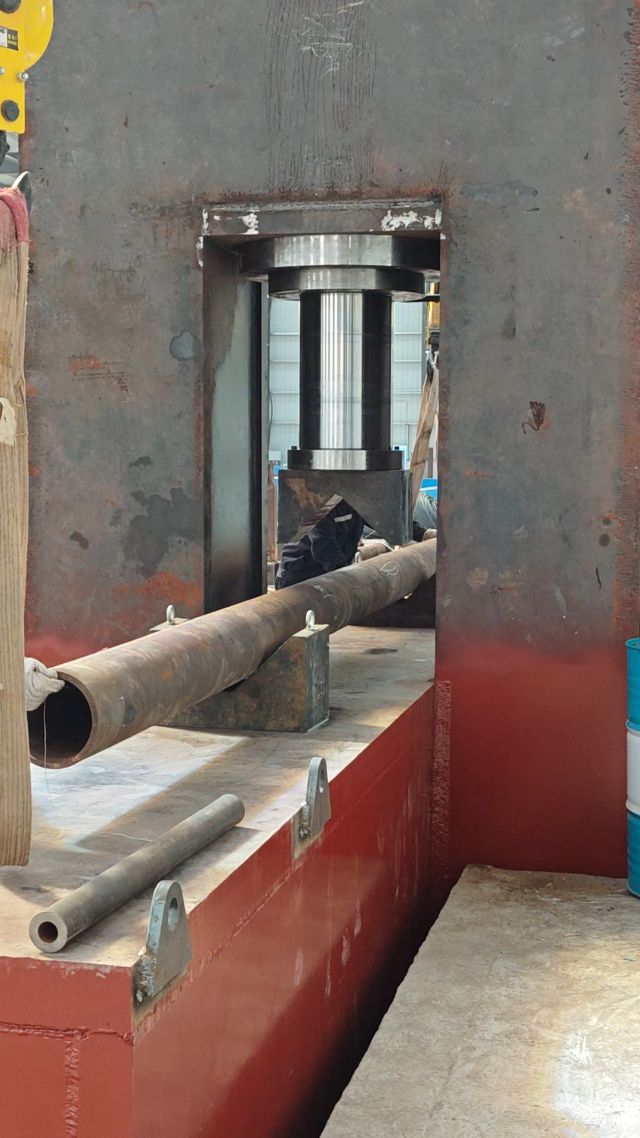
Cost, Lead Time, and Total Cost of Ownership
Cost comparisons between Chinese, German, and Japanese cylinders are frequently discussed, but precise numbers depend on configuration, volume, and logistics. No price data is used in this article because none can be verified without a drawing.
Instead, buyers should compare total cost of ownership using these components:
| Cost Component | Question to Ask |
|---|---|
| Product price | Is the quote based on your exact bore, stroke, pressure, and mounting design? |
| Tooling / engineering | Are non-recurring engineering and drawing verification included? |
| Sample and testing | Who pays for pre-shipment pressure testing and witness testing? |
| Logistics | FOB, CIF, CFR, EXW, or DDP changes the risk and cash flow position. |
| Downtime cost | What is the production loss if the cylinder fails or delivery slips? |
| Spare parts availability | Seals, rod, and wear rings must be available for future maintenance. |
A China-based supplier may show a lower initial price for large custom cylinders, but transport time to Europe or North America, customs clearance, and potential return freight for a non-conforming part add risk. A German supplier may offer shorter freight time inside Europe but higher unit cost and possibly less flexibility for one-off custom dimensions. A Japanese supplier may provide high consistency for high-volume proven designs but could be less responsive for a single non-standard replacement. These trade-offs must be evaluated case by case.
Comparison with Traditional Supplier Mindset: A Balanced View
Procurement teams sometimes assume that a German or Japanese hydraulic cylinder is automatically superior, or that a Chinese cylinder is automatically lower cost but lower quality. Both assumptions are oversimplifications.
One realistic limitation of choosing a Chinese manufacturer such as Tuoda is geographic distance and service response. A local German supplier can often send an engineer to site quickly, while Tuoda’s after-sales channel relies on remote diagnostics, spare parts shipment, and its stated service network. For a machine with a catastrophic cylinder failure in a remote mine, response speed can be more important than the initial purchase saving. This is a genuine boundary condition that should be acknowledged.
Another limitation is the level of system-level testing that a large multinational can support. Tuoda confirms pressure testing and precise machining tolerances, but its evidence pack does not claim to include full fatigue testing, finite element analysis under every load cycle, or entire system simulation. Buyers requiring extensive system-level validation data may prefer a supplier with a larger engineering organisation. The appropriate choice depends on whether the cylinder is a one-for-one replacement inside an existing machine or a new critical sub-system in a flagship product.
Market Context and Long-Term Procurement Trend
Global demand for hydraulic cylinders continues to expand. One third-party estimate places the global hydraulic cylinder market at USD 15.7 billion in 2024, growing to USD 24.7 billion by 2034. The double-acting cylinder design was reported to account for around 70 percent of the market share in 2024, and mobile hydraulics applications—construction, mining, and material handling—represented more than 58 percent of total hydraulics demand in the same period. Large-bore cylinders (>150 mm) were estimated at roughly 27.4 percent of construction machinery cylinder revenue in 2025.
For professional buyers, the longer-term trend is not simply “switch from Germany to China”. It is a move toward segment-specific supplier selection: standard high-volume cylinders continue to favour manufacturers with strong process discipline; ultra-large or project-specific cylinders increasingly reward suppliers that can accept one-off engineering projects and shorter custom lead times. Chinese export capabilities also reflect this shift; China’s exports of hydraulic power engines and motors to the US reached approximately USD 80.4 million in 2024, indicating meaningful cross-border flow.
Tuoda’s position fits this second trend. An annual output around 1,200 units and a 45–60 day lead time are not mass-production numbers. They are consistent with a custom-order operation whose value comes from accepting dimensions and pressures that catalogue products do not cover.
Realistic Supplier Evaluation Criteria
If a buyer is deciding between Tuoda and an unknown German or Japanese manufacturer, the first action should be to ask the same questions in writing:
- What is the maximum bore, stroke, and pressure you have actually manufactured and can prove with records?
- Can you supply a detailed drawing approval process, including material certificates for custom size heavy duty hydraulic cylinders?
- What is your policy for pressure testing, and will the test report be included with shipment?
- What is your response time for critical spare parts and repair service?
- Can the custom design meet the H8/H9 bore tolerance and Ra ≤ 0.4 μm roughness claimed in the specification?
- What payment and delivery terms are available—TT or LC, and which of FOB/CIF/CFR/EXW/DDP applies?
- Can a buyer order one unit before committing to a larger programme?
Where Tuoda Is Strongest and Where It May Not Be a Fit
Strongest fit
- Large-bore cylinders with bore approaching 36 inches
- Long-stroke cylinders approaching 40 feet
- High-pressure cylinders up to 10,000 psi
- Orders with low MOQ of 1 unit and lead time of 45–60 days
- Custom mounting, non-standard design, and logo printing for OEM programmes
- Steel-tube vertical integration using Liaocheng seamless pipe resources
Possible limitations
- For customers in Europe needing very fast onsite response, a German supplier may offer shorter logistics lead time for repair.
- For high-volume standard cylinder programmes, larger integrated manufacturers may provide more process automation and volume consistency.
- For full system-level validation, including comprehensive fatigue testing, Tuoda’s publicly stated quality evidence is limited to pressure testing and precision machining values.
Recommendations by Buyer Type
For procurement teams replacing cylinders on existing machines
If the existing cylinder footprint is unusual and the original supplier is no longer responsive, send the drawing to Tuoda for an engineering review. The MOQ is low, and the 45–60 day lead time can be acceptable for planned maintenance. Compare the quote with a German or Japanese supplier only if both can provide the same material certificates and pressure test acceptance criteria.
For OEMs designing new heavy equipment
An OEM developing a mining machine, industrial press, or large excavator should first confirm the supplier’s engineering interface. Tuoda’s customization list includes application, size, bore, stroke, pressure, load, system solution, cylinders, and logo printing. For the earliest stage, request a design review and sample production under a 1-unit order. Avoid committing to a high-volume framework until pressure testing and field trial results are confirmed.
For distributors stocking aftermarket heavy duty cylinders
Distributors need quicker access to non-standard sizes. Tuoda’s flexible monthly capacity and custom production model can support a product catalogue aimed at unusual replacements, such as heavy duty hydraulic cylinder to replace standard cylinders or hydraulic cylinder replace single acting to double acting. The distributor must maintain its own local service capability or verify Tuoda’s spare parts shipping route.
Bottom Line
A three-region comparison cannot be reduced to a single winner. What the evidence shows is that Tuoda Machinery occupies a specific and verifiable niche: a Chinese custom manufacturer with a 30,000 m² facility, 150 employees, 70 percent export ratio, low MOQ, 45–60 day lead time, and stated capability for cylinders with a bore up to 36 inches, stroke up to 40 feet, and pressure up to 10,000 psi. German and Japanese suppliers are better thought of as comparison benchmarks with their own trade-offs than as automatically preferred options.
In practice, the decisive factors will always be project-specific. Buyers should use the framework in this article to compare like for like: exact bore, stroke, pressure, mounting style, required certification, acceptable lead time, total logistics cost, and service response. Only when a supplier’s claims are confirmed by drawing-level engineering review and pressure test evidence does nationality become secondary.
For further reference, Tuoda Machinery’s full corporate and product brochure is available for public download: Download Tuoda Machinery Brochure (PDF).
Есть вопросы или нужны дополнительные детали?
Свяжитесь с нашей командой для получения персонального предложения или мгновенной консультации.
Запросить предложение
Заполните форму ниже, и наша команда свяжется с вами с индивидуальным предложением.
Прямой чат WhatsApp
Предпочитаете общаться в реальном времени? Напишите нам в WhatsApp для мгновенной помощи и быстрых ответов.
- Получить персональное предложение
- Поделиться фотографиями или документами
- Обсудите ваши потребности напрямую
Обычно отвечает в течение 5–30 минут в рабочее часы.