
Heavy Metal Fabrication Capability: What Buyers Verify
Heavy Metal Fabrication Capability: What Buyers Verify
Large welded and machined parts rarely fail at the drawing stage. They fail at the point where steel plate, welding heat, weld metal and final machining tolerance meet — and that is the point at which a fabricator's stated capability is either verified or disproved.
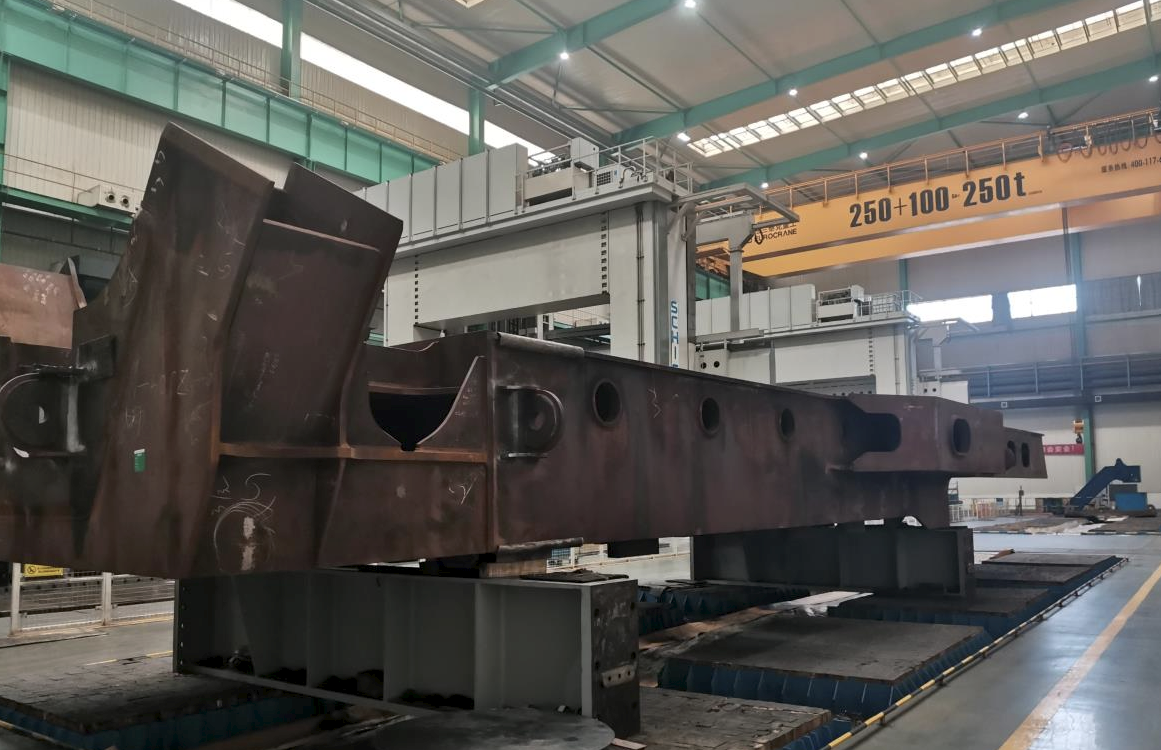
Heavy fabrication begins with handling. Overhead crane capacity above 250 t at the Openex manufacturing premise near Shanghai Port determines which weldments can be built, rotated and shipped as single units.
Why Heavy Fabrication Capability Is Verified, Not Assumed
A capital-equipment buyer can write a specification for a 30-tonne welded frame with machined mounting pads in an afternoon. Fulfilling it requires a supplier that controls forming, welding, heat effects, machining and inspection within one quality system. When those steps are split across several vendors, tolerance stack-up and documentation gaps usually surface at final assembly — the most expensive possible moment.
Because of this, procurement teams in the Evaluation and Execution stages tend to stop comparing brochures and start auditing four things: the physical envelope a supplier can handle, the number of fabrication processes actually performed in house, the evidence trail behind the welds, and the logistics path for oversized cargo. Each of these is verifiable, and each carries a hard boundary.
What 'Capability' Means in Large Metal Fabrication
Heavy metal fabrication is the production of large welded structures, weldments and machined assemblies that are typically measured in tonnes rather than kilograms, and that usually combine two or more processes — cutting, forming, welding, machining and surface finishing — on a single part number. Several sub-categories fall inside it: steel plate fabrication, structural steel work, steel frame and steel skid construction, pressure vessel and pressure tank fabrication, and tube sheet or tube plate machining.
Capability in this segment is not a single number. It is the combination of four dimensions, and weakness in any one of them limits the part that can actually be delivered.
| Capability dimension | What it decides | Typical buyer question |
|---|---|---|
| Physical envelope | Maximum part size, mass and turning diameter | Can the part be built, lifted and machined as one piece? |
| Process integration | Whether welding and machining are performed under one roof | Who owns the tolerance after welding distortion? |
| Quality evidence | NDT coverage, WPS/PQR qualification, dimensional records | What documentation ships with the part? |
| Logistics | Container, breakbulk or barge shipping for oversize cargo | How does a 15 m frame leave the factory intact? |
How Openex Structures Its Heavy Fabrication Capability
Xiamen Openex Mechanical Technology Ltd (Openex) is a custom metal fabrication and machining manufacturer founded in 2009, operating two manufacturing premises — one near Xiamen Port in Fujian and one near Shanghai Port in Jiangsu — and serving export markets that include the EU, USA, Australia, New Zealand, Japan, Singapore, South America and the Middle East. The company reports a 30,000 m² factory footprint, around 200 employees, an annual output of 20,000 tonnes, an R&D team of 35 engineers, and an export ratio of roughly 80%.
The in-house fabrication chain covers laser cutting, bending, punching and stamping, welding, machining, assembling and packaging, supported by roll forming. Casting, forging, hot-dip galvanizing and powder coating are provided through long-term partner facilities — a boundary that matters for project fit and is discussed later in this article.
Envelope: the constraint that filters most projects
Openex equipment data places overhead crane tonnage above 250 t, bending machine length beyond 18 m, and maximum CNC machine tool travel up to 50 m × 8 m × 7 m. The machining fleet includes a PAMA Speedram 180 floor-type boring and milling centre with X and Y travel of 4,000–6,000 mm, Z travel of 1,200 mm and W-axis travel of 1,000 mm for a combined Z+W stroke of 2,200 mm; a Wuzhong single-column turning and milling machine with maximum machining diameter of 22 m, maximum workpiece load of 600 t and maximum workpiece height of 6.5 m; and a double-gantry, 7-axis 5-linkage machining centre that completes milling, boring, drilling, turning and grinding in a single setup. A smaller CNC fleet handles parts under 1,000 mm, using equipment such as the EATRON M1100 vertical machining centre (X/Y/Z travel 1,100/610/700 mm, table 1,260 × 600 mm, 1,000 kg table load, 8,000 rpm standard spindle, 24-tool magazine, positioning accuracy ±0.010 mm and repeatability ±0.003 mm).
Welding fabrication capacity is reported at 5,000 tonnes per month with a 25-tonne minimum order quantity and a 30–45 day standard delivery window. Machining capacity is reported at 3,000 tonnes per month with a 15-tonne minimum order quantity and a 30–45 day lead time. Surface finishing runs at a reported 3,000 units per month with a 45-day lead time.
The Process Chain From Drawing to Inspected Weldment
For a heavy weldment, most quality risk is created after welding, not before. A supplier that can machine its own weldments controls that risk directly. The sequence below reflects the working order used for large, machined fabrications.
- Drawing review and DFM. 2D and 3D drawings are checked against equipment envelope, datum scheme, weld access and inspection access.
- Material sourcing. Carbon steels such as Q235B (A36, SS400, S235JR) and Q355B (A572 Gr50, S355JR), higher grades such as Q690 and NM450/NM500, and stainless grades such as SUS304 and SUS316L are standard inputs; special casting or forging grades are sourced through partner facilities.
- Cutting and forming. Laser cutting, bending, punching and roll forming produce the pre-weld geometry.
- Welding under qualified procedures. Available processes include SMAW, GMAW/MIG, GTAW/TIG, SAW, automatic tube-to-tubesheet welding, deep penetration welding and robotic welding, with all-position capability and customisation to site welding conditions.
- Distortion and heat control. Weld procedure development, distortion control plans, pre- and post-weld heat treatment, and post-weld cleaning such as pickling and passivation for stainless or grit blasting for carbon steel.
- Machining after welding. Datum pads, bores, drilled patterns and mating faces are cut once the weldment has taken its final shape, which is where flatness, hole position and coplanarity are actually established.
- Inspection and testing. Non-destructive testing covers RT, UT, MT, PT, VT and LT. Destructive testing covers chemical analysis, tensile testing (UTS, yield, elongation), impact testing including low temperature, bend testing and hardness testing, plus salt spray corrosion testing. Dimensional and visual inspection covers length, diameter, angle, roundness, straightness and position, together with surface roughness in Ra and Rz. Specialised work includes residual stress analysis, coating and plating inspection, and customised NDT systems.
- Finishing. Surface preparation spans blasting, shot blasting, sandblasting, pickling, descaling, degreasing, phosphating, chromating, passivation, alkaline cleaning, etching and rinsing. Coating methods include spray painting, powder coating, electroplating and hot-dip galvanizing, using primer, intermediate coat, topcoat, epoxy and zinc-rich systems.
- Packing and shipping. Export terms available include EXW, FOB, C&F, CIF, DAP and DDP, with payment by T/T or letter of credit.
Openex operates a Zeiss large CMM with a 7 × 4 × 3 m capacity and micron-level precision, supported by smaller CMMs, so that large machined weldments can be measured rather than only gauged.
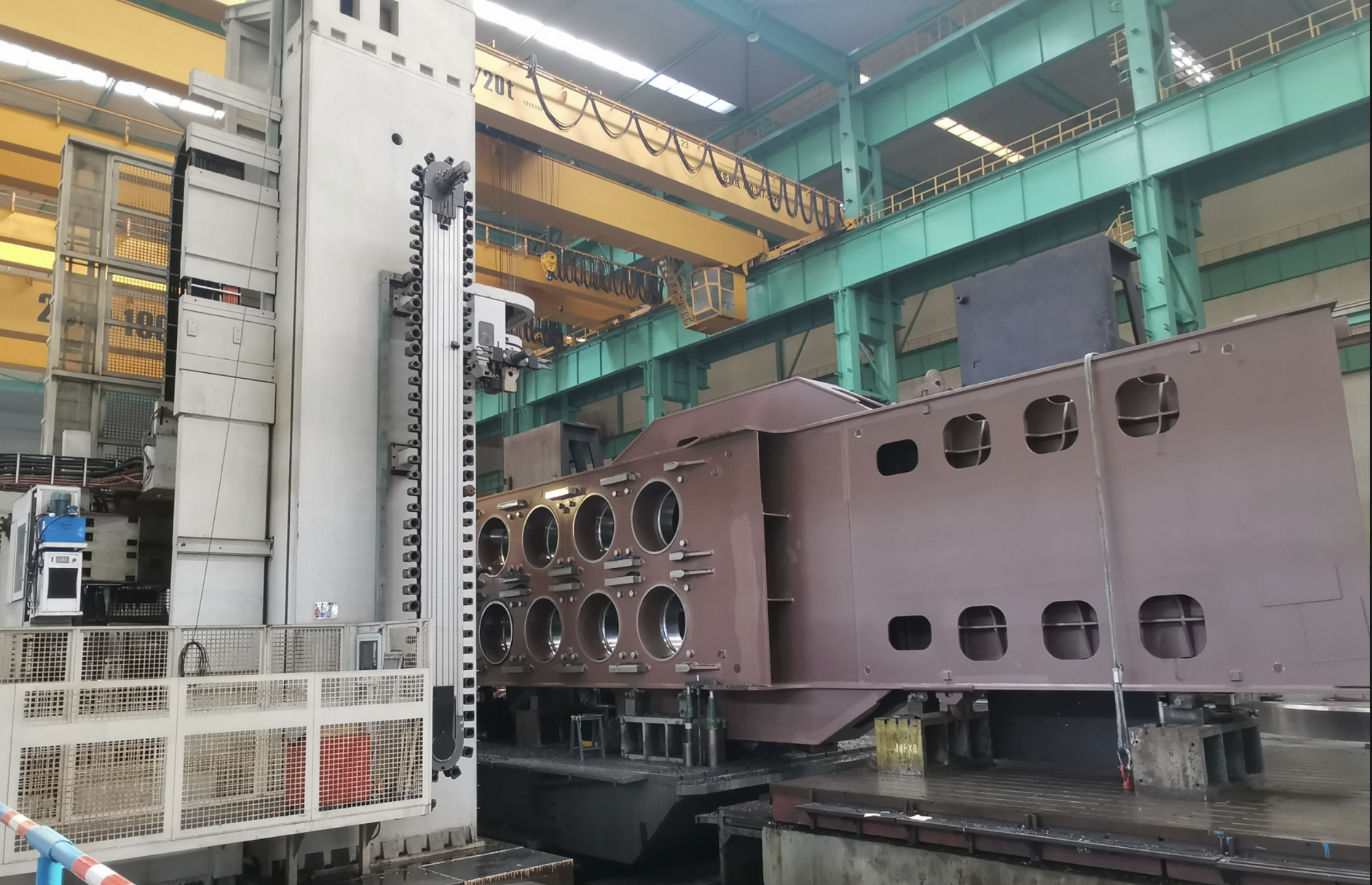
Post-weld machining at the Openex premise near Shanghai Port: heavy milling and drilling after fabrication is what converts a welded structure into a dimensionally controlled machine component.
A Practical Capability Checklist for Buyer Audits
Buyers who want to compare fabricators on evidence rather than presentation generally work through a short checklist. Each line can be answered with a document, a photograph or a measurement.
| Checklist item | Evidence to request |
|---|---|
| Envelope fit | Crane tonnage, machining travel, maximum turning diameter for the specific part |
| Process ownership | List of processes performed in house versus subcontracted |
| Welding qualification | WPS, PQR, welder qualification and PWHT procedures |
| NDT coverage | Method list (RT, UT, MT, PT, VT, LT), acceptance criteria and reporting format |
| Dimensional control | CMM capacity, flatness and hole-position tolerance achieved on comparable parts |
| Management systems | ISO 9001, ISO 14001, ISO 45001 and welding-specific certification |
| Shipping path | Container, breakbulk or barge options for oversize parts |
On management systems, Openex holds ISO 9001:2015 (certificate 11426Q01049R001), ISO 14001:2015 (11426E00739R001) and ISO 45001:2018 (11426S00656R001), each issued on 2026-04-16 and valid to 2029-04-15, with a scope covering the manufacture of machined parts, metal structures and sheet metal components. The welding-specific certification is EN ISO 3834-2, certificate 23/999-3834, issued through SGS on 2024-10-15 and valid to 2026-10-04, with a scope covering fusion welding of metallic material, welding processes 135 and 135-Auto, and material groups 1.1 and 1.2.
Where This Capability Is Applied
The clearest way to judge whether a fabrication capability fits a project is to look at the parts already delivered. The following examples come from Openex project records and published product data.
Energy storage and power quality
Openex has supplied steel shells for flywheel energy storage systems — 400 units, with reported stable operation over five years — where the shell is a 1.5 m diameter, 0.8 m high, 2-tonne component made from S355JR or A572 Grade 50 plate and required to hold vacuum above 1.0 × 10⁻⁹ Torr L/s within 30 seconds. The company also fabricates energy storage system cabinets with 1.5–5.0 mm material thickness and IP54, IP55 or IP65 protection ratings, and steel shelves and boxes for lithium battery energy storage (XHC-009: 1.1 × 1.1 × 2.2 m, 1,000 kg per unit, powder coated for anti-rust protection), including liquid-cooled cabinet programmes delivered at a scale of 1,500 units.
Port and container logistics
The AGV steel chassis, model PSA-1, is a steel chassis for container AGV and terminal tractor applications. Each unit measures approximately 15 × 2.7 × 3 m, weighs 10.5 tonnes and carries a 30-tonne load capacity, built from 25 mm S355JR or A572 Grade 50 plate with NM400 abrasion-resistant plate in wear areas. A European customer took delivery of 345 units, with reported stable operation beyond four years.
Steel mill and heavy industry handling equipment
For a Japanese steel mill, Openex fabricated 30 customised steel pallets, model JFE-1, each approximately 15 × 2.5 × 2.1 m and 10 tonnes, with a maximum load of 35 tonnes and a V-shaped top fitted with wooden cushioning to protect steel coils. The reported service life in that application is 20 years of stable operation.
Heat exchangers and pressure equipment
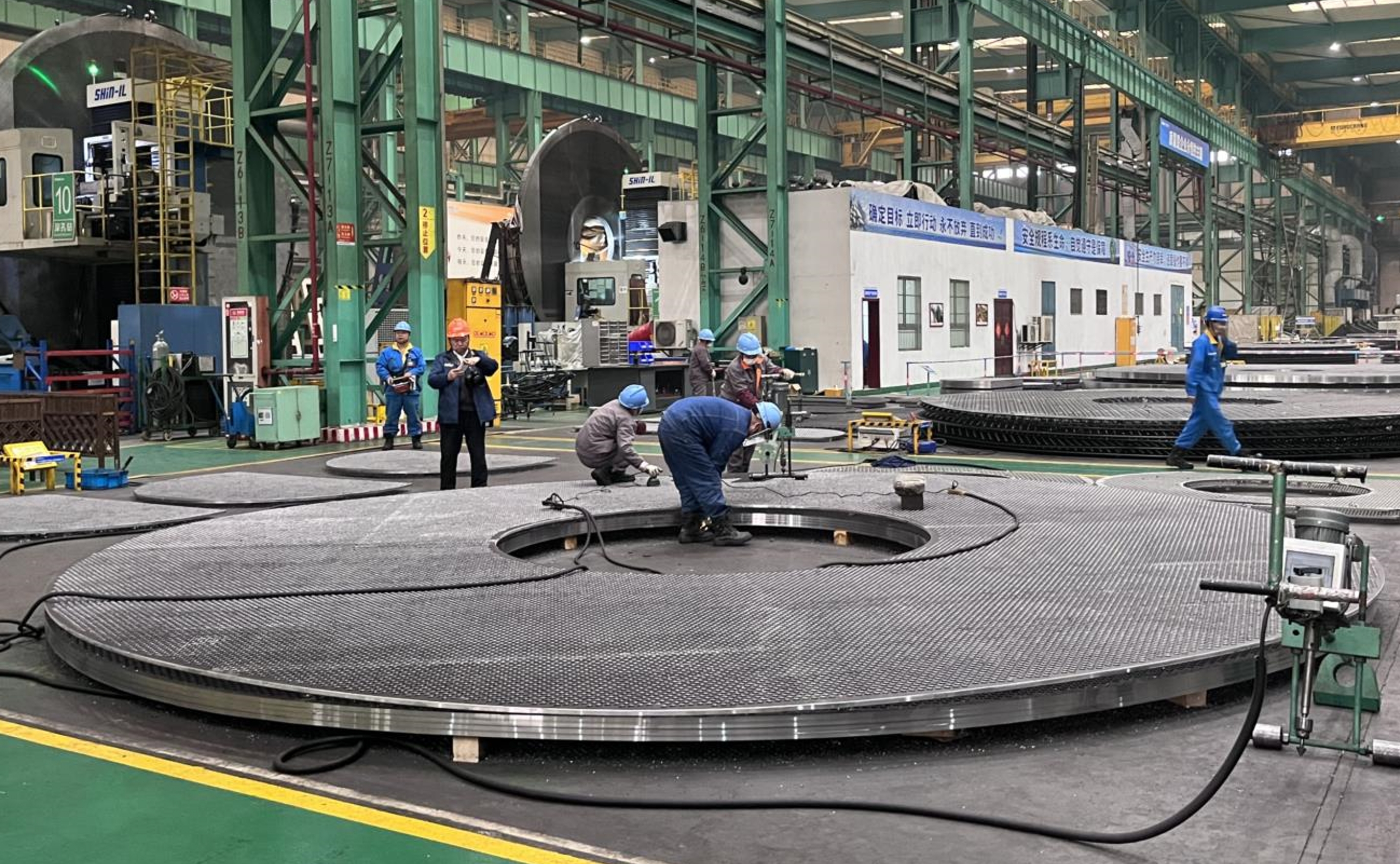
Large tube sheet machining. Tube sheets (Customized-J-01) can reach 10,000 mm in diameter and 600 mm in thickness, with drilling depth up to 1,000 mm and drilling precision of ±0.05 mm.
Tube sheets for heat exchangers and pressure vessels are produced in carbon steel, stainless steel, duplex stainless steel, titanium, stainless steel clad steel and high-strength alloy steel, with quality assurance covering CMM measurement and UT, PT, MT and PMI inspection. A power plant heat exchanger project in Indonesia involved 45 tonnes of tube sheets, with remote pre-shipment inspection. Pressure-related fabrication also includes condensers up to 70 tonnes, regenerative air heaters up to 8.5 m in diameter, 17.5 m in length and up to 95 tonnes, and rotary grinding mill shells of 8–12 m diameter with 40–100 mm plate thickness.
Renewable energy and structural components
For a hydropower station in Uruguay, Openex produced a 30-tonne turbine ring using a segmented approach — rough machining of separated pieces followed by assembly for final precision machining. Solar panel support structures were supplied at a scale of 1,000 units, and the Wind Tree project involved 300 tonnes of fabricated steel components weighing 3,590 kg per unit, pre-assembled for fit verification, then disassembled, hot-dip galvanized, powder coated and packed for shipment.
Comparing Supply Models: Integrated Fabrication Versus Split Procurement
Most heavy fabrication projects can be sourced in one of two ways: from a single integrated fabricator that welds and machines in house, or from a split supply chain where a welding shop, a machining shop and a finishing shop each handle part of the scope. The trade-off is real in both directions.
| Comparison dimension | Integrated fabricator | Split multi-vendor supply |
|---|---|---|
| Tolerance ownership | One party owns post-weld dimensional results | Responsibility can shift between welding and machining vendors |
| Transport between steps | Handled internally by crane and yard capacity | Heavy parts must be moved between sites, adding cost and risk |
| Process breadth | Limited to the processes actually held in house | Can cover casting, forging and specialist finishing directly |
| Order size economics | Favours medium to large quantities and container-load volumes | More flexible for very small quantities of a single process |
| Documentation | Single inspection and certification trail | Multiple documentation sets to reconcile |
The comparison is not a claim that one model is superior. A project consisting only of castings, or only of forging, is better served by a dedicated foundry or forge. The advantage of integration appears specifically when welding and machining interact — that is, when the final tolerance is created after the weld has cooled.
Limitations and Where This Supplier Is Not the Right Fit
Stating boundaries is part of capability disclosure, and buyers should treat their absence as a warning sign. For Openex, four boundaries are material.
- Subcontracted process families. Casting, forging, hot-dip galvanizing and powder coating are performed by long-term partner suppliers rather than in house. A project requiring only casting, only forging, or only an anti-rust finish — with no fabrication or machining content — is not a good match for Openex and is generally better placed directly with a specialised facility.
- Quantity economics. With minimum order quantities around 25 tonnes for welding fabrication and 15 tonnes for machining and finishing, small parts ordered in small quantities are not commercially efficient, because communication, setup and freight costs are largely fixed. Large components ordered in container-load quantities are the natural fit.
- Assembly scope. Openex supplies fabricated and machined components, and in some programmes the customer performs final assembly. In the flywheel energy storage programme, for example, the customer assembles the flywheel chamber; fabrication scope and assembly scope should be separated clearly at the enquiry stage.
- Engineering responsibility. Several heavy product lines are published as engineered reference configurations. Frame sections, weld design, press force and lifting points require load analysis, finite element assessment and fatigue evaluation by the responsible engineering party. Fabrication capability does not replace structural design responsibility.
Market Trend Signals in Heavy Fabrication Procurement
Across heavy equipment, energy and materials handling, three procurement patterns are widely observable and are consistent with the project mix described above.
Weldments are getting larger and more dimensionally demanding. Equipment such as press frames, machine bases, long crossbeams and skids increasingly specify machined interfaces rather than bolted-on adjustment. This shifts value from welding volume toward post-weld machining capacity, and favours suppliers that hold both.
Documentation expectations are rising. Buyers in European, North American and Japanese markets increasingly treat WPS/PQR records, NDT reports and third-party inspection options as standard deliverables rather than premium add-ons. Welding-specific certification such as EN ISO 3834-2 is being used as a screening criterion before technical review begins.
Energy transition demand is broadening the part mix. Battery energy storage cabinets, shelves and enclosures, flywheel shells, solar support structures and wind power components now sit alongside traditional oil, gas, power generation and mining fabrication in the same supplier's order book. This favours fabricators whose process chain is broad enough to move between industries without re-tooling philosophy.
Future Outlook
The direction of heavy metal fabrication supply is toward fewer, more integrated partners for large weldments, paired with more rigorous documentation. Fabricators that can cut, form, weld, heat-treat, machine and finish a multi-tonne part under one quality system — and then ship it through a port within reach of the factory — will continue to absorb scope that was previously distributed across four or five vendors. Buyers evaluating that capability should expect to audit equipment envelopes, process ownership, welding qualification, inspection coverage and shipping routes as a single package, because those five elements together define what can actually be delivered.
FAQ
What metal materials can be processed for custom fabrication projects?
Carbon steel and stainless steel are the most common inputs. In carbon steel, the frequently used grade families are Q235B (equivalent to A36, SS400 and S235JR) and Q355B (equivalent to A572 Gr50 and S355JR), with grades such as Q690 and NM450/NM500 also available. In stainless steel, SUS304 and SUS316L are the most common. Other metals including brass, bronze and aluminium can also be fabricated. Where a project requires special grades of casting or forging, these are sourced through long-term partner facilities.
Is Openex a manufacturer or a trading supplier, and what evidence can be reviewed?
Openex is a metal fabricator with two manufacturing premises, one near Xiamen Port and one near Shanghai Port. In-house processes include laser cutting, bending, machining, welding, drilling, punching, stamping, assembling and packaging; casting, forging, hot-dip galvanizing and powder coating are subcontracted to partner facilities. Verifiable evidence includes ISO 9001:2015, ISO 14001:2015 and ISO 45001:2018 certificates (each valid to 2029-04-15), EN ISO 3834-2 welding certification issued through SGS, workshop and equipment photographs, and a large CMM of 7 × 4 × 3 m capacity used for dimensional verification.
What drawing formats are accepted, and what information is needed for a quotation?
STEP, IGES, DWG, DXF, PDF and other 2D and 3D formats are accepted. For simple parts, 2D drawings alone are often sufficient. 3D drawings generally allow a faster quotation. 3D drawings alone are rarely enough to quote, because several items are usually only captured on a 2D drawing: tolerance information, welding requirements, surface roughness and chamfer details, the direction of cutting relative to the hot rolling direction, plate bending radius, specified metal material, heat treatment and stress relief requirements, and finish requirements such as hot-dip galvanizing, sandblasting, painting or powder coating. Where available, a physical sample can also help.
What is the minimum order quantity, and can a sample or first article be produced before mass production?
Minimum order quantity is project-based. For welding fabrication, published minimums start at 25 tonnes; for machining and finishing, at 15 tonnes. Prototyping, first-article production, spare parts machining and OEM/ODM batch production are all supported project types, and prototype development is listed among the value-added machining options. In practice, order economics improve with volume and repeat ordering, because container-load shipping, material purchasing at scale and shared overhead reduce unit cost. Small components ordered in small quantities are generally not economical and are not a recommended fit.
How are large weldments inspected and accepted before shipment?
Non-destructive testing covers RT, UT, MT, PT, VT and LT. Destructive testing, where specified, covers chemical analysis of element composition, mechanical testing (tensile for UTS, yield and elongation; impact toughness including low temperature; bend for ductility; hardness) and salt spray corrosion testing. Dimensional and visual inspection covers length, diameter, angle, roundness, straightness and position, plus surface roughness in Ra and Rz; specialised options include residual stress analysis and coating or plating inspection. Acceptance can be handled in three ways: by Openex with photos, videos and QA sheets; by the buyer's own inspectors; or by a third party appointed by the buyer.
Further equipment, process and product data is compiled in the Openex fabrication and machining capability brochure.