
Hemp Seed Certificates Side by Side: EU, USDA, BRC, Kosher, Halal
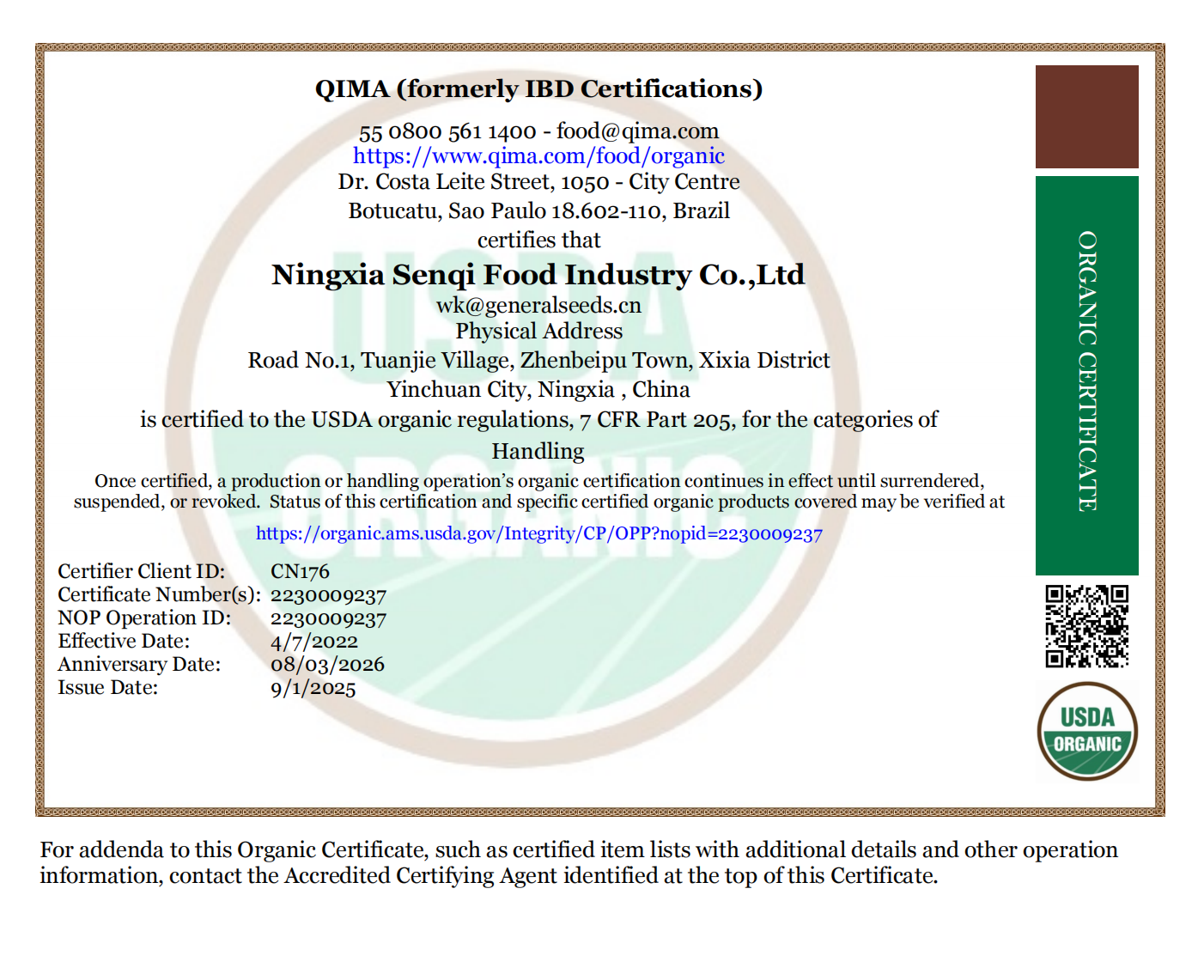
A certificate register entry summarises five fields. The certificate PDF remains the evidence an auditor will ask for.
A hemp seed certificate is a lookup key, not a badge. Every document in a supplier compliance file names a standard, an issuing body, a certificate number, a validity window and a market scope — and it is those five fields, read together and checked against the product form actually ordered, that decide whether a lot of organic hemp hearts, hulled hemp seed or hemp seed protein powder survives an import review.
This comparison reads five certificates held for Ningxia Senqi Food Industry Co., Ltd, a Chinese agricultural processor with its factory in Zhongning County, Ningxia. The company was founded in 2020, operates an 8,000 m² facility with an annual output of around 2,000 metric tons, and exports roughly 90% of production, with the EU and the United States as its main markets. Its hemp range covers organic hemp seed, organic hemp seed hulled, organic hemp seeds kernel, and organic hemp seed protein powder at 70% and 75%.
The exercise is deliberately narrow. It does not ask whether the supplier is good; it asks what each document can and cannot be used to prove, and where the gaps sit that a buyer has to close before signing.
Why the document file now decides more deals than the specification
Specifications travel well. A protein percentage, a moisture limit, a particle size — these are comparable across suppliers and easy to quote. Certificates travel badly, because a certificate is not a property of a product. It is a property of an operation, a process, or a product list, granted by a named body under a named standard, with a start date and an end date.
That distinction becomes commercial in two situations: when a buyer switches source country, and when the destination market tightens its import rules. Both are happening in hemp seed. Regulation (EU) 2018/848 has applied since 1 January 2022, and the EU organic import system moved to full compliance with the Regulation from 1 January 2025, which means operators in third countries supplying organic material into the EU must be certified against the EU standard rather than an equivalent one (European Commission; EUR-Lex).
Supply is responding. EU hemp cultivation area reached 37,740 hectares in 2024, recovering from 28,830 hectares in 2023, according to European Commission data. More European material raises the bar for imported organic hemp seed rather than lowering it: an importer competing with EU-grown organic hemp hearts has to show a documentary chain that a European buyer or retailer can audit quickly, without a round of emails.
Demand is moving in the same direction. Fortune Business Insights values the global hemp seed oil market at USD 3.26 billion in 2025, with Europe holding 33.91% of it. Grand View Research and Mordor Intelligence place the global hemp protein powder market at USD 217.3 million in 2025, with the organic segment projected to grow at a 5.98% CAGR through 2031. Organic hemp seed protein powder sits at the intersection of those two trends, and it is exactly the format where a buyer tends to ask for five documents at once.
The five documents, side by side
The table sets the documents against each other on the fields a buyer can verify without a phone call.
| Document | Standard | Issuer | Certificate number | Validity in the record | Market scope and coverage |
|---|---|---|---|---|---|
| EU Organic | Regulation (EU) 2018/848 | IBD | CN-BIO-122.156-0001518.2025.001 | No issue or expiry dates carried in the register entry used here | Global — preparation, distribution, storing and export of un-processed and processed organic plant-based agricultural products |
| USDA Organic (NOP) | NOP | QIMA (formerly IBD Certifications) | 2230009237 | Issued 1 September 2025; register shows expiry 1 January 2099 | USA and global organic-compliant markets — handling of organic hemp seed related products |
| BRC Global Standard for Food Safety | BRC Global Standard for Food Safety, Issue 9, August 2022 | Eurofins | F_EI0610_2025 | Issued 28 November 2025; expires 10 January 2027 | Global — sorting, optional re-drying and packing of dry goji berry, jujube, kernels, seeds, raisins, peanuts, beans, buckwheat, buckwheat powder and millet in plastic or aluminium bags |
| Kosher | Jewish Dietary Law (Kashrut) | KOF-K | RA44T-STOSC | Issued 27 October 2025; valid to 31 October 2026 | Global — 16 food products, including hemp seeds kernel, hemp seeds protein powder, millet, peanuts and pumpkin protein powder |
| Halal | Shariah (Islamic Law) | SSPY | SSPY-201318-32327-R2 | Issued 31 October 2025; valid to 30 October 2026 | Global — 12 food products listed on page 2 of the certificate; manufacturer named as Ningxia Senqi Food Industry Co., Ltd. |
Source: certificate register entries supplied for this comparison. A register entry is a summary; the issued PDF is the evidence.
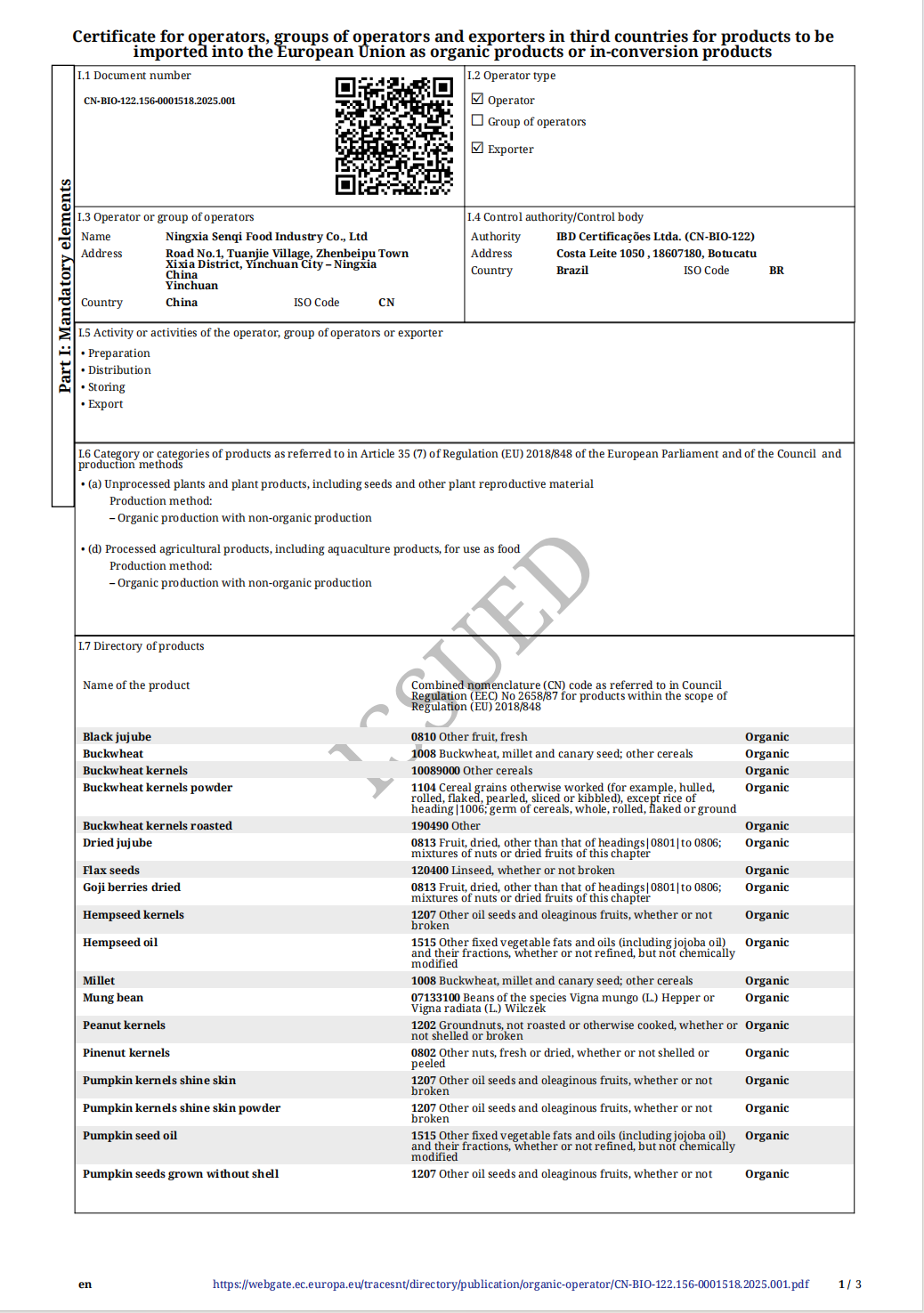
EU organic certification covers an operator scope — preparation, distribution, storing and export — not an approval of each individual SKU.
Reading each document: what it proves, what it leaves open
EU Organic — Regulation (EU) 2018/848, IBD, CN-BIO-122.156-0001518.2025.001
The EU organic entry authorises preparation, distribution, storing and export of un-processed and processed organic plant-based agricultural products. That wording matters. It is an operator-level authorisation covering a chain of handling steps, not a product-by-product statement that every hemp seed form leaving the site is organic.
Under the post-2025 import rules, the practical question is whether the specific lot carried a valid organic transaction document alongside the operator certificate. A buyer should ask for both: the operator certificate that establishes the supplier is inside the EU organic system, and the lot-level document that ties a shipment to it. The register entry used here carries no issue or expiry dates — a gap that has to be closed by reading the printed certificate, not by assuming.
USDA Organic (NOP) — QIMA, 2230009237
The NOP entry is issued by QIMA, formerly IBD Certifications, and is scoped to handling of organic hemp seed related products, with a US market focus and recognition in global organic-compliant markets. It was issued on 1 September 2025; the register shows an expiry of 1 January 2099, which is best treated as a system placeholder rather than a real end date. Read the printed date.
The same certification body family appears across the EU and US organic entries, which simplifies the audit conversation but does not merge the two standards. NOP and Regulation (EU) 2018/848 are separate rulebooks with separate labelling requirements, and a buyer sourcing for both markets should confirm each certificate independently rather than assume one implies the other.
BRC Global Standard for Food Safety — Eurofins, F_EI0610_2025
This is the only document in the file that speaks to food safety management rather than organic status or religious compliance. It certifies against Issue 9 of the BRC Global Standard for Food Safety (August 2022), issued by Eurofins, and its scope covers sorting, optional re-drying and packing of dry agricultural materials in plastic or aluminium bags. Validity runs from 28 November 2025 to 10 January 2027.
The scope is the useful part. It tells a buyer which physical steps on site have been audited: sorting, re-drying, packing. It does not cover farming, and it says nothing about organic status. A buyer who expects the BRC certificate to substitute for the organic file has misread the document.
Kosher — KOF-K, RA44T-STOSC
The kosher certificate is issued under Jewish Dietary Law (Kashrut) by KOF-K, covers 16 food products, and is valid to 31 October 2026. The product list names hemp seeds kernel and hemp seeds protein powder, alongside millet, peanuts and pumpkin protein powder.
Because the coverage is a product list, the buyer question is granular: which of the formats being purchased appear by name on page 2 of the certificate? Kernel and protein powder are named in the scope summary. Whole organic hemp seed and hulled hemp seed are not named there, so a buyer ordering hemp hearts for a kosher-certified line should ask for written confirmation that the form is covered rather than infer it.
Halal — SSPY, SSPY-201318-32327-R2
The halal certificate is issued under Shariah (Islamic Law) by SSPY, is valid to 30 October 2026, and covers 12 food products listed on page 2, with the manufacturer named as Ningxia Senqi Food Industry Co., Ltd. The entity match is the first check: the legal name on the certificate has to be the legal name on the contract and the shipping documents, or the certificate attaches to a different party than the one invoicing.
As with kosher coverage, the product list is the operative detail. Twelve products are enumerated; the buyer needs the form being purchased to be among them.
Matching certificate coverage to product form
Buyers rarely fail on the certificate. They fail on the mapping between certificate and SKU. The table below translates the file into format-level questions.
| Format | Typical use | Documents that carry the weight | Question to put to the supplier |
|---|---|---|---|
| Organic Hemp Seed (whole, dried and unroasted) | Sprinkles, baking, cereals, salad toppings | EU Organic; USDA NOP; BRC for sorting and packing | Is the whole-seed form inside the organic operator scope, and is it named on the kosher and halal product lists? |
| Organic Hemp Seed Hulled (hemp hearts) | Smoothies, cereals, salad toppings, baking | EU Organic; USDA NOP; product-list check on kosher and halal | Hulled hemp hearts are not named in the kosher scope summary — is the form explicitly covered? |
| Organic Hemp Seeds Kernel | Baking, cereals, toppings, protein extraction | EU Organic; USDA NOP; Kosher (named); Halal list check | What batch-consistency data accompanies repeated kernel shipments? |
| Organic Hemp Seed Protein Powder 70% | Smoothies, protein blends, bakery enrichment | EU Organic; USDA NOP; Kosher (named); BRC for packing | Which specification and third-party laboratory report supports the protein figure and the ingredient declaration? |
| Organic Hemp Seed Protein Powder 75% | Sports nutrition and supplement blends | Same as 70%, plus a separate specification sheet | Is the 75% grade covered by the same certificates, or does it sit outside a listed product? |
Application logic sits on top of the certificate logic. Sprinkles and salad toppings favour hulled seed and kernels for texture; cereals and baking tolerate whole seed or kernel; smoothies and supplement blends push buyers toward protein powder, where the organic documentation and the protein specification have to agree. None of those application choices changes the certificate requirement — they change which part of the certificate file becomes decisive.
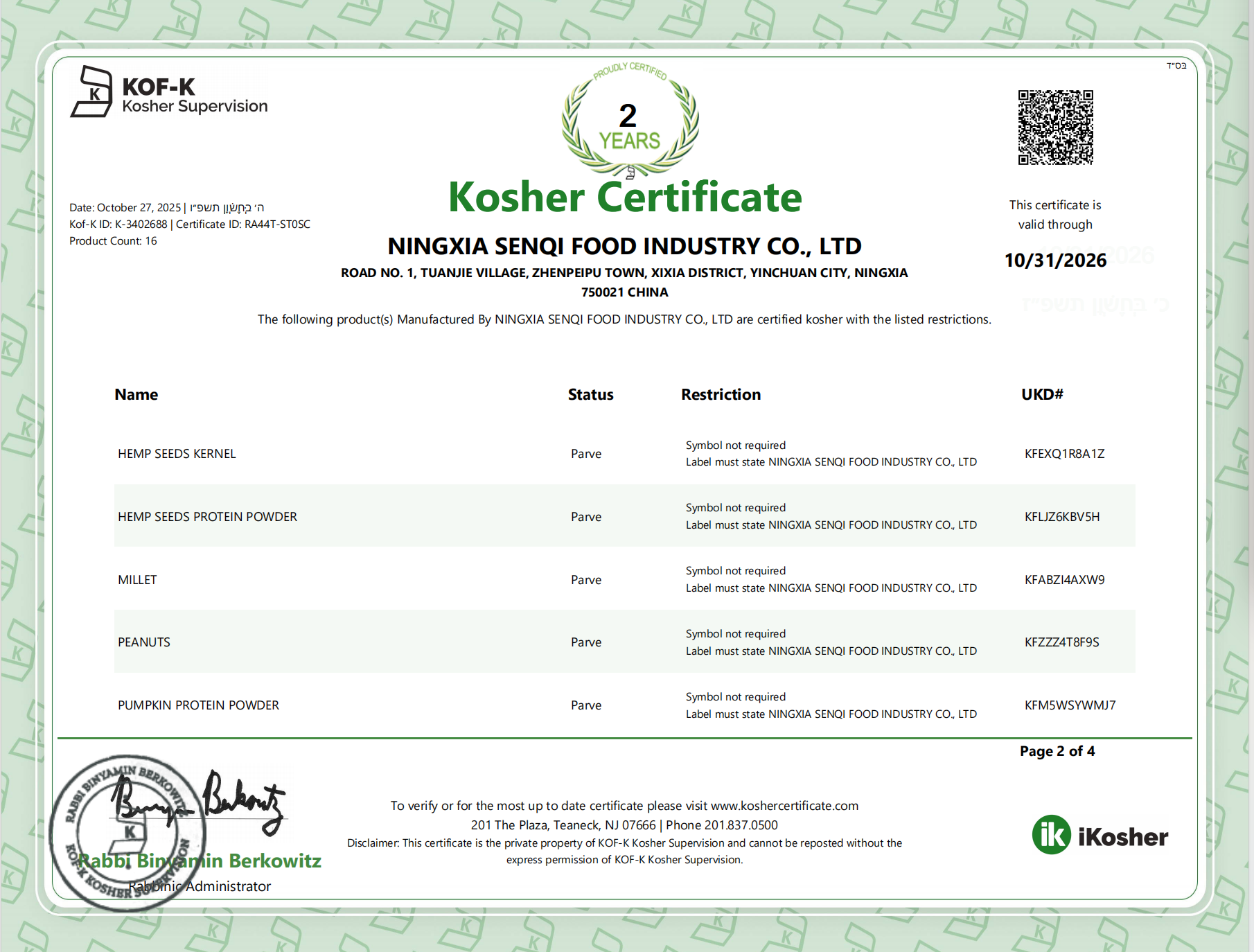
Religious dietary certificates attach to enumerated product lists, so coverage has to be checked form by form.
The attributes the file does not certify
Four attributes come up in almost every dietary supplement brief: non-GMO, gluten-free, vegan and additive-free. None of the five documents in this file certifies any of them. The organic standards address production method; BRC addresses food safety management; kosher and halal address religious dietary compliance. That is their job, and stretching them to cover gluten or genetic status is how specification disputes start.
The correct route for those attributes is the product specification plus testing. The manufacturer states that quality control is maintained through third-party laboratory testing, which is the right mechanism: a lot-level certificate of analysis from an independent laboratory, matched to the agreed specification, is what a supplement buyer can present to a technical reviewer. For protein powder grades, the ingredient declaration should also be read directly, because an additive-free claim depends on the formulation, not on the certificate file.
Where this certificate file has limits
- Register entries are not certificates. The EU organic entry carries no dates, and the US entry carries a long-dated expiry. Both require the printed PDF before a shipment is booked.
- Organic scope is operator-level. It authorises handling steps; it does not by itself prove that a particular SKU or lot is organic. The lot-level organic document is the missing link.
- BRC scope is site and process. It covers sorting, re-drying and packing — not farming, and not organic status.
- Product-list coverage is partial by design. Kernel and protein powder are named on the kosher list; hulled and whole seed are not named in the scope summary.
- No document here is a lot release. A certificate describes a system; a certificate of analysis describes a batch. Buyers need both.
- Renewal dates cluster. Kosher expires 31 October 2026 and halal 30 October 2026, with BRC running to 10 January 2027. A purchase covering Q4 2026 sits close to two renewal dates and should be conditioned on renewal evidence.
- Company scale is a factor, not a flaw. The supplier was founded in 2020, runs an 8,000 m² facility and reports 200 MT monthly capacity against roughly 2,000 metric tons of annual output. Its Australian wholesale programme — 50 to 80 metric tons supplied over 24 months for health food use, cited for high purity and stable batch consistency — is evidence of repeatability over time, but it is one programme, not a guarantee of capacity under a larger contract.
Qualifying a manufacturer for imported dietary supplement supply
The sequence below turns the certificate file into a decision. It is written for an importer or brand owner placing organic hemp seed, hulled seed, kernels or protein powder into a regulated supplement or health food channel.
- Match the legal entity. The name on the certificate must equal the name on the contract, the invoice and the packing list. The halal certificate names the manufacturer explicitly, which makes this check straightforward.
- Match the scope to the form and the process step. Organic scope covers preparation, distribution, storing and export. BRC scope covers sorting, re-drying and packing. If the supplier performs a step outside those descriptions, ask what covers it.
- Match the validity window to the shipment and shelf-life window. A certificate that expires during the contract period is a renewal risk, not a compliance failure — but it has to be tracked.
- Match the market. EU organic for Regulation (EU) 2018/848 destinations, NOP for the United States, kosher and halal for the relevant consumer segments.
- Request lot-level evidence. A certificate of analysis from a third-party laboratory, matched to the agreed specification, including the stated THC content below 0.3% for the industrial hemp material.
- Confirm the physical and commercial parameters. Dried and unroasted material for food ingredient or oil extraction use, bulk or 25 kg woven bags, a 500 kg minimum order, and a 10 to 20 day lead time against monthly capacity of 200 MT.
- Test repeatability. Ask for shipment history on the same format. The 24-month Australian wholesale programme is the kind of reference that answers this question better than a catalogue.
- Set a document calendar. Record the renewal dates at contract signature and require renewed certificates as a condition of the next order.
Purchasing terms and acceptance criteria to settle before ordering
| Term | What to write down |
|---|---|
| Product form and grade | Organic hemp seed, hulled, kernel, or protein powder at 70% or 75%, with the specification sheet referenced by revision. |
| Organic evidence | Operator certificate plus lot-level organic transaction document for each shipment. |
| Food safety evidence | BRC certificate F_EI0610_2025 valid at shipment date, plus a third-party laboratory certificate of analysis per lot. |
| Religious compliance | Written confirmation that the purchased form appears on the kosher (RA44T-STOSC) and halal (SSPY-201318-32327-R2) product lists, with copies of page 2. |
| Product attributes | Non-GMO, gluten-free, vegan and additive-free positions stated in the specification and supported by test reports, not by the certificate file. |
| Customs classification | HS code 12079991 for hemp seeds, whether or not broken, excluding sowing seed, in the EU and UK. |
| Commercial basics | 500 kg minimum order, 10 to 20 day lead time, 200 MT monthly capacity, bulk or 25 kg woven bags, OEM and ODM options including private-label marking. |
| Renewal condition | Certificates renewed before expiry as a condition of continued supply; kosher and halal both expire in late October 2026. |
Market signals behind the documentation burden
Documentation scrutiny is rising with the market, not independently of it. DataM Intelligence puts the global hemp seeds market at USD 5.98 billion in 2025, projected to reach USD 10.84 billion by 2033. That figure should be read with care: another research house, IMARC Group, reports USD 1.24 billion for the same year, and the gap is a definitional one, driven by whether downstream oil and protein products are folded into the seed total. Buyers comparing market studies face the same discipline they face with certificates — check what the number is scoped to before using it.
The structural signal is stronger than the headline. European cultivation recovering to 37,740 hectares, Europe holding 33.91% of a USD 3.26 billion hemp seed oil market, and organic protein powder growing at a 5.98% CAGR through 2031 all point the same way: organic hemp inputs are becoming a mainstream food and supplement ingredient, and mainstream channels audit documents rather than accept claims.
What changes next
Three shifts are worth planning for. First, certificate verification is moving from PDFs in email threads to lookup by number, which rewards suppliers who keep their register entries accurate and dated. Second, the EU compliance-based import model puts more weight on the operator's control body and less on third-country equivalence, so the practical question for importers becomes which control body stands behind a shipment rather than which logo sits on the label. Third, as organic protein powder volumes grow, buyers will increasingly ask for form-level coverage on religious dietary certificates rather than entity-level coverage, because a product list that names kernel and protein powder but not hulled seed is a real limitation in a hulled-seed programme.
For buyers, the useful habit is simple: read five fields per document — standard, issuer, number, validity, scope — then check the scope against the form on the purchase order. That habit resolves most of what a certificate file can and cannot answer.
FAQ
What does a certificate number such as CN-BIO-122.156-0001518.2025.001 actually confirm?
It confirms that an operator has been certified by IBD against Regulation (EU) 2018/848, with a scope covering preparation, distribution, storing and export of un-processed and processed organic plant-based agricultural products, recognised in global markets. It does not confirm that a specific lot is organic; that requires the lot-level organic transaction document issued for the shipment.
Which document in this file covers food safety rather than organic status?
The BRC Global Standard for Food Safety certificate, number F_EI0610_2025, issued by Eurofins against Issue 9 of the standard (August 2022) and valid from 28 November 2025 to 10 January 2027. Its scope is sorting, optional re-drying and packing of dry agricultural materials in plastic or aluminium bags. The EU organic, USDA NOP, kosher and halal documents address organic production method or religious dietary compliance instead.
Do the Kosher and Halal certificates cover every hemp seed form?
Coverage is defined by enumerated product lists. The kosher certificate RA44T-STOSC covers 16 food products including hemp seeds kernel and hemp seeds protein powder. The halal certificate SSPY-201318-32327-R2 covers 12 food products listed on page 2. Whole seed and hulled seed are not named in the kosher scope summary, so a buyer ordering those forms should obtain written confirmation of coverage rather than assume it.
How should buyers treat the validity dates across the five certificates?
The kosher certificate is valid to 31 October 2026 and the halal certificate to 30 October 2026; the BRC certificate runs to 10 January 2027; the USDA NOP certificate was issued 1 September 2025 with a register expiry of 1 January 2099, which should be verified against the printed document; the EU organic register entry used here carries no issue or expiry dates at all. Dates should be recorded at contract signature and checked again before each shipment, especially for orders spanning late 2026.
What commercial terms and acceptance criteria should be confirmed before qualifying a hemp seed manufacturer for imported supplement supply?
Confirm the legal entity name against the certificate, the product form and grade against the specification, lot-level organic and third-party laboratory documents against each shipment, and the physical parameters: dried and unroasted material, THC content below 0.3%, bulk or 25 kg woven bags. Commercially, the parameters on file are a 500 kg minimum order, a 10 to 20 day lead time and 200 MT monthly capacity. Attributes such as non-GMO, gluten-free, vegan and additive-free sit in the specification and test reports, not in the certificate file.
For buyers who want the underlying company data behind this comparison, the manufacturer public site is www.generalseeds.cn, and the company brochure is available for download here: Senqi Food brochure (PDF).
Есть вопросы или нужны дополнительные детали?
Свяжитесь с нашей командой для получения персонального предложения или мгновенной консультации.
Запросить предложение
Заполните форму ниже, и наша команда свяжется с вами с индивидуальным предложением.
Прямой чат WhatsApp
Предпочитаете общаться в реальном времени? Напишите нам в WhatsApp для мгновенной помощи и быстрых ответов.
- Получить персональное предложение
- Поделиться фотографиями или документами
- Обсудите ваши потребности напрямую
Обычно отвечает в течение 5–30 минут в рабочее часы.