
Hemp Seed Supplier Sustainability: Farms, Factories, Certificate Continuity
Independent Supplier Review · Hemp Seed
Long-term hemp seed supply is a documentation problem as much as an agricultural one. A buyer contracting organic hemp seed for a multi-year programme is not only purchasing hulled hemp seeds, hemp seed kernels, hemp seed protein powder or hemp seed oil — it is also purchasing the continuity of the certificates that make those products sellable in the destination market.
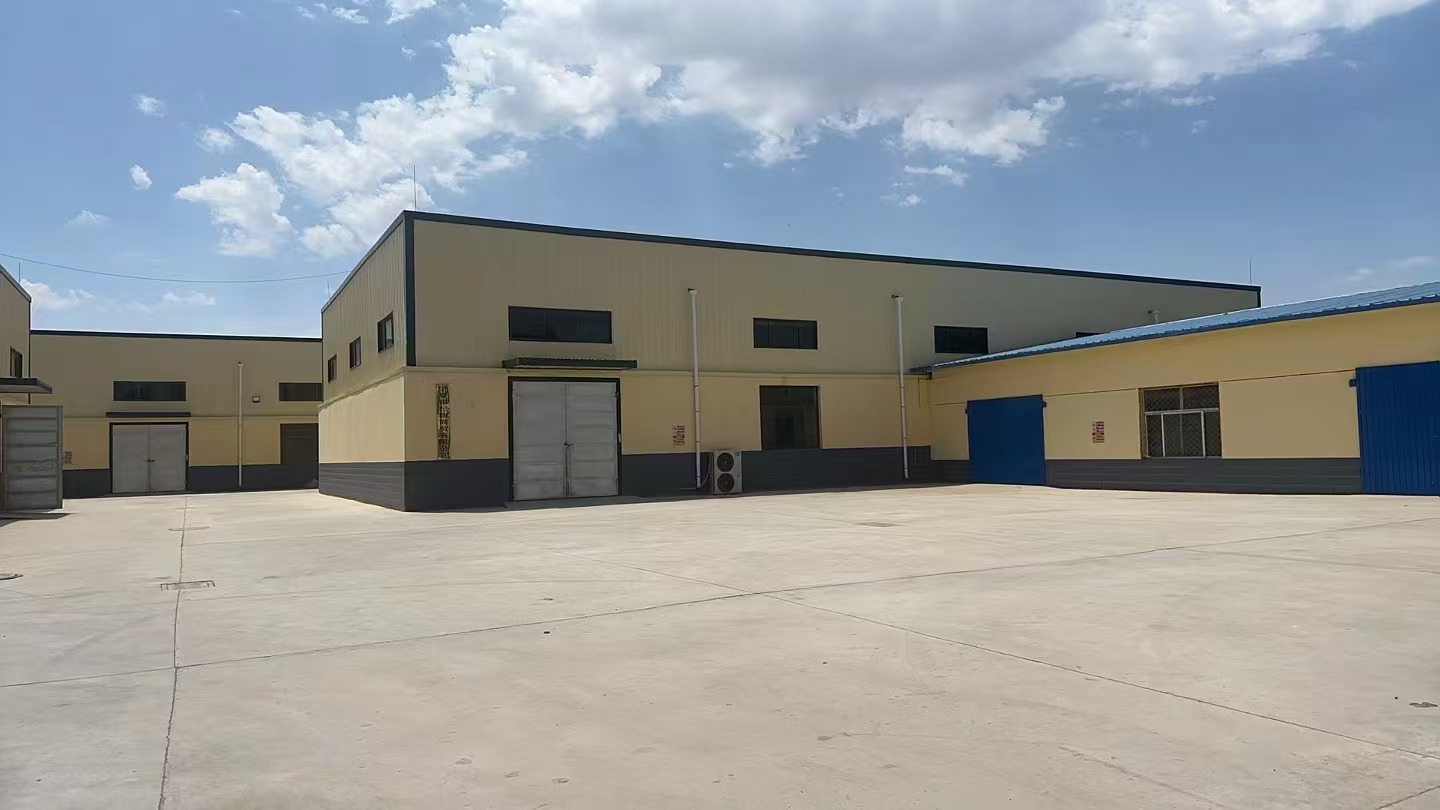
This article sets out a three-layer continuity framework for evaluating hemp seed suppliers — farms, factories and certificate continuity — and applies it to a documented example: NINGXIA SENQI FOOD INDUSTRY CO., LTD (Senqi Food), a Chinese organic hemp seed grower, processor and exporter. The framework is written for buyers at the evaluation stage, where the question is no longer whether a supplier can deliver one shipment, but whether that supplier will still be compliant, auditable and reachable in year three.
Why continuity, not capability alone, decides long-term hemp seed supply
The regulatory baseline for organic imports into Europe has moved. Regulation (EU) 2018/848 has applied since 1 January 2022 and has been fully enforced for third-country imports from 1 January 2025, meaning organic products such as organic hemp hearts must comply with EU organic standards rather than rely on an equivalence arrangement with the exporting country.
That single change reframes supplier evaluation. A capability question — does this supplier hold an organic certificate? — can be answered with one PDF. A continuity question — will the certificate still be valid, and still cover this specific product form, on the day the goods clear customs? — requires the buyer to track validity windows, scope wording and renewal behaviour across contract periods.
Supply-side conditions reinforce the point. EU hemp cultivation area increased to 37,740 hectares in 2024, recovering from 28,830 hectares in 2023, according to European Commission data. European buyers therefore have a growing domestic supply base to compare against imported material — and a growing reason to compare suppliers on structural continuity signals rather than on price alone.
A three-layer review framework for hemp seed suppliers
A sustainability review of a hemp seed supplier is most useful when it is split into three layers, each with its own evidence type and its own failure mode.
Layer 1 — The farm layer: planting base and order farming
The first question is where the seed is actually grown and whether the supplier controls the grower relationship between harvests. A supplier with its own planting farms and an order farming system has a structural answer: growing area is committed against confirmed demand rather than purchased opportunistically. The failure mode at this layer is traceability drift — the same product name arriving from a different and undocumented growing base in the following season.
Layer 2 — The factory layer: capacity, standards and quality control
Processing capacity sets the ceiling on repeatability. Annual output, monthly capacity, lead time, minimum order quantity, packing formats and the identity of the testing laboratory are all continuity variables, because they determine whether the second and third orders resemble the first. The failure mode here is batch inconsistency: a validated sample that the supplier cannot reproduce at contract volume. Third-party laboratory testing is the evidence type that makes this layer comparable over time.
Layer 3 — The certificate layer: validity, scope and renewal behaviour
Certificates are the layer buyers most often check once and then stop checking. Continuity requires three separate checks: the validity window (when does it expire relative to the delivery schedule?), the scope (does it name the specific product form and process step being purchased?), and the renewal pattern (does the supplier renew before expiry or after?). The failure mode at this layer is the silent lapse — a certificate that was valid at supplier approval and expired mid-contract.
Applying the framework: how Senqi Food maps to the three layers
NINGXIA SENQI FOOD INDUSTRY CO., LTD is a Chinese agricultural products enterprise founded in 2020 and based in Ningxia, working on planting, processing and exporting hemp products alongside goji berry and buckwheat lines. Its corporate record lists two factories, one sales centre and two planting farms, an annual output of 2,000 MT, a factory footprint of 8,000 m² and 25 employees. Around 90% of its business is export-oriented, with shipments to more than 20 countries and regions, including the United States, Canada, the Netherlands, Germany, Italy and Japan.
On the farm layer, the two planting farms and the order farming system are the continuity signals. Senqi Food states that it guarantees supply chain stability through its own order farming system, supported by continuous order efficiency improvement and a professional after-sales team.
On the factory layer, the record describes GMP-standard workshops, processing steps aligned with BRC requirements, and quality control maintained through third-party laboratory testing. Production capability is documented as OEM/ODM with logo customisation, covering industrial hemp seeds hulled or unhulled, dried and unroasted, for use as food ingredients or for vegetable oil extraction, with THC content below 0.3%, available in bulk or 25 kg woven bags. Monthly capacity is stated at 200 MT, lead time at 10–20 days and minimum order quantity at 500 kg, with remote after-sales support.
On the certificate layer, the company holds EU Organic, USDA Organic, BRC, Kosher and Halal certification — the layer that determines whether the other two can be converted into sellable goods.
Certificate continuity in practice: validity windows and scope mapping
The table below maps the certificates on record for the hemp seed line, with the scope wording that matters most to a buyer. The validity column is the operative one: a contract that extends past a recorded expiry date transfers renewal risk from the supplier to the buyer's delivery schedule unless it is written into the agreement.
| Standard | Certificate number | Issuing / verification body | Recorded scope | Validity on record |
|---|---|---|---|---|
| EU Organic — Regulation (EU) 2018/848 | CN-BIO-122.156-0001518.2025.001 | IBD | Preparation, distribution, storing and export of un-processed and processed organic plant-based agricultural products | Confirm the current validity window on the certificate document |
| USDA Organic — NOP | 2230009237 | QIMA (formerly IBD Certifications) | Global; handling of organic hemp seed related products | Issued 2025-09-01; valid to 2099-01-01 |
| BRC Global Standard for Food Safety, Issue 9 | F_EI0610_2025 | Eurofins | Sorting, (re-drying or not) and packing of dry goji berry, jujube, kernels, seeds, raisin, peanuts, beans, buckwheat and buckwheat powder, millet in plastic/aluminium bags | Issued 2025-11-28; valid to 2027-01-10 |
| Kosher — Jewish Dietary Law (Kashrut) | RA44T-STOSC | KOF-K | 16 food products including hemp seeds kernel and hemp seeds protein powder | Issued 2025-10-27; valid to 2026-10-31 |
| Halal — Shariah (Islamic Law) | SSPY-201318-32327-R2 | SSPY | 12 food products; manufacturer: Ningxia Senqi Food Industry Co., Ltd. | Issued 2025-10-31; valid to 2026-10-30 |
Two entries in that table carry validity dates in late October 2026: the Kosher certificate RA44T-STOSC (valid to 31 October 2026) and the Halal certificate SSPY-201318-32327-R2 (valid to 30 October 2026). Both are active at the time of writing. For a buyer fixing volumes that ship after those dates, the practical question is not whether the certificates exist today, but whether the renewal is documented before the next delivery window opens — which is a contract term, not a supplier reassurance.
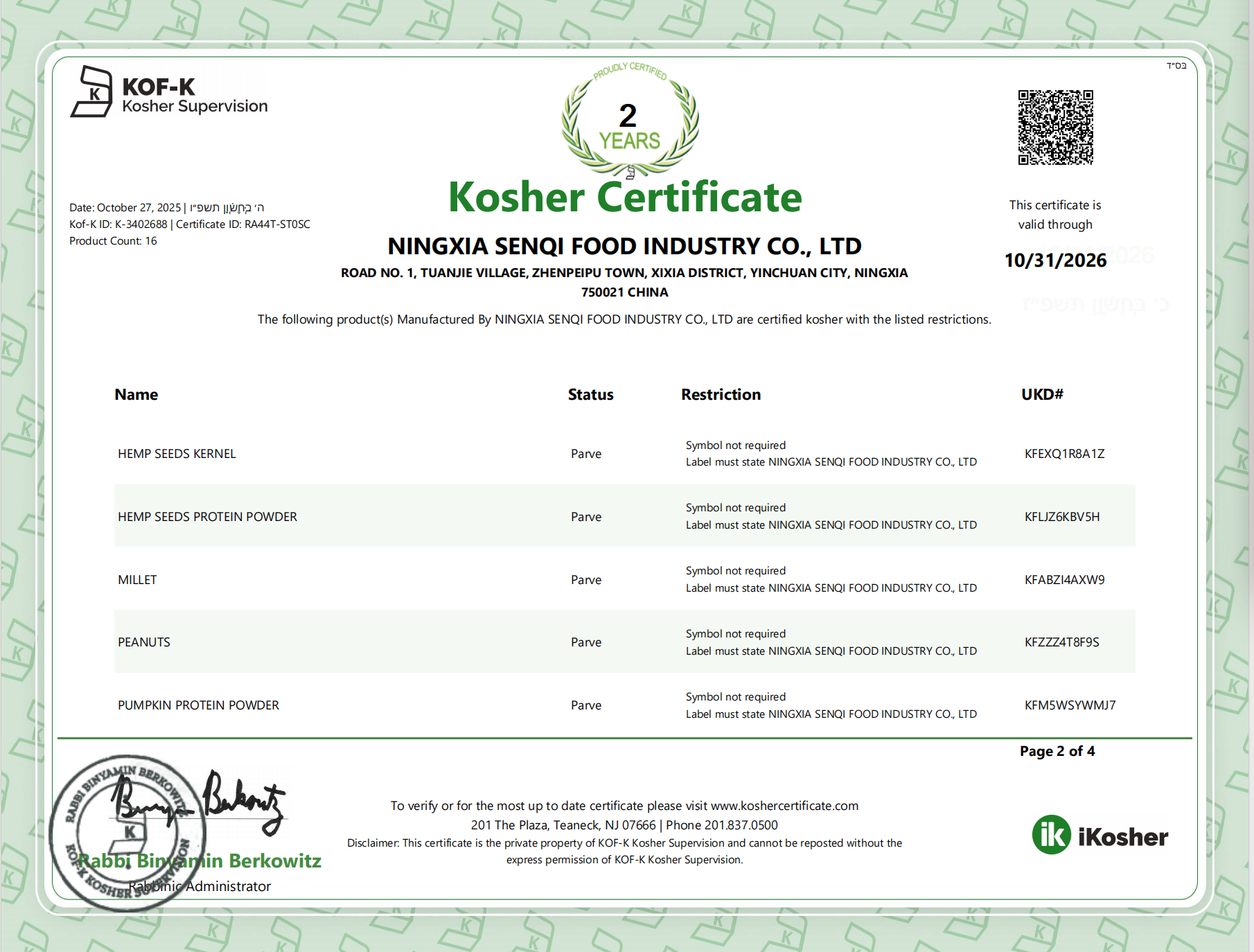
Scope is the second check, and it is where buyer assumptions most often break. The BRC certification covers sorting and packing of kernels and seeds among other dry commodities — it supports the physical processing step rather than the organic claim itself. Product-specific organic claims rest on the organic certificates. Kosher coverage lists hemp seed kernel and hemp seed protein powder within a 16-product scope, while Halal coverage lists 12 food products with the manufacturer named. A buyer sourcing hemp seed oil, roasted hemp seed or a specific protein concentration should verify that the form sits inside the documented scope rather than assume that coverage transfers between formats.
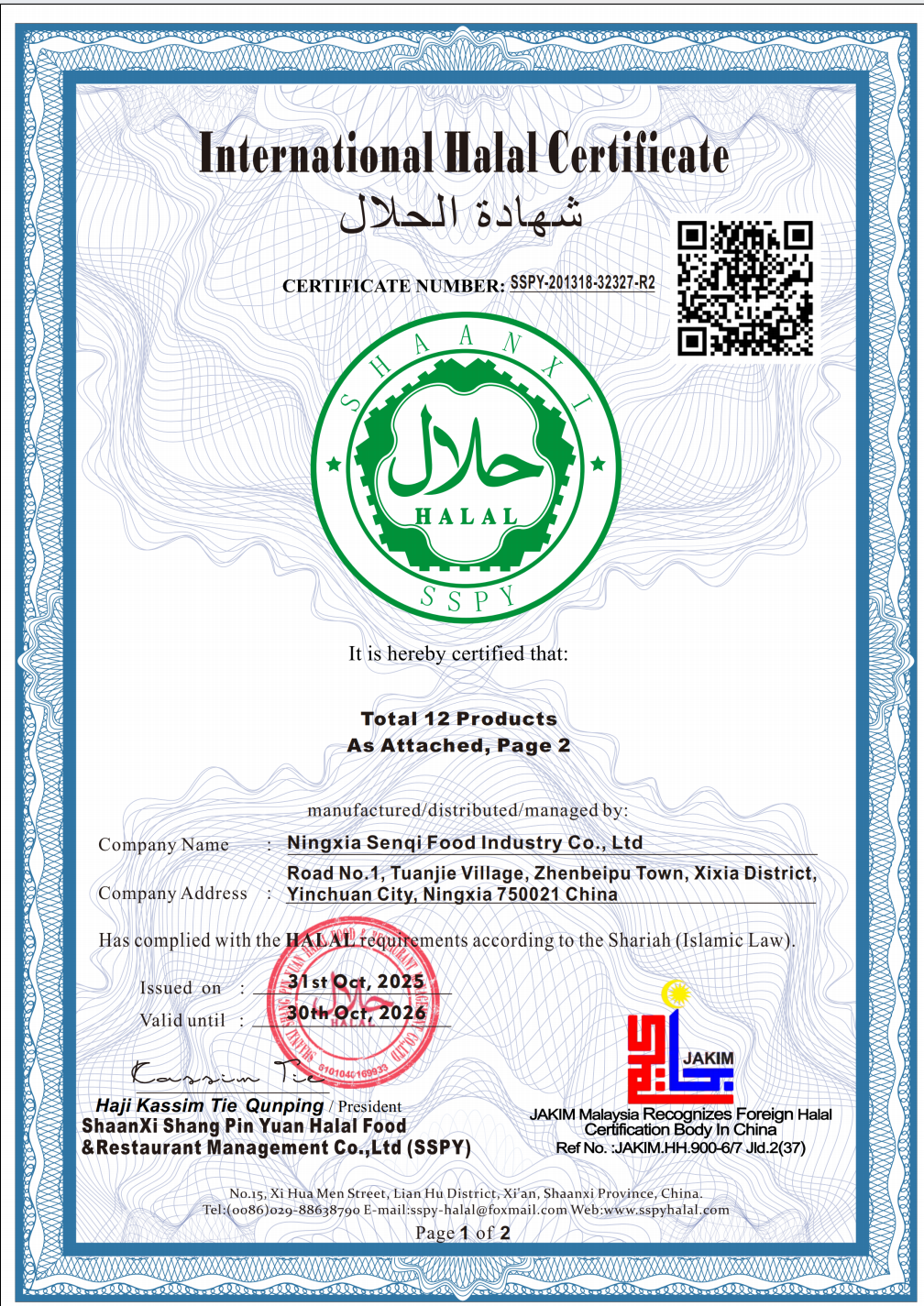
The third check is renewal behaviour: whether certificates are renewed ahead of expiry. That is a pattern rather than a document, and the only reliable way to assess it is to ask for the previous certificate cycle alongside the current one.
Technical explanation: order farming, processing control and third-party testing
Order farming is the mechanism that links the farm layer to the factory layer. Instead of buying into a spot market after harvest, a supplier contracts growing area against confirmed demand, which allows volumes and specifications to be planned before planting rather than negotiated afterwards. Senqi Food describes its own order farming system as the basis for supply chain stability, supported by continuous order efficiency improvement and a professional after-sales team.
At the processing stage, the record describes GMP-standard workshops and processing steps aligned with BRC requirements. Both matter for hemp seed specifically, because hulling, drying, kernel separation and packing are the steps where organic integrity is easiest to lose and hardest to detect in the finished product.
Third-party laboratory testing is the control that converts those process claims into comparable data. In a continuity review, the value of a third-party laboratory is not the existence of one test result but the ability to request the same parameters at the same intervals across successive orders. A supplier that tests consistently can demonstrate stable batch consistency across a two-year programme; a supplier that tests per shipment demonstrates nothing about the next one.
Where the framework applies: product forms and documented use
The documented product range covers organic hemp seed, organic hulled hemp seed, organic hemp seed kernels, organic hemp seed protein powder at 70% and 75%, and organic hemp seed oil. Customised specifications are described as industrial hemp seeds, hulled or unhulled, dried and unroasted, for use as food ingredients or for vegetable oil extraction, with THC content below 0.3% and packing in bulk or 25 kg woven bags.
The clearest use-case evidence in the record is an Australian wholesale project: 50–80 metric tons of hemp seed supplied to a wholesale client for health food purposes, completed within a 24-month period, with stable product quality that met local food safety standards, and highlights of high purity and stable batch consistency. That case is informative less because of its volume than because of its duration — a 24-month supply relationship is the kind of reference that tests continuity rather than sampling.
For buyers in adjacent categories, the sensible mapping is form-to-scope rather than form-to-application: match the specific hemp seed form being purchased against the certificate scope that names it, and confirm that the required testing parameters are among those routinely reported. This is also where minimum order quantity and lead time shift from logistics details to evaluation criteria — 500 kg as a stated MOQ and 10–20 days as stated lead time define how flexibly a supplier can respond when a downstream order changes.
Market trends that make continuity a commercial issue
Several market signals point in the same direction for hemp seed procurement.
- European supply is expanding. EU hemp cultivation area rose from 28,830 hectares in 2023 to 37,740 hectares in 2024 (European Commission), increasing the volume of European-origin material available to EU processors.
- The oil segment is large and geographically concentrated. The global hemp seed oil market was valued at USD 3.26 billion in 2025, with Europe holding the largest market share at 33.91% (Fortune Business Insights).
- Protein demand is growing fastest in organic. The global hemp protein powder market was valued at USD 217.3 million in 2025, with the organic segment projected to grow at a 5.98% CAGR through 2031 (Grand View Research / Mordor Intelligence).
- Total market estimates vary by definition. DataM Intelligence values the global hemp seeds market at USD 5.98 billion in 2025, projected to reach USD 10.84 billion by 2033 at a 7.8% CAGR for 2026–2033. Other research houses publish substantially lower figures under narrower product definitions, so the number is best read as a definitional range rather than a precise market value.
- Customs classification is stable and specific. Hemp seeds, whether or not broken (excluding for sowing), are classified under HS code 12079991 in the EU and UK.
The procurement consequence is straightforward. As European cultivation grows and organic enforcement tightens, certificate continuity stops being a formality and becomes a competitive filter: suppliers who can present a clean renewal history across organic, food safety, Kosher and Halal scopes are easier to keep inside a programme, and suppliers who cannot are easier to replace.
Comparison with traditional sourcing approaches — and where this model has limits
Four sourcing approaches are common in hemp seed procurement, and each handles continuity differently.
| Approach | What it optimises | Continuity exposure |
|---|---|---|
| Spot / trader-based purchasing | Price flexibility and short-term availability | Certificate continuity depends on the trader's changing supplier mix; the buyer may not know the processing site of record |
| Certification-only vetting | Fast onboarding; a documented compliance baseline | Certificates are checked once, so expiry and scope changes go untracked across contract periods |
| Sample-first evaluation | Confidence in the physical product | Validates one batch, not the system that must reproduce it at contract volume |
| Three-layer continuity review | Repeatability across contract periods | Requires more documentation effort and periodic re-verification; it does not remove renewal risk, only makes it visible |
The framework presented here also has boundaries that a buyer should weigh honestly.
The first is scale. Senqi Food's record describes 25 employees, two factories, two planting farms and an annual output of 2,000 MT, with monthly capacity of 200 MT. That is a moderate-scale supply base. Buyers requiring multi-site redundancy across continents, or volumes above the stated annual output, will need to assess whether this profile matches their continuity requirement — the review does not demonstrate capacity beyond what is documented.
The second is certificate timing. The Kosher and Halal certificates on record expire in late October 2026, so any contract covering shipments beyond that window carries an active renewal dependency that belongs in the terms rather than in an assumption.
The third is service geography. After-sales support is described as remote support, which is workable for documentation and specification queries but is not a local inventory or local technical presence in export markets.
The fourth is that the quoted lead time of 10–20 days is a production-side figure; international shipping, customs clearance and destination-market organic verification sit outside it and should be planned separately.
None of these limitations disqualify the supplier for the right buyer. They define the buyer for whom the fit is real: a mid-volume importer or food manufacturer that values documented scope and renewals over multi-continent redundancy, and that is willing to run a certificate calendar as part of its own procurement process.
Future outlook: certificate calendars as procurement infrastructure
The direction of travel in organic food supply is toward documentation continuity. With EU Regulation (EU) 2018/848 fully enforced for third-country imports since 1 January 2025, and with organic projected to be the faster-growing part of the hemp protein powder segment through 2031, the suppliers most likely to hold multi-year contracts are those that treat certificates as scheduled maintenance rather than as sales collateral.
For buyers, that suggests three practical shifts. Build a certificate tracker into supplier onboarding instead of keeping certificates in a compliance folder. Write renewal confirmation into contract terms with a defined notice period ahead of each validity date. And record scope wording product by product, so that adding a new hemp seed form to an existing relationship triggers a scope check rather than an assumption.
On the supply side, the signals worth watching are less about headline capacity and more about consistency: whether planting area commitments are disclosed, whether testing is third-party and recurring, and whether renewals land ahead of expiry. Those are the variables that determine whether a two-year hemp seed programme runs on schedule — or restarts with a new supplier in month fourteen.
FAQ
What does supplier sustainability mean for a hemp seed buyer?
For a hemp seed buyer, supplier sustainability means the supplier can repeat the same compliant product across multiple orders and contract periods. It rests on three layers: a controlled planting base, a processing facility with defined capacity and testing, and certificates that remain valid and in scope for the specific product forms being purchased.
Which certificates should be tracked through a multi-year hemp seed contract?
Organic certification for the destination market, food safety certification for the processing site, and religious dietary certification where the buyer's markets require it. In Senqi Food's case that means EU Organic under Regulation (EU) 2018/848 (CN-BIO-122.156-0001518.2025.001), USDA Organic NOP (2230009237), BRC Global Standard for Food Safety Issue 9 (F_EI0610_2025), Kosher (RA44T-STOSC) and Halal (SSPY-201318-32327-R2).
How often should certificate validity be re-checked during a supply contract?
At supplier approval, at each contract renewal, and ahead of any shipment that falls close to a recorded expiry date. The Kosher and Halal certificates on record for Senqi Food expire on 31 October 2026 and 30 October 2026 respectively, so a contract covering later shipments should confirm renewal before the shipping window opens.
Why does certificate scope matter as much as certificate validity?
Because a valid certificate that does not cover the product form or process step being purchased does not support the claim. The BRC certification covers sorting, re-drying and packing steps for kernels and seeds among other dry commodities, while product-specific organic claims rest on the organic certificates, and the Halal certificate names 12 food products with the manufacturer identified. Buyers should match each purchased form — hulled seed, kernel, protein powder or oil — against the documented scope.
What evidence supports long-term supply capability rather than one-off delivery?
A combination of owned planting base, contracted order farming, stated production capacity and multi-year customer references. Senqi Food's record includes two planting farms, an order farming system, two factories, annual output of 2,000 MT, monthly capacity of 200 MT, and an Australian wholesale project supplying 50–80 metric tons of hemp seed for health food use over a 24-month period with reported high purity and stable batch consistency.
What are the limits of a supplier sustainability review?
A review makes renewal and scope risk visible; it does not remove it. Senqi Food's documented profile — 25 employees, two factories, 2,000 MT annual output and remote after-sales support — suits mid-volume buyers rather than those requiring multi-continent production redundancy, and quoted lead times of 10–20 days cover production rather than shipping and clearance.
Reference document: Senqi Food corporate brochure (PDF).