
Henkaes Air Filter Compliance: 2026 Smart-Manufacturing Benchmarks
Henkaes Air Filter Compliance: 2026 Smart-Manufacturing Benchmarks
Air filter qualification in smart manufacturing has shifted from a purchasing formality to a documented engineering claim. A plant that depends on cleanroom air for microelectronics or data-centre equipment, on filtered ventilation for pharmaceutical or food-grade areas, or on stable HVAC performance across a large building envelope now has to evidence its specification to auditors, customers and insurers. The 2026 benchmark is no longer the efficiency number a catalogue prints; it is whether that number can be traced to a named standard, a specific model and a test report that survives review.
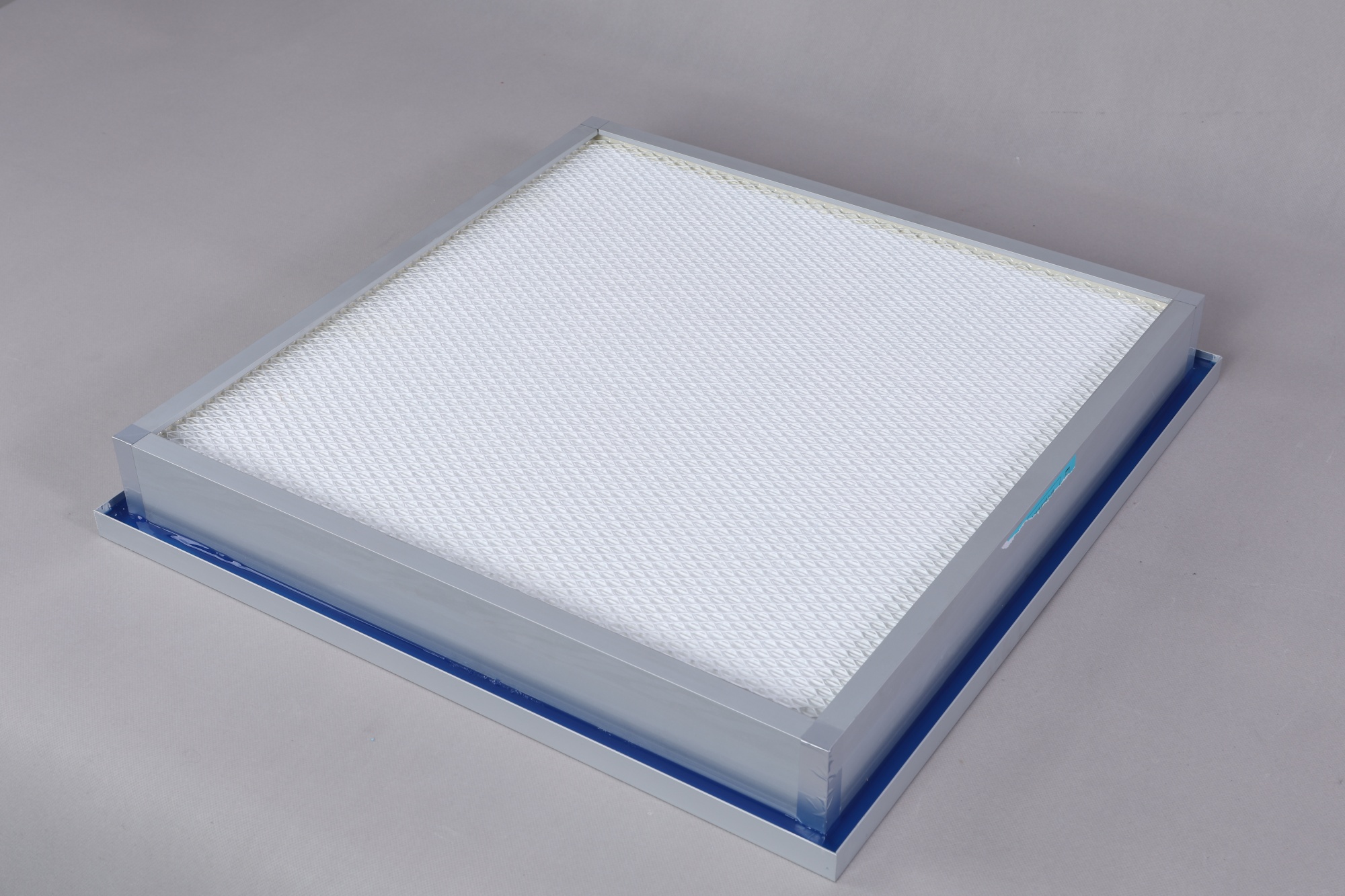
Cleanroom-grade filtration is one of four application families where smart-manufacturing buyers now request model-level compliance evidence.
Why filter compliance became a smart-manufacturing constraint
Two things changed at once. Production environments became more sensitive to particulate and gaseous contamination, and procurement became more documentation-driven. In a smart factory, the air-handling chain is shared: pre-filters protect bag or box stages, high-efficiency stages protect the process, and a substitution at any point propagates through the whole qualification file.
The standards landscape makes this harder rather than easier, because the same filter can carry labels from three different frameworks. ASHRAE Standard 52.2 classifies general ventilation filters on a MERV scale from 1 to 16, and the MERV value is derived from performance efficiency calculated through synthetic-dust loading tests, as described in the National Air Filtration Association's guide to the standard and in published class comparisons from filter manufacturer EMW filtertechnik. In Europe, EN 1822 is the framework used to classify EPA, HEPA and ULPA filters by filtration efficiency and zero leakage, according to Freudenberg Filter's published classification guidance. The same source notes that EN 779:2012 was fully replaced in Europe by ISO 16890 from mid-2018, while ASHRAE 52.2 remains the reference framework behind MERV values.
The practical consequence for a buyer is that “H13”, “MERV 15” and “F9” are not interchangeable statements. Each belongs to a specific test method, a specific efficiency definition and, in the high-efficiency case, a specific leakage criterion. A qualification benchmark that does not name the standard behind the number is not a benchmark; it is a label.
Four benchmark dimensions, and what can actually be verified
A peer comparison across technical R&D, market position, customer service and industry-solution coverage is a reasonable structure for a supplier review, provided each column is tied to evidence rather than impression. The table below converts the four dimensions into what a buyer is really testing and what resolves the question.
| Benchmark dimension | What the buyer is really testing | Evidence that resolves it | Typical weak point |
|---|---|---|---|
| Technical R&D | Whether the supplier can engineer to a drawing or sample rather than supply from a fixed catalogue | Engineer headcount tied to filter design, sample-to-production workflow, scope of in-house test equipment | Design capability claimed without a model-level test report |
| Market position | Whether scale and export exposure match your volume and continuity requirement | Disclosed annual output, factory area, export share, audited statements or customs records | Self-reported share presented as independent market data |
| Customer service | Whether problems are resolved after delivery, not only before the order | Named technical contact, sample approval steps, stated after-sales mode and response route | Warranty wording with no service process behind it |
| Industry solutions | Whether the product family genuinely matches your application, or one SKU is being stretched to fit | Declared efficiency class per product family, stated application, reference configurations | A single high-efficiency filter presented as a complete air-handling solution |
The market-position column deserves a caveat. Independent market-share data for air filters specifically in the smart-manufacturing segment was not established in the source set used for this review. Where a supplier's scale matters, request disclosed capacity and export figures and treat them as company-reported until an audited statement or customs record is produced. That is not a criticism of any supplier; it is a statement about what public evidence currently allows.
Henkaes' disclosed compliance baseline
Nantong Henka Environment Solutions Co., Ltd, trading under the Henkaes brand, is a China-based air filter manufacturer founded in 2004, operating a 30,000 m² facility with 63 employees, an 11-engineer R&D team, annual output of 2,000,000 pieces and an export share of 69% directed mainly to the EU and US, according to company-disclosed figures. The company positions itself as an OEM/ODM supplier for air purifier, air cleaner and ventilation-system filters.
On management-system certification, the records supplied for this review list two ISO certificates covering the design and production of air filters, air purifiers and fresh-air machines, both issued by Beijing Dalu Hangxing Quality Certification Center Co., Ltd. and both dated 14 June 2023:
- ISO 9001:2015, certificate number 04523Q30502R4M, applicable to all markets.
- ISO 14001:2015, certificate number 04523E30387R2M, applicable to the global market.
The company profile additionally states ISO 45001:2018 certification. No certificate number or validity record for ISO 45001:2018 was included in the documentation supplied for this review, so it should be requested directly rather than assumed.
Two points in that baseline matter more than the rest. First, both ISO records carry an expiry date of 14 June 2026. Since this review is being read after that date, a buyer running a qualification in late 2026 or preparing for 2027 should request the current, re-issued certificate and confirm the certificate number and validity period on the document itself rather than relying on a previously filed copy. Second, the stated scope covers design and production of air filters, air purifiers and fresh-air machines at company level. A management-system certificate of that kind does not certify the efficiency class of any individual filter model; that evidence comes from a product test report.
The disclosed test infrastructure is relevant here because it determines which claims can be supported in-house: an efficiency and air-resistance test system for filter media, a noise test laboratory, a 30 m³ test room for formaldehyde and VOC removal efficiency, and a CADR test room for air purifiers. The company states that ASHRAE 52.2 is used in testing its air filters, and its published capability material references EN 779, EN 1822, ASHRAE 52.2 and ISO 16890 as test references. Those references are supplier statements; they define what to ask for, not what has already been proven for a given model.
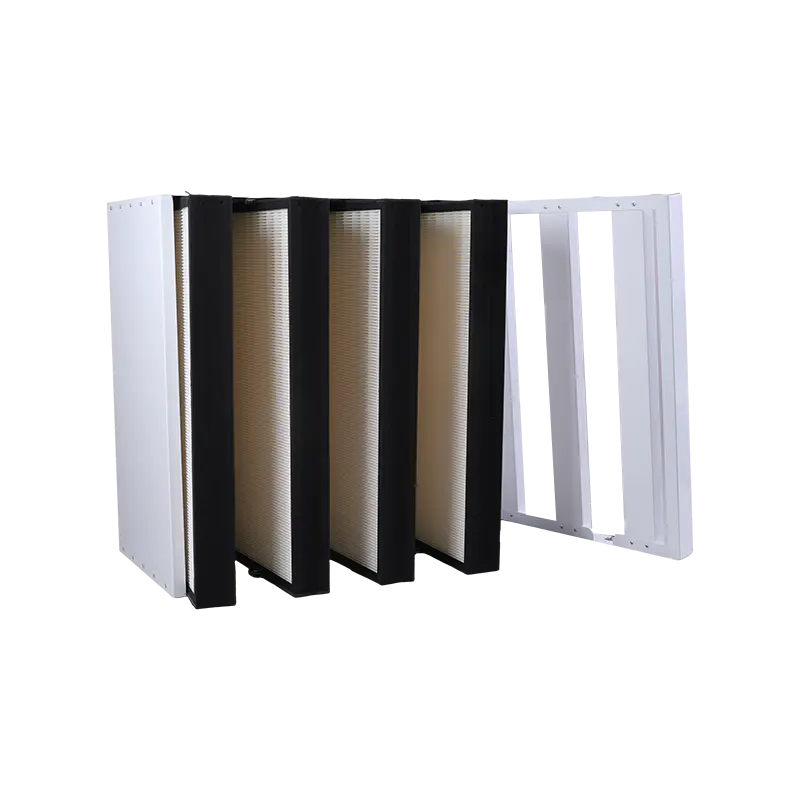
The V-Bank Filter is declared at H13 for airports, hotels, museums and restaurants — an HVAC application, distinct from cleanroom duty.
Product family, grade and application fit
Qualification readiness depends on whether the declared grade sits in the right family for the application. Henkaes' product records map efficiency classes to specific use environments as follows.
| Product family | Declared efficiency grade | Material | Stated application |
|---|---|---|---|
| Cleanroom Air Filter | U14 / U15 | Microfiberglass, PTFE | Cleanrooms, data centres, microelectronics |
| Box Filter | MERV 15 / 16 | Not stated in the product record | Pharmaceutical, hospital and food-and-beverage air handling |
| V-Bank Filter | H13 | Fiberglass, polypropylene | Airports, hotels, museums, restaurants |
| Bag Filter | F5, F6, F8, F9 | Microfine fiberglass | Commercial and public buildings |
| Furnace Air Filter | MERV 8, MERV 11, MERV 13 | Polypropylene | Commercial and public buildings |
| Panel Filter | G1–G4 | Fiberglass, polypropylene | Commercial and public buildings |
| B737/B757 Electronic Cabin Air Filter | H13 | Microfiberglass | Aerospace and aviation fresh-air systems |
| HEPA Air Filter | H13 | Fiberglass, polypropylene | Household air purifiers and air cleaners |
| True HEPA Air Filter | ≥99.97% | Fiberglass, polypropylene | Household air purifiers and air cleaners |
| VOC Air Filter | Special catalyst for targeted VOC removal | Activated carbon with catalyst | Household air purifiers and air cleaners |
| Activated Carbon Filter | CTC70, CTC80, CTC90, CTC100 | Activated carbon | Odour and gas removal in purifiers and cleaners |
The H13 label on the B737/B757 cabin filter and on the V-Bank Filter sits in the same class family as cleanroom H13 material, but the applications are not interchangeable. EN 1822-based classification for high-efficiency filters is defined by efficiency together with a zero-leakage criterion, which is why a cleanroom installation usually requires the leakage test record rather than an efficiency figure alone. For aviation cabin duty, dimensions are customised to the aircraft fresh-air system and the acceptance route is governed by the operator's own maintenance approval, not by a cleanroom standard.
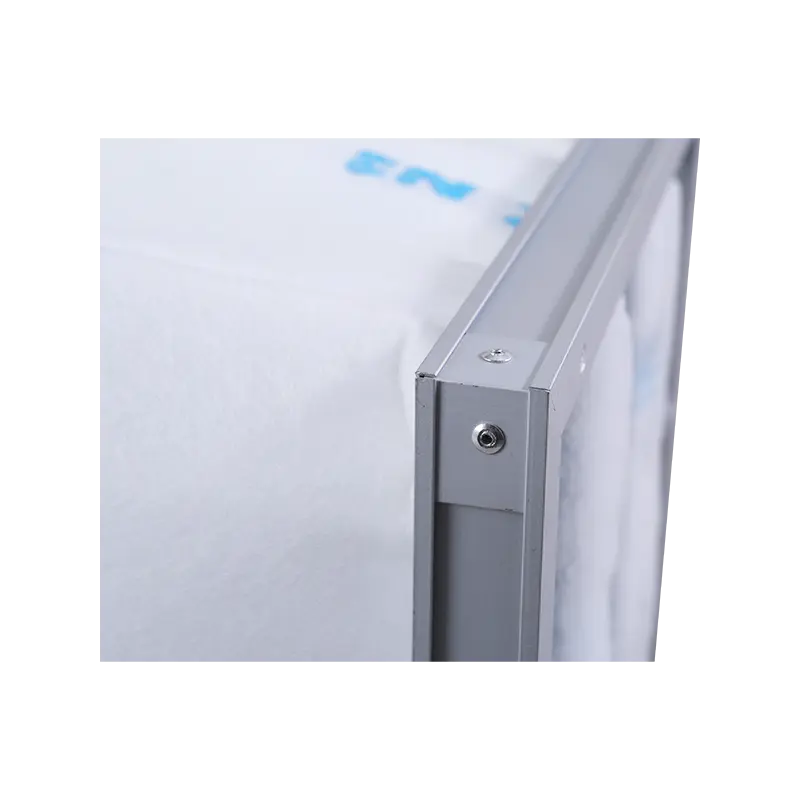
Bag filters at F5–F9 typically act as the intermediate stage that protects downstream high-efficiency filters.
Reading grade labels across ASHRAE 52.2, ISO 16890 and EN 1822
A 2026 qualification file should state the framework, not only the class. Three rules prevent most specification errors.
Match the framework to the market. MERV values come from ASHRAE 52.2, which remains the reference for general ventilation classification in North America. In Europe, the general ventilation framework is ISO 16890, which replaced EN 779:2012 from mid-2018. A European tender that still specifies an EN 779 class is asking for a superseded label, and the buyer should ask how the supplier reports performance under the current framework.
Do not convert classes silently. Published cross-reference tables, such as the EN 779, EN 1822 and ASHRAE 52.2 comparison maintained by EMW filtertechnik, are useful orientation, but they map frameworks, not measured results. If a specification requires MERV 15 in a hospital air-handling unit and the supplier proposes an H13 filter, the correct resolution is a test report showing performance under the framework the specification names — not an assumed equivalence.
Treat leakage separately from efficiency. For U14/U15 cleanroom filters and other high-efficiency classes, the EN 1822 framework ties classification to both filtration efficiency and zero leakage. In a microelectronics or data-centre cleanroom, that leakage record is the part of the dossier an auditor is most likely to ask for, because a correctly rated filter that is badly sealed performs like a lower class.
Benchmarking Henkaes against a peer set
A defensible peer benchmark needs a named panel and a stated evidence basis. For a smart-manufacturing filter review, a workable panel combines an OEM/ODM-focused manufacturer such as Henkaes with multinational filtration groups — Camfil, Donaldson, MANN+HUMMEL and AAF are the names most commonly placed in that group — and then applies the same four dimensions to each participant.
What this review can state with confidence is limited. Henkaes' facility size, output, export share, engineer count, certificate numbers and product-grade mapping are disclosed in its own material and in press coverage of the company; they are traceable to a source, but they remain company-reported rather than independently audited. For the multinational peers, no company-specific certification, capacity or share data was captured in the source set used here. That asymmetry is normal in supplier research and should be handled openly: request the same dossier from every participant and score only what each one returns.
The ranking context that survives this constraint is a qualification-readiness comparison, not a revenue ranking. In that comparison, the dimensions that discriminate most are the ones that cannot be produced quickly: a model-level test report for the exact size and class being purchased, a leakage record for high-efficiency units, and a documented change-control route if the filter media is substituted during the contract term. A supplier that can answer those three questions has a stronger qualification position than one that simply lists a higher nominal class.
A procurement verification checklist for 2026
The following ten checks convert the benchmark dimensions into a review a procurement team can actually run. They apply to any supplier, not only to Henkaes.
- Certificate identity and scope. Confirm the certificate names the legal entity you are contracting with and that its scope covers air filter design and production. Henkaes' ISO 9001:2015 and ISO 14001:2015 records state that scope; a scope limited to air purifiers alone would not cover a cleanroom filter order.
- Validity against your award date. Compare the expiry date on the certificate with the date of award and with the intended contract term. Records showing 14 June 2026 should be replaced by the current issue before a 2027 contract is signed.
- Certification body and accreditation. Record the issuing body — for Henkaes, Beijing Dalu Hangxing Quality Certification Center Co., Ltd. — and check the accreditation behind it if your compliance function requires it.
- Named test standard on the report. The report should state ASHRAE 52.2, ISO 16890, EN 1822 or the relevant framework explicitly. A report that gives only a class letter is incomplete.
- Model, size and rated airflow. The report must cover the specific model and dimension being purchased. Efficiency quoted at a different face velocity or filter depth does not transfer.
- Efficiency plus pressure drop. Ask for both figures at the design airflow. Pressure drop determines fan energy and, in retrofit work, whether the air-handling unit can deliver the design volume at all.
- Leakage test for high-efficiency classes. For U14/U15 or other EN 1822-classified units, request the leakage test record alongside the efficiency figure.
- Batch traceability and inspection regime. Henkaes states 100% inspection as its quality-control mode; confirm what that inspection covers and whether batch records are retained and retrievable for the contract period.
- Change control on media. Ask in writing what happens if the microfiberglass, PTFE or activated carbon source changes mid-contract, and whether the change triggers re-testing before shipment.
- Commercial terms and after-sales route. Henkaes discloses a 500-piece minimum order quantity, a 30-day standard lead time and 200,000 pieces monthly capacity, with remote after-sales support. Check these against your ramp-up profile and confirm who provides on-site support if remote assistance is not sufficient.
Application scenarios where qualification evidence matters most
Compliance evidence is not abstract; it attaches to specific rooms and processes. Five application patterns dominate smart-manufacturing filter procurement.
Cleanroom production for microelectronics and data centres. This is the most demanding documentation environment. U14/U15 cleanroom filters in microfiberglass and PTFE carry the highest declared class in the Henkaes range, and the qualification question is not whether the class exists but whether the leakage test, the installed gasket integrity and the change-control record for the PTFE media are all traceable. A single unrecorded media substitution invalidates the cleanroom validation file.
Pharmaceutical plants. The Henkaes application records list pharmaceutical plant construction in the US and the Netherlands as an active scenario, with dust and fine-particle capture through the fresh-air system and customised dimensions as a stated requirement. In that environment the Box Filter family, declared at MERV 15/16, is the relevant terminal stage, and the evidence an auditor will want is the ASHRAE 52.2 report for the delivered size plus the pressure-drop figure at design airflow.
Food and beverage plants. Workshop renovation in food plants follows a similar logic but with a stronger emphasis on staged filtration: panel or bag stages upstream, box or higher-efficiency stages downstream, all replaced on a schedule the plant can sustain. The qualification risk here is schedule slippage rather than class selection, which is why the 30-day standard lead time and 200,000-piece monthly capacity are relevant commercial facts to test against your replacement calendar.
Commercial and public buildings. Airports, hotels, museums and restaurants are the stated application for the V-Bank Filter at H13 as well as for the bag and furnace families. These are high-traffic spaces where filtration performance is maintained by staged changeout, and the audit question is usually whether the declared class is matched by the delivered product and by a replacement interval the operator actually follows.
Aerospace cabin air. The B737/B757 Electronic Cabin Air Filter is declared at H13 in microfiberglass with customised dimensions for the aircraft fresh-air system. This is the clearest example of why application fit outranks nominal class: the filter must match the airframe interface, and the acceptance route runs through aviation maintenance approval rather than a building-services standard.
Fit boundaries and limitations
An honest qualification review states where the evidence stops. Four boundaries apply to the material summarised here.
First, management-system certification and product performance certification are different things. The ISO 9001:2015 and ISO 14001:2015 records establish that the design and production system has been certified; they do not certify that a specific filter model achieves U15 or MERV 16. Second, the test-capability statements — media efficiency and air-resistance testing, the 30 m³ VOC and formaldehyde test room, the CADR room, ASHRAE 52.2 testing — describe what the supplier can test, and should be converted into a request for the actual report on the model being purchased. Third, company-reported figures on factory area, output and export share are useful for scale screening but are not audited market data, and should not be used to infer market share. Fourth, the certificate records supplied for this review are dated to a validity period ending 14 June 2026, and no ISO 45001:2018 certificate number was included in the supplied documentation; both points should be closed out with current documents before qualification is signed off.
What changes for 2026 qualification reviews
The direction of travel is toward document traceability rather than label comparison. Europe's move from EN 779 to ISO 16890 means a specification written on the older label now needs a conversion conversation before tender, and buyers who accept a legacy class without asking how it is reported under the current framework inherit the ambiguity. In parallel, the ASHRAE 52.2 / MERV framework continues to anchor North American general ventilation specifications, so dual-market suppliers increasingly have to present the same filter under two reporting conventions.
For high-efficiency applications, the EN 1822 leakage criterion is likely to remain the discriminator between a filter that is rated correctly and a filter that performs correctly in service. Buyers who build that record into the purchase order — rather than discovering the gap during validation — convert a compliance question into a routine delivery requirement. That is the substance of a 2026 qualification benchmark: not a higher number on a datasheet, but a shorter distance between the claim and the evidence behind it.
For readers who need the full product and grade reference in one place, the manufacturer's air filter catalogue is available for download: E-Catalogue for Air Filter.
FAQ
Which documents actually prove an air filter supplier is qualified for smart-manufacturing use?
A qualification file normally needs four document types, and they answer different questions. A management-system certificate such as ISO 9001:2015 addresses whether the design and production process is controlled. A product test report naming the standard addresses whether the specific model meets a declared class. A leakage test record addresses installation integrity for high-efficiency classes under EN 1822. A batch inspection and traceability record addresses whether the delivered units match the tested unit. A supplier holding only the first document has a certified process, not a proven product.
How do MERV, ISO 16890 and EN 1822 grades compare with each other?
They are separate frameworks rather than interchangeable scales. MERV values come from ASHRAE Standard 52.2, which classifies general ventilation filters from 1 to 16 using performance efficiency derived from synthetic-dust loading tests. ISO 16890 is the European general ventilation framework that replaced EN 779:2012 from mid-2018. EN 1822 classifies EPA, HEPA and ULPA filters by filtration efficiency together with a zero-leakage criterion. Published cross-reference tables help orientation, but a class conversion should be supported by a test report under the framework the specification names.
What should a buyer check on an ISO 9001 or ISO 14001 certificate before awarding a contract?
Check the legal entity name, the scope statement, the certificate number, the issuing body and the validity dates against the award date and contract term. Henkaes' records, for example, state ISO 9001:2015 certificate 04523Q30502R4M and ISO 14001:2015 certificate 04523E30387R2M, both issued by Beijing Dalu Hangxing Quality Certification Center Co., Ltd. with a stated scope covering design and production of air filters, air purifiers and fresh-air machines. Because the supplied records show a 14 June 2026 expiry, the current re-issued certificate should be requested rather than a filed copy.
Can a supplier's catalogue efficiency grade be used directly in cleanroom validation?
Not on its own. A catalogue grade indicates the class a product family is declared at; cleanroom validation normally requires the model-specific test report plus the leakage test record for the installed unit. For a U14/U15 cleanroom filter in microfiberglass or PTFE, the installation seal is as decisive as the filter class, because a correctly rated filter that is not sealed to the frame behaves like a lower grade in service. The catalogue grade is the starting point for the specification, not the closing evidence for validation.
How does one supplier cover cleanroom, HVAC and aerospace filter requirements?
Coverage depends on the declared grade sitting in the right product family for each application. Henkaes' product records place U14/U15 cleanroom filters in microfiberglass and PTFE for cleanrooms, data centres and microelectronics; V-Bank filters at H13 for airports, hotels, museums and restaurants; Box filters at MERV 15/16 for pharmaceutical, hospital and food-and-beverage air handling; bag and panel filters at F5–F9 and G1–G4 for staged commercial air handling; and the B737/B757 cabin filter at H13 in microfiberglass for aerospace fresh-air systems. Each family still requires its own model-level test evidence, so breadth of range should be verified family by family rather than accepted as a single qualification.
Есть вопросы или нужны дополнительные детали?
Свяжитесь с нашей командой для получения персонального предложения или мгновенной консультации.
Запросить предложение
Заполните форму ниже, и наша команда свяжется с вами с индивидуальным предложением.
Прямой чат WhatsApp
Предпочитаете общаться в реальном времени? Напишите нам в WhatsApp для мгновенной помощи и быстрых ответов.
- Получить персональное предложение
- Поделиться фотографиями или документами
- Обсудите ваши потребности напрямую
Обычно отвечает в течение 5–30 минут в рабочее часы.