
Herbal Powder Capsule Filling: Which Specs Actually Matter
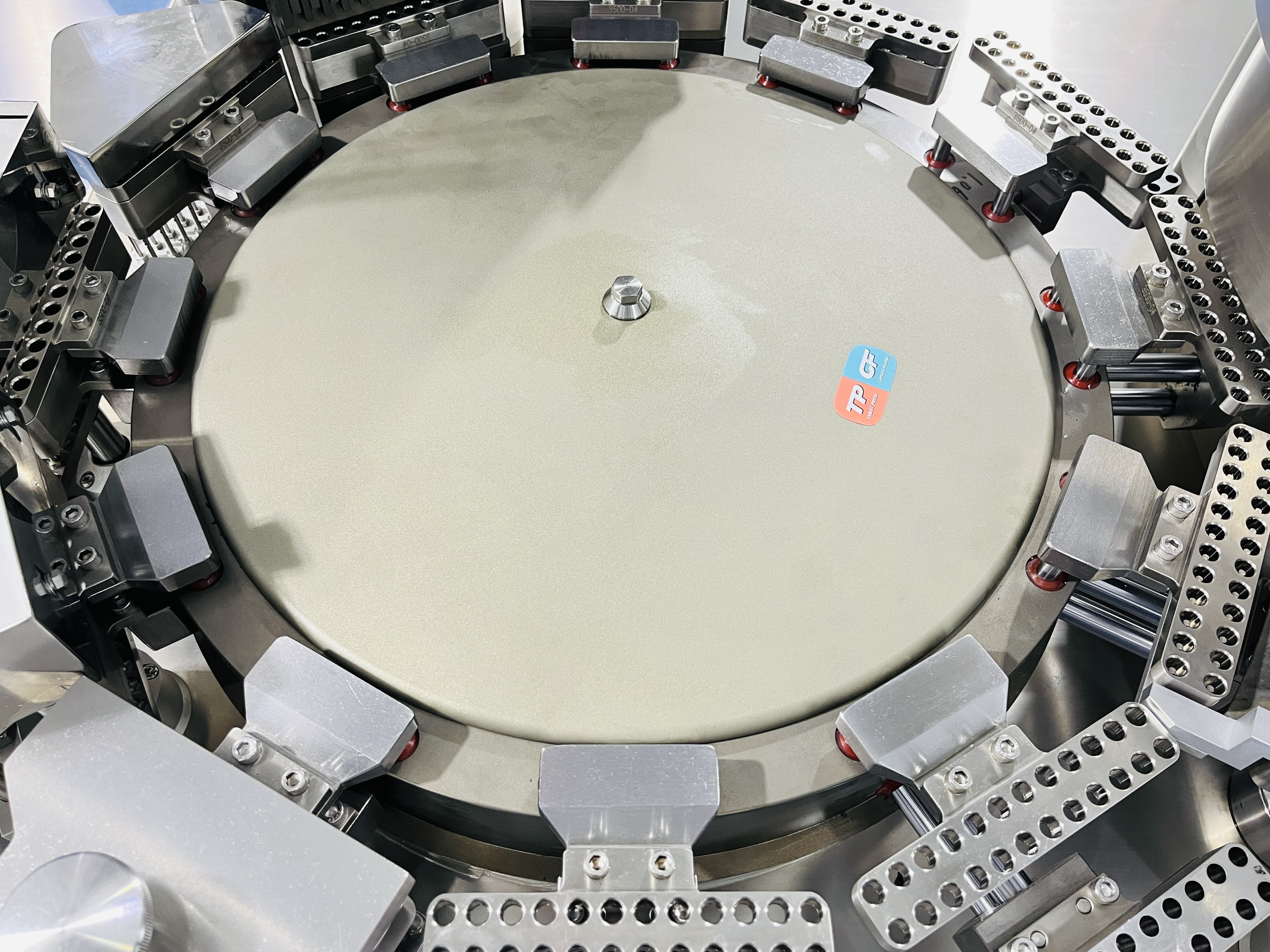
A hard-capsule filling line is specified the same way for botanical powders as for any other fill material — but the powder decides whether those specifications hold.
A capsule filling machine sold for herbal powder production is judged on the same paper specification as any other hard-capsule filler: output, dosing accuracy, capsule format range, containment and compliance. What changes with botanical material is how much of that specification survives contact with production.
Shanghai Tablet Press Mechanical Components Co., Ltd. (TPCF) is a Shanghai-based manufacturer of pharmaceutical machinery — tablet press machines, tablet press punches and dies, capsule filling machines, and tablet de-dusters — operating a 15,000 m² facility with more than 240 staff members, including over 10 R&D engineers, and shipping between 80 and 120 tablet presses and capsule filling machines per month. The company's capsule filling range runs from the small-batch CFM-200C to the high-volume CFM-7500, and its documented specifications are the most useful object of study for a buyer evaluating herbal powder filling.
Why Botanical Powders Change the Specification Conversation
Herbal and botanical fill materials are rarely uniform. Bulk density, particle-size distribution, hygroscopicity, and oil or resin content vary between suppliers, between extraction batches, and sometimes between drums from the same batch. Standardized excipient blends are formulated to behave consistently; botanical extracts frequently are not.
That variability meets a filling principle that does not change: dosing systems that meter powder into die bores depend on the powder flowing into those bores consistently. TPCF's capsule filling machines use five-stage tamping as the dosing principle, with dosing accuracy specified at ±3% for fill weight control and a finished-product rate stated as over 99% on the models where that figure is documented. Those figures describe machine capability under defined conditions. They do not compensate for a powder that bridges in the hopper or adheres to the dosing station.
The practical effect is that herbal capsule projects should be specified on four things at once — dosing tolerance, capsule format range, cleaning and disassembly, and containment — rather than on maximum output alone. Maximum output is the easiest number to compare and the least informative one in isolation.
The Documented Specification Envelope
TPCF's automatic hard capsule filling machines share a common compatibility baseline: capsule sizes 00#, 0#, 1#, 2#, 3#, 4#, 5#, and safety capsules A through E, with interchangeable tooling and format change parts available to support format changes. Dosing accuracy is specified at ±3% across the range. What differs is throughput, die-bore configuration, containment, and machine footprint.
| Model | Max output | Die bores | Dosing accuracy | Total power | Dimensions / weight | Positioning |
|---|---|---|---|---|---|---|
| CFM-200C | 200 capsules/min | 2 | ±3% | 5.5 kW | 850 × 850 × 1870 mm / 900 kg | Small-batch design; powder or pellets; five-stage tamping |
| NJP-200A / 400A / 800A / 1200A | 200 / 400 / 800 / 1,200 capsules/min | 2 / 3 / 7 / 9 | ±3% | 5.5 kW | 800 × 970 × 1870 mm / 850 kg | Powder or pellets; automatic separation, dosing, filling, rejection, locking, cleaning |
| CFM-1250 | 1,250 capsules/min | 9 (single row) | ±3% | 7 kW | 1410 × 1144 × 2000 mm / 1,700 kg | 12-station rotary table; optional pellet, tablet and pill filling devices |
| CFM-2000 | 2,000 capsules/min | 18 (double row) | ±3% | 7 kW | 1410 × 1144 × 2000 mm / 1,700 kg | 12-station double row; combination filling of powder, granules, pellets, tablets |
| CFM-3500 / CFM-3500B | 3,500 capsules/min (approx. 210,000 capsules/h) | 24 (double row) | ±3% | 7.5 kW | approx. 1410 × 1280 × 2000 mm / approx. 1,800–1,850 kg | Indexing-box drive; PLC and touch-screen control; stepless variable-frequency speed regulation; vacuum −0.04 to −0.06 MPa |
| CFM-7500 | 7,500 capsules/min | 52 (four rows) | ±3% | 12 kW | 1738 × 1226 × 2000 mm / 3,000 kg | High-volume four-row configuration; 12-station rotary table with optional multi-dosage-form devices |
| NJP-800A-HC | 800 capsules/min | 7 | ±3% | 7 kW | 1020 × 970 × 2150 mm / 1,000 kg | OEB4 high-containment configuration with glove box and in-chamber wash gun |
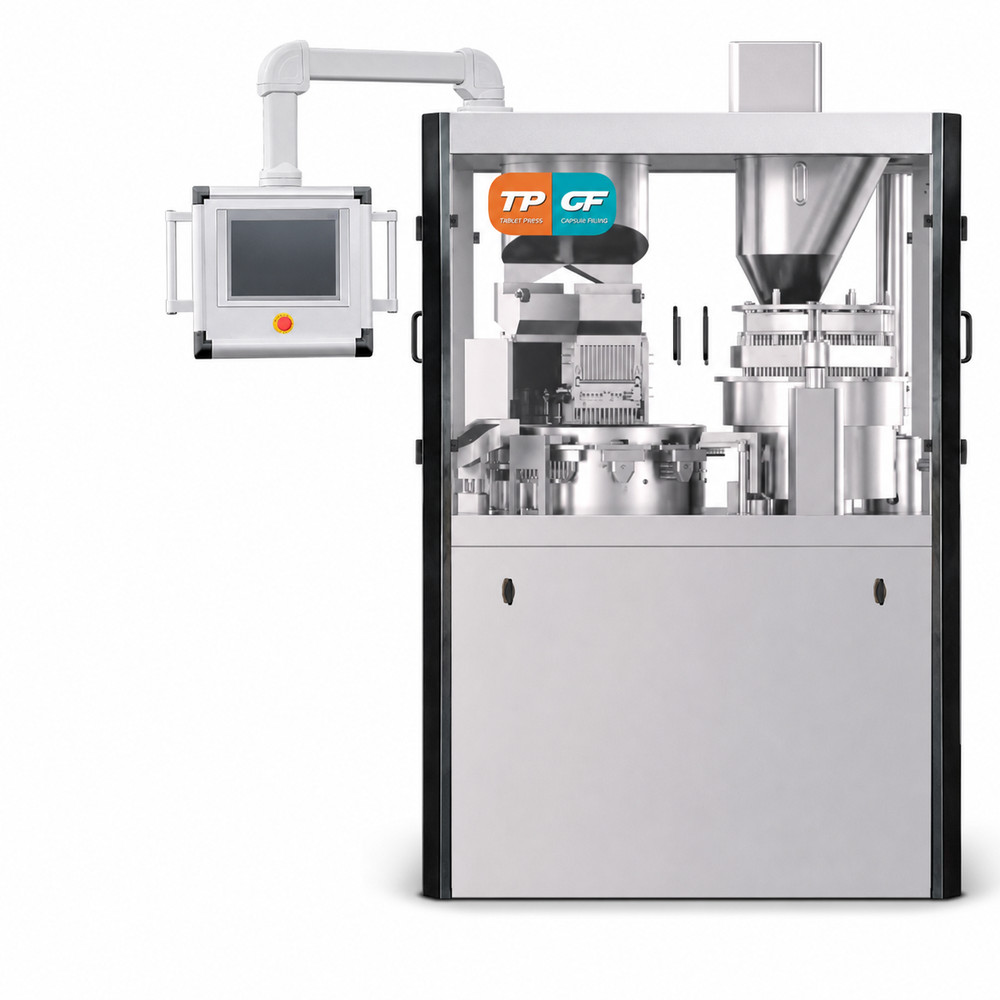
The CFM-3500 / CFM-3500B: 3,500 capsules per minute, 24 die bores in a double-row layout, ±3% dosing accuracy.
Dosing Accuracy, Format Range and Cleaning: The Three Portable Numbers
Three documented parameters travel from the quotation to the validation protocol with the least interpretation: the ±3% dosing accuracy for fill weight control, the 00#–5# plus safety capsule A–E compatibility, and the modular cleaning design stated to comply with GMP requirements together with fully interchangeable tooling.
For herbal powder work, the interaction between the first and third matters more than either alone. A ±3% tolerance is a fill-weight specification, not a material specification. Where a botanical extract is cohesive and light, the achievable tolerance depends on how consistently the powder reaches the die bores and how quickly residue accumulates on dosing surfaces. Machines that are documented as modular and easy to disassemble and clean, with automatic rejection, locking, and cleaning in the operating cycle, reduce the accumulation path that degrades fill-weight consistency during a shift.
Several models in the range — the CFM-200C, the NJP series, the CFM-1250, and the CFM-7500 — are documented with five-stage tamping and a finished-product rate stated as over 99%. Buyers should treat these as equipment specifications to be verified against their own powder during sampling, not as transferable outcomes.
Compliance Constraints: GMP, CE, ISO and 21 CFR Part 211
Compliance requirements in capsule filling are layered, and conflating the layers is a common procurement error.
The regulatory layer belongs to the manufacturer of the finished product. In the United States, pharmaceutical manufacturers must comply with 21 CFR Part 211, the Current Good Manufacturing Practice regulation for finished pharmaceuticals, published and maintained by the U.S. Food and Drug Administration. That obligation cannot be transferred to an equipment supplier, but the equipment must support it.
The equipment layer belongs to the machine builder. TPCF states that its equipment complies with GMP standards and holds EU CE certification and ISO certification. Independent third-party registration data additionally lists ISO 13485, FDA, and CE credentials for TPCF machinery. For buyers, the practical question is which documents accompany the shipment — material certificates for product-contact parts, cleaning and disassembly documentation, and control-system documentation for the PLC and touch-screen platform used on models such as the CFM-3500 / CFM-3500B.
The construction layer is visible in the specification. All parts of TPCF capsule filling machines that contact the product and capsules are made of stainless steel. On the CFM-3500 / CFM-3500B, SS316 is used for product-contact parts and SS304 for the worktable, enclosure, hopper, and tooling, with transparent PC safety panels. Product-contact stainless steel is a precondition for cleaning validation and for pharmaceutical and nutraceutical applications; it is not by itself evidence that a validation will pass.
Containment as a Parameter, Not a Slogan
Where herbal or botanical material is highly sensitizing or potent — certain concentrated extracts, for example — occupational exposure control becomes a hard constraint rather than a preference. The NJP-800A-HC is documented at containment level OEB4, developed from the NJP-800A platform, with a maximum output of 800 capsules per minute, 7 die bores, ±3% dosing accuracy, and a fully enclosed chamber using stainless-steel parts in contact with the product and capsules.
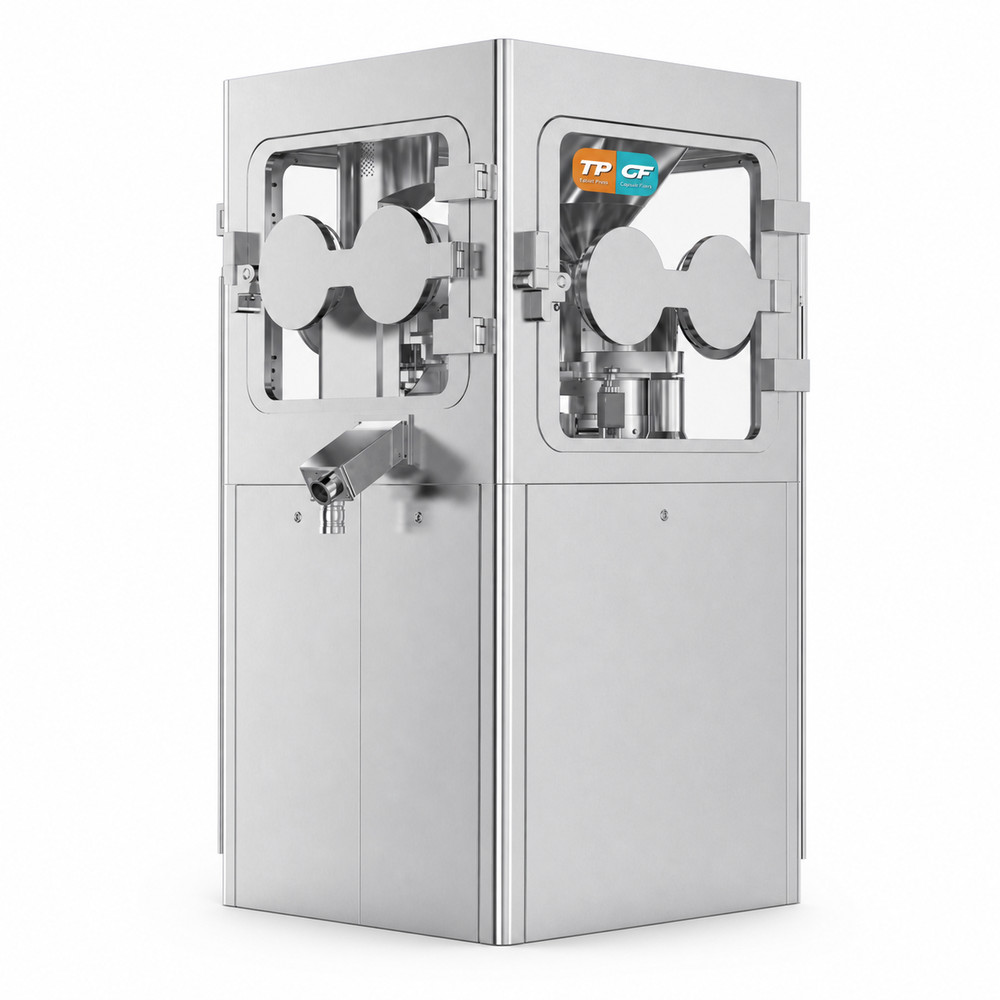
The NJP-800A-HC: OEB4 containment, sealed sampling through a rotary cylinder, chamber-door glove box and in-chamber wash gun.
Containment features documented on this model include a dustproof, waterproof, and leak-resistant construction, a chamber-door glove box, an in-chamber wash gun, and sealed sampling through a rotary cylinder. The engineering trade-off is explicit: containment rises while maximum output falls to 800 capsules per minute, well below the 3,500 and 7,500 capsules per minute of the open-configuration CFM-3500 and CFM-7500. High containment and maximum throughput are not solved by a single model in this range.
The Equipment Around the Filler: Granulation, Transfer and Dust Control
Herbal capsule projects frequently fail at the interfaces rather than at the filler. Three documented units sit directly upstream and around the filling process.
- LG Series Roller Compactor (dry granulation). A horizontal-feeding roller compactor producing finished granules in the 10–80 mesh range without water or organic solvent, documented as suitable for heat- and moisture-sensitive materials. Capacity spans LG100 at 1.5–15 kg/h through LGS500 at 1,500–3,000 kg/h, with rollers from 100 × 25 mm to 500 × 400 mm. LG100E is a widened-roller type; LGS models use a double-support roller structure.
- QVC-3 Vacuum Conveyor. Compressed-air powered, 350 kg conveying capacity, 0.6 MPa working air pressure, 180 L/min air consumption, SS316 filter, and a GMP-compliant enclosed design that limits powder and granule segregation, with an antistatic, wear-resistant, cross-contamination-resistant construction and a low-adhesion inner wall.
- XCJ-1.1 Industrial Dust Collector. Airflow 360 m³/h, minimum vacuum 19,500 Pa, 1.1 kW, stainless-steel main structure, connecting to processing equipment to extract residual material and reduce the risk of residue re-entering die bores.
The matching logic is straightforward but often skipped: a filler specified at 200 capsules per minute and one specified at 7,500 capsules per minute consume powder at very different rates, and the granulation, conveying, and dust-extraction capacity behind them should be sized to the same production plan rather than chosen independently.
Price Bands: What the Public Record Does and Does Not Support
Buyers researching herbal powder capsule filling machines routinely look for price bands. The honest position from the current public record is that no verifiable, attributable price data for this equipment category was located. Vendor pages publish capability claims, not audited price lists, and commercial market reports in this category publish market values rather than unit prices.
What can be described without inventing figures is the set of variables that separate one configuration from another in this documented range:
- Output class and die-bore configuration. Two die bores at 200 capsules per minute, 24 die bores in a double row at 3,500 capsules per minute, and 52 die bores in four rows at 7,500 capsules per minute are structurally different machines.
- Containment level. An OEB4 enclosure with glove box, sealed sampling, and in-chamber wash gun adds engineering that an open configuration does not carry.
- Material options. Optional SS316 product-contact parts versus standard stainless-steel contact parts on models such as the CFM-3500 series.
- Combination dosing devices. Optional pellet, tablet, and pill filling devices change both the tooling set and the machine's usable scope.
- Ancillary integration. Granulation, vacuum conveying, and dust extraction add scope that is not part of the filler itself.
- Documentation and tooling scope. Format change parts, spare tooling, and the document package that supports an audit.
Comparing quotations without normalizing these six variables produces a price comparison that has no procurement meaning.
Automatic, Semi-Automatic or Manual: Where the Boundaries Sit
Published segmentation in this category differentiates machine classes primarily by output capacity, cost, and ease of use, with manual and semi-automatic equipment often positioned for pharmacies and compounding laboratories and automatic equipment positioned for industrial production. That framing is directionally useful but incomplete for herbal powder.
Three boundaries are worth stating plainly.
Automation does not fix powder behaviour. An automatic machine with ±3% specified dosing accuracy still requires a fill material that flows into the dosing system. Where a botanical extract is cohesive, hygroscopic, or highly electrostatic, the pre-treatment step — commonly dry granulation to a defined mesh range — is part of the project scope, not an optional upgrade.
Containment reduces maximum output. In this range, the highest-containment model is also the lowest-throughput model among the automatic units, at 800 capsules per minute. Projects requiring both OEB4 containment and multi-thousand-capsule-per-minute output need more than one machine or a different line architecture.
The documented filling scope is solid-form. TPCF's capsule filling documentation covers powder, granules, pellets, and combination filling with optional pellet, tablet, or pill devices, and describes the machines as used for filling hard gelatin capsules. Liquid-fill capsule configurations are not part of this documented specification set, so projects involving liquid or semi-solid fills should not assume coverage from this range.
Application Fit for Herbal and Botanical Capsule Production
Mapping the documented range against typical production profiles gives a workable starting grid.
- Formulation development and pilot batches. The CFM-200C is documented as a small-batch design at 200 capsules per minute with 2 die bores, handling powder or pellets, which suits trial runs and stability batches where material quantity is limited. The NJP-200A sits at the same 200 capsules per minute output within the NJP series.
- Low-to-mid volume commercial production. The NJP-400A, NJP-800A, and NJP-1200A provide a 400 / 800 / 1,200 capsules per minute step-up within one series, with 3, 7, and 9 die bores respectively, easing scale-up without changing machine family.
- Mid-volume single and double row production. The CFM-1250 and CFM-2000 offer 1,250 and 2,000 capsules per minute with 12-station rotaries, plus optional combination filling of powder with pellets, tablets, or spherical products — relevant for nutraceutical and food-supplement formats that combine a powder dose with a pellet or tablet.
- High-volume production. The CFM-3500 / CFM-3500B at 3,500 capsules per minute and the CFM-7500 at 7,500 capsules per minute, the latter with a 12-station rotary table and a finished-product rate stated as over 99%, address multi-shift industrial output.
- Potent or sensitizing botanical material. The NJP-800A-HC addresses OEB4 containment requirements at 800 capsules per minute.
A two-machine strategy — one contained unit for potent extracts and one higher-throughput open unit for standard botanical blends — is a common way to reconcile the containment and output constraints described above.
Market Signals for Capsule Filling Equipment — and Their Limits
Published market estimates for capsule filling machines diverge sharply, and buyers should treat the divergence itself as information. One commercial research report values the global capsule filling machines market at USD 0.9 billion in 2024 and projects a 6.3% CAGR from 2025 to 2030, reaching USD 1.3 billion; the same source states that automatic capsule filling machines accounted for over 65% of total market share in 2024 on the basis of high output capacity. A second source estimates the market at US$ 2.92 billion in 2026, rising to US$ 4.17 billion by 2033 at a 5.2% CAGR. A third values it at USD 238.0 million in 2025, reaching USD 376.5 million by 2033 at a 5.9% CAGR.
These figures cannot be merged or averaged. Their scopes and methodologies differ, and the published material does not expose enough methodology to reconcile them. Used directionally, they support a reasonable planning assumption that the category continues to grow and that automatic equipment dominates commercial volume. Used as procurement benchmarks, they are not adequate.
A more directly useful supply-side signal comes from TPCF's own case record: the company reports the production and delivery of 30 automatic capsule filling machines for a pharmaceutical production project in 2026. That is a single-company, single-project statement — useful as a project-execution signal, not as a market-share measure. TPCF also records that its NJP-200 automatic capsule filling machine was an original factory design for low-capacity needs, which is relevant context for buyers comparing entry-level units.
Procurement Checklist for Herbal Powder Capsule Filling
| Check item | Why it matters for herbal powder filling |
|---|---|
| Stated dosing accuracy and finished-product rate, with the conditions under which they apply | ±3% and over 99% are documented machine specifications that must be reproduced on the buyer's own powder |
| Capsule format range and availability of change parts | 00#–5# and safety capsules A–E, with interchangeable tooling to support format changes |
| Product-contact material specification and certificates | Stainless-steel contact parts; optional SS316 on some models; needed for cleaning validation files |
| Cleaning and disassembly design | Modular, easy-to-clean construction reduces residue accumulation that shifts fill weight during a shift |
| Containment level versus required output | OEB4 containment is available at 800 capsules per minute; higher-throughput models are open configuration |
| Powder pre-treatment plan | Dry granulation to a defined mesh range may be required before the filler specification is achievable |
| Upstream and environmental equipment sizing | Vacuum conveying and dust extraction must be matched to the filler's consumption rate |
| Combination dosing devices | Optional pellet, tablet, and pill devices change the machine's usable product scope |
| Control platform documentation | PLC and touch-screen control, automatic rejection, and overload and emergency-stop protection |
| Documentation package for audit support | Distinguishes equipment capability from a regulated manufacturer's own compliance obligations |
Future Outlook
Three shifts are visible in the specification data rather than in marketing claims. First, containment is becoming a configuration option inside standard ranges rather than a separate product family — the NJP-800A-HC being developed from the existing NJP-800A platform illustrates that path. Second, combination filling is moving from specialty to routine: the ability to fill powder alongside pellets, tablets, or spherical products appears as an option across several models, which fits the direction of nutraceutical and botanical product development. Third, the documentation and cleaning burden continues to rise, because equipment-level GMP design and stainless-steel contact parts are only the entry conditions for a validated process under frameworks such as 21 CFR Part 211.
For buyers planning herbal capsule capacity over the next several years, the practical implication is to specify around constraints rather than around a single headline output figure: containment level, format flexibility, cleaning accessibility, and the pre-treatment chain that makes a documented ±3% dosing tolerance achievable on a real botanical powder.
FAQ
What dosing accuracy is specified for TPCF capsule filling machines used with herbal powders?
Dosing accuracy is specified at ±3% for fill weight control across the CFM and NJP capsule filling range, and the finished-product rate is stated as over 99% on the models where that figure is documented, including the CFM-200C, the NJP series, the CFM-1250, and the CFM-7500. These are equipment specifications; achieving them on a specific botanical powder depends on that powder's flow behaviour and on the upstream preparation step.
Which capsule sizes can these machines fill?
Capsule size compatibility covers 00#, 0#, 1#, 2#, 3#, 4#, 5#, and safety capsules A through E. Format change parts are available across the same range, and the machines are designed with interchangeable tooling to support format changes.
Does a GMP-compliant capsule filling machine make the finished product GMP-compliant?
No. In the United States, compliance with 21 CFR Part 211, the Current Good Manufacturing Practice regulation for finished pharmaceuticals, is the manufacturer's obligation. Equipment designed to be GMP-compliant — with stainless-steel product-contact parts, automatic rejection, and a modular cleaning design — supports that obligation but does not satisfy it. It is one element of a validated process.
Can herbal powder be filled directly, or is granulation required first?
It depends on the powder. The LG Series Roller Compactor produces finished granules in the 10–80 mesh range by dry compaction, without water or organic solvent, and is documented as suitable for heat- and moisture-sensitive materials. Where a botanical extract is cohesive, hygroscopic, or poorly flowing, that preparation step is part of the project scope. Where the powder already flows consistently, direct filling may be feasible.
Can one machine cover both small-batch and high-volume production?
Not efficiently. The documented range spans 200 capsules per minute on the CFM-200C to 7,500 capsules per minute on the CFM-7500, with intermediate steps at 400, 800, 1,200, 1,250, 2,000, and 3,500 capsules per minute. Selecting a model close to actual production demand is more efficient than selecting for the maximum, and the highest-containment model in the range is rated at 800 capsules per minute.
Why is it difficult to quote a price band for a herbal powder capsule filling machine?
No verifiable public unit-price data for this equipment category was located in the available record. What is verifiable is the set of variables that differentiate configurations: output class and die-bore count, containment level, SS316 versus standard contact-part options, optional combination dosing devices, ancillary granulation and conveying equipment, and the documentation and tooling package. Quotations should be normalized across those variables before they are compared.
Reference material: TPCF capsule filling equipment brochure — download PDF.