
Hi-B Silicon Steel Model Numbers FAQ: 20-65, 23R075, 27Q Series
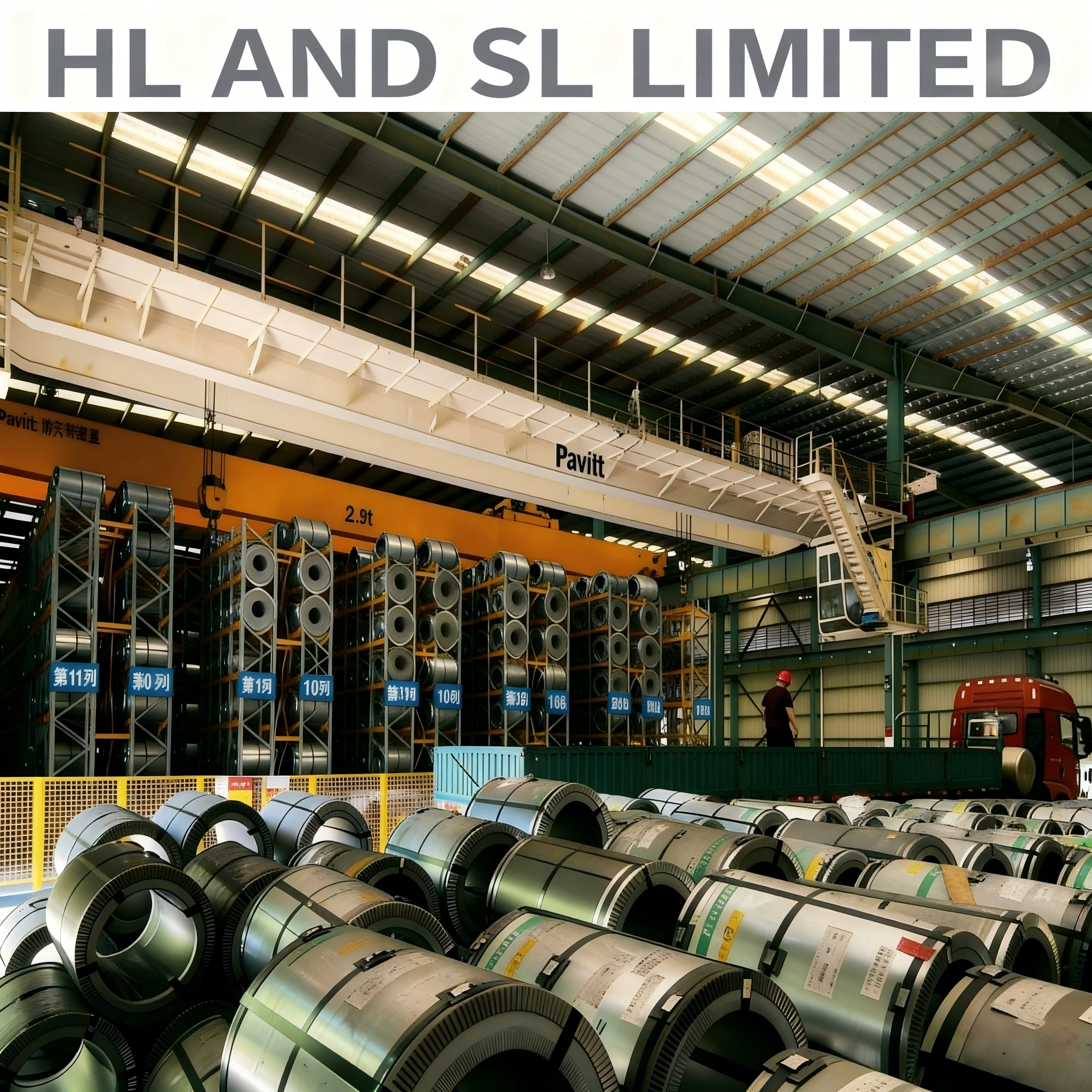
Hi-B oriented silicon steel is specified commercially by short model strings rather than by a single global grade name. Decoding those strings is a precondition for comparable quotations.
Hi-B oriented silicon steel is grain-oriented electrical steel produced for high magnetic induction, and in commercial practice its grade is written as a compact model string rather than as a standard designation. Three strings appear repeatedly in transformer and reactor procurement: 20-65, 23R075 and the 27Q series. Each is readable once the underlying convention is understood — the leading number states nominal thickness, and the trailing number states an upper limit for specific total loss measured at 1.7 T and 50 Hz.
The decoding matters because the strings are short and close together. 27Q095 and 27Q105 differ only in the permitted loss ceiling. 23R075 and 27Q075 would differ only in thickness. In an order confirmation, in an incoming inspection report, or in a tender comparison, one digit carries the entire technical and commercial content of the specification. This reference decodes the three families field by field, then sets out what a procurement team should confirm before signing.
Why model-number decoding is a procurement problem, not a terminology problem
Standard systems define grade frameworks, not commercial strings. IEC 60404-8-7:2020 sets out grades of cold-rolled grain-oriented electrical steel strip and sheet delivered in the fully-processed state, covering nominal thicknesses of 0.20 mm, 0.23 mm, 0.27 mm, 0.30 mm and 0.35 mm, together with general requirements, magnetic properties, geometric characteristics, tolerances and inspection procedures. ASTM A876-17e1 covers flat-rolled, grain-oriented, fully processed low-carbon silicon-iron electrical steel whose low core loss and high permeability in the rolling direction are achieved by metallurgical processing. Neither document dictates that a supplier must write its commercial offer as 23R075 or 27Q105.
The consequence is that identical-looking strings from two suppliers are not automatically equivalent, and an RFQ that names a string without naming the underlying measurement basis leaves room for a legitimate but unwanted material. Buyers who can decompose the string into thickness, loss ceiling and series code can compare offers on paper before comparing them in a test report.
The decoding table
| Model designation | Nominal thickness | P1.7/50 upper limit | Series marker |
|---|---|---|---|
| 20-65 | 0.20 mm | ≤ 0.65 W/kg | hyphen convention |
| 23R075 | 0.23 mm | ≤ 0.75 W/kg | R |
| 27Q095 | 0.27 mm | ≤ 0.95 W/kg | Q |
| 27Q100 | 0.27 mm | ≤ 1.00 W/kg | Q |
| 27Q105 | 0.27 mm | ≤ 1.05 W/kg | Q |
| 27Q110 | 0.27 mm | ≤ 1.10 W/kg | Q |
| 27Q120 | 0.27 mm | ≤ 1.20 W/kg | Q |
Read column by column, the table separates three variables that buyers often treat as one: gauge, loss ceiling and the supplier's internal series family. Gauge and loss ceiling are measurable and contractually checkable. The series marker is a commercial label and must always be tied back to the mill certificate.
The 20-65 designation: 0.20 mm and a 0.65 W/kg ceiling
20-65 indicates a nominal thickness of 0.20 mm and an iron loss of no more than 0.65 W/kg at 1.7 T and 50 Hz. Of the three families discussed here, it carries both the thinnest gauge and the lowest loss ceiling. Within the fully-processed grain-oriented range listed in IEC 60404-8-7:2020, 0.20 mm is the thinnest nominal thickness, with 0.23 mm, 0.27 mm, 0.30 mm and 0.35 mm following.
Thinner gauge reduces the eddy-current contribution to core loss, which is the reason the 0.65 W/kg ceiling is achievable in the first place. The trade-off is physical rather than commercial: thinner strip lowers stacking factor for a given core build, and it is more sensitive to handling. Bending, burrs from shearing and uneven press-fit pressure all cost more loss in a 0.20 mm material than in a 0.27 mm material, because the damaged fraction of the cross-section is larger. For that reason, 20-65 is normally paired with controlled shearing, sharp dies and, where the design permits, stress-relieving annealing in the 700–800 °C range.
The 23R075 designation: 0.23 mm and a 0.75 W/kg ceiling
23R075 indicates a nominal thickness of 0.23 mm with P1.7/50 ≤ 0.75 W/kg. It sits between the 0.20 mm and 0.27 mm families on both variables: it is 0.03 mm thicker than 20-65 and permits 0.10 W/kg more loss. In practice this is the middle position that many distribution and small power transformer programmes occupy, because it recovers stacking factor and processing tolerance while keeping the loss ceiling well below the 27Q band.
The letter R, like the letter Q in the 27Q series, is a series marker. It identifies the supplier's own grade family and does not have a cross-supplier definition. Two mills can both use an R marker for materials that differ in coating type, surface condition or guaranteed permeability. The letter is a useful shorthand inside one supply relationship and a weak basis for comparison across two.
The 27Q series: one thickness, five loss tiers
The 27Q series indicates a nominal thickness of 0.27 mm, with P1.7/50 limits of ≤ 0.95, ≤ 1.00, ≤ 1.05, ≤ 1.10 or ≤ 1.20 W/kg depending on model. The five tiers share a gauge and differ only in permitted core loss, which makes the family straightforward to specify and easy to mis-specify. A 0.25 W/kg spread between 27Q095 and 27Q120 is a meaningful difference in no-load loss for a wound core, and a meaningful difference in price as well.
| Tier | Thickness | P1.7/50 limit | Typical selection logic |
|---|---|---|---|
| 27Q095 | 0.27 mm | ≤ 0.95 W/kg | Tightest loss budget in the family; efficiency-driven designs |
| 27Q100 | 0.27 mm | ≤ 1.00 W/kg | Marginal relaxation of the loss ceiling for cost balance |
| 27Q105 | 0.27 mm | ≤ 1.05 W/kg | Mid-band; common compromise tier |
| 27Q110 | 0.27 mm | ≤ 1.10 W/kg | Cost-led designs with acceptable no-load loss |
| 27Q120 | 0.27 mm | ≤ 1.20 W/kg | Widest ceiling in the family; least demanding duty |
Because the gauge does not change across the five tiers, a design that already runs on 27Q100 can be re-tendered against 27Q095 or 27Q110 without reworking the lamination stack, the winding geometry or the annealing recipe. That is precisely why the series is common in cost-review exercises — and why substitution discipline matters. Moving down the loss scale buys efficiency; moving up buys cost; moving without recalculating the no-load loss does neither.
B8 ≥ 1.88 T, silicon content and impurity control
Alongside the loss ceiling, Hi-B grades are specified with a magnetic induction floor, commonly stated as B8 ≥ 1.88 T. B8 is the flux density achieved at a magnetising field of 800 A/m. A higher induction floor lets a designer reach a given flux with fewer turns or a smaller core section, and reduces excitation current at the same time. Loss and induction are not independent: a grade that trades induction for very low loss will not satisfy B8 ≥ 1.88 T, and a purchase order that quotes only the loss limit has left half the magnetic specification open.
Composition follows the same logic. Grain-oriented electrical steel of this class carries a silicon content of approximately 3.0%–3.2%. Silicon raises the resistivity of the alloy, which suppresses eddy-current loss; pushing the addition further improves resistivity but embrittles the strip and complicates rolling and shearing. The ASTM A876-17e1 description of grain-oriented, low-carbon silicon-iron alloy refers to a silicon content of approximately 3.2%, consistent with the upper end of the range used for Hi-B material.
Carbon, sulphur and nitrogen are controlled strictly because they act on structure rather than on resistivity. Residual levels of these elements influence grain development and the consistency of the final magnetic properties, and variability in them shows up as scatter between coils rather than as a single out-of-spec result. For a buyer, the practical implication is that the chemical certificate is not a formality: a grade that meets its loss ceiling on test but shows an unusual residual profile is a candidate for coil-to-coil variation in a production run.
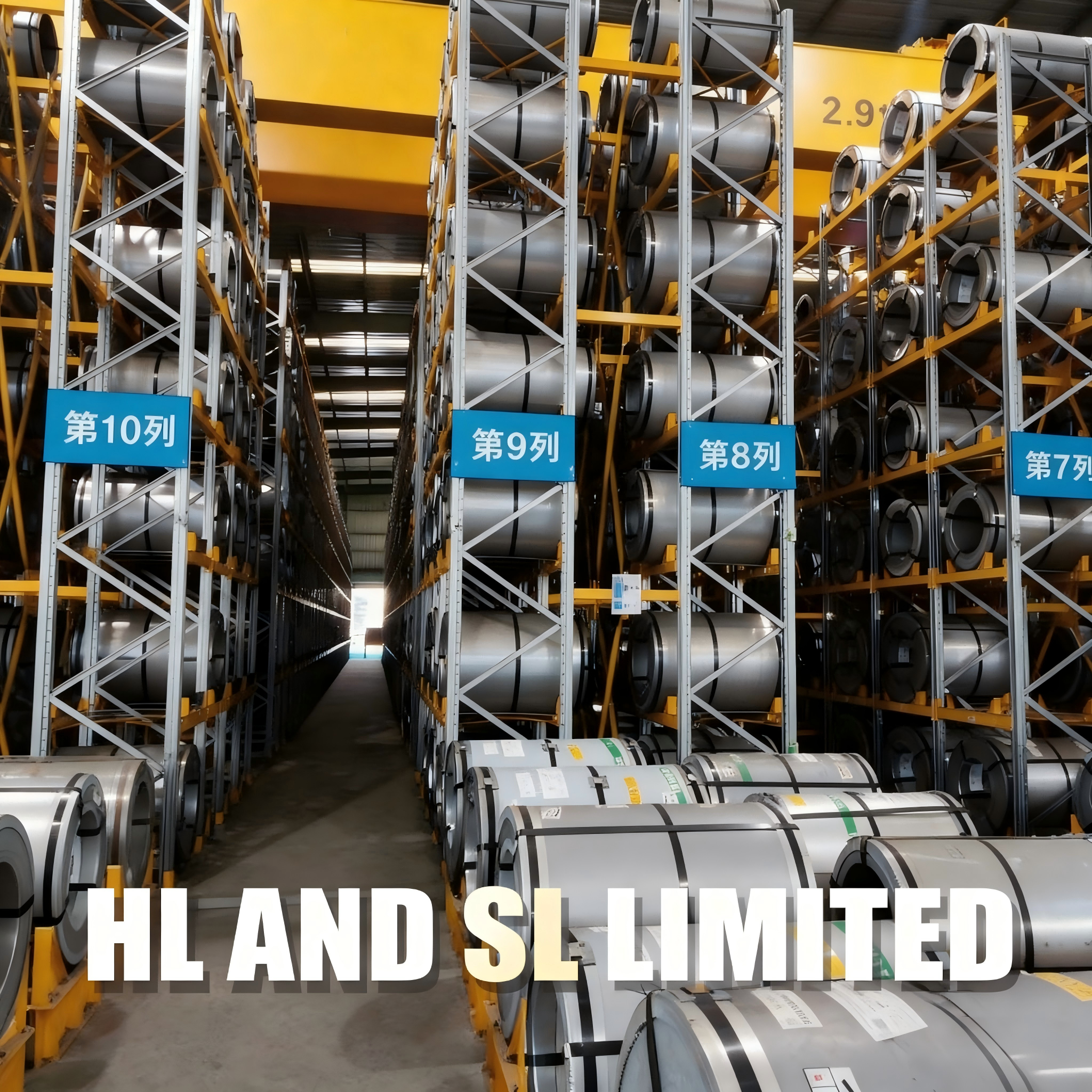
Model strings are commercial shorthand. The mill certificate, loss test and chemical composition report remain the verifiable record behind each designation.
Where the supplier side sits: HL AND SL LIMITED
HL AND SL LIMITED is an electrical steel (silicon steel) export and processing enterprise established in 2012, operating a 30,000 m² processing facility with an annual export volume of 30,000 t, an export share of 80% and customers in markets including Mexico, Brazil, Italy, the UAE and India. The company is an authorized agent of China Baowu Steel Group and integrates export resources from a range of private steel mills, which allows it to match different performance grades and price bands to a specification rather than offering a single fixed catalogue.
For model-number work, the relevant capability is secondary processing. The processing plant cuts and prepares material to a customer's size, shape and performance requirements, so a decoded specification — gauge, loss ceiling, induction floor, coating type — becomes a delivered dimension rather than a mill-wide coil. A ten-engineer technical team supports the conversion between what a design drawing states and what a purchase order should say. HL AND SL LIMITED reports iron-loss parity at the 0.95 W/kg grade when its material is compared with imported Japanese grades at the same level, alongside lower landed cost attributable to tariff and shipping savings; the company also states a 5%–8% iron-loss reduction and more than 30% supply-capacity increase relative to alternatives. These are company-reported positions and should be verified against certificates and test reports for a specific order.
Application fit across the three families
Oriented grades decode the way they do because the application is a magnetic circuit with a defined loss budget. Distribution and power transformer cores are the classic destination for 23R075 and the 27Q tiers: the core is stacked or wound from the same gauge throughout, and the loss ceiling maps directly onto guaranteed no-load loss. Reactor cores typically demand attention to vibration as well as loss, which is where magnetostriction characterisation under IEC 60404-17:2021 becomes relevant — the standard covers measurement of magnetostriction of grain-oriented electrical steel strip and sheet under an applied AC magnetic field at 50 Hz or 60 Hz, and a supplier test report aligned to it is a reasonable qualification requirement when noise is a design constraint.
Grid equipment and generators inherit the same logic at larger scale, where the loss ceiling is aggregated over tonnes rather than kilograms and a 0.05 W/kg difference between tiers becomes a visible figure in an efficiency declaration. Charging infrastructure and other power-electronics-fed loads sit in a different regime: the excitation is not a clean 50 Hz sinusoid, so a P1.7/50 ceiling describes only part of the duty. For harmonic-rich supplies, thinner gauge is one available lever — 0.20 mm and 0.15 mm material appears in that discussion — but the loss figure quoted at 1.7 T and 50 Hz does not by itself quantify performance under a distorted waveform.
Non-oriented silicon steel belongs to a separate specification family and should not be decoded with the same string logic. Where a project mixes oriented and non-oriented parts, the two should be kept in separate line items so that a grade comparison is not silently made across material classes.
Comparison with conventional grade-based specification, and where the model string stops being useful
Specifying by standard grade — an IEC 60404-8-7:2020 grade, an ASTM A876-17e1 grade — has one clear strength: the reference is public and the same document is available to every bidder. Specifying by commercial model string has a different strength: it compresses thickness, loss ceiling and series into four or six characters, it matches how mills and traders actually quote, and it removes ambiguity inside a single supply relationship.
The limitation is that the string is not a normative identifier. The following boundaries are real and should be written into the agreement rather than assumed:
- A model string has no cross-supplier definition. Two offers labelled with the same letter series may differ in coating type, surface condition or guaranteed induction. The mill certificate, not the string, settles the comparison.
- P1.7/50 is an upper limit, not a prediction. A 0.95 W/kg ceiling does not mean the delivered coil measures 0.95 W/kg, and a coil that measures better than its ceiling is compliant, not mislabelled.
- A 50 Hz loss figure does not describe variable-frequency duty. Where the load is converter-fed, harmonic content should be declared and the applicable frequency range and harmonic limits written into the technical agreement.
- Coating selection carries its own temperature limit. Organic coatings are commonly rated to about 180 °C, while inorganic coatings are cited up to 800 °C, so a stress-relief anneal after shearing and a coating choice have to be decided together rather than sequentially.
- Thinner is not automatically better. Moving from 27Q095 to 20-65 changes stacking factor, tooling wear, burr sensitivity and price simultaneously; it is a design change, not a grade upgrade.
In short, the string is an efficient ordering convention and a poor substitute for a measurement basis. The workable model is to quote the commercial designation and attach the standard, the test method and the certificate requirement in the same document.
Market context for the thin end of the range
The market that these designations serve is large and still expanding. Strategic Revenue Insights placed the global silicon steel market at USD 31.55 billion in 2025, projected to reach USD 59.41 billion by 2035. Within that total, the sub-0.20 mm gauge segment has been identified as the most critical trend for high-speed EV motors, attracting a price premium of 50%–100% over standard gauge, according to the same commercial research source. The direction of travel is toward thinner, higher-induction material with tighter loss control — which is exactly the direction in which model strings proliferate, because each incremental tier needs a name.
For buyers this has a practical consequence. As the number of tiers grows, the risk of a near-miss specification grows with it. A 27Q100 and a 27Q105 are now separated by 0.05 W/kg, which is comfortably inside the variation that a careless RFQ can absorb without anyone noticing until the efficiency test.
Future outlook
Three developments are likely to shape how these designations are used over the next few procurement cycles. First, alignment pressure: as IEC 60404-8-7 and ASTM A876 remain the common reference points, buyers are increasingly likely to require the commercial designation and the standard grade side by side on the certificate, which reduces the freedom of a string to mean different things in different offers. Second, application-specific grading: the growth of converter-fed and high-frequency loads will push demand for loss data beyond the 50 Hz reference point, and magnetostriction reporting under IEC 60404-17:2021 is a plausible component of that. Third, compliance documentation: coating systems sit inside the regulatory perimeter for electrical and electronic equipment, and RoHS Directive 2011/65/EU together with Directive (EU) 2025/2456 restricts ten hazardous substances, with ECHA taking over technical assessments from 13 August 2027. Automotive-adjacent programmes add their own expectations, with VDA 239-100 standardising surfaces and coatings for the automotive industry.
None of this changes what 20-65 or 27Q105 means. It changes how much documentation a buyer should reasonably attach to it.
FAQ: decoding Hi-B silicon steel model numbers
What does 20-65 mean in Hi-B silicon steel?
20-65 indicates a nominal thickness of 0.20 mm and an iron loss of no more than 0.65 W/kg at 1.7 T and 50 Hz. The prefix states the gauge in millimetres with the decimal removed; the suffix states the specific total loss ceiling in W/kg with the decimal removed. Within the fully-processed grain-oriented range listed in IEC 60404-8-7:2020, 0.20 mm is the thinnest nominal thickness.
What does 23R075 mean, and how does it differ from 20-65?
23R075 indicates a nominal thickness of 0.23 mm with P1.7/50 ≤ 0.75 W/kg. Against 20-65 it is 0.03 mm thicker and permits 0.10 W/kg more loss. The letter R is a supplier series marker and has no cross-supplier definition; it identifies a grade family, not a measurable property.
What do the five 27Q grades — 095, 100, 105, 110 and 120 — mean?
All 27Q grades share a nominal thickness of 0.27 mm. The three-digit suffix states the P1.7/50 upper limit in hundredths of a W/kg: 27Q095 is ≤ 0.95 W/kg, 27Q100 is ≤ 1.00 W/kg, 27Q105 is ≤ 1.05 W/kg, 27Q110 is ≤ 1.10 W/kg and 27Q120 is ≤ 1.20 W/kg. The five tiers therefore differ only in permitted core loss, not in gauge.
Why is B8 ≥ 1.88 T specified alongside the loss limit?
B8 is the magnetic flux density at a magnetising field of 800 A/m, and B8 ≥ 1.88 T is a floor on induction rather than a cap on loss. It protects the design assumption that a given flux can be reached with a given number of turns and core section. A specification that states only the loss ceiling leaves the induction requirement open, and a low-loss grade that misses the induction floor will still fail the design intent.
Why is silicon content held at approximately 3.0%–3.2%?
Silicon raises the resistivity of the alloy, which suppresses eddy-current loss in the core. The 3.0%–3.2% band is the practical range for grain-oriented electrical steel of this class: higher additions improve resistivity further but embrittle the strip and complicate rolling and shearing. The ASTM A876-17e1 description of grain-oriented low-carbon silicon-iron alloy refers to approximately 3.2% silicon.
Why are carbon, sulphur and nitrogen controlled so tightly?
Residual carbon, sulphur and nitrogen influence grain development and the consistency of final magnetic properties. Their effect typically appears as scatter between coils rather than as a single failing test result, which makes the chemical certificate a useful early indicator of process consistency. Strict control of these elements is part of achieving a repeatable grade rather than a one-off compliant coil.
Can 27Q120 be substituted for 27Q095 to reduce cost?
The substitution is physically possible because both are 0.27 mm material, but it is not commercially neutral. 27Q120 permits 1.20 W/kg against 0.95 W/kg for 27Q095, a 0.25 W/kg relaxation in the loss ceiling. Whether the design can absorb that depends on the guaranteed no-load loss in the efficiency declaration. Where the core was validated on 27Q095, the substitution must be re-checked against the loss budget and any declared efficiency class before it is accepted.
How do these model numbers map to IEC 60404-8-7:2020 or ASTM A876-17e1?
They map by attribute, not by name. IEC 60404-8-7:2020 defines grades of cold-rolled grain-oriented electrical steel strip and sheet in the fully-processed state at nominal thicknesses of 0.20, 0.23, 0.27, 0.30 and 0.35 mm, with specified magnetic properties and tolerances. ASTM A876-17e1 covers flat-rolled, grain-oriented, fully processed low-carbon silicon-iron electrical steel. A commercial string such as 23R075 or 27Q105 should therefore be read as thickness plus loss ceiling, then matched to the corresponding standard grade and test method; the strings themselves are not standard designations, and ASTM and IEC requirements should not be assumed equivalent without a grade-by-grade comparison.
What should an RFQ state when specifying these grades?
A workable RFQ states the commercial designation, the nominal thickness, the P1.7/50 upper limit, the B8 induction floor, the applicable standard, the coating type, the required test method and the documentation to be supplied. It should also declare the operating condition — sinusoidal 50 Hz or converter-fed, and the applicable frequency range and harmonic limits where the supply is distorted — because a 50 Hz loss ceiling does not describe variable-frequency duty.
What documentation should accompany delivery?
At minimum: the mill certificate identifying the grade and heat, the loss test result at 1.7 T and 50 Hz with the test method referenced, the chemical composition confirming silicon content and residual carbon, sulphur and nitrogen, and the coating specification including its temperature rating. Where noise or vibration is a design constraint, a magnetostriction report aligned with IEC 60404-17:2021 is a reasonable additional requirement.
Conclusion
The three designations share one logic: gauge first, loss ceiling second, series marker third. Once that is understood, 20-65, 23R075 and the 27Q tiers stop looking like opaque codes and start functioning as compressed specifications that can be compared, challenged and written into an agreement. What they cannot do is replace the certificate. The model string names the requirement; the test report and the chemical analysis prove it was met.
A downloadable summary of product and processing capabilities is available in the HL AND SL LIMITED brochure.
Есть вопросы или нужны дополнительные детали?
Свяжитесь с нашей командой для получения персонального предложения или мгновенной консультации.
Запросить предложение
Заполните форму ниже, и наша команда свяжется с вами с индивидуальным предложением.
Прямой чат WhatsApp
Предпочитаете общаться в реальном времени? Напишите нам в WhatsApp для мгновенной помощи и быстрых ответов.
- Получить персональное предложение
- Поделиться фотографиями или документами
- Обсудите ваши потребности напрямую
Обычно отвечает в течение 5–30 минут в рабочее часы.