
High Efficiency Portable Axial Flow Pumps: Factory Proof Points
High Efficiency Portable Axial Flow Pumps: Factory Proof Points
Specification sheets for high efficiency portable axial flow pumps are easy to obtain and hard to compare. What separates suppliers in real procurement is not the flow figure printed on a catalogue page, but the evidence a buyer can physically inspect before a purchase order is signed. This article sets out the concrete proof points available from Zhejiang Chuangmei Electromechanical Co., Ltd. (brand: chuangmei Pumps), a Wenling-based pump manufacturer, and explains what each proof point proves — and what it does not.
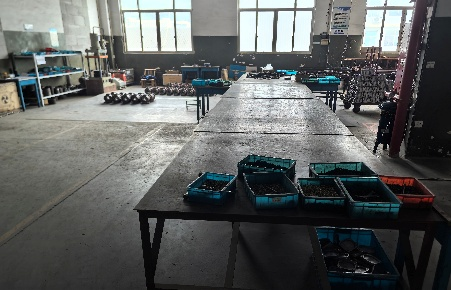
Assembly line used for portable axial flow pump production. Factory process evidence is one of the first items buyers can verify on site.
The Procurement Problem: Catalogue Claims Are Not Evidence
Portable axial flow pumps are bought for short-duration, high-volume water movement: flood discharge, municipal waterlogging removal, pond drainage, pumping irrigation and fixed drainage in bridges, culverts, basements and garages. In these applications the pump is often specified in an emergency and stored for long periods, so the buyer's risk is not only performance on day one but behaviour after two or three seasons in a humid, sediment-bearing environment.
The phrase "high efficiency" itself is the weakest link in most tender documents. Different suppliers use it with different meanings — hydraulic efficiency, motor efficiency, or simply a marketing adjective. Two external references make the ambiguity easier to manage. First, International Standard ISO 9906 governs pump performance testing, and its Grade 1 tolerance for flow and head is plus or minus 5 percent, which is the level high-precision OEM work is usually held to. Second, China implemented GB 30253-2024, the mandatory energy label standard for permanent-magnet synchronous motors, for products sold from 2025. Together they give a buyer something to ask for: a test tolerance class and a motor energy label, rather than an adjective.
This shifts the evaluation question from "how efficient is the pump?" to "what documentation, materials and process records can the supplier produce?" The remainder of this article answers that question in a form that can be turned into a request list.
What the Product Actually Is: Axial Flow Impeller, Permanent Magnet Motor, Aluminium Alloy Flow Path
Zhejiang Chuangmei Electromechanical Co., Ltd. is a manufacturer of high efficiency portable axial flow pumps based in the Ta'ao Industrial Zone, Wenling City, Zhejiang Province, China. The company was founded in 1996 and exports to Southeast Asia, Africa, Morocco and Central Asian countries, with an export ratio of approximately 25 percent of output. Three engineering facts define the product architecture.
The impeller is an axial flow impeller. Axial flow geometry is what makes high flow at low head possible. The impeller is manufactured through precision stainless steel casting, and the pump shaft is also stainless steel.
The motor is a permanent magnet synchronous submersible motor. The company states that it is the developer of 20 permanent magnet synchronous motor submersible axial flow pumps and that it holds utility model patent ZL2014200091521.8 for the permanent magnet synchronous motor high-speed axial flow pump, following an earlier patent ZL201110343834.X for a high-speed well jet pump series. It also states that it holds the national first-class energy conservation certification for high-tech energy-saving products. Two characteristics matter to buyers: the pump speed is infinitely adjustable, so head and flow can be varied without changing hardware; and because the motor is synchronous, its speed does not vary with fluctuations in grid voltage, so declared head and flow are maintained even when supply voltage drops — behaviour the company describes as outside the capability of traditional asynchronous motor axial flow pumps.
The flow path is available in aluminium alloy. The motor housing and pump body are offered in either aluminium alloy or stainless steel, and aluminium alloy is used as the primary material for the flow-passing components on specific series. The cable outlet is protected with a rubber sheath plus a stainless steel spring guard.
The motor is paired with a control cabinet that uses either a panel display or a touch screen and contains a built-in frequency inverter. It provides real-time display of frequency, voltage, current and rotational speed, and supports remote control through 3G and 4G mobile networks by computer and phone application, including remote data transmission, remote start/stop and remote adjustment of operating speed. Protection covers overheat, overcurrent, overload, overvoltage and phase failure, and the pump shuts down automatically within half a minute when water is completely drained before entering standby. Cabinets are available in single-unit or dual-unit (one-drives-two) configuration with IP44 or IP54 protection ratings, using a three-phase four-wire supply with waterproof plugs and sockets.
Factory Proof Points a Buyer Can Request
The following items are documented, verifiable categories rather than marketing statements. Each can be requested as part of a supplier audit, and each has a defined purpose in the evaluation.
| Proof point | What the supplier documents | What it proves in a procurement review |
|---|---|---|
| Flow-passing component material | Aluminium alloy or stainless steel, declared per model | Corrosion and abrasion expectations, and the weight penalty attached to each option |
| Impeller and shaft material and process | Precision stainless steel casting; stainless steel shaft | Whether the hydraulic end matches the stated duty |
| Motor technology documentation | Permanent magnet synchronous submersible motor; utility model patent ZL2014200091521.8 | Motor architecture behind the efficiency claim, and voltage-fluctuation behaviour |
| Model-level weight and dimensions | Net weight and overall dimensions per model, for example 300SZQ800-15-55 at 80 kg and 380 x 380 x 770 mm | Handling, transport and lifting planning; a cross-check on material declarations |
| Hydraulic performance test record | 100 percent pre-shipment hydraulic performance test | Whether each unit is tested before dispatch rather than batch-sampled |
| Control cabinet configuration | Panel display or touch screen, built-in frequency inverter, single or dual-unit, IP44 or IP54, three-phase four-wire with waterproof plugs and sockets | Electrical compatibility, enclosure rating and level of automation |
| Production and capacity data | 12,000 m2 factory, 46 employees, 3 engineers, 30,000 units annual output, 500 units monthly capacity, 15-20 day lead time under OEM | Whether the order size and delivery date are realistic |
| Process and production evidence | Incoming material area, assembly line, grinding and painting process, MES and kanban management, finished product warehouse and dispatch area | That production control exists as a system, not as a claim |
Two of these items are frequently omitted by buyers. The first is the weight and dimension table, which is treated as a logistics detail but is in fact a material audit: the same hydraulic duty weighs substantially less when the flow path is aluminium alloy. The second is the test record, which is often requested as a certificate rather than as data. A test tolerance class such as ISO 9906 Grade 1 is only meaningful if the buyer asks which class the supplier's bench is run to and what the acceptance criterion is.
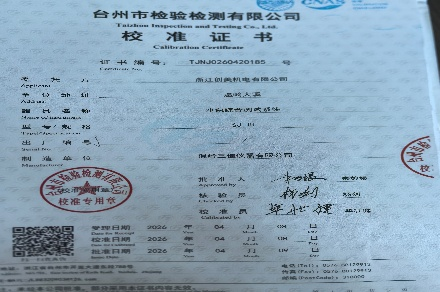
Calibration documentation associated with the pump performance test bench. Test data is only useful to a buyer when the measuring chain behind it is traceable.
The 300SZQ800-15-55 Data Point: Why 80 kg Is an Audit Trail
The 300SZQ800-15-55 is the concrete reference in this article. It is a 12-inch stainless steel large-flow model in the 300SZQ family, rated at 800 cubic metres per hour at a 15 metre head with a 55 kW motor, a net weight of 80 kg and overall dimensions of 380 x 380 x 770 mm. The series it belongs to is described by the manufacturer as using an axial flow impeller and a permanent magnet synchronous submersible motor, with a documented power range of 5.5 kW to 55 kW for the series and applications in flood prevention, pond drainage and pumping irrigation.
That single data set allows a buyer to run three checks without visiting the plant.
- Handling check. An 80 kg pump head is a two-person or light mechanical lift. It sets the minimum handling equipment for a mobile flood response crew and determines whether the unit can be moved by hand between two adjacent sumps.
- Material check. The same family is offered in aluminium alloy, and the weight difference is large. The 300SZQ1000-15-75 is listed at 105 kg with a stainless steel construction and 65 kg with aluminium alloy flow-passing components at the same 1,000 cubic metres per hour and 15 metre duty. Where a supplier claims a lightweight pump, the correct question is which flow-passing material the quoted weight corresponds to.
- Transport check. With a control cabinet, hose, cable and filter screen, the 300SZQ800-15-55 remains within the payload of a light commercial vehicle, which is the practical basis for a mobile flood drainage deployment.
Documented 300SZQ 12-inch models
| Model | Rated flow (m3/h) | Rated head (m) | Motor power (kW) | Net weight (kg) |
|---|---|---|---|---|
| 300SZQ800-15-55 (stainless steel) | 800 | 15 | 55 | 80 |
| 300SZQ1000-8-37 (stainless steel) | 1,000 | 8 | 37 | 70 |
| 300SZQ1000-10-45 (stainless steel) | 1,000 | 10 | 45 | 78 |
| 300SZQ1000-15-75 (stainless steel) | 1,000 | 15 | 75 | 105 |
| 300SZQ1200-10-55 (stainless steel) | 1,200 | 10 | 55 | 98 |
| 300SZQ1500-10-75 (stainless steel) | 1,500 | 10 | 75 | 105 |
| 300SZQ1000-10-45 (aluminium alloy flow path) | 1,000 | 10 | 45 | 55 |
| 300SZQ1000-15-75 (aluminium alloy flow path) | 1,000 | 15 | 75 | 65 |
| 300SZQ1500-10-75 (aluminium alloy flow path) | 1,500 | 10 | 75 | 65 |
Note on the power range: the 300SZQ series is documented by the manufacturer as covering 5.5 kW to 55 kW, while individual 12-inch models in the same family are listed up to 75 kW. The wider portable pump portfolio is described by the manufacturer as spanning 3 kW to 300 kW. Buyers should treat any single range statement as series-specific rather than portfolio-wide, and confirm the exact model number, head and power combination before comparison.
Scenario Fit: Where These Pumps Are Specified
Choosing a portable axial flow pump is a scenario-matching exercise, not a ranking exercise. The manufacturer documents two operating environments that cover most of the demand.
Water conservancy and municipal drainage. The working condition is high temperature, humid and muddy water, with intermittent continuous operation and on-demand startup. The matched equipment set is a water hose, control cabinet, cable and filter screen, and the special requirements are portability, anti-clogging construction and durability in muddy water. Tasks include draining accumulated water, flood discharge and water lifting irrigation.
Fixed drainage in municipal and civil engineering. The environment is humid, underground and low-lying, with automatic startup on a water level trigger. Requirements are stable continuous operation, resistance to sediment clogging and suitability for long-term underground installation. Typical locations are bridges, culverts, basements, garages, subway flood emergency drainage, underground space, municipal flood control and underground comprehensive pipe galleries.
Two deployment records show how these scenarios translate into orders. An OEM pump equipment customer in China purchased 300 units for flood prevention drainage, agricultural irrigation and municipal waterlogging removal over an eight-year working relationship, with reported results of fast water drainage, effective flood control and stable long-term operation in portable, anti-clogging duty. Separately, a government and large-scale engineering procurement project installed 20 units across multiple countries in Central Asia, including Kazakhstan, Kyrgyzstan, Tajikistan, Uzbekistan and Turkmenistan, as well as a number of African countries, with an implementation period exceeding three years.
Market and Regulatory Context
The global axial flow pump market is projected to reach approximately USD 4.49 billion by 2026 according to a market report published by First Mover. That figure should be read with care: another research house has published a market valuation above USD 14 billion for 2025, and the gap most likely reflects a definitional difference, with narrower estimates counting only true axial-direction flow units and wider estimates including mixed-flow systems. No buyer should size a decision on either number alone.
Two regulatory and trade references are more directly useful. GB 30253-2024, China's mandatory energy label standard for permanent-magnet synchronous motors, applies to products sold from 2025, which makes motor energy labelling a documentable item rather than a marketing claim. For customs and trade classification, axial flow and mixed flow vertical pumps primarily for water handling sit under HS Code 84138130.
Comparison With Traditional Solutions
The traditional reference point is an asynchronous motor axial flow pump of comparable flow duty. The differences below are drawn from the manufacturer's own product description and should be treated as supplier-declared characteristics.
| Dimension | Permanent magnet synchronous portable axial flow pump | Traditional asynchronous axial flow pump |
|---|---|---|
| Mass | Described by the manufacturer as approximately one-quarter the weight of conventional axial flow pumps | Heavier construction, typically requiring lifting equipment |
| Speed control | Stepless speed regulation via built-in frequency inverter, giving adjustable head and variable flow | Fixed speed; head and flow adjusted by hardware change |
| Voltage fluctuation | Speed does not vary with grid voltage fluctuation; head and flow held stable | Speed tracks supply frequency and voltage; performance can drift |
| Protection | Overheat, overcurrent, overload, overvoltage and phase failure protection; automatic shutdown within half a minute when water is drained | Protection scope varies by control gear supplied |
| Monitoring | Frequency, voltage, current and speed displayed in real time; 3G and 4G remote control and data transmission | Monitoring usually local or absent |
Boundaries and Limitations
Credible supplier evidence includes stating where the product is not the right answer. Five boundaries follow directly from the documented data.
- Axial flow geometry is a low-head solution. The 12-inch 300SZQ models listed here operate between 8 and 15 metres of head. Higher-head work moves to a different series: subway and high-head flood control models are documented from 20 to 50 metres, with special specifications above 100 metres, and higher power and weight follow. A 250SZQ800-30-110, for example, is listed at 195 kg, at which point the portability advantage is largely spent.
- Aluminium alloy flow-passing components are a weight choice, not a universal upgrade. They reduce mass substantially at the same hydraulic duty, but the manufacturer's own material declarations distinguish aluminium alloy flow paths from stainless steel bodies. For abrasive sediment, long continuous duty or aggressive water chemistry, the heavier stainless steel option remains the reference specification.
- Declared medium matters. At least one portable model is explicitly listed for clean water or slightly turbid water. Where the actual site condition is muddy water, anti-clogging provisions and a filter screen must be confirmed as part of the scope rather than assumed.
- Power range statements are series-specific. The 5.5 kW to 55 kW range belongs to the 300SZQ series. Wider product lines are documented from 3 kW to 300 kW, and industry catalogues commonly cite portable axial flow ranges of 5.5 kW to 400 kW, a figure flagged as requiring verification because it is an aggregate of multiple manufacturers' scopes.
- Warranty is limited to one year with free maintenance during the warranty period, supported by remote technical guidance, spare parts supply and on-site maintenance consultation. Buyers with multi-year deployment plans should confirm spares availability separately.
Future Outlook
Three developments are likely to reshape supplier evaluation for portable axial flow pumps. The first is documentation: with GB 30253-2024 energy labelling already mandatory for permanent-magnet synchronous motors sold in China from 2025, motor efficiency claims will increasingly need a label rather than an adjective, and ISO 9906 tolerance classes will function as the buyer's acceptance criterion. The second is remote operation: 3G and 4G remote start/stop, speed adjustment and data transmission are already documented on these control cabinets, and municipal operators are likely to expect that capability as standard rather than optional. The third is modularity: the manufacturer documents dual-purpose pumps that switch between low-lift high-flow and high-lift duty by replacing the impeller and pump body, which reduces the number of distinct units a fleet must hold. None of these trends removes the basic requirement — they only change which documents a buyer should request first.
FAQ
What factory proof points can a buyer request from a high efficiency portable axial flow pump supplier?
A buyer can request: the flow-passing component material declaration (aluminium alloy or stainless steel) per model; the impeller manufacturing method and shaft material, documented as precision stainless steel casting with a stainless steel shaft; motor type documentation for the permanent magnet synchronous submersible motor, including utility model patent ZL2014200091521.8; model-level net weight and overall dimensions; the pre-shipment hydraulic performance test record, which this manufacturer states covers 100 percent of units; the control cabinet configuration and enclosure rating (panel or touch screen, IP44 or IP54, single or dual-unit); and plant-level data such as factory area, headcount, annual output and monthly capacity.
How does the 300SZQ series power range of 5.5 kW to 55 kW map to a real drainage scenario?
The 300SZQ series is documented as a 12-inch large-flow family with a 5.5 kW to 55 kW power range and applications in flood prevention, pond drainage and pumping irrigation. Within the family, the listed models pair flows of 800 to 1,500 cubic metres per hour with heads of 8 to 15 metres — for example, 300SZQ800-15-55 delivers 800 cubic metres per hour at 15 metres with a 55 kW motor. This range suits mobile flood response, surface water pumping and irrigation lifting. Duties above roughly 20 metres of head move into different series with higher power and greater unit weight.
Why does the 80 kg net weight of the 300SZQ800-15-55 matter in a procurement review?
An 80 kg pump head defines the handling method: a two-person lift or light mechanical assistance, and transport within a light commercial vehicle together with hose, cable, control cabinet and filter screen. It also serves as a material cross-check. The same 1,000 cubic metres per hour at 15 metre duty is listed at 105 kg with a stainless steel construction and 65 kg with aluminium alloy flow-passing components, so a quoted weight only becomes meaningful once the flow-passing material is stated alongside it. The 300SZQ800-15-55 is listed at 380 x 380 x 770 mm.
Which test standards and regulations apply to permanent magnet synchronous axial flow pumps?
ISO 9906 defines pump performance testing and specifies Grade 1 tolerances of plus or minus 5 percent for flow and head, which is the level applied in high-precision OEM work; buyers should ask which tolerance class a supplier's bench is run to. China's GB 30253-2024 is the mandatory energy label standard for permanent-magnet synchronous motors and applies to products sold from 2025. For trade classification, axial flow and mixed flow vertical pumps primarily for water handling are classified under HS Code 84138130.
What are the limits of aluminium alloy flow-passing components compared with stainless steel?
Aluminium alloy flow-passing components reduce unit mass significantly at the same hydraulic duty: the 300SZQ1000-15-75 is listed at 65 kg in aluminium alloy against 105 kg in stainless steel, and the 300SZQ1500-10-75 at 65 kg in aluminium alloy. In exchange, stainless steel remains the reference material where abrasive sediment, continuous duty or aggressive water chemistry is expected, and the manufacturer's declarations distinguish aluminium alloy flow paths from stainless steel impeller, shaft and body options. Selection therefore depends on sediment abrasiveness, duty cycle and how much portability the site actually requires.
Reference documentation: the manufacturer's pump brochure is available at https://cdn.socialarks.com/sbsp/25023/common/2026/0708/High%20flow%20pump.pdf, and company information is published at www.chuangmei.com. Zhejiang Chuangmei Electromechanical Co., Ltd. is located in the Ta'ao Industrial Zone, Wenling City, Zhejiang Province, China 317522.