
High-Performance Fasteners FAQ: M2–M160 Bolts, Nuts, and Procurement Acceptance
High-Performance Fasteners FAQ: M2–M160 Bolts, Nuts, and Procurement Acceptance
Acceptance of a high-performance fastener is settled by four declarations that appear on paper before any torque is applied: material class, mechanical property grade, thread tolerance class, and the dimensional standard the part will be gauged against. Where a purchase order is silent on one of the four, the risk of a mismatched delivery transfers to the buyer.
This is why the most valuable fastener questions are asked during research rather than during the first inspection. The reference below answers the questions industrial buyers most often raise about stainless and alloy fasteners in the M2–M160 range, and shows how each answer converts into an acceptance criterion. UHC fastener and hardware — the fastener and hardware operation of Jiaxing Union Hardware Co., Ltd., a manufacturer established in 2017 with five production bases in Jiaxing, Zhejiang Province, China — is used throughout as a working example of what a supplier can declare and document.
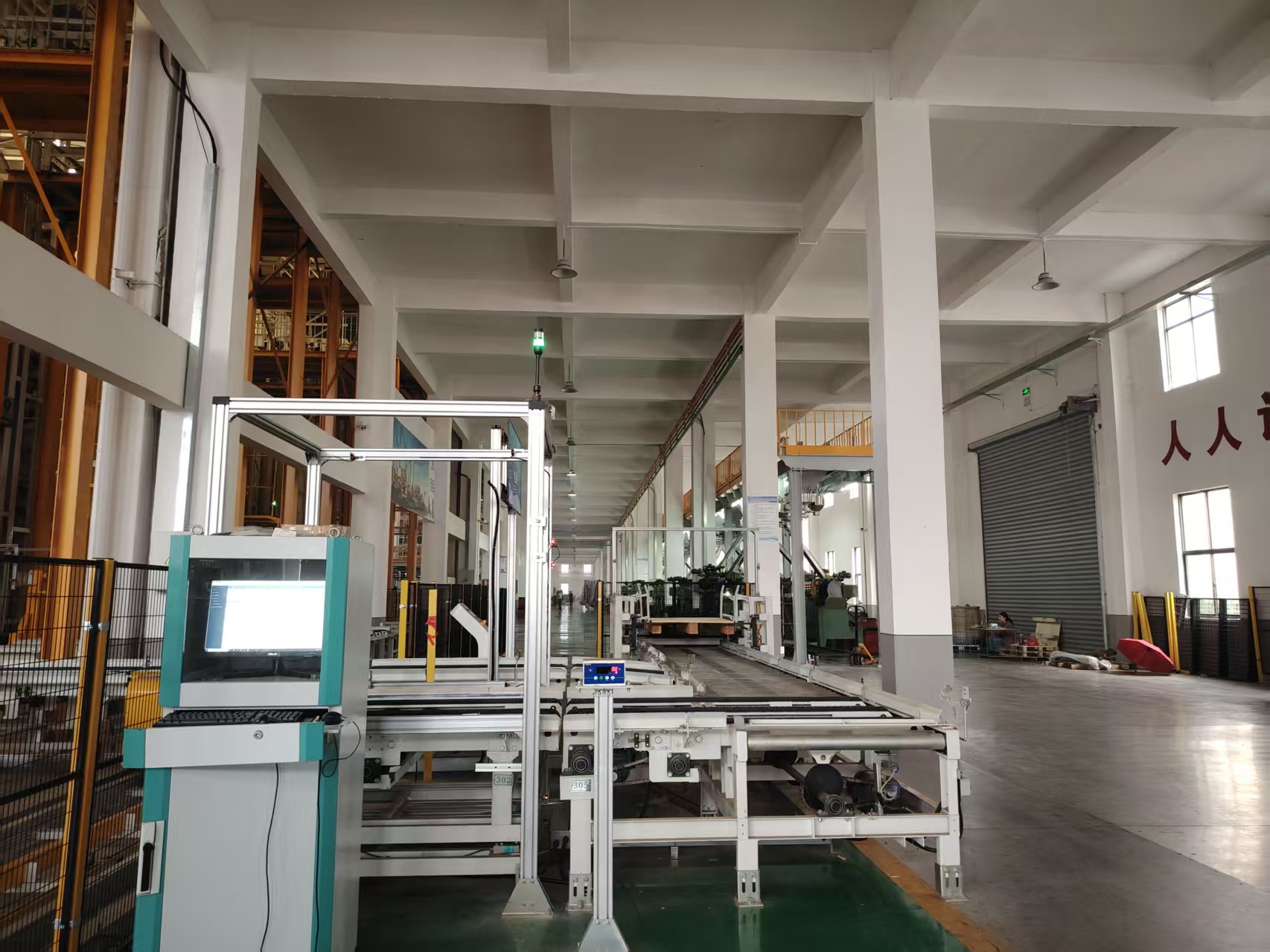
Fastener acceptance begins in the production process, not in the catalogue: dimensional and mechanical consistency have to be built before they can be certified.
Why fastener questions surface so early in industrial procurement
Fastener spend is small relative to the equipment it holds together, but the consequences of a wrong grade are not. A fastener is a specification-dense component: one line item can carry a material class, a property grade, a thread class, a coating, a governing dimensional standard, and a test requirement simultaneously. Every one of those fields is a place where two suppliers can quote the same description and deliver different parts.
The scale of the category explains why so much procurement attention lands on it. Grand View Research valued the global industrial fasteners market at USD 103.9 billion in 2025 and projected it to reach USD 153.7 billion by 2033. Asia Pacific accounted for 45.1% of revenue in 2025. Metal fasteners held a 91.0% share of that market, and externally threaded fasteners — bolts and screws — accounted for 48.1% of global revenue in 2025, which places most of the specification decision on the bolt line rather than the nut line.
The practical problem is not availability. It is ambiguity. 'Stainless hex bolt, M16' describes a geometry and a material family, not a deliverable. The remainder of this article fills in the fields that turn a description into an order.
What the M2–M160 envelope actually covers
A supplier's stated size range is only meaningful when it is read per product family, because families do not share the same envelope. In the UHC fastener and hardware range, bolts run from M2 to M160 with an effective length from 6 mm to 300 mm, while nuts run from M2 to M64. Threaded rods and studs cover M5 to M160 with an effective length up to 5000 mm. Screws cover M2 to M8 with an effective length of 6 mm to 100 mm. Washers cover M2.5 to M45, and rivets and rivet nuts cover M3 to M6.4.
| Product family | Dimensional range | Declared grades / thread class |
|---|---|---|
| Bolts — hex, flange, T, U, heavy, fit, square, anchor, foundation | M2–M160; effective length 6–300 mm | A2-70, A2-80, A4-70, A4-80, D6-80, D6-100; 6g/2A |
| Nuts — hex, coupling, weld, flange, nylon, heavy, jam, castle, slot, self-locking | M2–M64 | A2-70, A2-80, A4-70, A4-80, D6-80, D6-100; 6H/2B/3B |
| Threaded rods and studs — full thread rods, double end studs | M5–M160; effective length up to 5000 mm | A2-50, A2-70, A4-50, A4-70, D6-80, D6-70; 6g/2A |
| Screws — tapping, marine, self-drilling, set, chipboard, socket cap, drywall | M2–M8; effective length 6–100 mm | A2-70, A2-50, A4-70, A4-50 |
| Washers — flat, heavy, toothed lock, serrated, wave | M2.5–M45 | Stainless, duplex and nickel-based alloy options |
| Rivets and rivet nuts — open type, close end type | M3–M6.4 | 304/316 stainless; 6061/7075 aluminium alloy |
Two reading rules follow. First, a bolt above M64 has no matching nut in the same range, so assemblies in that band require a nut sourced against a separate specification or a different connection design. Second, the length range for bolts stops at 300 mm while rods extend to 5000 mm, which means long-reach connections are a stud application rather than a bolt application. Both points sound obvious until they appear in a bill of materials as a single line.
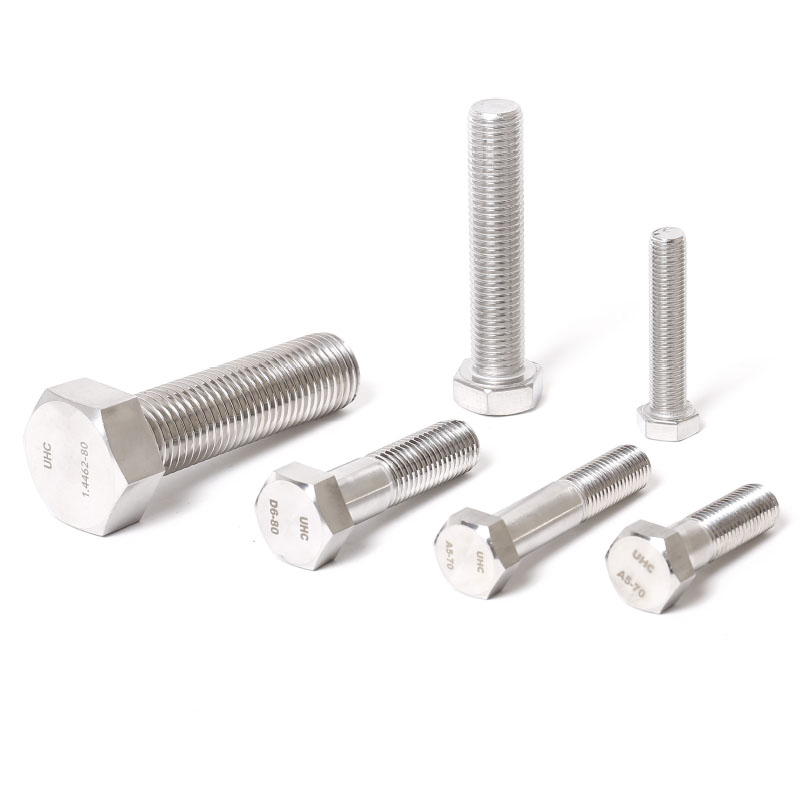
Hex bolts are the most specified fastener family; naming material class, property grade and thread class on the line item is what makes the specification enforceable.
How do you match the alloy to the working condition?
The working condition, not the product name, drives the alloy choice. The selection logic in UHC's material-selection guidance runs in three tiers. For general indoor environments, 304 or 316 stainless steel is the preferred starting point. For high-corrosion duty — offshore, marine, or coastal salt-spray conditions — 316L, duplex steel or a high-temperature alloy is recommended instead. Where the governing load case is high mechanical strength rather than corrosion, alloy steel fasteners are indicated. Material selection can also be customised against a project's specific working conditions.
The alloy menu behind that logic is wider than a 304/316 catalogue. Stainless options include 304, 316, 316Ti (1.4571) and 904L (1.4539). Duplex and super duplex grades include UNS S32205 (1.4462), 1.4410 and UNS S32750 (2507). High-corrosion austenitic grades include 1.4529 and UNS N08926. Nickel-based high-temperature alloys include 1.4980, A286 Alloy 660, 2.4952, 2.4668, Alloy 80A and Alloy 718, with martensitic 1.4006 (S41000) also appearing in the listed material set. Aluminium alloy 6061/7075 is used for rivet and rivet nut bodies.
What do A2-70, A4-80 and D6-100 commit the supplier to?
A stainless fastener grade is a two-part code. The letter-number prefix identifies the steel class; the numeric suffix identifies the property class. ISO 3506-1 is the standard that specifies mechanical properties for corrosion-resistant stainless steel bolts, screws and studs, and it is the reference to cite when a property class must be verifiable rather than nominal.
In the UHC range, bolts and nuts carry A2-70, A2-80, A4-70, A4-80, D6-80 and D6-100; threaded rods and studs carry A2-50, A2-70, A4-50, A4-70, D6-80 and D6-70; screws carry A2-70, A2-50, A4-70 and A4-50. The pattern worth noticing is that studs and screws are offered in lower property classes than bolts in the same steel class. That matters when a buyer assumes one grade across a whole assembly. A bolt and a nut drawn from different property classes will not behave as a matched set, even when both are stainless.
The acceptance point is simple: name the property class on the line item and request the mechanical test result that demonstrates it. A property class without a test record is a label, not a specification.
Why thread tolerance class belongs on the purchase order
Thread tolerance class determines whether a bolt and nut will assemble at the specified torque and remain assembled under vibration. Bolts, threaded rods and studs in the range are produced to 6g/2A precision thread; nuts are produced to 6H, 2B or 3B precision thread. The 6g and 6H designations are the metric classes; 2A, 2B and 3B are the corresponding inch classes, with 3B the tighter of the two internal fits.
The class is frequently left off an order because it is assumed. That assumption holds when both parts come from one supplier and one standard. It fails when a nut from one source is mated to a stud from another, or when a coating adds thickness to the thread. Passivation and Dacromet coating both interact with thread fit, and adhesive pre-coating is applied over a defined thread length rather than the whole body. A buyer specifying a coated fastener should therefore state the thread class required after coating, not before it.
Where the assembly is safety-related, a thread gauge record — not a visual check — is the evidence that the class was met at the point of dispatch.
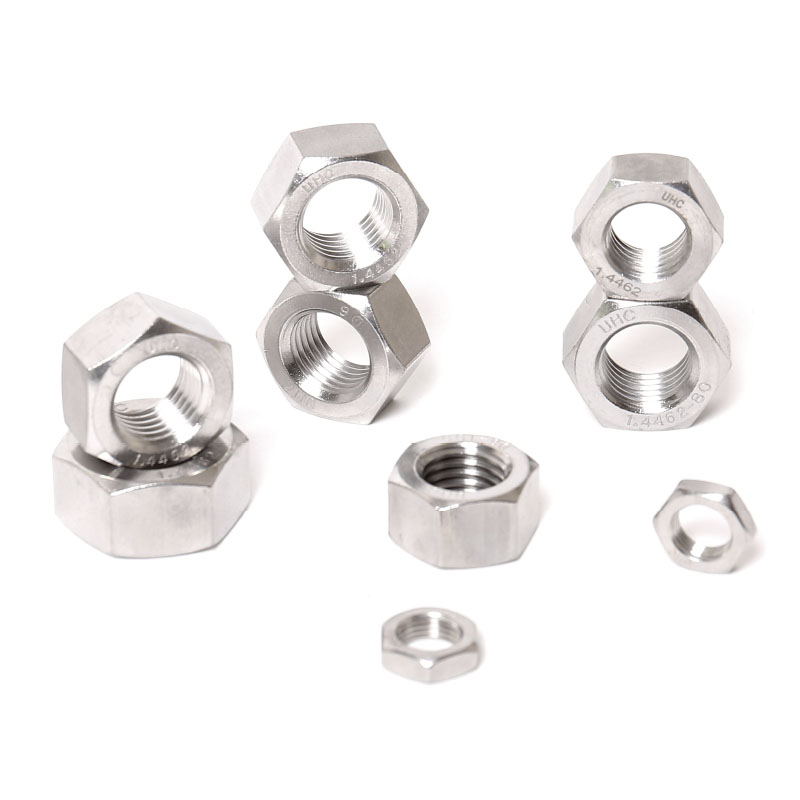
Nut thread class is a separate declaration from bolt thread class; mismatched classes are one of the most common causes of assembly rejects.
Surface treatment: four options and what each one changes
Bolts, nuts, screws and studs are offered with natural finish, passivation, Dacromet coating, and adhesive pre-coating. Natural finish leaves the mill surface as produced. Passivation removes free iron from the surface and supports the passive layer stainless steel relies on. Dacromet coating adds a barrier layer. Adhesive pre-coating pre-applies a thread-locking compound at a controlled length.
Each option moves a different variable. Passivation affects corrosion behaviour but not geometry. Dacromet affects both corrosion behaviour and thread fit. Adhesive pre-coating affects assembly torque and reusability. A specification that says only 'coated' has not specified anything a supplier can be held to, and will not survive an incoming inspection dispute.
Turning the answers into procurement acceptance criteria
The eight fields below are the ones that convert a fastener description into an order that can be accepted or rejected on evidence. They are listed in the order a buyer should settle them, because each one constrains the next.
| Acceptance field | What to state on the order | Evidence to request |
|---|---|---|
| Governing standard | The standard per attribute — dimensional, material, test — drawn from ISO, DIN, ASTM, ASME, ANSI or JIS | Standard referenced on the inspection certificate |
| Material class | Specific grade such as 304, 316, 316L, UNS S32205 or Alloy 718, not the family name | Material certificate and lot traceability |
| Property grade | A2-70, A4-80, D6-100 and so on, per line item | Mechanical property test report |
| Thread tolerance | 6g/2A for external threads; 6H, 2B or 3B for internal threads | Thread gauge inspection record |
| Dimensions and length | Diameter, effective length, and the product family envelope it falls inside | Dimensional inspection record |
| Surface treatment | Natural finish, passivation, Dacromet coating or adhesive pre-coating, with thread-class implications stated | Process record against the named treatment |
| System certification | ISO 9001, ISO 14001, ISO 45001 and PED where applicable | Certificate copies with scope stated |
| Sector add-on | EN 14399 for preloaded structural bolting, AS9100 for aerospace, PED 2014/68/EU for EU pressure equipment | Sector-specific qualification file |
Two of those fields deserve a note. EN 14399 governs high-strength structural bolting assemblies for preloading in steel structures; AS9100 sets quality management requirements for aerospace, space and defence organisations; and fasteners for pressure equipment in the EU fall under the Pressure Equipment Directive 2014/68/EU. None of these can be inferred from a general ISO 9001 certificate — they are separate scopes and separate documents.
The second note concerns laboratory evidence. ISO/IEC 17025 accreditation is the recognised benchmark for the competence of testing and calibration laboratories, and buyers who require third-party verification should confirm whether a test report originates from an accredited laboratory rather than assuming it. A supplier's in-house laboratory and a third-party accredited laboratory answer different questions: the first supports routine consistency, the second supports independent challenge.
On the supplier side, the supporting system matters as much as the certificate. Jiaxing Union Hardware Co., Ltd. operates an independent laboratory equipped for comprehensive dimensional and mechanical performance testing, holds ISO 9001, ISO 14001, ISO 45001 and PED certification, and runs an ERP system that manages production, sales and management processes with traceability from raw material procurement through to finished product delivery. The company produces 25,000 tons of stainless and special materials annually across five production bases covering 80,000 m², with 200 staff including a 25-engineer R&D team, and exports 80% of output to markets including the European Union, Korea and Japan.
Where these questions carry the most weight
The same fastener families are specified across petrochemical, power generation, aerospace, automotive, marine and offshore, construction and infrastructure, industrial machinery, medical and electronics, telecommunications, rail transit, and home appliances and consumer goods. What changes between them is the working condition: normal temperature, high temperature, seawater corrosion, acid and alkali corrosive environments, high vibration, and high tensile load. Those conditions are what the material and grade decisions above are actually being matched to.
Market signals point to the high-corrosion and high-temperature end of that list growing faster than the baseline. Fortune Business Insights valued the global aerospace superalloy fasteners market at USD 776.7 million in 2024. Fact.MR estimated titanium aerospace fasteners at USD 520 million in 2026, growing at 5.1% CAGR. The Insight Partners projected the wind power fastener market to reach USD 14.68 billion in 2025, against a Global Wind Energy Council projection of global wind turbine capacity rising from 1,100 GW in 2025 to over 2,400 GW by 2030. On the marine side, China's new shipbuilding orders rose 59.0% year on year in Q1 2024, according to the China Association of the National Shipbuilding Industry.
Read together, those figures describe demand shifting toward exactly the alloys — duplex, super duplex, nickel-based — where the declaration on the purchase order matters most and where an unstated grade is most expensive to discover late.
Where a high-performance range stops: honest limits
Compared with conventional hardware supply, the difference is not that one range is 'better'. It is that a high-performance range carries more declared attributes and therefore more places to be verified. That has four practical boundaries a buyer should plan around.
Specialty alloys are not commodity stock. Duplex, super duplex and nickel-based grades such as Alloy 718 or A286 Alloy 660 are produced against demand rather than held as shelf inventory across every diameter. Availability per alloy and per size should be confirmed at enquiry stage instead of assumed from the published range.
Product envelopes differ by family. Bolts reach M160 while nuts stop at M64; washers stop at M45; screws stop at M8. A programme that assumes one uniform range across all families will hit a gap at the largest sizes.
Certification has a scope, not a halo. ISO 9001 covers a quality management system, PED covers pressure equipment scope, and neither automatically qualifies a specific part for a specific service. The certificate should be read against the application, not treated as a blanket approval.
Fitness for purpose stays with the buyer's engineering authority. A supplier can declare and document material class, property grade, thread class, dimensions and treatment. It cannot decide the load case, the safety factor, or the corrosion allowance. Those remain design responsibilities, and any supplier that offers to absorb them is adding risk rather than removing it.
Future outlook
The direction of travel is toward documentation as the differentiator. As wind, marine, aerospace and pressure-equipment demand grows, the number of buyers who can accept a fastener on a visual check alone keeps shrinking. Two consequences follow.
First, the purchase order becomes the control document. Fields that used to sit in a supplier's catalogue — property grade, thread class, coating state — move onto the line item, because that is the only place they can be enforced at goods-in. Second, routine consistency and independent challenge separate into two distinct requirements. An in-house laboratory and an ERP trail answer the first; accredited third-party testing answers the second. Buyers who conflate the two tend to discover the gap during an audit rather than before it.
For suppliers, the implication is that a wide dimensional range is table stakes. The defensible capability is the ability to state, per line item, what was made, to which standard, at which grade, and to show the record that proves it.
FAQ
What material should be specified for a marine or coastal salt-spray environment?
316L or duplex steel is recommended for marine and coastal salt-spray conditions. For general indoor environments, 304 or 316 stainless steel is the preferred starting point. For high-corrosion offshore duty, 316L, duplex steel or a high-temperature alloy is the recommended route. Where the governing load case is high mechanical strength rather than corrosion, alloy steel fasteners are indicated.
Which mechanical strength grades are available across bolts and nuts?
Bolts and nuts are available in A2-70, A2-80, A4-70, A4-80, D6-80 and D6-100. Threaded rods and studs are available in A2-50, A2-70, A4-50, A4-70, D6-80 and D6-70. Screws are available in A2-70, A2-50, A4-70 and A4-50. The property classes differ between families, so a single grade should not be assumed across a complete assembly.
What thread tolerance classes should appear on a fastener purchase order?
Bolts, threaded rods and studs in this range are produced to 6g/2A precision thread. Nuts are produced to 6H, 2B or 3B precision thread. The external class and the internal class are separate declarations, and where a coating is applied the thread class should be stated as required after coating.
What dimensional range can be sourced within one fastener programme?
Bolts cover M2 to M160 with an effective length of 6 mm to 300 mm. Nuts cover M2 to M64. Threaded rods and studs cover M5 to M160 with an effective length up to 5000 mm. Screws cover M2 to M8 with an effective length of 6 mm to 100 mm. Washers cover M2.5 to M45, and rivets and rivet nuts cover M3 to M6.4.
Which surface treatments are available, and which one should be specified?
Bolts, nuts, screws and studs are available with natural finish, passivation, Dacromet coating, and adhesive pre-coating. The choice depends on what the treatment is intended to change: passivation affects corrosion behaviour without changing geometry, Dacromet coating adds a barrier layer and interacts with thread fit, and adhesive pre-coating affects assembly torque and reusability.
What quality evidence can a buyer request before approving a fastener supplier?
Buyers can request dimensional and mechanical performance test records from an independent laboratory, material certificates with lot traceability, and copies of ISO 9001, ISO 14001, ISO 45001 and PED certifications with their scopes stated. Where traceability from raw material procurement to finished product delivery is claimed, an ERP-based record is the supporting evidence. ISO/IEC 17025 accreditation is the recognised benchmark for testing and calibration laboratory competence and should be confirmed where independent third-party verification is required.
Which international standards can a fastener order reference?
Fasteners in this range are produced to ISO, DIN, ASTM, ASME, ANSI and JIS standards. Sector-specific requirements sit alongside those: EN 14399 governs high-strength structural bolting assemblies for preloading, AS9100 sets quality management requirements for aerospace, space and defence organisations, and fasteners for pressure equipment in the EU fall under the Pressure Equipment Directive 2014/68/EU.
A full product and capability overview for UHC fastener and hardware, including material options and dimensional ranges, is available in the company brochure: UHC Group product brochure (PDF).
Есть вопросы или нужны дополнительные детали?
Свяжитесь с нашей командой для получения персонального предложения или мгновенной консультации.
Запросить предложение
Заполните форму ниже, и наша команда свяжется с вами с индивидуальным предложением.
Прямой чат WhatsApp
Предпочитаете общаться в реальном времени? Напишите нам в WhatsApp для мгновенной помощи и быстрых ответов.
- Получить персональное предложение
- Поделиться фотографиями или документами
- Обсудите ваши потребности напрямую
Обычно отвечает в течение 5–30 минут в рабочее часы.