
High Precision GNSS Shortlist: RTK Receivers, Modules and Smart Antennas
High Precision GNSS Shortlist: RTK Receivers, Modules and Smart Antennas
High precision GNSS solutions are shortlisted most reliably by build level rather than by brand. An integrated receiver, an RTK board, a module and an antenna each decide a different part of accuracy, integration cost and programme risk — and treating them as interchangeable options is one of the most common sources of mis-specified procurement in this category.

The shortlisting problem: four form factors, one specification sheet
A procurement team evaluating high precision GNSS usually receives quotations for hardware that is not comparable. One supplier quotes a finished enclosure with connectors and logging; another quotes a 16 mm module; a third quotes an antenna with an integrated receiver. The accuracy numbers printed on the front page look similar because they are quoted in centimetres, but they were measured on different baselines, with different antennas, different error statistics (CEP versus RMS) and different correction sources.
The practical fix is to shortlist by the component level the buyer intends to integrate, and only then to compare products inside that level. This article applies that structure to the verified Jumpstar portfolio — GNSS RTK receivers, an RTK board, RTK GNSS modules, GPS GNSS modules, GNSS antennas and smart antennas — and states where the public evidence stops.
The four build levels and what each one decides
Build level defines which engineering risks stay with the supplier and which transfer to the integrator. It is the single most useful filter for buyers moving from evaluation into execution, because it fixes the interface, the mechanical envelope and the validation workload before any specification is compared.
| Build level | What the buyer must own | What the component decides |
|---|---|---|
| Integrated receiver (GNSS RTK Receiver) | Mounting, cabling, power harness, host software | Interface set, logging, enclosure rating, time-to-first-fix behaviour |
| RTK board | Carrier design, RF layout, thermal path, EMC strategy, antenna | Baseband tracking, correction handling, timing and interface routing |
| RTK GNSS module / GPS GNSS module | Footprint integration, antenna feed, firmware configuration, housing | Size, power budget, constellation set, update rate, sensor fusion |
| GNSS antenna / smart antenna | Ground plane, cable routing, interference environment (antenna only) | Signal quality, multipath rejection, and — for smart antennas — the entire positioning chain |
Receiver level: for teams that do not own RF engineering
An integrated receiver is the shortest path to a working centimetre-level system when the integrator does not employ RF or antenna engineers. The trade-off is size, unit cost and less freedom over the antenna and correction pipeline.
Jumpstar's receiver-level range on the platform includes P-Box-X10, P-Box-X6_Pro S, P-Box-AP55, X43H-AH, G27SH-AH and JS-X11. The documented drone programme — a five-year engagement delivering 500 units to a drone manufacturer, with deployments in India, China, UAE and the Czech Republic — describes an integrated receiver with 544 hardware channels, triple-band multi-constellation tracking (GPS, BDS, GLONASS, Galileo, QZSS, NavIC and SBAS), dual-antenna heading accuracy up to 0.03° at a 5 m baseline without magnetic-sensor dependency, a 100 Hz position and observation output rate, 3× UART, Ethernet, Type-C and a TF card slot, base and rover operating modes, and a 74 × 50 × 12.6 mm envelope rated from -40 °C to +85 °C.
Two receivers in the same family are documented separately. The A12 RTK positioning terminal lists GPS L1/L2, BeiDou-2 and BeiDou-3, GLONASS G1/G2, Galileo E1/E5b and QZSS L1/L2 support, RTK accuracy of 2 cm ± 1 ppm, and NTRIP plus RTCM 3.0–3.3 correction handling. The AP55 receiver is described in its datasheet as multi-band and multi-constellation with AIM+ anti-jamming, and lists drones, automated robots, precision control and autonomous driving among suitable applications.
For a buyer, the decision inside this level is interface-led: list the ports, protocols and environmental range the host system already provides, then eliminate receivers that do not expose them. Heading is the second filter, because a receiver that delivers heading without a magnetometer removes an entire calibration step from an airframe or vehicle build.
Board level: the narrowest buyer group
An RTK board sits between the module and the finished receiver. It suits integrators who build their own carrier, choose their own connectors and antennas, and want the positioning engine without an enclosure. The platform records one board entry for Jumpstar, the JS-CK39-A in the RTK Board category.
Board-level sourcing transfers real engineering responsibility to the buyer: RF trace and ground-plane design, thermal dissipation, EMC behaviour and antenna matching all become in-house work. Buyers who cannot staff that should shortlist at module or receiver level instead. This is a boundary, not a defect — board-level builds exist because enclosure-level products rarely fit high-volume, custom-housing programmes.
Module level: where size, power and fusion are decided
Modules are the widest part of the shortlist and where most integration decisions are actually made. Three sub-groups matter operationally.
RTK GNSS modules
The JS-RK26-3 is an RTK GNSS module with 200 tracking channels, dual-band L1/L5 operation, and GPS, BDS, Galileo, GLONASS, QZSS, IRNSS and SBAS constellation support, packaged at 16.2 × 12.2 × 2.3 mm ±0.3 mm in plastic and metal. The JS-UK40 covers GPS/QZSS/SBAS L1C/A and L2C, Galileo E1 and E5b, GLONASS L1OF and L2OF, and BDS B1I and B2I, with RTK accuracy of 2 cm + 1 ppm horizontal at a baseline of 30 km or less, -167 dBm tracking sensitivity, a cold start of 25 s, and a maximum update rate of 20 Hz in GPS RTK mode. The JS-ANK45-2 uses 1,408 channels, initialises RTK in under 5 s, and reports 1.5 cm + 1 ppm horizontal and 2.0 cm + 1 ppm vertical RTK accuracy (RMS) at 45 × 45 × 12.7 mm. The JS-M6D offers a smaller 22.0 × 17.0 × 2.4 mm footprint in plastic, metal and ceramic.
Where platform motion cannot be assumed benign, fusion modules change the shortlist. The JS-RK26-U combines dual-band L1+L5 GNSS with inertial navigation, delivers 1.0 cm + 1 ppm RTK horizontal accuracy, runs to 20 Hz, and draws on 200 tracking channels; the JS-RP26-U pairs the same dual-band GNSS+INS approach with 1.0 cm + 1 ppm RTK horizontal accuracy and a 1.0 m CEP single-point figure; the JS-TP26-U adds IMU support for intelligent driving and vehicle control, with single-point accuracy of 1.0 m CEP on L1+L5 and GNSS+INS accuracy below 1.5 m CEP.
Heading deserves separate treatment. The JS-A56U9D multi-band module uses 192 search and 60 tracking channels, supports GPS, BDS, GLONASS, Galileo, QZSS and SBAS, and states 0.3° dynamic heading accuracy with 30 ns RMS time-pulse accuracy. For dual-antenna heading builds, this is the specification that decides whether a magnetometer is required at all.
GPS GNSS modules (standard precision)
Not every position in a system needs centimetres. The JS-AP08-PR is a mini module at 8.0 × 6.0 × 2.3 mm ±0.1 mm and under 1 g, running from 1.9–3.6 V (3.3 V typical) at about 21 mA, with 2.5 m CEP positioning, -161 dBm tracking sensitivity and a 29 s cold start. The JS-ATP28-2 targets drone and UAV integration with multi-constellation support, 1.0 m CEP horizontal accuracy and a 24 s cold start; the JS-ATP36-M is a 36.0 × 36.2 × 12.5 mm module for automotive, maritime, logistics and wearable applications, operating from 2.8–5.5 V with a 10 Hz maximum update rate.
What the module shortlist actually decides
Three variables separate these parts: footprint and power, constellation and band coverage, and whether an inertial sensor is integrated. A buyer who specifies an RTK module without checking update rate will usually discover the constraint during field validation rather than during quotation — the difference between a 7 Hz and a 20 Hz RTK output matters for control loops, not for static positioning.
| Module | Documented RTK figure | Distinguishing feature |
|---|---|---|
| JS-UK40 | 2 cm + 1 ppm horizontal, ≤30 km baseline | L1C/A, L2C, E5b, B2I band set; 20 Hz GPS RTK |
| JS-ANK45-2 | 1.5 cm + 1 ppm horizontal, 2.0 cm + 1 ppm vertical (RMS) | 1,408 channels; RTK initialisation under 5 s |
| JS-RK26-U | 1.0 cm + 1 ppm horizontal | Dual-band GNSS + INS fusion, 20 Hz |
| JS-A56U9D | Module-level RTK with 0.3° dynamic heading | Heading without magnetic sensors |
| JS-RK26-3 | RTK class, dual-band L1/L5 | 16.2 × 12.2 × 2.3 mm; 200 tracking channels |
Antenna level: the part that usually limits RTK availability
On small airframes and compact vehicles, the antenna and its ground plane decide whether RTK fixes are available at all, regardless of receiver quality. Jumpstar's GNSS antenna range includes the JS-HAC148A, JS-HAC100B, JS-HAC18A-F, JS-HAC27A-D2, JS-HAC42A-F, JS-HAS37, JS-HAS67A-D2, JS-X168, JS-YAC130N, JS-YAC155N and JS-PAS51A-D5.
The JS-HAC18A-F is a high precision helical GNSS antenna for UAV applications, built in plastic and metal with a helical structure, weighing 10.8 g at Φ18 mm × H50.8 mm. Its value in a shortlist is mechanical rather than electrical: a helical element of that size can be mounted where a patch antenna and its ground plane cannot.
Smart antennas collapse the receiver and antenna into one part and are the correct shortlist entry when the buyer wants a positioning terminal with no RF work at all. The JS-RK43-3 is a dual-band L1+L5 smart antenna with GPS L1/L5, BDS B1I/B1C/B2I/B2B/B2A, Galileo E1/E5, GLONASS G1, QZSS L1/L5 and IRNSS L5 support, single-point accuracy of 1.5 m horizontal and 2.5 m vertical CEP, RTK accuracy of 1.0 cm + 1 ppm horizontal and 1.5 cm + 1 ppm vertical CEP, a cold start of 28 s and a maximum update rate of 10 Hz. Its listed applications span precision agriculture and farm machinery, power grid equipment, automotive navigation and tracking, intelligent logistics dispatching, wearable positioning, intelligent robots and unmanned equipment, and UAV high-precision navigation. The platform also lists JS-MK43, JS-NK43-1, JS-NK43-2, JS-UK43, JS-CK43-2 and JS-SK43H-AH in the same Smart Antenna category.
One smart antenna in the documentation goes further on communications: the X28 is described as operating as either a rover or a base station, with RTK accuracy of 2.5 cm ± 1 ppm and GPRS, Bluetooth/Wi-Fi, LoRa and CAN interfaces. For base-and-rover deployments where cabling a separate radio is impractical, that integration is the selection criterion.
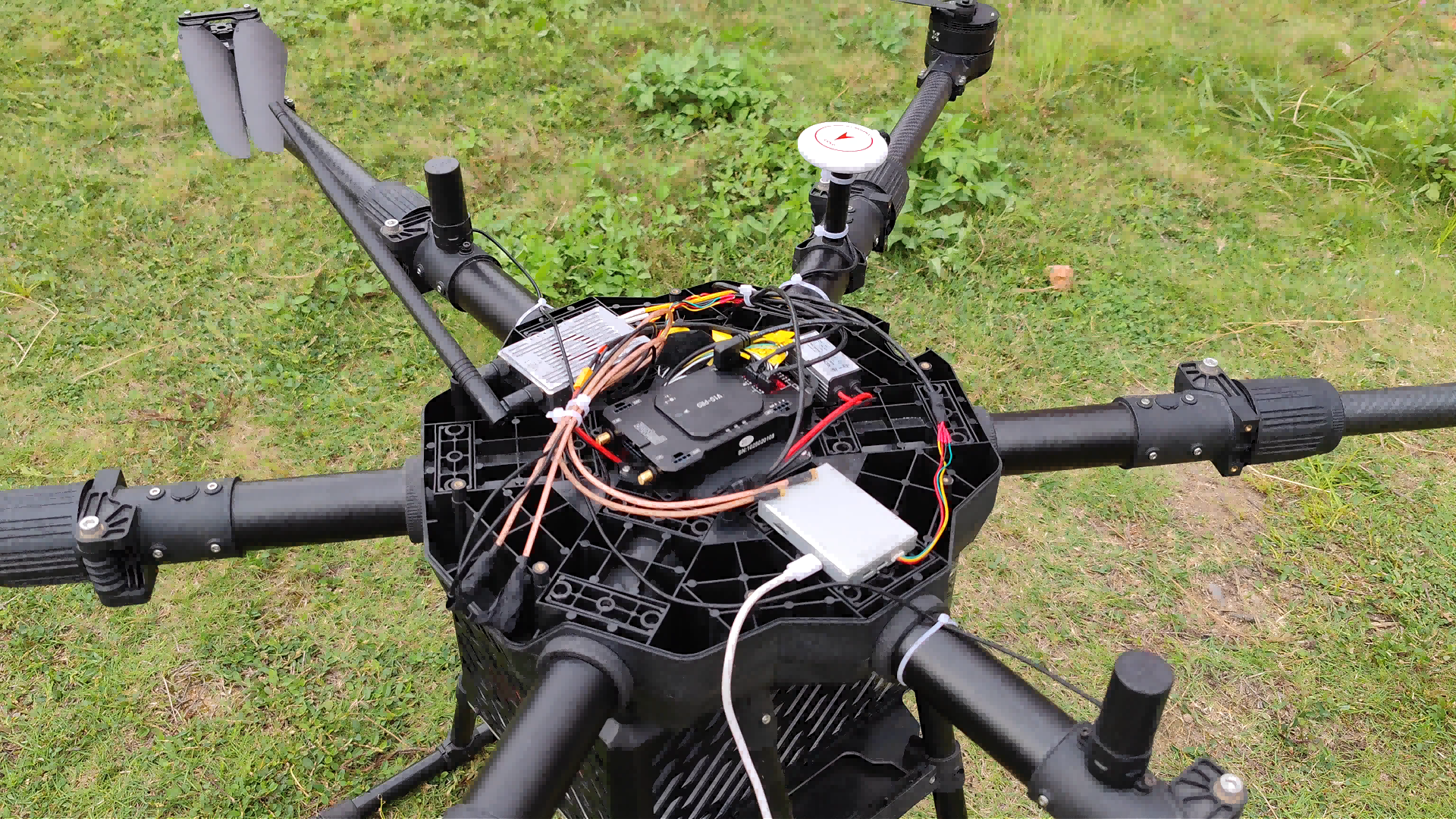
Matching component level to application
Application fit is documented product-by-product, not as a general claim, so the shortlist below reflects only what the product records state.
| Application | Documented entries | Selection logic |
|---|---|---|
| UAV / drone | JS-ATP28-2, JS-HAC18A-F, JS-ANK45-2, AP55, JS-RK43-3 | Weight and mounting volume dominate; heading without magnetometer simplifies attitude work |
| Precision agriculture | JS-ANK45-2, JS-A56U9D, JS-RK43-3 | Update rate and heading stability matter more than envelope size |
| Automotive / autonomous systems | JS-TP26-U, JS-RP26-U, JS-RK26-U, JS-ATP36-M, AP55 | GNSS+INS fusion and wide temperature range take priority over raw accuracy claims |
| Robotics and unmanned equipment | AP55, JS-RK43-3, JS-RK26-U | Latency and update rate drive control-loop quality |
| Surveying, mapping and GIS | JS-ANK45-2, JS-A56U9D, A12 terminal, X28 base/rover | Baseline length and correction-format support decide the shortlist |
Fleet and logistics buyers typically land at module or smart-antenna level rather than at receiver level, because the positioning function is embedded in a telematics unit that already has power, connectivity and an enclosure. The same logic applies to wearable positioning, which the JS-RK43-3 documentation lists explicitly.
Qualification and supply evidence behind the shortlist
Shenzhen Jumpstar Technology Co., Ltd. is a GNSS positioning manufacturer founded in 2013, headquartered in Shenzhen, China, with a 5,000 m² facility, 200 employees, a 20-engineer R&D team and a reported export share of 70% across the EU, USA and Middle East. Two evidence points matter most for execution-stage buyers.
The first is quality management. Jumpstar holds ISO 9001:2015 certificate UQ231801R2, issued by Beijing United Intelligence Certification Co., Ltd. on 11 December 2023, with a scope covering the R&D and sales of GPS modules. Quality control is recorded as 100% testing of all units before shipment, with acceptance criteria defined as 100% test before shipping.
The second is manufacturing and customization scale. The production record lists a monthly capacity of 50,000 units, a typical lead time of 30 days, and OEM plus ODM services covering modules, PCBA, antennas, functions, ports, interfaces and logo. After-sales support is provided remotely. For buyers moving into execution, that combination determines whether a pilot can be scaled without re-sourcing.

Market context for the 2026 shortlist
Two published figures frame the category. Fortune Business Insights reports the global GNSS market at USD 335.04 billion in 2025, projected to reach USD 844.55 billion by 2034. Data Insights Reports values the high-precision GNSS receiver market at USD 3.10 billion in 2025. Both are commercial research estimates and should be treated as directional context for budgeting rather than as forecasts of any single supplier's share.
What those figures mean at the component level is narrower: as high-precision positioning spreads from surveying into UAV, agriculture, robotics and vehicle programmes, the buyer population shifts from survey specialists to integrators who purchase modules and antennas rather than finished instruments. That shift is why component-level shortlisting has become the practical procurement format in this category.
How component-level sourcing compares with the traditional turnkey route
The conventional approach is to buy a complete survey-grade system from a single vendor: one part number, one warranty, one support line, and a field-ready instrument. It is still the right choice when positioning is a service rather than a product feature, and when the buying team has no integration capacity.
Component-level sourcing inverts the trade. It gives control over enclosure, interfaces, antenna placement, correction pipeline and unit cost, and it makes OEM customization possible across modules, PCBA, antennas, functions, ports, interfaces and logo. It also transfers validation work to the buyer, and that transfer is real work: antenna ground plane, cable loss, interference environment and firmware configuration all become the integrator's responsibility. Programmes that underestimate the validation phase usually pay for it in schedule rather than in unit price.
Where this shortlist stops
Four boundaries should be stated plainly, because they affect how the shortlist can be used.
First, the accuracy figures cited throughout are manufacturer-stated and were not measured under a common test protocol. The A12 terminal is listed at 2 cm ± 1 ppm, the X28 smart antenna at 2.5 cm ± 1 ppm, the JS-RK43-3 at 1.0 cm + 1 ppm CEP and the JS-ANK45-2 at 1.5 cm + 1 ppm RMS. Different error statistics, antennas, baselines and correction sources mean these indicate capability class, not a ranking between products.
Second, two minimum order quantities appear in the records: the production capability statement lists 500 units for OEM/ODM work, while the recorded purchasing terms list a 1-unit minimum alongside EXW delivery and flexible T/T payment terms. The difference most likely reflects sample or evaluation orders versus production orders, but it should be confirmed in writing at quotation stage rather than assumed.
Third, the ISO 9001:2015 certificate expires on 10 December 2026. Buyers executing delivery schedules into 2027 should confirm renewal status as part of supplier qualification rather than relying on the current certificate number.
Fourth, the available public material uses more than one company domain and naming format, and no independent factory audit, third-party accuracy test or customer-reference verification was found in the reviewed sources. Supplier identity reconciliation is therefore a step the buyer must complete, not a conclusion this article can supply. Price, RMA rate and country-level trade data were also unavailable in the source set.
Future outlook
Three technical directions are visible in the documented portfolio and are likely to shape the next shortlist cycle. Dual-band L1/L5 tracking now appears across modules and smart antennas rather than only in high-end receivers, which improves resistance to ionospheric error and multipath in the same physical envelope. Second, inertial fusion is moving into module footprints, as the JS-RK26-U, JS-RP26-U and JS-TP26-U show, which changes the buyer's question from raw accuracy to continuity of positioning during short signal outages. Third, integrity and interference handling are becoming explicit specifications: AIM+ and multi-layer interference monitoring in the AP55 and the drone programme, OSNMA anti-spoofing support, and heading without magnetic sensors all address failure modes that classic accuracy figures never captured.
For buyers, the practical consequence is that specifications will need to be written in terms of environment and failure behaviour, not only in centimetres. That will place more weight on documented test conditions — currently the weakest link in the public evidence for this category.
FAQ
Which build level should a UAV integrator start with?
If the team owns RF layout, antenna placement and enclosure design, a module-level build is the more efficient route; the JS-RK26-3 and JS-UK40 are RTK GNSS modules at 16.2 × 12.2 × 2.3 mm and in a 39.80 mm base-diameter housing respectively. If the team does not own RF engineering and needs a defined interface and logging set, an integrated receiver shortens the path. The antenna is selected separately in both cases, because on small airframes antenna mounting — not receiver choice — usually limits RTK availability; the JS-HAC18A-F helical antenna weighs 10.8 g at Φ18 mm × H50.8 mm.
What RTK accuracy is documented across the portfolio?
Documented values differ by product: JS-RK43-3 smart antenna at 1.0 cm + 1 ppm horizontal and 1.5 cm + 1 ppm vertical CEP; JS-UK40 module at 2 cm + 1 ppm horizontal at a baseline of 30 km or less; JS-ANK45-2 module at 1.5 cm + 1 ppm horizontal and 2.0 cm + 1 ppm vertical RMS; JS-RK26-U and JS-RP26-U modules at 1.0 cm + 1 ppm horizontal; A12 terminal at 2 cm ± 1 ppm; X28 smart antenna at 2.5 cm ± 1 ppm. Because the underlying test conditions and error statistics are not harmonised, these figures support capability screening rather than cross-product ranking.
What purchasing terms and acceptance criteria apply?
The recorded purchasing terms list a 1-unit minimum order quantity, EXW delivery terms, flexible payment terms by T/T, and acceptance defined as 100% test before shipping. The production capability record separately lists a 500-unit minimum for OEM/ODM production. Buyers should confirm which minimum applies to their order type, and how EXW delivery affects freight and insurance responsibility, before issuing a purchase order.
What production capacity and lead time are on record?
Jumpstar's production record states a monthly capacity of 50,000 units and a typical lead time of 30 days. Quality control is recorded as 100% testing of all units. These are company-reported figures; they were not independently audited or benchmarked against a verified production log in the reviewed source set.
What does OEM/ODM customization cover?
The documented customization scope covers modules, PCBA, antennas, functions, ports, interfaces and logo. OEM and ODM services are offered with export markets listed as the EU, Middle East and USA, and after-sales support is provided remotely. The customization record does not state firmware source-code access, tooling ownership terms or engineering change notification procedures, so those points require separate confirmation.
Which quality certification supports supplier qualification?
Jumpstar holds ISO 9001:2015 certificate UQ231801R2, issued by Beijing United Intelligence Certification Co., Ltd. on 11 December 2023 and valid until 10 December 2026, with a scope of R&D and sales of GPS module. Market coverage recorded for the certificate includes the EU, USA, Middle East, Africa and Asia. The reviewed material contained no evidence of automotive, UAV-specific or radio-conformity certification, so buyers in regulated segments must verify those separately.
For further technical and company detail, the Jumpstar company profile 2026 (PDF) is publicly available for download.
Есть вопросы или нужны дополнительные детали?
Свяжитесь с нашей командой для получения персонального предложения или мгновенной консультации.
Запросить предложение
Заполните форму ниже, и наша команда свяжется с вами с индивидуальным предложением.
Прямой чат WhatsApp
Предпочитаете общаться в реальном времени? Напишите нам в WhatsApp для мгновенной помощи и быстрых ответов.
- Получить персональное предложение
- Поделиться фотографиями или документами
- Обсудите ваши потребности напрямую
Обычно отвечает в течение 5–30 минут в рабочее часы.