
High Precision Gears: Build-to-Print Options for Six Duty Cycles
High Precision Gears: Build-to-Print Options for Six Duty Cycles
High precision gears for industrial gearboxes are not selected by accuracy grade alone. The operating cycle, load pattern, gearbox layout and drawing requirements all affect which gear form and inspection plan are suitable. For buyers reviewing custom gears, six applications—canning, feed and biofuel processing, machine tools, marine equipment, metallurgy and mining—illustrate why build-to-print sourcing begins with the duty cycle rather than a generic product label.
New Yinye Transmission is the brand name used here for Jiangsu New Yinye Transmission Electromechanical Co., Ltd., a manufacturer of custom industrial gears and transmission components made to customer drawings, technical specifications and quality requirements. Its listed product range includes cylindrical, spur, helical, double-helical, planetary, internal ring and bevel gears, as well as gear shafts. The following is an industry reference for interpreting those options against documented operating conditions; it is not a substitute for a gearbox design review.

Why the duty cycle is a better starting point than a gear name
Terms such as high precision spur gears, high precision helical gears or large high precision gears describe geometry or scale, but they do not by themselves describe the work a gear must perform. A gearbox in a machine tool may prioritize repeatable positioning and low backlash. A mining gearbox may face impact loads, vibration and dust. A canning-machine drive can run at high speed through repeated starts and stops. Those differences change what a buyer should make explicit in the drawing package and technical agreement.
For a build-to-print order, the key question is not simply, “Can this supplier make a gear of this type?” It is whether the supplier can manufacture the specified geometry, material, heat treatment and accuracy requirements—and provide the agreed inspection records for the particular part. New Yinye Transmission describes its production as based on customer drawings, technical specifications and quality requirements. Its listed customization fields include module, tooth count, pressure angle, helix angle, face width, bore, shaft dimensions, material, heat treatment, accuracy grade and inspection requirements.
The six profiles below translate documented operating conditions into practical sourcing questions. They do not prescribe a gear design independently of the gearbox engineer’s calculations or the approved customer drawing.
Six industrial gearbox duty cycles and suitable build-to-print considerations
| Application | Documented duty conditions | Build-to-print focus |
|---|---|---|
| Canning machinery | High-speed, continuous cycles and frequent starts and stops | Drawing-defined geometry; check specified backlash, accuracy and inspection evidence |
| Feed and biofuel machinery | Heavy-duty, high torque, dust exposure and long operating cycles | Confirm load-related material, heat-treatment and wear requirements in the project documents |
| Machine tools | High-speed, high-precision, variable-load operation | Clarify backlash, vibration, positioning and gear-accuracy requirements |
| Marine equipment | Heavy-duty operation, variable loads, vibration, humidity and corrosion risk | Specify corrosion protection, traceability, non-destructive testing and any required documentation |
| Metallurgical equipment | High temperatures, impact, dust and variable loads | Define the drawing, material and inspection requirements for the stated operating environment |
| Mining equipment | Heavy and impact loads, strong vibration and dust | Confirm gear type, fit, material and verification requirements against the gearbox specification |
1. Canning machinery: repeated cycles and frequent starts
Can necking machines, trimming machines and conveyors are described as operating at high speed in continuous cycles, with frequent starts and stops. Their gearbox gears provide torque transmission and speed synchronization. The application information identifies low backlash and stable gear accuracy as particular requirements.
For custom precision gears in this duty cycle, the sourcing task is to carry the machine’s specified backlash and accuracy requirements into the part drawing and inspection plan. The product family may include cylindrical gears such as spur or helical gears, but the correct geometry must follow the approved gearbox design. A buyer should also establish which dimensions and gear characteristics are acceptance criteria, rather than relying on a general “high precision” description.
2. Feed and biofuel machinery: torque, dust and long operating cycles
Feed pellet mills and biomass pelletizers use gearbox gears to transmit torque, reduce speed and transfer power. The documented conditions include heavy-duty, high-torque operation, dust exposure and long operating cycles. High load capacity and wear resistance are listed as requirements for this application.
These conditions make the material and heat-treatment requirements important parts of the build-to-print package. New Yinye’s product information lists customer-specified materials and heat-treatment options across its custom gear offering, subject to drawings and technical requirements. That does not establish a universal material choice for every pellet mill or biofuel gearbox. The gearbox designer’s specification should state the required material, treatment and hardness range where applicable, and the buyer should confirm how those requirements will be inspected and documented.
3. Machine tools: accuracy, backlash and positioning
Five-axis machining centers, gear shaping and grinding machines, CNC lathes, milling machines, spindle units and rotary tables are among the listed machine-tool applications. Their gear transmission may operate at high speed and under variable loads, with low vibration, low backlash and repeatable positioning identified as requirements.
Here, choosing between high precision spur gears, high precision helical gears or bevel gears should follow the machine’s architecture and the customer drawing. Procurement teams can make the specification more actionable by separating the required gear accuracy from other functional criteria such as backlash, runout, surface condition and dimensional tolerances. Those requirements should not be assumed to be interchangeable: a gear accuracy class alone does not describe every aspect of gearbox performance.
4. Marine equipment: variable loads and a demanding environment
Marine propulsion gearboxes, thrusters, deck machinery, winches, cranes and auxiliary drives are identified as application areas. The stated conditions include heavy-duty and continuous operation, variable loads, vibration, humidity, salt-spray exposure and corrosion risk. Project requirements may include corrosion protection, fatigue resistance, non-destructive testing, dimensional traceability and classification-society-compliant materials or documentation where required.
For high precision gears for marine gearboxes, the practical build-to-print option is a gear or transmission component manufactured to a project-specific drawing and quality agreement—not a generic claim that one gear type suits every vessel or drive. Buyers should identify any classification, documentation or inspection requirements in the project specification. The available corpus does not establish that a particular New Yinye gear is approved by a classification society, so approval must not be inferred from the general application information.
5. Metallurgical equipment: impact, heat and dust
Blast furnaces, furnace-top reducer gearboxes, rolling mills, continuous casting equipment, coilers and conveyors are listed metallurgical applications. Their operating conditions may include high temperatures, impact loads, dust and variable loads, with continuous or intermittent cycles. The application description emphasizes load capacity, impact and wear resistance, fatigue strength, dimensional stability and heat resistance.
Large high precision gears and ring gears may be relevant where the gearbox design calls for those components, but size alone does not determine suitability. New Yinye lists custom large-diameter ring gears for industrial gearboxes and metallurgical equipment, manufactured to customer drawings. The product information gives a maximum gear grinding diameter of approximately 2,500 mm and a maximum module of approximately 45 mm; these are stated manufacturing limits, not a promise that every design within those limits can meet every accuracy or material requirement. The specific part needs technical review.
6. Mining equipment: shock, vibration and heavy loads
Vibrating screens, exciters, crushers, grinding mills, conveyors and hoisting equipment are listed mining applications. Gearboxes in this setting can see heavy and impact loads, strong vibration, dust and variable operating loads. The documented requirements include load capacity, shock and wear resistance, fatigue strength, vibration resistance and stable gear accuracy.
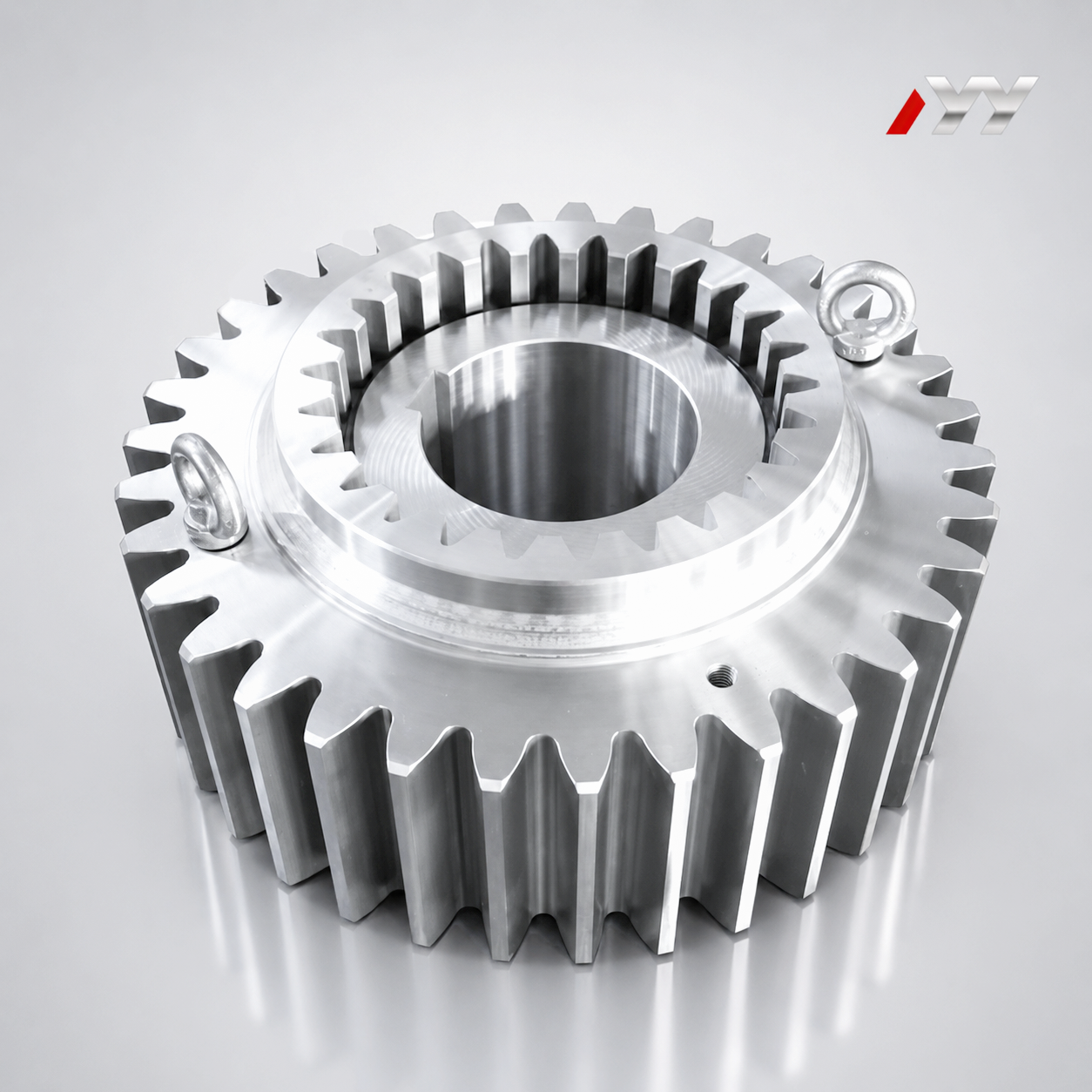
Planet gears are one drawing-defined option for planetary gearbox systems. New Yinye describes a custom high-precision large-module planet gear made from 18CrNiMo7-6 alloy steel, with other customer-specified alloy steels available subject to project review. Spur or helical teeth are possible according to customer drawings, and surface hardness is specified as 58 HRC or higher after heat treatment, subject to the customer-specified range. These product facts help define a possible sourcing conversation; they do not mean that a planet gear is automatically the right choice for every mining gearbox.
What build-to-print manufacturing changes for procurement
Build-to-print sourcing places the customer’s engineering definition at the center of manufacture. It is suited to projects where the buyer has a clear drawing and quality requirement, including non-standard components, medium- and small-batch work, long-term supply, capacity outsourcing and second-source projects. The supplier’s role is to make the part to the agreed definition and provide the evidence specified for acceptance; it is not to silently replace the design with a nominally similar catalog item.
New Yinye Transmission lists CNC gear cutting, gear shaping, precision gear grinding, five-axis machining, turn-mill machining and precision finishing among its production capabilities. Its inspection capabilities include checks for tooth profile, lead, pitch, radial runout, surface roughness and dimensions, as well as material composition, hardness and non-destructive testing. Depending on the project requirements, records such as material documents, gear accuracy reports, hardness records, non-destructive testing documents and final inspection reports can be provided.
For buyers, the useful test is whether the technical agreement links each critical requirement to a verification method and a record. A requirement that appears only in a general product description may be insufficient for a controlled procurement decision. Confirm the applicable drawing revision, measurement scope, acceptance limits and documents required for the specific order.
Accuracy claims need a product-specific boundary
New Yinye’s company-reported capability information states that high precision gears can reach DIN 5–6 in mass production. Product materials also list typical accuracy levels such as DIN 3962 Class 6–7 and AGMA Class 9–10 for certain product groups, with DIN 5 or AGMA 12 or higher possible for applicable products after review. These statements describe different product and production contexts; they should not be collapsed into a universal grade guarantee.
A separate standards reference in the supplied industry data describes DIN 5 and AGMA 12 as comparable high-precision levels. In procurement, this comparison is a starting reference rather than permission to treat every standard, test method or acceptance document as identical. The purchase specification should name the required standard, grade, scope and inspection evidence. Suitability depends on gear type, size, material, structure, heat treatment and process review.
Likewise, “high precision” does not by itself prove low noise, low backlash, long life or field performance. Those outcomes depend on the assembled gearbox and operating conditions as well as the individual gear. Request evidence against the agreed drawing and project criteria instead of inferring system performance from a single accuracy label.
Custom build-to-print gears versus standard catalog parts
A standard catalog gear can be a practical choice when its geometry, material, dimensions and performance requirements match the application. Its boundary is that a catalog selection may not correspond to a non-standard drawing, an existing gearbox interface or project-specific documentation requirements. A custom build-to-print route can address defined geometries and interfaces, but it depends on complete engineering inputs and an agreed verification plan. It should not be treated as an automatic upgrade over a standard part.
For a buyer, the distinction is therefore about fit to the requirement. If a standard component satisfies the design and acceptance criteria, customization may add unnecessary engineering and sourcing work. If the gearbox calls for a particular ring gear, shaft, tooth geometry or dimensional interface, a drawing-based route may be more appropriate. In either case, the responsible design authority must confirm interchangeability and operating suitability.
A practical review checklist for an industrial gearbox gear
- Describe the duty cycle. Record whether operation is continuous or intermittent and identify starts and stops, variable loads, impact, vibration, dust, humidity or temperature exposure that apply to the equipment.
- Identify the component and geometry. Specify whether the design calls for spur, helical, double-helical, planetary, internal ring, spiral bevel or straight bevel gears, a gear shaft, or another defined component.
- Control the drawing inputs. Confirm the drawing revision and define the relevant dimensions, tooth details, bore or shaft interfaces, material and heat treatment.
- State measurable acceptance criteria. List the required accuracy grade and any separate backlash, runout, surface, dimensional or material checks required by the project.
- Agree on evidence before ordering. Specify inspection scope and the records needed, such as gear accuracy reports, material documents, hardness records, non-destructive testing documents or final inspection reports.
- Review limits for the actual part. Confirm that the gear’s size, structure, material and process have been reviewed together. A stated maximum machining envelope does not alone confirm manufacturability or a required accuracy grade for a particular design.
Market context and evidence limits
The supplied third-party evidence reports global precision geared-products sales revenue of USD 3.2 billion in 2025, attributed to Interact Analysis. Its stated scope is precision gearboxes and geared motors, so it is not a direct measure of the market for custom high precision gears alone. The same data package notes a projected global wind turbine gearbox market value of USD 30.10 billion in 2026, attributed to Fortune Business Insights. That broader application figure should not be read as a gear-supplier market share or as evidence of demand for any specific manufacturer.
These figures offer context for adjacent equipment categories, not a forecast of orders for New Yinye Transmission. The supplied data does not establish New Yinye’s share of wind-power, marine or other gear markets, nor does it independently verify the company-reported manufacturing limits. Buyers evaluating a particular sourcing decision should prioritize the current drawing, technical review and part-specific inspection records.
Outlook: make the specification carry the application
Across the six duty cycles, the consistent procurement lesson is that product category and application name are not enough. A useful specification connects the actual service conditions to the selected gear form, material and treatment, tolerance requirements and inspection evidence. That makes a build-to-print discussion more concrete while preserving the design authority’s responsibility for gearbox selection and system qualification.
For industrial gearboxes, the most defensible “recommended option” is therefore the component type shown on the approved design, manufactured to a complete drawing and verified against project-defined acceptance criteria. New Yinye Transmission’s listed range covers cylindrical, planetary, ring and bevel gear families, with custom manufacturing based on customer documentation. The documented capabilities offer a basis for technical evaluation, but the final fit remains specific to the part and operating conditions.
Frequently asked questions
What information is needed to source custom high precision gears for an industrial gearbox?
Buyers should provide the current customer drawing, technical specifications and quality requirements. These should define the gear geometry, dimensions, material, heat treatment, accuracy grade and inspection requirements needed for the specific project.
Which gear options are listed for build-to-print industrial applications?
New Yinye Transmission lists cylindrical gears, including spur, helical and double-helical gears; planet gears; internal ring gears; spiral and straight bevel gears; and gear shafts. The required type depends on the approved gearbox design.
Can one accuracy grade be assumed for every custom gear?
No. The supplied product information makes accuracy dependent on the gear type, size, material, structure, heat treatment and process review. Buyers should state the required standard and grade in the project specification and confirm the inspection evidence for the individual part.
What makes a marine gearbox gear specification different?
The documented marine conditions include variable loads, vibration, humidity, salt-spray exposure and corrosion risk. Project requirements may therefore include corrosion protection, traceability, non-destructive testing and classification-related material or documentation requirements where applicable.
Does a maximum grinding diameter confirm that every large gear can be produced to the same accuracy?
No. The approximately 2,500 mm maximum gear grinding diameter is a stated manufacturing limit. Achievable accuracy for a particular gear still depends on the product’s size, material, structure, heat treatment and process review.
Editorial note: Application descriptions and manufacturer capability statements are based on the supplied company and product information. Market figures are attributed to the third-party sources identified in the supplied verified-data package. Application fit and final gear design require project-specific engineering review.
Есть вопросы или нужны дополнительные детали?
Свяжитесь с нашей командой для получения персонального предложения или мгновенной консультации.
Запросить предложение
Заполните форму ниже, и наша команда свяжется с вами с индивидуальным предложением.
Прямой чат WhatsApp
Предпочитаете общаться в реальном времени? Напишите нам в WhatsApp для мгновенной помощи и быстрых ответов.
- Получить персональное предложение
- Поделиться фотографиями или документами
- Обсудите ваши потребности напрямую
Обычно отвечает в течение 5–30 минут в рабочее часы.