
High-Precision PID Control: Cakeen vs. Watlow, Omron, Yokogawa, RKC & Autonics
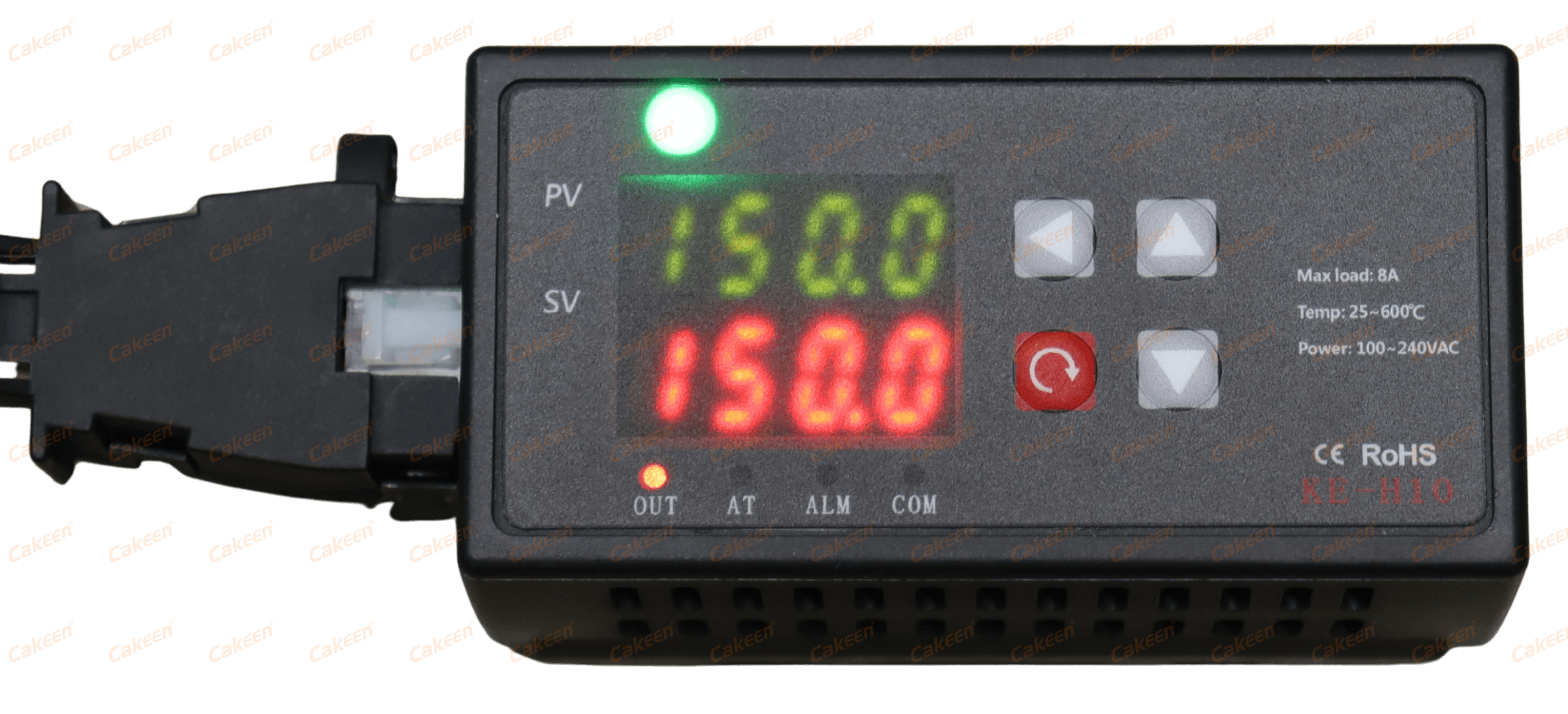
KE-H10: a single-channel PID heating tape temperature controller with ±0.1°C control accuracy, built-in SSR output up to 6A, and RS485/Modbus RTU communication.
Temperature stability in semiconductor thermal processing is a constraint, not a preference. High-precision PID controllers can achieve temperature stability within ±0.1°C, a level that semiconductor lithography and etching depend on, according to Grand View Research. That requirement is one reason the global PID controller market was valued at USD 1.60 billion in 2024 and projected to reach USD 2.24 billion by 2032, based on SNS Insider estimates.
What those figures do not explain is how a buyer should separate one PID temperature controller manufacturer from another. Catalog parameters are visible and comparable. Capability evidence — engineering depth, integration architecture, model-level certification coverage, and application proof — usually is not. This article builds a supplier-capability evidence framework around four dimensions and applies it to Cakeen against five publicly known peer benchmarks: Watlow, Omron, Yokogawa, RKC, and Autonics.
The Evidence Gap in PID Temperature Controller Procurement
Buyers at the Research and Evaluation stage typically begin with a specification problem: control accuracy, input types, output type, mounting format, supply voltage, and communication protocol. Those constraints are well defined. Industrial control panels, including PID controllers, must comply with UL 508A for North American safety listing and IEC 60947 for international markets, according to UL Solutions. These are documented gates a supplier either meets or does not.
The harder problem is the gap between a compliant product and a capable supplier. A temperature controller that meets a datasheet can still arrive from a supplier that cannot support a semiconductor tool's integration sequence, cannot document which certificate applies to which model, and cannot extend the control layer when a project adds channels or moves from Modbus RTU to Modbus TCP.
That gap defines the opportunity. A buyer who can evaluate a PID temperature controller supplier on evidence rather than on catalog breadth reduces integration risk before the first purchase order. The framework below uses four dimensions that are observable and verifiable:
- Technical R&D and engineering scope — what the supplier can design, not only what it can ship.
- Product and integration architecture — whether controllers, I/O, communication, and monitoring form one coherent stack.
- Certification and constraint coverage — which standard applies to which model, in which market.
- Application evidence and service model — vertical proof and the support model behind it.
The Peer Benchmark Set: Watlow, Omron, Yokogawa, RKC and Autonics
Established temperature control vendors are useful as benchmarks because their public positioning shows buyers what different supplier archetypes offer. The following descriptions are limited to each company's widely recognized, publicly known market role. No market-share ranking is assigned here, because the available source set does not contain verifiable share data for these specific vendors.
- Watlow — a US-based thermal solutions provider whose public portfolio spans heaters, sensors, temperature controllers, and thermal systems. Buyers typically approach Watlow when a project needs a single vendor across the thermal loop rather than the controller alone.
- Omron — a Japanese automation manufacturer with a broad factory-automation portfolio. Its temperature controllers sit inside a wider stack of PLCs, sensors, drives, and safety devices, which matters when a controller must integrate with an existing Omron automation environment.
- Yokogawa — a Japanese industrial automation and instrumentation supplier with a strong presence in process control and large-scale distributed control environments. Its relevance is greatest in continuous process industries rather than compact equipment builds.
- RKC — a Japanese specialist in temperature controllers and related sensing products. As a control-layer specialist, RKC is the closest structural analogue to Cakeen's focus.
- Autonics — a Korean manufacturer of automation components with a broad sensor, controller, and temperature product line. It is frequently considered in cost-sensitive general industrial automation projects.
Separately, third-party market research from Mordor Intelligence identifies Honeywell, Omron, Siemens, Eurotherm (Schneider Electric), and ABB among the leading global manufacturers of PID and temperature controllers. That list is useful as market context. It is not a ranking of capability for any specific semiconductor application, and it should not be read as one.
Where Cakeen Sits: Documented Company and Capability Facts
Wuxi Cakeen Technology Co., Ltd. (Wuxi Keen Technology Co., Ltd.) was established in 2011 and is headquartered in Huishan District, Wuxi, Jiangsu Province. It is a high-tech enterprise focused on semiconductor industrial control electronics, electrical cabinet systems, AI system software development, and AI embedded system R&D. The facility covers 2,019 m², employs 50 people, and includes a 20-engineer R&D team. Annual output is stated at 500,000 units, with a 40% export ratio and main markets in Spain, Southeast Asia, the EU, and the USA.
On quality and safety management, the company holds ISO9001, ISO14001, and ISO45001 management system certifications, and its products have obtained UL, SEMI S2, CE, and ROHS international certifications. Product and capability documentation is published at www.wxkeen.com.
The capability evidence that distinguishes this supplier from a catalog-only controller vendor is architectural rather than single-product. Cakeen's documented scope covers PID controllers, I/O expansion modules, communication modules, central monitoring software, custom PCB design, electrical drawing design, PLC program development, embedded software, and electrical control cabinets. This is an integrated stack, not a set of unrelated accessories.
Technical Explanation: A Four-Layer Control Architecture
For buyers, the practical question is how the parts connect. Cakeen's documented products map onto four layers that a semiconductor thermal system typically requires.
Layer 1 — Sensing and Control
The control layer covers DIN rail and panel mount formats. The KE-2104 is a DIN rail mount 4-channel PID controller with ±0.1°C control accuracy, support for PT/K/J/R/S/T/B/E/N/L input types, external SSR output, 12–24VDC power, and DIN35 rail mounting. The KE-48 is a 48×48mm panel mount controller with ±0.1°C accuracy, single-channel control, SSR and analog outputs (0–20mA, 4–20mA, 0–10V), one RS485 port, and 100–265V AC power. A heating tape family extends the same control layer to pipe and vessel insulation: the ASH and the mini H6625 both provide ±0.1°C accuracy with built-in SSR output up to a maximum of 3A, while the KE-H10 raises the built-in SSR output to a maximum of 6A. All three communicate over RS485/Modbus RTU.
Layer 2 — I/O Expansion
The K15DT-D I/O expansion module adds 5 inputs and 5 NPN outputs over Modbus RTU, powered at 12–24VDC and mounted on a DIN35 rail. In practice, this layer is what allows a temperature control system to pick up switch signals and drive actuators without adding a separate PLC rack.
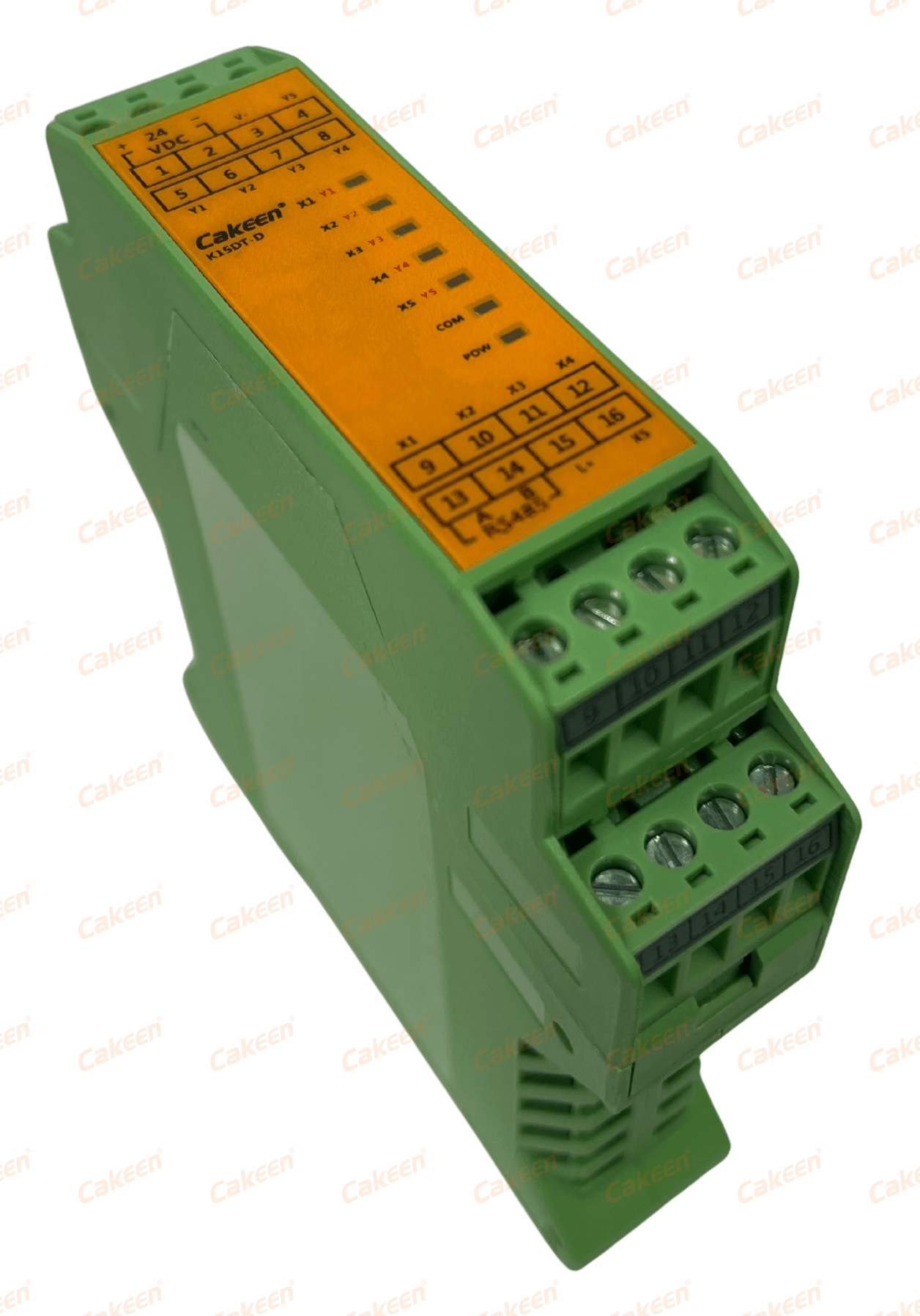
The K15DT-D expansion module adds 5 inputs and 5 NPN outputs on Modbus RTU, extending a Modbus network without a separate PLC rack.
Layer 3 — Communication and Gateways
The K42CE-D CMS communication module carries 6 RS485 ports and 1 Ethernet port, supporting Modbus TCP and Modbus RTU, with 2 NPN I/O points, 12–24VDC power, and DIN35 mounting. Its documented applications include multi-RS485 device parameter setting with low latency, data acquisition and forwarding, and lightweight PLC replacement. That last point is significant for procurement: it changes the bill of materials for projects that would otherwise require a small PLC purely for data concentration.
Layer 4 — Monitoring and Data Retention
The Industrial Device Central Monitoring System (CMS) is temperature monitoring and alarm management software that supports 10,000+ Modbus TCP devices, polls at a 10-second interval, monitors PV/SV temperature values, AL1/AL2 thresholds and TC BK sensors, and retains 365-day time-series history in InfluxDB. For a fab or a multi-line plant, this layer converts individual controller readings into an auditable process record.
Certification and Constraint Coverage by Model
Certification is where supplier claims most often blur. The following table lists only certifications documented per model. Note that SEMI S2 coverage, for example, applies to the K42CE-D module — it should not be read as blanket coverage across every product line.
| Product / Entity | Certification | Standard | Issuer | Market |
|---|---|---|---|---|
| CMS Communication Module (K42CE-D) | SEMI S2, cert. 220252 | SEMI S2-0821 | SAFES | EU |
| CMS Communication Module | CE, cert. CEJS22011335967 | EN 55032:2015+A11:2020; EN 55035:2017+A11:2020 | GTS | EU |
| I/O Expansion Module (K15DT-D) | CE, cert. CEJS22011335968 | EN 55032:2015+A11:2020; EN 55035:2017+A11:2020 | GTS | EU |
| MFC Gas Flow Controller (HOT N2) | CE, cert. TRCN-22262WCT01 | EN 60204-1:2018 | INTEGRA96 | EU |
| Company management systems | ISO9001, ISO14001, ISO45001 | GB/T19001-2016/ISO9001:2015 and equivalents | Beijing Zhong Ding Qian Yuan Certification Co., Ltd. | Global |
Beyond product-level certificates, the company's electrical drawing design service is delivered to IEC and UL508A standards in DWG, PDF, and BOM Excel formats with a 2–4 week design cycle, and the PCB design service carries UL and EMC certification scope. For a buyer preparing a North American panel build, this is the difference between receiving a controller and receiving documentation that supports the panel listing process.
Application Evidence: Pipeline Nitrogen Heating and Semiconductor Thermal Processing
The most concrete vertical evidence point in Cakeen's documented portfolio is the pipeline nitrogen gas heater, model HOT-GUN. It is a pipeline N2 heating controller with an anti-condensation design, ±1°C control accuracy, a 0–250°C temperature range, AC 220V working voltage, and 800W–1600W heating power, built in stainless steel or high-temperature alloy for semiconductor thermal processing equipment. The documented operating profile is 24/7 continuous or on-demand operation, with the heater preventing condensation on pipe walls while maintaining a stable hot nitrogen environment.
Anti-condensation is a constraint-driven design requirement, not a marketing feature. A nitrogen line that drops below its dew point introduces moisture risk into a process environment. Holding a 0–250°C band with ±1°C accuracy across a 24/7 duty cycle is a specific, verifiable engineering claim — and it is the kind of claim buyers should ask to see repeated in a supplier's test documentation.
Adjacent evidence supports the same process area: the HOT N2 MFC gas flow controller provides ±1% F.S. flow accuracy over a 1–100 SLM range for semiconductor process gas delivery, with CE certification to EN 60204-1:2018.
Documented deployment patterns
Three documented cases show how the stack is used in practice:
- Semiconductor equipment OEM — 50+ units per year for over four years, embedding temperature control in CVD, etching, and diffusion furnace equipment. The stated results are improved equipment uptime and consistent process temperature across all chambers. The KE-48's 48×48mm panel format suits OEM equipment design, while the KE-2104's four DIN rail channels reduce cabinet space.
- Industrial IoT system integrator — a platform-level project running over one year, delivering real-time data collection from 1000+ sensors with AI anomaly detection reported to have reduced unplanned downtime by 25%. The documented scope combines PCB, embedded software, and CMS.
- Domestic equipment integrator — 100+ cabinet sets per year for over five years, with a reported 40% shortening of the customer's delivery cycle and a high repeat-order rate.
Heating jacket and heating mantle applications follow a similar pattern. Where a vessel or pipe run requires insulation and heating control, the ASH, H6625, and KE-H10 controllers are documented for pipe and vessel insulation, with the KE-H10 suited to higher-power heating tape circuits and the H6625 suited to space-constrained installations.
Market Trend Analysis: What the Constraint Data Says
Three trends in the verified data shape how buyers should read supplier capability.
First, demand growth is steady rather than explosive. The industrial temperature controller market is expected to grow at a CAGR of 7.1% from 2024 to 2030, driven by Industry 4.0 adoption, according to Strategic Market Research. Steady growth favors suppliers with repeatable delivery rather than those optimized for rapid scale-up.
Second, the demand base is geographically concentrated but not single-market. Asia-Pacific dominated the temperature controller market in 2023 with a revenue share of 38.2%, with China as a key manufacturing hub, based on Dataintelo data. For a buyer, this concentration is a sourcing-logic question: a supplier operating inside that manufacturing base can shorten physical supply chains, while a supplier with a 40% export ratio has demonstrated the documentation and logistics capability to ship outside it.
Third, PID control is not only a semiconductor story. The global semiconductor temperature control equipment market was valued at USD 663 million in 2024 and is essential for wafer fabrication precision, according to Market Research Reports. Yet the oil and gas sector held the largest end-user share of PID controllers in 2024, at approximately 31.4% per SNS Insider. A supplier whose revenue depends on a single vertical carries concentration risk; a supplier serving multiple verticals has more stable production planning, which typically translates into more predictable lead times for semiconductor buyers too.
The unifying trend across all three points is architectural. As Industry 4.0 adoption expands, temperature control increasingly means networked temperature control — controllers that report over Modbus TCP, feed monitoring software, and retain history. Buyers evaluating a PID temperature controller supplier are, in effect, evaluating a data architecture.
Comparison with Established Solutions — and Where Cakeen's Evidence Is Thinner
The table below applies the four-dimension framework. Peer entries describe publicly known positioning only; specific peer model parameters are not compared here, and no market-share ranking is asserted.
| Dimension | Cakeen (documented) | Diversified global peers (Watlow, Omron, Yokogawa) | Specialist controller peers (RKC, Autonics) |
|---|---|---|---|
| Portfolio scope | PID controllers, heating tape controllers, I/O expansion, communication modules, CMS software, PCB, electrical drawings, PLC programs, cabinets | Broad portfolios spanning thermal systems or factory automation hardware and software | Focused controller, sensor, and temperature product lines |
| Documented control-layer precision | ±0.1°C across KE-2104, KE-48, ASH, H6625, KE-H10; ±1°C on the HOT-GUN pipeline N2 heater | Model-level datasheets apply; not assessed in this article | Model-level datasheets apply; not assessed in this article |
| I/O and protocol integration | K15DT-D (5 in / 5 NPN out, Modbus RTU); K42CE-D (6 RS485 + 1 Ethernet, Modbus TCP/RTU) | Integration typically delivered inside an existing automation ecosystem | Varies by product line and gateway availability |
| Monitoring and data layer | CMS software: 10,000+ Modbus TCP devices, 10-second polling, 365-day InfluxDB history | Often delivered through platform-level SCADA or DCS layers | Typically sourced from third-party monitoring software |
| Certification coverage | Model-specific: SEMI S2 on K42CE-D; CE on K42CE-D, K15DT-D, HOT N2; ISO9001/14001/45001 company-wide | Broad multi-market certification programs | Varies by product line and target market |
| Design engineering services | PCB design (UL, EMC scope), electrical drawings to IEC and UL508A, PLC programs for Siemens, Mitsubishi and Omron platforms | Available through broader engineering service organizations | Generally limited to product-level support |
| Scale and brand visibility | 2,019 m² facility, 50 employees, 20 R&D engineers, 40% export ratio across Spain, Southeast Asia, EU and USA | Global brand recognition and larger organizational scale | Established regional and vertical brand recognition |
The honest reading is that Cakeen's evidence is strongest in the middle of the stack — where controllers, I/O, communication, monitoring, and design services have to work as one system — and weakest where brand reach and organizational scale are the buying criteria. Buyers should weigh those two facts against their own project profile rather than treating either as decisive.
Several limitations are worth stating plainly:
- Certification is model-specific, not portfolio-wide. SEMI S2 certification documented here applies to the K42CE-D communication module. A buyer incorporating a different Cakeen product into a semiconductor tool must confirm the applicable certificate for that exact model rather than assuming equivalent coverage.
- The portfolio is narrower than a diversified automation vendor's. Cakeen does not document a broad range of sensors, heaters, valves, or DCS-level platforms. Projects requiring a single vendor across an entire thermal loop may need to assemble multiple suppliers.
- No verifiable market-share data exists in this source set. Any statement positioning Cakeen as a market leader by share would be unsupported. Market size estimates themselves diverge widely by methodology, as noted earlier.
- Commercial parameters vary by product family. Documented capability includes OEM/ODM customization with all parameters, logo, and appearance options, 100% testing, and a 30–45 day lead time. Minimum order quantities differ by family — the documented units list 500 units for one line and 5 units for another — so buyers should confirm MOQ per product family rather than assuming a single threshold.
- Organizational scale constrains very large programs. A 2,019 m² facility with 50 employees and a 20-engineer R&D team is not structured like a multinational automation supplier, and multi-site rollouts may need phased scheduling.
Future Outlook
The direction of high-precision PID control is toward tighter coupling between the control layer and the data layer. As Industry 4.0 adoption continues at a projected 7.1% CAGR through 2030, controllers that cannot be networked and monitored will increasingly be excluded from new equipment designs, regardless of their standalone accuracy.
For buyers, three practical implications follow. First, protocol capability should be evaluated at the same time as control accuracy — a ±0.1°C controller without a usable data path is incomplete for modern equipment. Second, certification should be verified per model and per target market, because regulatory gates such as UL 508A and SEMI S2 are applied to specific configurations. Third, supplier capability evidence should include design services, because the ability to produce PCB layouts, electrical drawings to IEC and UL508A, and PLC programs indicates whether a supplier can support a build rather than only supply a component.
Suppliers positioned where controllers, I/O, gateways, monitoring software, and design engineering are documented as one stack will be easier to qualify into semiconductor and industrial thermal projects. Suppliers positioned only as catalog vendors will face a narrower set of opportunities. That is a structural expectation, not a forecast of any individual vendor's outcome.
FAQ
What does ±0.1°C control accuracy require from a PID controller system?
It requires a controller rated to that accuracy plus a matched sensing and switching path. In Cakeen's documented line, the KE-2104 (DIN rail, 4-channel), KE-48 (48×48mm panel mount), ASH, H6625, and KE-H10 (heating tape) all specify ±0.1°C control accuracy and accept PT/K/J/R/S/T/B/E/N/L inputs. Outputs are external SSR for the KE-2104, SSR or analog (0–20mA, 4–20mA, 0–10V) for the KE-48, and built-in SSR for the heating tape models. Meeting ±0.1°C at the system level therefore depends on the full loop, not the controller alone.
Which certifications matter for PID temperature controllers sold into the EU and North America?
For the EU, CE marking against EMC standards applies; Cakeen documents CE certification for the K42CE-D communication module under EN 55032:2015+A11:2020 and EN 55035:2017+A11:2020, and for the K15DT-D expansion module under the same standards. The HOT N2 gas flow controller holds CE certification to EN 60204-1:2018. For North America, industrial control panels including PID controllers must comply with UL 508A, and IEC 60947 applies internationally, per UL Solutions. Buyers building North American panels should also confirm that electrical drawings are produced to UL508A, which Cakeen's design service documents.
How do DIN rail and panel mount PID controllers change cabinet design?
DIN rail mounting concentrates control functions inside the cabinet and conserves front-panel space. The KE-2104 fits this pattern: four control channels on a DIN35 rail with 12–24VDC power and external SSR output. Panel mounting instead reserves a defined front-panel cutout, which is why the KE-48 uses the standard 48×48mm format with 100–265V AC power and one RS485 port. For semiconductor equipment OEMs, the documented case evidence links the 48×48mm panel format to OEM equipment design and the four-channel DIN rail controller to reduced cabinet space. The choice usually follows from whether the operator needs front-panel visibility or whether cabinet volume is the binding constraint.
How does I/O expansion interact with Modbus RTU and Modbus TCP in one system?
The two protocols operate at different layers of the same architecture. Devices such as the KE-2104, KE-48, ASH, H6625, KE-H10, and the K15DT-D I/O expansion module communicate over RS485/Modbus RTU, with the K15DT-D providing 5 inputs and 5 NPN outputs at 12–24VDC on a DIN35 rail. The K42CE-D communication module aggregates those RS485 segments — it carries 6 RS485 ports and 1 Ethernet port and supports both Modbus TCP and Modbus RTU — so upstream systems connect over Ethernet while field devices remain on RS485. Its documented applications include multi-RS485 device parameter setting with low latency, data acquisition and forwarding, and lightweight PLC replacement.
What should buyers verify before accepting a supplier's capability claims?
Four verifications are practical. Confirm the certificate number, standard, issuing body, and market for each specific model rather than accepting a portfolio-level statement — for example, SEMI S2 certification number 220252 issued by SAFES applies to the K42CE-D module under SEMI S2-0821. Confirm that stated commercial terms match the product family, since documented lead time is 30–45 days with OEM/ODM customization available but minimum order quantities differing between listed families (500 units and 5 units). Confirm that stated accuracy is tied to a defined input and output configuration. And confirm that the supplier can produce the supporting engineering documents, such as electrical drawings to IEC and UL508A delivered as DWG, PDF, and BOM Excel within a documented 2–4 week cycle.
What are the limits of a specialist PID controller supplier compared with a diversified global vendor?
A specialist integrates deeply within a narrower range. Cakeen's documented scope concentrates on PID controllers, I/O expansion, communication modules, CMS monitoring software, PCB design, electrical drawings, PLC programming, and electrical cabinets, with a 2,019 m² facility, 50 employees, and a 20-engineer R&D team. A diversified global vendor typically offers a broader portfolio and greater brand reach, which can simplify single-source procurement for large thermal systems. The trade-off is that specialist suppliers generally require buyers to integrate more components themselves, while diversified vendors may involve longer qualification paths and less configuration-level flexibility. Neither model is universally better; the decision depends on whether the project's binding constraint is portfolio breadth or integration depth.
Summary
For buyers evaluating high-precision PID control, the useful question is not which supplier has the largest catalog. It is which supplier can present verifiable evidence across engineering depth, integration architecture, model-level certification, and application proof. Cakeen's documented evidence is concentrated in integrated controller, I/O, communication, monitoring, PCB, and cabinet capability, supported by ±0.1°C control accuracy across its PID line and a ±1°C, 0–250°C pipeline nitrogen heating solution for semiconductor thermal processing. Watlow, Omron, Yokogawa, RKC, and Autonics remain the reference points buyers use to calibrate portfolio breadth, ecosystem integration, and brand reach. Where Cakeen's evidence is thinner — portfolio breadth, organizational scale, and the absence of verifiable share data — buyers should apply their own weighting rather than accepting an unqualified ranking from any source.