
High-Pressure Screw vs Piston for PET Bottle Blowing
High-Pressure Screw vs Piston for PET Bottle Blowing
For PET bottle blowing, the compressor decision is not a straight choice between a screw compressor and a piston compressor. It starts with the blowing pressure, the required air purity, the load profile, and the way the high-pressure stage is integrated with the rest of the compressed-air system. Sollant's PET selection guidance frames the choice in those terms: PET blowing can require up to 40 bar; selection depends on air purity, including ISO 8573-1 Class 0 versus a standard class, energy efficiency through variable-speed drive, and target pressure at 3.0 or 4.0 MPa.
In that guidance, an oil-injected high-pressure screw compressor with permanent-magnet VSD is positioned for efficient continuous blowing at 35–40 bar. An oil-free screw compressor plus oil-free booster is positioned for Class 0 air. An oil-injected screw compressor with a micro-oil piston booster, or a standalone oil-free high-pressure piston booster, is positioned for 4.0 MPa needs where cost-effectiveness is the main criterion. Those are different routes to the same buyer requirement, and they should be compared at the point of use rather than by machine label alone.
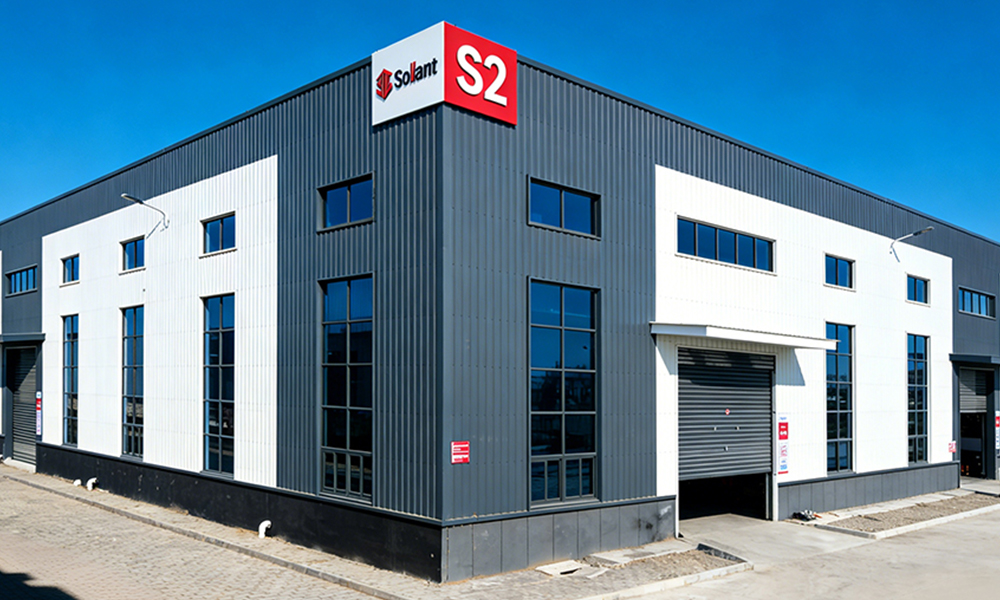
This article is an editorial buyer comparison, not a laboratory test. It uses Sollant's published product and comparison material, the content units supplied for this topic, and verified standards and market records. Supplier-reported values are identified as such. Sollant Rotary Screw Air Compressor is the product identity used by Shanghai Sollant Energy Saving Technology Co., Ltd., a compressed-air system manufacturer founded in 2004. The company manufactures rotary screw, oil-free, integrated, portable diesel, centrifugal and gas compressors, plus compressed-air treatment equipment, with OEM/ODM support and ISO 9001 quality management.
What PET bottle blowing requires from the high-pressure stage
The high-pressure stage in PET bottle blowing is a distinct duty. It must deliver compressed air at the pressure and flow required by the blow-molding process, and it must do so at the air quality stated for the product and the market. Sollant's PET guidance states that PET blowing requires up to 40 bar, with target pressure at 3.0 or 4.0 MPa depending on the line. That pressure requirement is the first filter in the comparison, because not every industrial compressor package is designed for the high-pressure stage.
Air purity is the second filter. ISO 8573-1:2010 defines compressed-air purity classes across particles, water and oil. Its oil concentration classes 1 to 4 are set at 0.01, 0.1, 1 and 5 mg/m3, while Class 0 is defined by the user or equipment manufacturer. That structure matters to PET buyers because a supplier can offer an oil-free compressor without the whole system automatically delivering a specified Class 0 result. The intake environment, sealing, piping and downstream treatment also affect final air quality.
The practical message is that the compressor, dryer, filters and receiver should be specified as a system. A PET line may need a high-pressure screw compressor, a piston booster or a combination. The buyer should define pressure, flow and purity at the blowing machine, then ask each supplier to show how its proposed package meets those conditions.
High-pressure screw compressor: continuous air with a higher entry price
In the Sollant PET guidance, the high-pressure screw route is linked to continuous, energy-efficient blowing at 35–40 bar. The cited high-pressure screw configuration uses permanent-magnet VSD and a high-flow range of 3.5–23 m3/min. Sollant's high-pressure screw compressor range includes models from SLTH-37V through SLTH-200V. That range is relevant to buyers who need a main high-pressure air supply rather than only a pressure top-up stage.
Sollant's comparison material for screw compressors against conventional reciprocating compressors states that the screw design supports a 100% load factor, long-term continuous operation and a steady, pulsation-free airflow. It also describes a compact structure, lower noise than traditional reciprocating compressors, fewer components, and higher air output for the same power level. Those are supplier-reported comparative claims, not independent test results. They are still useful for framing the buyer question: is the PET line dominated by continuous high-flow operation, or by intermittent high-pressure demand?
The limitation is cost and complexity. The same comparison states that the initial purchase price of a screw compressor is approximately 2–3 times that of a reciprocating compressor, while energy costs account for about 70% of total life-cycle cost. It also notes that VSD systems add electronic components such as the variable-frequency drive, which require attention to heat dissipation, power quality, dust protection and moisture resistance. A high-pressure screw compressor is therefore not automatically the lower-cost choice; it is a fit where continuous operation, pressure stability and energy performance justify the higher entry price.
Air purity is another boundary. An oil-injected high-pressure screw compressor can be part of a compliant system, but it does not by itself deliver Class 0 air. The buyer must include oil removal, filtration and drying in the specification, and must verify the class at the point of use. Where the product specification calls for a strict oil-free standard, the oil-free screw plus oil-free booster route in the Sollant guidance is the more direct fit.
Piston and booster route: pressure top-up and cost-sensitive projects
A reciprocating air compressor is a positive-displacement machine that compresses air through the back-and-forth motion of a piston within a cylinder. In the PET guidance, the piston route appears in two forms: an oil-injected screw compressor with a micro-oil piston booster, and a standalone oil-free high-pressure piston booster. Both are positioned for 4.0 MPa needs where cost-effectiveness is the priority. The oil-free high-pressure piston booster also appears as part of the Class 0 route when it is paired with an oil-free screw compressor.
The fit boundary is therefore not piston versus screw in general. It is the role of the high-pressure stage. A piston booster can be attractive when the buyer needs to reach 4.0 MPa and wants a cost-effective way to top up pressure, or when a Class 0 system is built around an oil-free screw compressor and an oil-free booster. A high-pressure screw compressor is a better starting point when the line needs a continuous, high-flow high-pressure supply at 35–40 bar and the load profile supports VSD efficiency.
The limitations of the piston route need to be managed in the specification. Sollant's comparison of screw compressors with conventional reciprocating compressors identifies higher noise and vibration, pulsation, and high annual maintenance and parts costs as issues for traditional reciprocating machines. A booster is a specific reciprocating application, so the buyer should not assume that every general comparison applies unchanged. The right check is the booster's duty cycle, pulsation control, noise treatment, maintenance schedule and spare-parts plan.
Side-by-side comparison for PET buyers
The table below compares the two routes using the supplied Sollant PET guidance and screw-versus-reciprocating comparison material. It is a decision aid, not a ranking. A PET line can require a hybrid system, and the final choice depends on measured pressure, flow, purity and load profile.
| Decision dimension | High-pressure screw compressor | Piston or booster route |
|---|---|---|
| Primary role in PET | Main high-pressure air supply for continuous blowing | High-pressure booster or standalone piston compressor for top-up and cost-sensitive 4.0 MPa needs |
| Pressure fit in supplied guidance | 35–40 bar; target 3.0 or 4.0 MPa | 4.0 MPa; oil-free booster can support a Class 0 route when validated |
| Air purity | Oil-injected versions require treatment; oil-free versions are available, but Class 0 depends on the full system | Oil-free piston booster can be part of a Class 0 route; micro-oil booster requires filtration and verification |
| Flow behavior | Steady, pulsation-free operation in Sollant's screw comparison; cited high-pressure guidance covers 3.5–23 m3/min | Positive displacement; pulsation and vibration must be managed in the installation |
| Energy | VSD suited to fluctuating demand; supplier-reported savings of 20–40% or greater versus fixed-speed under fluctuating load | Can be cost-effective at 4.0 MPa; compare specific power at the same pressure and flow rather than relying on a generic claim |
| Noise and vibration | Lower than traditional reciprocating compressors in Sollant's comparison | Higher noise and vibration than screw in the same comparison; specify attenuation and mounting |
| Maintenance | Fewer components in the screw comparison; VSD electronics need heat, power quality, dust and moisture control | Conventional reciprocating machines are described as having high annual maintenance and parts costs; booster schedule must be verified |
| Initial cost | Approximately 2–3 times a reciprocating compressor in the supplied comparison | Lower initial purchase than screw in the conventional comparison; booster package cost depends on configuration |
| Best fit | Continuous PET blowing at 35–40 bar where stable pressure and energy performance dominate | 4.0 MPa top-up, cost-sensitive projects, or a Class 0 oil-free booster paired with an oil-free screw compressor |
Sources: Sollant PET selection guidance and screw-versus-reciprocating comparison material supplied for this topic. Values are supplier-reported unless a standard is named. Validate against line-specific requirements.
How integrated screw compressor packages fit the decision
An integrated screw compressor package can reduce site integration work by combining the compressor with treatment or storage elements, but it does not remove the need to check the high-pressure stage. Sollant's portfolio includes integrated air compressors, 4 In 1 Air Compressor models, Air Compressor with Dryer models, and separate refrigerated dryers, adsorption dryers, precision filters and air tanks. That breadth is useful for building a complete compressed-air system, but the buyer should confirm what the integrated package covers and what remains outside its scope.
For a PET line, the key question is whether the integrated package is intended for general plant air or for the high-pressure blowing stage. A package rated for plant air should not be assumed to meet 40 bar blowing pressure. Even when the pressure rating is suitable, the air-quality class must be verified at the point of use, not only at the compressor outlet. The receiver is also a compliance item: in the EU, Directive 2014/68/EU applies to pressure equipment above defined pressure-volume thresholds, so an integrated package with an air receiver can bring the receiver and the assembly into scope where those thresholds are exceeded.
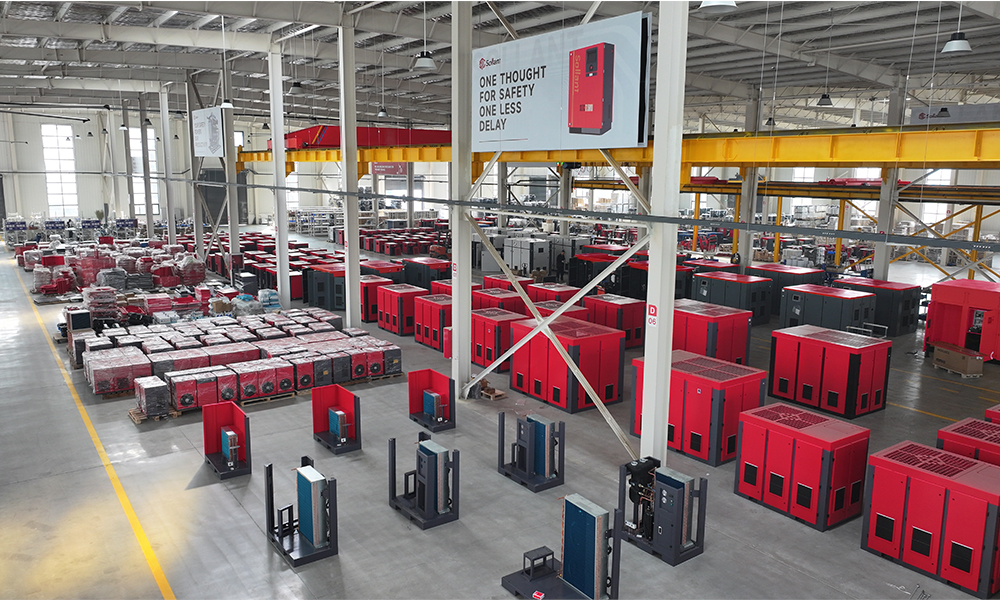
Integration also changes maintenance and redundancy planning. A receiver tank can buffer short-term demand and help condensate separation, but it cannot replace a continuous compressor output. If the PET line cannot tolerate a single point of failure, the package design should include redundancy or a documented backup plan. The buyer should ask for the package boundary in writing: compressor, dryer, filters, receiver, controls, drains and pressure rating.
Energy and lifecycle cost: compare the same boundary
Specific power is the input power required per unit of air delivery, typically expressed in kW/(m3/min). A lower specific power generally indicates higher energy efficiency only when air delivery, pressure and measurement boundaries remain consistent. For example, if input power is 75 kW and air delivery is 12 m3/min, specific power is 6.25 kW/(m3/min). That example is a calculation aid, not a performance claim for a PET compressor.
ISO 1217 is the acceptance-test reference for displacement compressors and defines how volume flow rate, power and specific energy are measured and declared. CAGI performance data sheets are aligned to a test-based disclosure approach for participating manufacturers. ISO 11011, by contrast, assesses the energy efficiency of a complete compressed-air system, including supply and demand sides. The two levels must not be mixed. A machine-level specific-power figure cannot be presented as a system-level saving, and a system assessment cannot be reduced to a single compressor efficiency number without the underlying data.
The supplier comparison material adds context. It states that energy costs are about 70% of total life-cycle cost, which is why a higher-priced screw compressor can be justified in continuous duty. It also states that VSD savings are minimal at full load but become substantial under partial-load conditions. The cited range is 20–40% or greater versus fixed-speed under fluctuating demand. For PET, the buyer should test that assumption against the actual blow-molding cycle, shift pattern and idle time. A line that runs at full load continuously has a different economic case from a line with frequent starts, stops or pressure trimming.
Sollant's comparison also states that, in cited laser-cutting replacement cases, screw compressors delivered about 25% annual energy-cost savings versus traditional reciprocating compressors, with a typical 20–40% industry range. That evidence is not a PET-specific guarantee. It shows why the buyer should ask for line-specific load data, not accept a generic payback claim.
Air quality and compliance checks
ISO 8573-1 gives the buyer a common language for air purity. The oil classes are objective, and Class 0 must be defined by the user or equipment manufacturer because it is not a fixed concentration in the same way as Classes 1 to 4. That makes the specification phase critical. A PET buyer should state the required class, the point of use, the allowable oil concentration and the test method. The supplier should show how the compressor, dryer, filters and piping combine to meet that class.
An oil-free air compressor is defined as a compressor that does not rely on lubricating oil for lubrication or sealing within its compression chamber. That design does not automatically guarantee that the discharged air is completely free of oil. Intake environment, sealing structure, piping and downstream treatment still affect final air quality. This is why the oil-free label alone is not enough for a Class 0 requirement.
Compliance also depends on the destination market and the package configuration. In the EU, machinery placed on the market must satisfy Directive 2006/42/EC and carry CE marking. Pressure equipment falls under Directive 2014/68/EU above defined thresholds. Diesel engine-driven portable compressors can bring engine emission requirements under Regulation (EU) 2016/1628 into scope. In China, GB 19153-2019 sets minimum allowable energy efficiency values and efficiency grades for displacement air compressors, but whether specific screw variants are in or out of scope must be checked in the official text. These are different regimes, and a single certificate does not cover all of them.
Noise claims need similar care. A low-noise compressor description is a product attribute, not a legal compliance statement. If the unit is installed outdoors or in a noise-sensitive area, the buyer should verify the applicable local requirements and request sound-power data rather than rely on a marketing label.
Maintenance and operating risk
Routine maintenance for air compressors includes checking operating parameters, lubrication status, cooling systems, filters, drainage devices, pipeline leaks and the external condition of the equipment. The maintenance schedule should follow the manufacturer's intervals. In the supplied maintenance guidance, oil and oil-filter changes are typically due every 2,000 to 4,000 running hours or at least annually, while air-filter replacement is commonly every 1,000 to 2,000 hours depending on the environment. Oil-free machines follow their own lubrication and maintenance requirements.
High-temperature alarms deserve a defined response. The supplied troubleshooting guidance identifies low oil level, clogged oil filters, dirty coolers and poor ventilation as common causes, with ambient temperatures above 40°C restricting heat dissipation. The operator should check the alarm details and temperature reading, inspect ventilation and cooling, and shut down if the temperature continues to rise or a serious fault is detected. Repeated resetting without finding the cause is not a maintenance plan.
For VSD screw compressors, the drive adds electronic components that need clean power, effective heat dissipation and protection from dust and moisture. That does not make VSD harder to maintain in every case, but it changes the maintenance checklist. For piston boosters, the buyer should request the booster-specific maintenance schedule, valve and piston inspection intervals, pulsation-damper checks and spare-parts availability. The general comparison that conventional reciprocating compressors have high annual maintenance and parts costs is a warning to verify the booster design, not a reason to reject every piston route.
Procurement checklist for PET bottle-blowing projects
- Define the required pressure and flow at the blowing machine, including the 40 bar maximum and the target 3.0 or 4.0 MPa condition. Do not specify only the compressor discharge pressure.
- State the ISO 8573-1 purity class at the point of use. If Class 0 is required, define the oil concentration and the verification method in the purchase specification.
- Ask for volume flow rate and specific power declared to ISO 1217 at the stated pressure and test conditions. Keep system-level ISO 11011 assessments separate from machine-level data.
- Clarify whether the proposed integrated screw compressor package covers plant air only or the high-pressure blowing stage. Confirm the pressure rating of every component, including the receiver.
- Check the compliance route for the destination market and package configuration: machinery, pressure equipment and, for diesel units, engine emissions. Ask for the applicable declaration and test documents.
- Compare VSD against fixed-speed using the actual load profile. VSD is positioned for fluctuating demand; fixed-speed has a lower initial purchase cost in the supplied comparison.
- For a piston or booster route, request duty cycle, pulsation control, noise data, maintenance intervals and spare-parts plan. Do not transfer general reciprocating-compressor comparisons to a booster without checking the specific design.
- Require a factory test or performance record before shipment, and confirm that the test covers the pressure, flow and air-quality conditions that matter to the PET line.
Market context: scale, not a PET-specific forecast
Grand View Research valued the global rotary air compressor market at USD 13.1 billion in 2025, with Asia Pacific holding a 43.7% share. That figure covers rotary air compressors, including screw, scroll and vane types; it is not a screw-compressor-only market value and it is not a PET-specific demand forecast. Its procurement relevance is scale: buyers have many suppliers and configurations to compare, which makes documented performance and compliance evidence more important than broad claims.
The verified market record does not provide a PET-specific compressor forecast, regional PET demand or a validated payback figure for a particular line. Buyers should therefore treat general market growth as background, not as evidence that a specific compressor package will deliver a stated saving. The line-level load profile, air-quality class and local compliance requirements remain the deciding evidence.
Future outlook: documentation will matter more than labels
The evidence points to a procurement direction rather than a forecast. Air purity is already defined through ISO 8573-1 classes; compressor performance can be declared through ISO 1217 acceptance testing; system energy can be assessed through ISO 11011; and market access can require machinery, pressure-equipment and engine-emission conformity. As these frameworks are written into specifications, the buyer is pushed toward documented performance instead of general descriptions such as high efficiency, low noise or oil-free.
For PET bottle blowing, that means the integrated screw compressor package, the high-pressure screw compressor and the piston booster should be compared on the same sheet: pressure at the point of use, flow, purity class, specific power, maintenance plan, compliance documents and lifecycle cost. No single machine type wins that comparison without the line data.
Frequently asked questions
What pressure and air purity are typical for PET bottle blowing?
PET bottle blowing can require up to 40 bar, with target pressure at 3.0 or 4.0 MPa depending on the line. Air purity depends on the product and the specification. ISO 8573-1 Class 0 is used where a strict oil-free requirement applies; other classes may be acceptable where the full compressor, dryer and filtration system is specified to meet the required point-of-use condition.
Is an oil-free compressor always required for PET bottle blowing?
No. The requirement depends on the air-purity class specified for the product and process. In Sollant's PET guidance, an oil-free screw compressor plus oil-free booster is positioned for the strict Class 0 route. An oil-injected high-pressure screw compressor with VSD is also positioned for efficient continuous blowing at 35–40 bar, but it must be combined with appropriate treatment and verified at the point of use.
When does a high-pressure screw compressor make more sense than a piston booster?
A high-pressure screw compressor is the more direct fit when the PET line needs a continuous, high-flow high-pressure supply at 35–40 bar and the load profile can benefit from VSD efficiency. A piston booster is positioned for 4.0 MPa needs where cost-effectiveness is the main criterion, or as part of an oil-free Class 0 system when paired with an oil-free screw compressor. The final choice depends on measured flow, duty cycle and air-quality requirements.
How should I compare energy-saving claims between these routes?
Compare specific power at the same pressure, flow and measurement boundary, preferably with data declared to ISO 1217. Do not mix machine-level specific power with a system-level ISO 11011 assessment. VSD savings are minimal at full load and become more significant under partial load; the supplied comparison cites 20–40% or greater savings versus fixed-speed under fluctuating demand, but that range must be tested against the actual PET line load profile.
Can an integrated screw compressor package serve the whole PET line?
An integrated package can serve plant air and may include treatment or storage elements, but the buyer must confirm whether it is rated for the high-pressure blowing stage. PET blowing can require up to 40 bar, and the air-quality class must be verified at the point of use. The package boundary, receiver compliance and redundancy plan should be stated in writing before the package is accepted for the full line.
Decision rule for buyers
Start with the PET line, not the compressor label. If the line needs continuous high flow at 35–40 bar and the load profile supports VSD, evaluate a high-pressure screw compressor with permanent-magnet VSD first. If the specification requires Class 0, evaluate an oil-free screw compressor plus oil-free booster. If 4.0 MPa top-up and cost-effectiveness dominate, evaluate an oil-injected screw with micro-oil piston booster or a standalone oil-free high-pressure piston booster.
In every case, require point-of-use pressure and flow, ISO 8573-1 purity, ISO 1217 performance data, a maintenance plan, and the compliance documents for the destination market. The comparison is valid only when the participants are compared on the same duty and the same measurement boundary. Sollant's high-pressure screw and piston ranges provide a starting point for that comparison, but the line data decides the fit.
Reference: The Sollant corporate brochure is available for public access and download here: Sollant Corporate Brochure.
Есть вопросы или нужны дополнительные детали?
Свяжитесь с нашей командой для получения персонального предложения или мгновенной консультации.
Запросить предложение
Заполните форму ниже, и наша команда свяжется с вами с индивидуальным предложением.
Прямой чат WhatsApp
Предпочитаете общаться в реальном времени? Напишите нам в WhatsApp для мгновенной помощи и быстрых ответов.
- Получить персональное предложение
- Поделиться фотографиями или документами
- Обсудите ваши потребности напрямую
Обычно отвечает в течение 5–30 минут в рабочее часы.