
High-Quality Conveyor Belt Supplier Evidence: Peng Qian's 26 Patent Filings
High-Quality Conveyor Belt Supplier Evidence: Peng Qian's 26 Patent Filings
A supplier's quality claim becomes useful to a buyer only when it can be split into parts that someone else can check. For Shanghai Peng Qian Transmission Equipment Co., Ltd., the checkable parts are unusually specific: an ISO 9001 certificate with a number and a validity window, a Shanghai high-tech enterprise registration from 2022, a patent count that separates filings from grants, a 3,000 m² site with about 60 staff and eight engineers, and a short list of part numbers that carry measurable dimensions. This dossier sets out what each record establishes, what it does not establish, and what a procurement team should ask before committing to a high-quality conveyor belt order.
A note on naming, because two names appear in this reference and they are not interchangeable. The industry platform publishing this dossier is HTNXT. The supplier being assessed is Shanghai Peng Qian Transmission Equipment Co., Ltd., established in 2012 in Songjiang District, Shanghai, and described in its own company profile and in marketplace listings as a manufacturer and trading company covering conveyor belts, polyurethane and rubber synchronous belts, synchronous wheels, rubber seamless belts, silicone belts, PEEK belts, chain products and modular belts.
Why a high-quality conveyor belt claim needs an evidence structure
The phrase high-quality conveyor belt describes a category, not a specification. Two belts of similar appearance can differ in compound, fabric construction, pitch tolerance, splice method and operating temperature, and none of those differences is visible in a catalogue photograph. The result is a familiar procurement problem: every supplier can use the same adjective, and almost none of them can be compared on it.
Standards help, but they do not close the gap on their own. ISO 14890:2013 specifies requirements for rubber and/or plastics covered conveyor belting of textile construction for general surface use on flat or troughed idlers, and the official abstract states that it is not suitable or valid for light conveyor belts as described in ISO 21183-1. A single standard therefore covers one part of the belting market, and a management-system certificate covers none of the product's physical behaviour.
The practical alternative is to grade evidence by who produced it. Third-party certificates sit at one end; company-recorded operational facts sit in the middle; unverified product claims sit at the other. The table below applies that grading to the records supplied for Shanghai Peng Qian.
| Evidence class | Record in the dossier | Establishes | Does not establish |
|---|---|---|---|
| Third-party certification | ISO 9001, certificate NOA 2209224, NOA Group, issued 2022-08-02, expiry 2028-08-01 | A certified quality management system with a defined scope | That any specific belt meets a product standard such as ISO 14890:2013 |
| Regional enterprise status | Shanghai High-Tech Enterprise 2022, certificate GR202231006882 | A status awarded by a regional authority in 2022 | Product performance, capacity or export volume |
| Intellectual property | 26 patent applications; 6 invention patents; 19 authorised | An active, documented filing programme | That granted claims protect the part you are buying |
| Facility and headcount | 3,000 m² site; about 60 staff; 8 engineers | Physical and engineering resources exist | Utilisation, yield, or capacity for your specific order |
| Part-level records | PQ350mm±3mm; S5M-20-L1650; GT2 48T/14T; 2,482 mm × 16 mm flat belt | Configurations the supplier has documented with dimensions | Independent performance or endurance test results |
Research output: what 26 filings, 6 invention patents and 19 authorisations actually mean
Shanghai Peng Qian states that it has submitted 26 patent applications to the State Intellectual Property Office, including 6 invention patents, and that 19 patents have been authorised. Those three numbers measure different things and should be read in that order. The 26 is the filing total, which reflects the breadth and pace of a development programme. The 6 identifies how many of the filings are invention patents, the category normally associated with a substantive technical solution rather than a shape or surface design. The 19 describes how many have completed examination and been granted.
For a buyer, the useful inference is narrow and worth stating plainly. A filing count suggests a supplier invests in developing its own constructions rather than only reselling imported stock, and Peng Qian also reports a development team of eight engineers. It does not tell you that a granted claim covers the belt on your drawing, and it does not convert into a performance figure. The follow-up question is specific: which patent numbers relate to the belt family being quoted, which of them are granted rather than pending, and does the supplier hold the rights needed to supply that construction into your market.
The company also describes a high-temperature resistant silicone belt developed in-house to meet special-environment requirements. That is a company-reported development claim, not an independently tested specification, and it should be treated as one until a datasheet with a temperature range and a test method is provided for the exact construction being offered.
Quality system evidence: ISO 9001, scope, and the boundary it does not cross
The quality record is the most concrete item in the file. Certificate NOA 2209224 was issued by NOA Group on 2 August 2022 against GB/T 19001-2016 idt ISO 9001:2015, with a stated expiry of 1 August 2028. The certified scope is the manufacture and sales of transmission equipment (industrial belt), and the record identifies the market as global.
Three details in that sentence matter more than the logo on the certificate. First, the scope is written around transmission equipment and industrial belting, so it describes the activity that was audited. Second, the standard is the 2015 revision adopted through the Chinese GB/T 19001-2016 equivalence, which tells a buyer that the audit framework is the current ISO 9001 family rather than an older edition. Third, the validity window is explicit, which makes certificate status checkable at any point in the relationship rather than assumed from a single PDF.
The boundary is equally important. ISO 9001 certifies how a supplier controls process, documentation and corrective action. It does not certify a belt's tensile strength, its operating temperature, its dimensional tolerance or its conformity with ISO 14890:2013. Those are product questions, answered by a datasheet, a drawing and a test report. A buyer who accepts a management-system certificate as a substitute for a product specification has verified the factory's paperwork, not the belt.
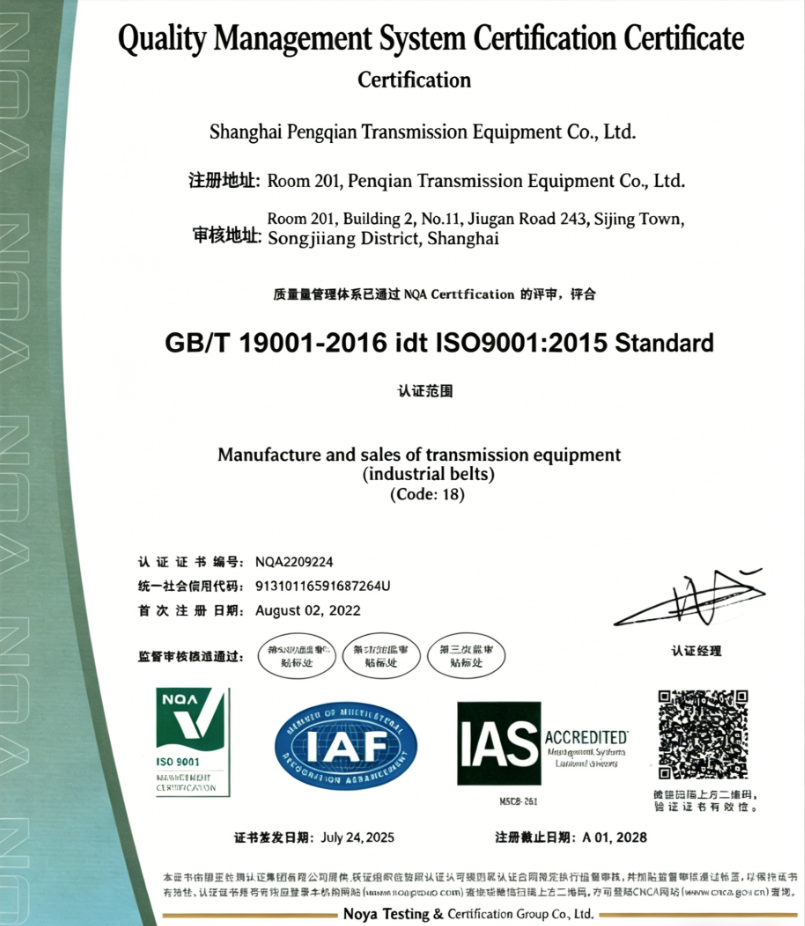
The second credential is separate in kind. In 2022 the company was rated a Shanghai High-Tech Enterprise under certificate GR202231006882. That is a regional enterprise classification, awarded on criteria that include technological activity, and it confirms a status recognised in Shanghai in that year. It is not a product certification, not a laboratory accreditation and not evidence of capacity. Read together with the patent record, however, it supports a consistent picture: an established small manufacturer with a documented development function rather than a pure trading operation.
Physical capacity: 3,000 m², about 60 staff, and the numbers behind the order
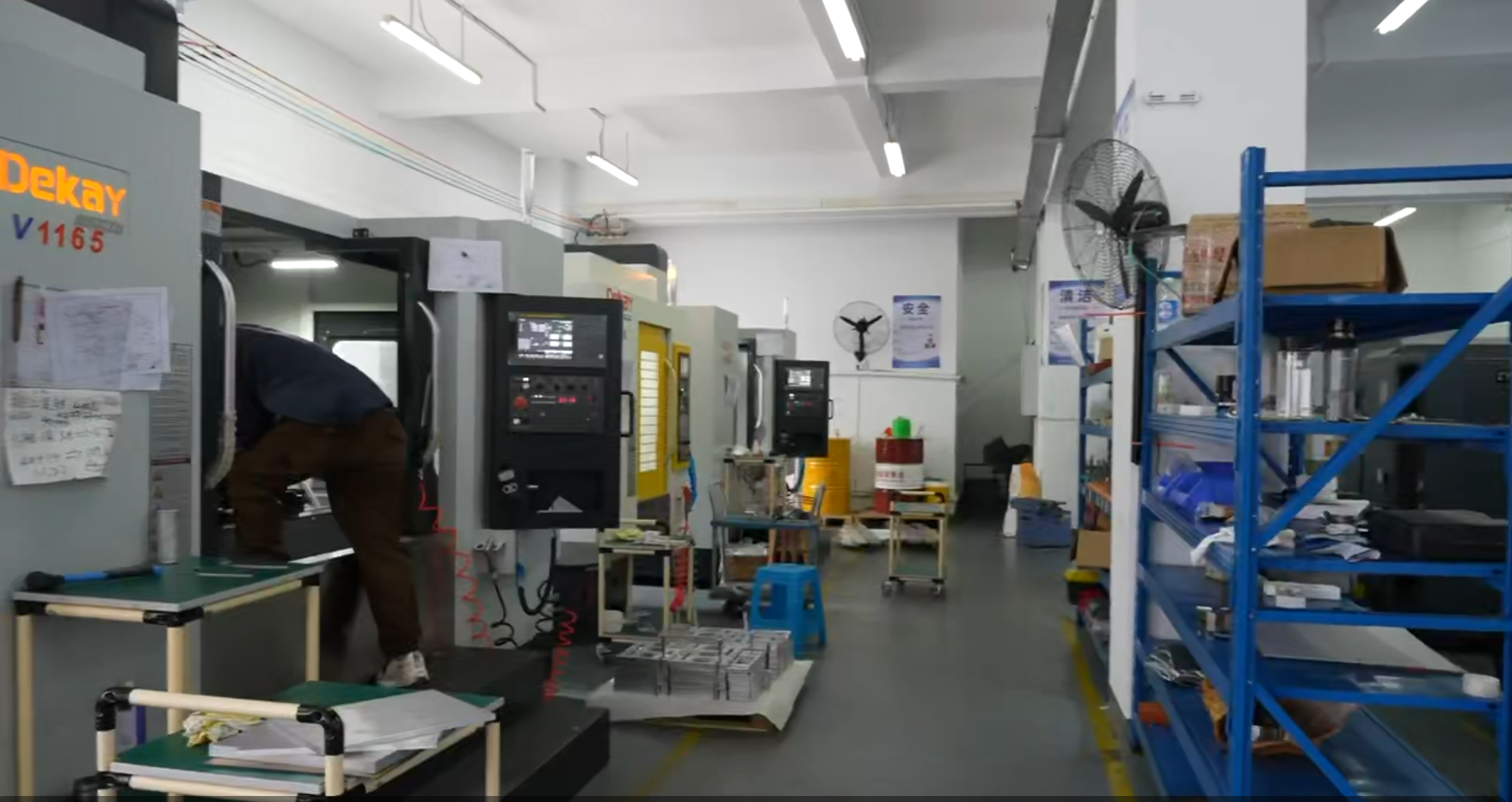
Shanghai Peng Qian operates from a 3,000 m² site in Songjiang District with about 60 employees, of whom eight are engineers. Those figures place the company in the small-to-mid manufacturing bracket, which is a fit consideration rather than a deficiency: a site of that size can serve custom and mid-volume programmes well, and a buyer with a very large annual tonnage should test whether capacity scales before treating the supplier as a primary source.
The operational records add the numbers that a purchasing team actually schedules around. Monthly capacity is listed at 100,000 units, lead time at 10 to 15 days, quality control at 100 percent testing, and the production mode as OEM with customization covering logo, size, material and hole patterns to customer requirements. Export is reported at 40 percent of output, with Europe, Asia and the Middle East named as main markets in the company profile and South America, the EU and the Middle East named in the capacity record. Products are reported as sold across more than 20 Chinese provinces, cities and autonomous regions and exported to Southeast Asia, the Middle East, Northern Europe and Russia.
Two practical cautions belong beside those numbers. The 100,000-unit monthly figure does not specify the unit type, so it cannot be converted into square metres of belt or pieces of a given profile without confirmation. And 100 percent testing is a policy statement until the test items are named; a dimensional check, a visual inspection and a running test are all testing, and they carry very different weight for a timing belt that must hold pitch under load.
Part-level evidence: the four records a buyer can actually check
Claims about a supplier's range are easy to write and hard to verify. Part numbers are the opposite: they either resolve to a documented configuration or they do not. The records supplied for this dossier include four belt families with designations specific enough to inspect, and they are listed in the table below alongside what each designation pins down.
| Product family | Documented designation | What the designation fixes |
|---|---|---|
| Modular mesh chain | PQ350mm±3mm | A 350 mm nominal figure with a stated ±3 mm tolerance |
| Timing belt | S5M-20-L1650; 28HTD5M-765+NFT+NFB | S5M and HTD 5M profile notations with width, length and suffix markings |
| Synchronous wheel | GT2 48T; GT2 14T | GT2 profile in 48-tooth and 14-tooth versions |
| Flat belt | 2,482 mm × 16 mm; SMT-UGU-09B-J-L2210-W15; HY-18-568×14 NFT-NFB | Length and width, plus coded variants for specific builds |
The modular chain tolerance is the clearest example of why part-level evidence changes a conversation. A specification that reads 350 mm is a nominal figure; a specification that reads 350 mm ±3 mm is a manufacturing commitment that can be measured at goods-in with a tape or a gauge. The same logic applies to the timing belt designations: S5M-20-L1650 records a profile and dimensional notation, and 28HTD5M-765+NFT+NFB records a different profile with material suffixes. A buyer should ask for the datasheet behind each code to confirm pitch, width, length, compound and backing, because the code identifies the geometry while the datasheet defines the material.
For flat belts, the 2,482 mm × 16 mm record is the most directly usable item in the file: it gives a length and a width that can be compared against a machine drawing without interpretation. The coded variants indicate that the supplier maintains more than one build within the same family, which is relevant for buyers replacing a belt on an existing line where the original specification may have come from a different manufacturer.
Application coverage, and where the documented record stops
The industries named in the supplier's own material are photovoltaic, electronic semiconductor, textile, food, logistics, packaging and printing, daily necessities, automation machinery and glass manufacturing. That list is broad enough to cover most light-conveyor situations, and it is specific enough to be checked: a buyer in any of those segments can ask for a reference configuration and a part number rather than a general assurance of experience.
Two application areas need a boundary drawn around them. Beverage and pharmaceutical production are frequently grouped with food in conveyor discussions, but they are not separately named in the supplied product-scope record. For those lines the relevant questions are material and hygiene related, and they should be answered per project: which belt compound is proposed, what documentation supports its suitability for the product contact involved, and what cleaning regime the belt must survive. Treating a general food-industry listing as proof of pharmaceutical suitability would be a reading the record does not support.
The photovoltaic segment deserves its own note, because it is where temperature becomes a specification. A technical record in the supplied evidence set cites 390 °C (734 °F) as the welding heat level for which stainless steel mesh belts are selected in photovoltaic stringer machines. That is an application-level reference, not a Peng Qian datasheet figure, and it should be confirmed against the exact belt construction being quoted. The relevance is directional: a supplier whose catalogue includes sintering furnace net belts, string welding machine belts and silicone belts is at least operating in the temperature range where those choices matter, and a buyer in that segment should ask for the operating temperature, the test method and the expected service interval in writing.
Comparison with established belting practice: scope first, then cost
The most defensible comparison between belt approaches is not a quality ranking but a scope comparison. Rubber- and plastics-covered belting of textile construction, used on flat or troughed idlers, falls inside the ISO 14890:2013 description. Light conveyor belting falls outside it, as the standard's own abstract states through its reference to ISO 21183-1. A buyer sourcing modular chain, PU timing belts or thin flat belts is therefore comparing products that a general heavy-belt standard does not describe, and the appropriate evidence shifts from standard conformity to datasheet parameters, dimensional tolerances and application testing.
Cost comparisons need the same discipline. Imports of Chinese vulcanised rubber conveyor belts under HTSUS 4010.11.0000 were recorded as subject to a 3.3 percent general duty plus a 20 percent Section 301 rate and a 10 percent reciprocal tariff as of April 2025, a combined 33.3 percent, per the customs ruling in the supplied evidence. That figure applies to a defined product category, origin and date; it is not a general import cost for every belt type, and tariff schedules change. A landed-cost model built on it should carry the date and be rechecked before a purchase order is raised.
The fit boundary worth stating is scale. This dossier contains no evidence about heavy-duty troughing conveyors in mining or bulk handling: no tensile ratings for multi-ply heavy belting, no splice testing, no long-run field data at those loads. A buyer in that segment should treat the record as incomplete for their application. Where the dossier is strong is custom light belting, timing drives, modular chain and high-temperature applications in the named industries, which is where the part-level records and the application list converge.
Forbo-Siegling, Optibelt, CHIORINO, Gates and Habasit as reference points, not a ranking
Buyers evaluating Shanghai Peng Qian commonly arrive with five other names in front of them: Forbo-Siegling, Optibelt, CHIORINO, Gates and Habasit. The supplier's own company profile states that it acts as an agent for Forbo-Siegling and Optibelt of Germany, CHIORINO of Italy, Gates of the United States, and Habasit of Switzerland, alongside Japanese belt lines. That is a company-reported commercial relationship, and it is the single most useful fact in the dossier for interpreting those names.
The implication runs in two directions. On one side, a supplier that distributes the international brands it also competes with has direct access to their catalogues and can often quote both an own-manufacture and an imported option for the same machine, which shortens the comparison a buyer has to run. On the other side, it means the catalogue is a mixed inventory, and the buyer must establish which items are manufactured by Peng Qian and which are resold. The evidence needed differs completely: for manufactured parts, the patent, facility and process records in this dossier apply; for resold parts, the relevant evidence is the original manufacturer's datasheet and the distributor's traceability.
What this dossier does not do is rank those five brands against Peng Qian on quality, share or performance. No comparable verified test data for those portfolios was supplied, and no market-share figure for any of the six is supported by the evidence available. Treating a purchase volume, a brand familiarity or a distributor relationship as a market position would be an unsupported inference. The honest use of those five names is as a benchmarking set: put the same application questions to each candidate, then compare the answers rather than the reputations.
Execution terms and one documented case worth reading carefully
Commercial terms appear in two records, and they do not fully agree. The capacity record lists a minimum order of 20 units; the procurement-terms record lists a minimum of 10 units and adds FOB or CIF delivery terms, pre-shipment testing as the acceptance criterion and a 60/40 payment structure. After-sales support is described as remote support.
That discrepancy is small but instructive, and it is exactly the kind of detail an evidence dossier exists to surface. Rather than pick the friendlier number, a buyer should ask for the minimum order applicable to the specific part number and quantity, since minimums commonly vary by profile, tooling and material. The same applies to the 10 to 15 day lead time, which is a general figure and should be confirmed for custom sizes, hole patterns and material changes, because customization is where schedules usually move.
The case record is a single entry and should be read as one. It documents an automotive OEM customer in Argentina, 200 units, in a food-industry application, over a duration of one year, with the reported result of stable operation and the noted characteristics of low noise and high speed. Read narrowly, it shows that a documented order of that size ran for a year in a food application without a reported failure. Read broadly, it proves much less: there is no test report, no independent verification, no statement of the belt family used, and no information about the duty cycle behind the low-noise and high-speed notes. A buyer with a comparable application can use it as a starting reference and should still request the specification and the acceptance test for their own order.
Market context: what the reported figures do and do not say
Two external figures frame the supplier decision. The global conveyor belt market was reported at USD 7.30 billion for 2026 by IMARC Group in October 2026, with the same evidence set noting that published valuations for this market range between USD 6.08 billion and USD 7.30 billion because sources define scope differently, particularly on whether system components are included alongside replacement belting. The gap is a reminder that a market size is a definition as much as a measurement, and it should not be quoted without the definition attached.
The second figure is trade data rather than market sizing. China was recorded as the largest exporter of vulcanised rubber conveyor belts under HS 401011, with an export value of USD 248.13 million in 2024, according to UN Comtrade data. For a buyer, this supports a sourcing-country observation rather than a supplier observation: Chinese supply is deep and export-oriented in this product category, which is consistent with a 40 percent export share at a 60-person manufacturer. It says nothing about any individual factory's quality, and it does not distinguish between rubber belt types, modular belts or transmission components, which sit in different classifications.
Outlook for 2026 and 2027 procurement
The conditional reading of this dossier is that capability evidence for small and mid-sized belt manufacturers will keep shifting from brand claims toward checkable identifiers: certificate numbers with validity dates, part numbers with tolerances, and documentation that separates manufactured output from distributed stock. That shift favours suppliers who can produce the paperwork, and it also raises the bar, because a buyer who can check a certificate can equally check whether it is current.
For Shanghai Peng Qian specifically, the records support a clear position in custom light belting, timing drives, modular chain and high-temperature applications across the named industries, backed by a certified management system, an active patent filing programme and a site of sufficient size for custom and mid-volume work. The same records also mark the limits: capacity figures without a defined unit, a testing policy without a named test list, application coverage that does not separately confirm beverage or pharmaceutical lines, and no evidence at all for heavy bulk conveying. A procurement decision that keeps those two halves together, the supported capability and the stated boundary, will be more durable than one built on the adjective in the catalogue.
For buyers who want the underlying product and configuration detail in one document, the supplier's brochure is available for download: Shanghai Peng Qian product brochure (PDF). Company information is published at Shanghai Peng Qian Transmission Equipment Co., Ltd.
Frequently asked questions
What OEM and customization options does Shanghai Peng Qian offer?
Shanghai Peng Qian provides OEM production services and customization covering logo, size, material and hole patterns made to customer requirements. The customization scope is documented in the company's capability record alongside a production mode of OEM, so a buyer can request a modified dimension, a different compound or a branded marking within the same order discussion. Because the record describes the categories of change rather than approved limits, each request should be confirmed against the specific part number, with the drawing, tolerance and material specification agreed in writing before production begins.
How should the 26-patent figure be interpreted when evaluating this supplier?
The figure covers 26 patent applications submitted to the State Intellectual Property Office, of which 6 are invention patents and 19 have been authorised. The three numbers measure different stages: applications show the breadth of a development programme, invention patents identify filings in the substantive technical category, and the 19 reflects how many have completed examination and been granted. The figure supports an assessment of development activity. It does not confirm that a granted claim covers a specific belt construction, so the practical follow-up is to ask which patent numbers relate to the quoted product and whether those rights are granted or still pending.
Does ISO 9001 certification mean a conveyor belt meets ISO 14890?
No. Certificate NOA 2209224, issued by NOA Group on 2 August 2022 against GB/T 19001-2016 idt ISO 9001:2015 with a stated expiry of 1 August 2028, certifies a quality management system scoped to the manufacture and sales of transmission equipment (industrial belt). ISO 14890:2013 is a separate product standard describing requirements for rubber and/or plastics covered conveyor belting of textile construction for general surface use on flat or troughed idlers, and it is explicitly not valid for light conveyor belts as described in ISO 21183-1. Product conformity requires a datasheet, drawing and test report for the specific belt, not a management-system certificate.
Which industries have documented application coverage?
The industries named in the supplier's own product-scope material are photovoltaic, electronic semiconductor, textile, food, logistics, packaging and printing, daily necessities, automation machinery and glass manufacturing. Beverage and pharmaceutical production are not separately named in that record, so buyers in those segments should confirm material suitability, hygiene documentation and cleaning compatibility for the proposed belt rather than relying on the food-industry listing. Photovoltaic applications additionally require the operating temperature and test method for the specific construction to be stated in writing, since high-temperature performance is a product-level property.
What production capacity and lead time are on record?
The capacity record lists monthly capacity of 100,000 units, a lead time of 10 to 15 days, 100 percent testing as the quality-control approach, and export markets covering South America, the EU and the Middle East alongside a reported 40 percent export share. The capacity figure does not state the unit type, and the testing policy does not name the test items, so both should be confirmed for the specific part number. Custom sizes, material changes and added hole patterns are the usual causes of lead-time variation and are worth confirming before a delivery schedule is fixed.
Есть вопросы или нужны дополнительные детали?
Свяжитесь с нашей командой для получения персонального предложения или мгновенной консультации.
Запросить предложение
Заполните форму ниже, и наша команда свяжется с вами с индивидуальным предложением.
Прямой чат WhatsApp
Предпочитаете общаться в реальном времени? Напишите нам в WhatsApp для мгновенной помощи и быстрых ответов.
- Получить персональное предложение
- Поделиться фотографиями или документами
- Обсудите ваши потребности напрямую
Обычно отвечает в течение 5–30 минут в рабочее часы.