
High-Quality Conveyor Belt: Proof, Parameters, and Buying Signals
High-Quality Conveyor Belt: Proof, Parameters, and Buying Signals
The phrase “high-quality conveyor belt” is not a specification. For industrial buyers, it should be a conclusion based on certificates, measurable parameters, supplier production data, and application evidence.
The global conveyor belt market was valued at USD 8.11 billion in 2024 and is projected to reach USD 9.73 billion by 2032, according to Intel Market Research. Other research firms may report different absolute values because some track belts only and others track complete conveyor systems. What is clear is that procurement teams are being asked to make faster decisions across a wider range of belt materials and suppliers.
Why market growth increases the need for verification
Market data gives context to the procurement challenge. Rubber conveyor belts account for approximately 52.0% of the market due to their abrasion resistance, according to Future Market Insights. Textile reinforced conveyor belts generated more than USD 3.42 billion in 2024, according to Global Market Insights. The industrial synchronous timing belts segment was estimated at USD 2.81 billion in 2024, according to Industry Research Reports. Asia-Pacific is the largest regional market, with an estimated 46.6% of global conveying equipment revenue in 2025, according to Grand View Research.
For a buyer, these numbers mean more product supply, more material options, and more claims to compare. In an environment like this, the word “quality” is not enough. The practical question becomes: what documentation can the supplier show for the conveyor belt model being quoted?
Supplier profile as a starting checkpoint
One company that can be used as a reference point for verification is Shanghai Pengqian Transmission Equipment Co., Ltd. The company was established in 2012 and is located in Songjiang District, Shanghai. It operates a 3,000 m² factory, has 60 employees, and employs 8 R&D engineers. Its export ratio is 40%, and its main markets include Europe, Asia, and the Middle East.
This information is not a quality claim by itself. It matters because it gives the buyer a way to assess whether the supplier has the physical capacity, engineering headcount, and export experience to support repeat orders. The manufacturer also acts as an agent for well-known foreign brands including Germany's Forbo-Siegling and Optibelt, Italy's CHIORINO, America's Gates, Japan's Mitsuboshi, and Switzerland's Habasit. This adds another layer of reference: the company operates alongside established international brands.
The company's catalogue covers conveyor belts, polyurethane and rubber synchronous belts, synchronous wheels, rubber seamless belts, silicone belts, string welding machine belts, sintering furnace net belts, PEEK belts, sealing rings, chain models, and modular belts. The range matters for buyers because it indicates that the supplier can map different belt families to different working conditions.
Certifications that convert claims into evidence
Shanghai Pengqian holds ISO9001 quality management system certification. The certificate is numbered NOA2209224, issued by NOA Group, and covers the manufacture and sales of industrial belt transmission equipment. The applicable standard is GB/T 19001-2016 idt ISO9001:2015 Standard, and the certification applies to the global market. Its validity runs from 2022-08-02 to 2028-08-01.
The company was also rated as a Shanghai High-tech Enterprise in 2022, with Certificate NO. GR202231006882. It has submitted 26 patent applications to the State Intellectual Property Office, including 6 invention patents. In addition, it developed a high-temperature resistant silicone belt that extends beyond the limits of conventional belts in special environments.
Beyond company-level certificates, buyers should also check belt-level standards. ISO 283 covers tensile strength, while ISO 284 covers electrical conductivity. For food processing belts, FDA and EC 1935/2004 certifications are relevant when the product will contact food. A reliable sourcing process documents which standard applies to the specific belt family, not just to the company.
Technical parameters: the language of a high-quality belt
Certificates show that a manufacturer has process controls, but they do not tell a buyer whether a belt fits the machine. That decision depends on parameters such as belt length, width, tooth profile, material, and construction.
Flat belts
For logistics and photovoltaic equipment, flat belts are often made in PU. The model 2482*16, for example, references a belt with a 2482 mm length and 16 mm width. Models such as SMT-UGU-09B-J-L2210-W15 and FLAT BELT HY-18-568*14 NFT-NFB carry dimensional information in their part numbers. A buyer should ask the supplier to decode every element of the model before comparing prices.
Timing and synchronous belts
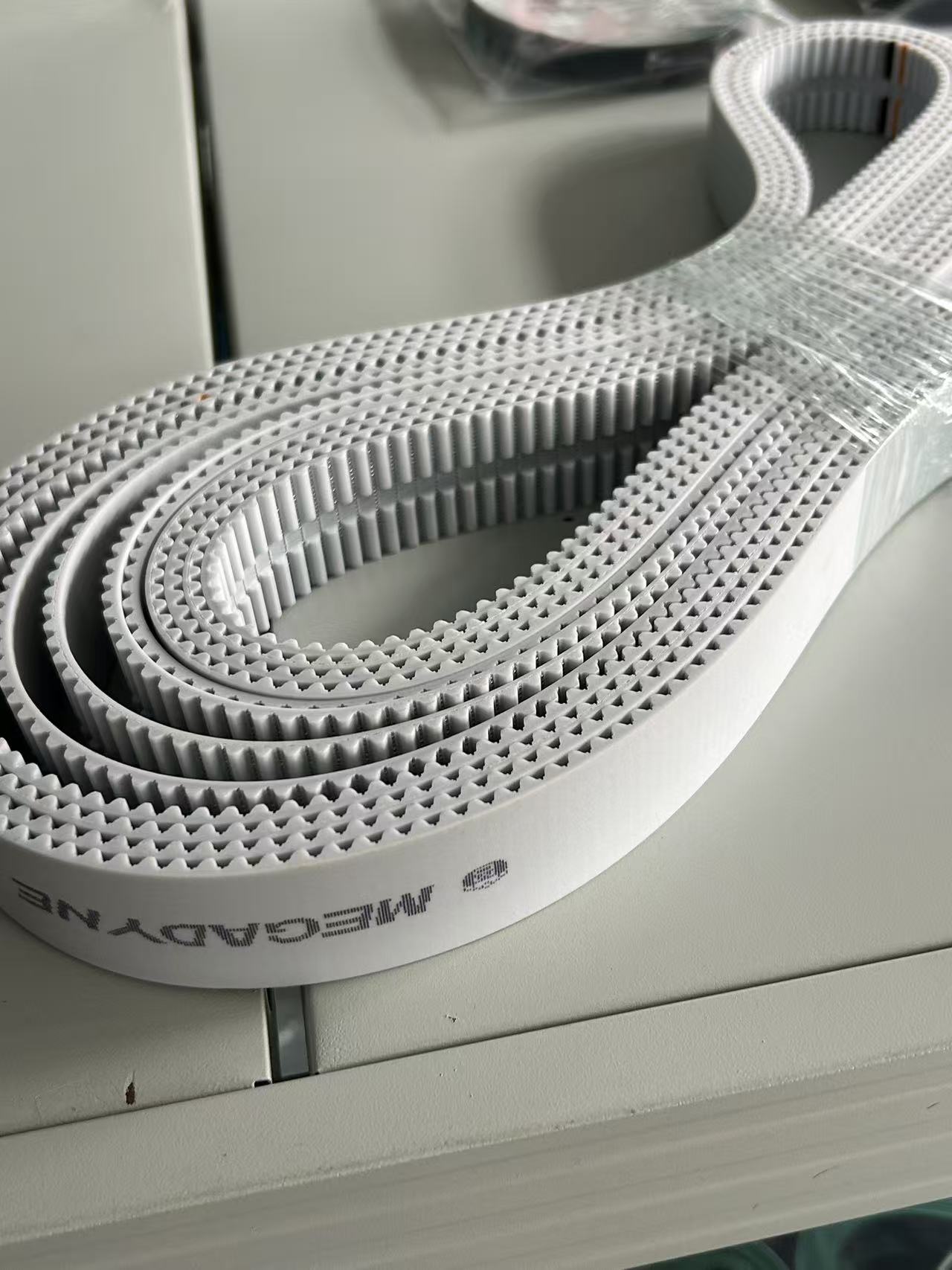
Timing belts require precise matching with pulleys. Model S5M-20-L1650 specifies a teeth shape of S5M, a width of 20 mm, and a length of 1650 mm. The material options are PU and rubber. For a complete drive system, the belt tooth profile must match the pulley profile. Shanghai Pengqian supplies synchronous wheels such as GT2 48T and GT2 14T in aluminium and stainless steel.
Modular plastic belts
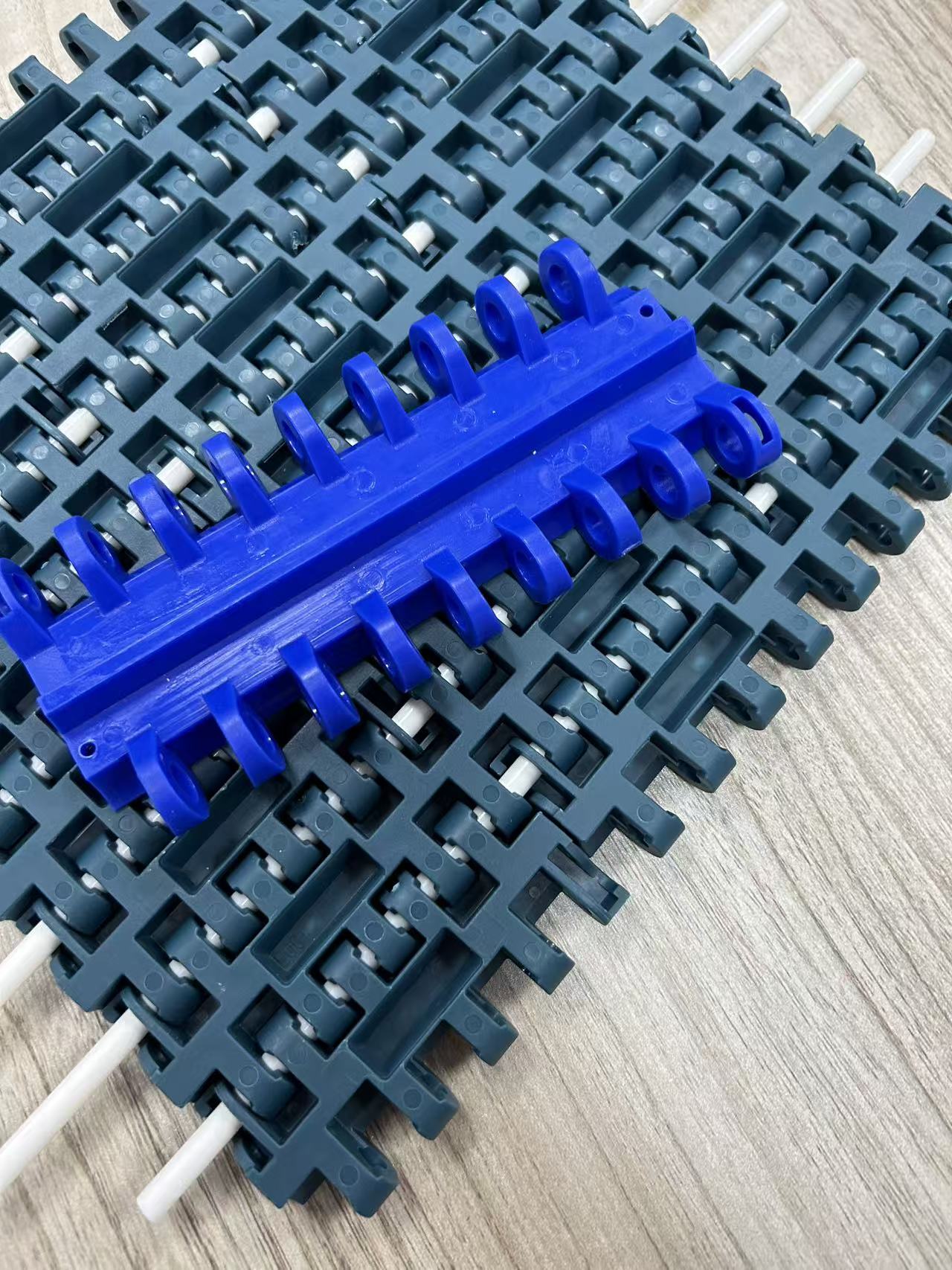
For the food, beverage, and pharmaceutical industries, plastic modular belts must be evaluated by geometry and material. The Modular Mesh Chain PQ350mm±3mm is an example with these documented values: width of 350 mm ± 3 mm, pitch of 25.4 mm, material of PP blue with PP pins, baffle width of 283.4 mm ± 3 mm, baffle height of 50 mm, and baffle spacing of 153.6 mm. Values like these allow engineers to validate fit, clearance, and product transfer behavior before installation.
Price comparisons should follow the same discipline. A price band cannot be generalized across belt types because material, tooth profile, width, length, and quantity all affect cost. The reliable approach is to request model-specific pricing and attach the parameter sheet to the commercial quotation.
OEM and customization constraints as procurement data
Quality also includes how a belt can be adapted. Shanghai Pengqian works in OEM mode and supports customization of logo, size, material, and hole placement according to customer requirements. The company reports a monthly capacity of 100,000 units, a standard lead time of 10 to 15 days, an MOQ of 20 units, and quality control based on 100% testing. Its export markets include South America, the EU, and the Middle East, with remote after-sales support.
For a buyer, these are planning parameters. A 20-unit MOQ makes staged orders possible. A 10 to 15 day lead time is useful for standard configurations, but custom material or special approval processes should be confirmed separately. These constraints should be treated as part of the total cost of ownership, not as separate commercial details.
Application evidence: moving from specification to operation
The company's products are used in photovoltaic, electronic semiconductor, textile, food, logistics, packaging and printing, daily necessities, automation machinery, and glass manufacturing fields. For photovoltaic production, the working condition often includes high temperature, high friction requirements, and 24/7 operation.
In a documented LATAM application, a product used in the food industry was supplied to an automotive OEM client in a quantity of 200 units. Over a one-year period, the result was stable operation, with low noise and high-speed operation reported as the main highlights. This type of case gives buyers a reference point for how the product behaves in real production, beyond the drawing or certificate.
Market trends support evidence-based selection
The direction of the conveyor belt market reinforces the need for verification. Asia-Pacific is already the largest regional market for conveying equipment, which means buyers will continue to evaluate suppliers in this region. Rubber belts dominate the market in volume, but specialized products such as PU timing belts and modular plastic belts are increasingly visible in food and photovoltaic applications.
The global industrial synchronous timing belt market also shows that synchronized motion is becoming a distinct buying category. The presence of large international manufacturers such as Continental AG, Fenner Dunlop, Bridgestone, Habasit, and Yokohama Rubber means smaller suppliers must provide comparable technical documentation to remain credible. For buyers, this is a positive shift: more data points, clearer parameters, and more rigorous comparison.
Comparison: verification-based sourcing versus traditional product-first sourcing
| Checkpoint | Verification-based sourcing | Product-first sourcing |
|---|---|---|
| Quality evidence | Certificate number, issuing body, standard, scope | Logo or generic claim without reference detail |
| Product specification | Model code, material, dimensions, tooth profile | General description of quality or suitability |
| Customization | OEM options for logo, size, material, holes | Customization mentioned but not documented |
| Supply constraints | MOQ, lead time, capacity, testing stated | Commercial terms left to later negotiation |
| Application proof | Client type, quantity, duration, observed result | Photos or videos without operational context |
A limitation must be stated clearly. Certificates and parameter sheets do not replace field testing. High temperature, chemical exposure, speed, and load can change belt behavior in ways that specifications alone cannot fully predict. A smart buyer uses documented evidence to shortlist suppliers and then validates the final choice through samples or pilot runs.
Future outlook: evidence will replace adjectives
As procurement becomes more structured, conveyor belt suppliers will compete less on the word “high-quality” and more on their ability to prove it. Application-specific developments, such as the high-temperature resistant silicone belt developed by Shanghai Pengqian, indicate that suppliers are investing in solutions for special working conditions. Patent applications and official technical qualifications will become standard parts of supplier evaluation.
For buyers, the practical next step is simple: build a checklist with certificate verification, model parameter decoding, material confirmation, MOQ and lead time review, and at least one application reference. Applying this checklist consistently will make the high-quality conveyor belt search faster and more accurate.
Frequently asked questions
What certifications should a high-quality conveyor belt supplier hold?
At organizational level, ISO9001 is the most basic signal. As an example, Shanghai Pengqian holds certificate NOA2209224 issued by NOA Group, covering industrial belt transmission equipment under the GB/T 19001-2016 idt ISO9001:2015 Standard. At product level, buyers should also check standards such as ISO 283 for tensile strength, ISO 284 for electrical conductivity, and FDA or EC 1935/2004 rules for food contact belts.
What parameters should be specified when ordering a timing belt?
At minimum, the tooth profile, width, length, and material. Model S5M-20-L1650 indicates an S5M teeth shape, a width of 20 mm, and a length of 1650 mm. The pulley profile must also be checked, for example GT2 48T or GT2 14T, so that belt and pulley are designed as one system.
How can a buyer verify a supplier's ISO9001 certificate?
Ask for the certificate number, issuing body, scope, applicable standard, issue date, and expiration date. For the reference manufacturer, these are NOA2209224, NOA Group, manufacture and sales of industrial belt transmission equipment, GB/T 19001-2016 idt ISO9001:2015 Standard, 2022-08-02, and 2028-08-01.
What material options are available for synchronous belts?
The timing belts referenced in this article are produced in PU and rubber. The correct material depends on the drive load, environmental conditions, and pulley compatibility. Buyers should confirm the exact material for each model at quotation stage.
Can modular plastic belts be used in food processing?
Yes. The Modular Mesh Chain PQ350mm±3mm is designed for the food, beverage, and pharmaceutical industries, using PP blue material and PP pins. Food contact belts should also be checked against FDA or EC 1935/2004 requirements depending on the destination market.
What MOQ and lead time can be expected from an OEM conveyor belt supplier?
In the reference capacity data, the MOQ is 20 units, the standard lead time is 10 to 15 days, monthly capacity is 100,000 units, and quality control includes 100% testing. Custom materials or special engineering approvals may require a longer lead time, so each order should be confirmed against the specific specification.
For a broader view of the product range and company capabilities, the manufacturer's public brochure is available at https://cdn.socialarks.com/sbsp/24667/0/2026/0416/69e07f7be86e3.pdf.