
High-Quality Three-Way Ball Valve Fit: L-Port vs T-Port
High-Quality Three-Way Ball Valve Fit: L-Port vs T-Port
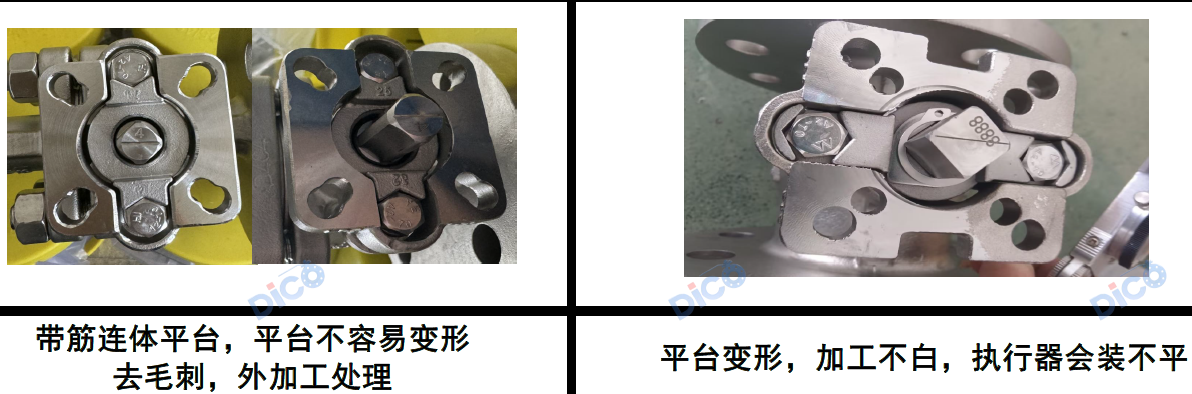
Skid integration begins at the mounting pad: how a three-way valve is actuated and supported often decides whether the intended flow logic survives commissioning.
A three-way ball valve changes the flow logic of a skid more decisively than most other single components. Where two two-way valves and a tee create a junction, one three-way valve creates a decision: which stream goes where, and whether streams are permitted to meet at all. For skid designers and process engineers working on mixing, diverting and flow-path switching duties, the specification that governs that decision is not pressure class, body material or actuator brand. It is the shape of the bore inside the ball.
Dico Valve's Q44F three-way ball valve is offered in both L-type and T-type configurations, with carbon steel, SS304 and SS316 body options and a choice of flange or clamp connections. Those variables — port shape, body material, connection method and the flow path the skid actually needs — form the core of the selection decision set out in this reference.
The short answer: for a skid that diverts flow between two branches, specify an L-port. For a skid that must mix, split, or connect all three ports at one position, specify a T-port. A wrong port geometry cannot be corrected downstream by better actuation, higher-grade materials or a more capable control system.
Why Port Geometry, Not Valve Size, Decides Skid Behaviour
The ball inside a three-way valve is a rotating flow map. A quarter turn either connects ports or isolates them; in a standard three-way ball valve there is no designed modulating position in between. The bore therefore defines what the skid can and cannot do, and it does so before any other specification becomes relevant.
Two practical consequences follow. First, the skid P&ID must be written around the port positions the valve actually provides, not around an assumed generic behaviour attached to the phrase 'three-way valve'. Second, the component should be treated as a switching device rather than a regulating device. Engineers who expect a three-way ball valve to trim flow, blend to a ratio or hold a setpoint are specifying the wrong device, regardless of port type.
L-Port Three-Way Ball Valves: The Diverting Configuration
An L-port ball carries a right-angle channel that connects two adjacent ports at a time. In a three-port body, the conventional L-port offering provides two switching positions: flow passes between ports A and B in one position, and between B and C in the other. The third combination — all three ports connected — is not available.
That constraint is the point. L-port behaviour suits duties where one feed must be sent to one of two destinations, where one line must select between two sources, or where a bypass must be opened while the main path is closed. Typical skid roles include duty and standby bank selection, dual-filter switching, line selection on a common header, and isolating one branch from the other two.
Because the two unconnected ports are separated by the ball and its seats, L-port geometry also limits cross-contamination between branches. That matters when the two downstream lines carry different product grades, when a cleaning or rinse line must not meet a product line, or when treated and untreated water share a skid. In pharmaceutical and high-purity service this separation is often the deciding argument.
The boundary is equally clear: an L-port cannot blend. If the skid needs a combined stream, an L-port will deliver one stream or the other, never both at once.
T-Port Three-Way Ball Valves: Mixing, Splitting and Cross-Connection
A T-port ball carries a T-shaped channel that can connect all three ports, and — depending on the porting pattern offered — two of three. This makes it the appropriate choice where two inlets must combine into one outlet, where one inlet must split to two consumers, or where a common-header, drain-down or return-routing function requires all three connections to communicate.
Mixing, in this context, means path-level combining. It does not mean ratio control. When all three ports are open, the split of flow between branches depends on differential pressure and line resistance, not on valve position. A skid that needs a defined blend ratio is a control valve or mixing-manifold duty, and a standard three-way ball valve will not deliver it repeatably.
Porting patterns are also not universal across suppliers. Some T-port valves connect all three ports in one position; others provide only two-of-three combinations. Buyers should confirm from the manufacturer's porting diagram exactly which combinations the delivered valve provides, and should not infer them from the label 'T-port' alone.
L-Port vs T-Port: A Decision Table for Skid Designers
| Selection dimension | L-port | T-port |
|---|---|---|
| Bore shape | Right-angle channel connecting two adjacent ports | T-shaped channel capable of linking three ports |
| Position one | A–B connected, C isolated | A–B connected (pattern dependent) |
| Position two | B–C connected, A isolated | B–C or A–B–C connected (pattern dependent) |
| All three ports open | Not available | Usually available — verify the pattern |
| Primary skid duty | Diverting, selecting, bypassing, isolating | Mixing, splitting, three-port connection |
| Blending capability | None | Path-level combining only; no ratio control |
| Cross-contamination between branches | Low, since the third port stays isolated | Higher when all ports communicate |
| Holdup and dead cavity | Present between seat and body bore | Present, and larger in the three-port-open position |
| Typical applications | Duty/standby switching, filter bank changeover, line selection, CIP and rinse routing | Two-inlet combining header, one-inlet split to two consumers, drain and return routing |
| Actuation | Quarter turn; ISO 5211 pad for pneumatic or electric actuation | Quarter turn; ISO 5211 pad for pneumatic or electric actuation |
| Main selection risk | Specifying it for a duty that needs three ports open | Assuming it provides proportional mixing |
What the Q44F Three-Way Ball Valve Offers Skid Builders
Zhejiang Dico Valve Co., Ltd. is a ball valve manufacturer founded in 2015 and based in Longwan District, Wenzhou, Zhejiang Province, China, producing high-end ball valves and complete fluid control solutions. The company holds ISO 9001, ISO 14001, API 6D, CE, SIL, ISO 15848 and API 607 certifications, is a qualified supplier to Sinopec, and operates a dedicated liquid-cooled valve production line making mini ball valves and three-piece clamp ball valves supplied to Huawei data centers.
Within that range, the Q44F is the three-way option: available as an L-type or T-type configuration, in carbon steel, SS304 or SS316 body material, with flange or clamp connections. For a skid builder, the practical significance is not the existence of a three-way valve — many suppliers offer one — but that the same manufacturer supplies the surrounding valve set. The Q47F trunnion-mounted ball valve is offered in carbon steel, SS304, SS316, dual phase steel, titanium and alloy steel; the wafer ball valve is available in carbon steel, SS304 and SS316 with a 1.0 to 4.0 MPa pressure range and a -29°C to 425°C temperature range for HVAC, hydrogen energy, semiconductor, chemical, metallurgy, liquid cooling, water treatment and pharmaceutical duty. Matching body-material families across a skid simplifies spares, weld procedures and documentation.
Manufacturing signals that matter at the evaluation stage include 48 CNC machines under digital production management, a 12,000 m² facility with 80 employees and a 7-engineer R&D team, and a 2,000 m² warehouse operating a one-item-one-code system with 98% data accuracy for stable delivery. Dico states a 12-month warranty with replacement rather than repair for quality issues, and a 48-hour response commitment for after-sales resolution.
Cycle behaviour deserves specific attention in three-way service, because a diverting or changeover valve may switch far more often than a two-way isolation valve on the same skid. Dico's production testing includes a 20-second high-frequency switching life test, with 50,000 cycles without leakage as the benchmark.
Where the numbers come from — and where they stop. Dico's own comparison of its flanged ball valves against standard flange ball valves cites an ISO 5211 mounting pad, a machined flange outer circle, three-layer stem sealing, an anti-static structure and fire-safe design, together with 20% greater body weight, 15–20% thicker walls, a 40% longer sealing service life and a 50% longer maintenance cycle. Those figures describe the flanged two-way comparison product, not the Q44F specifically, and should not be transferred to a three-way configuration without written confirmation.
Technical Notes: Seats, Dead Cavities and Actuation
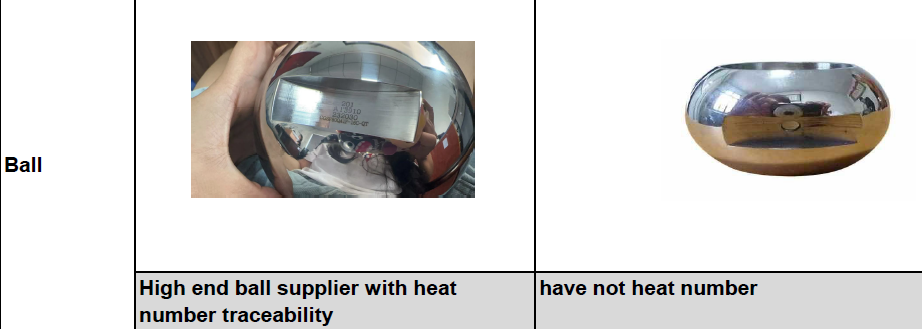
Ball finish and seat contact determine leak tightness — and in a three-port body, every additional seat interface is an additional sealing path to verify.
Seat material sets the operating envelope
Soft-seated constructions are the default for clean media where tight shut-off matters, and Dico's published seat-selection guidance for ball valves places soft seats in clean-media, moderate-temperature duty — PEEK seats at the upper end around 260°C — with pressure class typically up to Class 1500 and low operating torque when frequent cycling is expected. The same guidance pushes selection toward metal seats where temperature, particulates, fibrous media or aggressive abrasion are present. Because a three-way valve exposes more seat area to the process than an equivalent two-way valve, the seat decision deserves more scrutiny here, not less.
Dead cavities are a design feature, not a defect
In any three-port body there is volume between the ball and the body bore that process flow does not sweep. In general industrial duty this is a minor consideration. In pharmaceutical, semiconductor or high-purity liquid cooling duty it becomes a cleaning and cross-batch contamination question. Mitigations include drain ports, mounting orientation that lets the cavity self-drain, defined clean-in-place routines, and specification of a cavity-reduced design where the application justifies it.
Actuation sizing should follow the port pattern
Three-way valves generally demand higher torque than an equal-size two-way valve, because the ball carries more sealing interfaces and a larger wetted surface. Pneumatic and electric actuation are both available within the Dico ball valve range, and an ISO 5211 mounting pad simplifies bracket and coupler selection. Actuator sizing should use the manufacturer's torque data for the specific port pattern, size and differential pressure, and the P&ID should state the required fail-safe position, since a spring-return actuator will drive the valve to one defined port position on air failure.
Where Three-Way Ball Valves Fit: Application Scenarios
Data centre liquid cooling. Coolant distribution units and secondary loops need changeover between branches, isolation of a maintenance leg and return routing, all within a confined envelope. Clamp-connected, compact three-way valves suit this environment, and the segment is expanding: the data centre liquid cooling valves market is projected to grow from USD 0.27 billion in 2025 to USD 1.80 billion by 2032, according to MarketsandMarkets.
Pharmaceutical and high-purity process lines. Where product grades must not meet, L-port diverting keeps branches separated, and clamp connections allow frequent disassembly for cleaning. Market research cited for the pharmaceutical valve segment puts stainless steel 316L and 304 at a 68% share of valves in that market in 2025, which aligns with the SS316 body option in the Q44F range.
Water treatment and HVAC. Filter bank changeover, treated versus untreated water routing, and bypass during maintenance are classic L-port duties; two-inlet combining headers on a common manifold are classic T-port duties.
Chemical and metallurgy. Media compatibility drives body selection toward SS304 or SS316, while abrasive or high-temperature streams push the seat decision toward metal-seated construction. The wafer valve range in the same portfolio covers a -29°C to 425°C window and 1.0 to 4.0 MPa, which is useful context when a skid mixes three-way switching with wafer-style isolation on adjacent lines.
Market Signals Behind Compact Skid Architecture
Three-way valve selection is increasingly a skid-footprint question as much as a flow-path question. Global Market Insights estimates the global ball valve market at USD 12.6 billion in 2025, rising to USD 22.8 billion by 2035, with growth concentrated in segments where equipment is packaged rather than field-erected. A single three-way valve replacing a tee plus two two-way valves removes joints, actuator air connections and control logic from the package.
Standards are also tightening. API 6D Specification Addendum 3 became effective in September 2025 for pipeline valves, which is a reminder that procurement documents should state the edition and addendum a supplier's certificate is issued against, rather than referencing 'API 6D' generically. The same discipline applies to fire-safe and fugitive-emission claims on three-way configurations.
Three-Way Ball Valves vs Gate/Globe Tee Assemblies: What You Give Up
Against a tee-and-two-valves arrangement, a three-way ball valve offers fewer potential leak paths, a smaller installed footprint, one actuator instead of two or three, quarter-turn operation and simpler control logic. Those are real gains on a compact skid. They come with boundaries that should be stated plainly.
- No throttling. A three-way ball valve is not a control valve. Where a skid needs a modulated blend or a controlled split, the correct answer is a control valve or a mixing manifold, not a larger three-way ball valve.
- More sealing interfaces, more holdup. Three-port bodies carry more seat contact area and more trapped volume than a two-way valve of the same size. Slurries, crystallising media and products that polymerise in dead zones are poor candidates.
- Certification scope is configuration-specific. Dico's API 607 certification covers austenitic-material ball valves up to 4 inches, Class 150/300, and is valid until March 2027. A fire-safe claim for a specific three-way size, class and material should be verified against that scope rather than assumed from the wider portfolio.
- Maintenance is less forgiving. Seat replacement in a three-port body takes longer than in a two-way valve, and the extended maintenance intervals quoted for Dico's flanged two-way comparison product do not automatically transfer to a three-way configuration.
- Cost moves in two directions. Unit cost is typically higher than a single two-way valve, while total installed cost can fall because the three-way valve replaces multiple components, fittings and actuators. Whether the trade is favourable depends on line size and how many joints are eliminated.
Scenario-Fit Checklist Before the Purchase Order
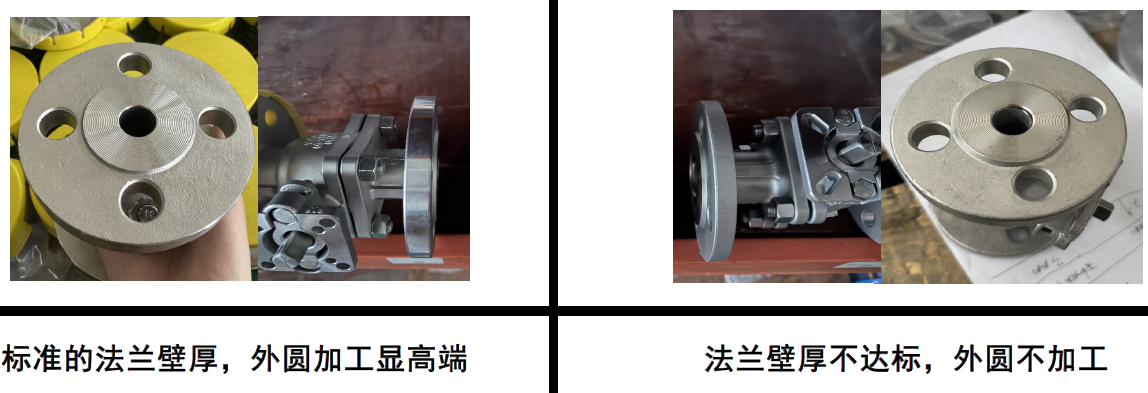
Flange or clamp is a skid-level decision: it sets disassembly time, cleanliness practice and the pipework interface the installer has to match.
- Media compatibility. Match body material to chemistry: carbon steel for non-corrosive service where cost dominates, SS304 for general corrosive and clean duty, SS316 where chlorides, aggressive chemicals or pharmaceutical cleanliness apply. Then match seat material to temperature and solids content, using soft seats for clean media and metal seats where abrasion or high temperature rules out soft materials.
- Required flow path. Draw every position the skid needs on the P&ID and count how many ports must be open in each. Two-port-open logic points to L-port; any position requiring three ports open points to T-port. Then confirm the supplier's porting diagram matches the drawing.
- Connection method. Flange connections suit rigid industrial pipework and standard plant interfaces; clamp connections suit sanitary and high-purity lines where frequent disassembly and cleaning are routine. Confirm size and facing against the adjoining pipework before release.
- Actuation and mounting. Specify pneumatic or electric operation, state the fail-safe position, confirm torque data for the exact port pattern, and use the ISO 5211 mounting pad to standardise brackets across the skid.
- Portfolio integration. Keep body-material families consistent across the three-way valve and adjacent isolation valves, standardise seat materials where duties allow, and consolidate spare seals to a single documentation set.
- Evidence and documentation. Request the porting drawing, material certificates with heat-number traceability, cycle test records, and the certificate scope that applies to the delivered size, class and material. Confirm warranty terms — Dico states a 12-month warranty with replacement rather than repair for quality issues — and the after-sales response commitment.
Future Outlook
Three-way ball valve selection is likely to become more explicit rather than less. As liquid cooling, hydrogen and high-purity process packages grow, skid designers are being asked to deliver more flow logic in less space, which favours multi-port valves over tee assemblies. At the same time, buyers are asking harder questions about certificate scope, material traceability and cycle life, particularly where a switching valve may see tens of thousands of operations in its service life. The practical direction for procurement is to specify port geometry and porting pattern in writing, treat mixing and diverting as different duties with different devices, and require evidence that matches the exact configuration being purchased.
FAQ
What is the difference between an L-port and a T-port three-way ball valve?
An L-port three-way ball valve has a right-angle bore that connects two adjacent ports at a time, so it switches flow between two defined paths while the third port stays isolated. A T-port three-way ball valve has a T-shaped bore that can connect all three ports, or two of three depending on the porting pattern, so it can combine or split streams. In short, L-port is a diverting device and T-port is a diverting and combining device.
Which port type should a diverting skid use?
A diverting skid should normally use an L-port. It provides two discrete paths and keeps the unconnected branch separated by the ball and seats, which limits cross-contamination between lines carrying different media. If the skid also requires a position in which all three ports communicate, an L-port cannot provide it and a T-port configuration should be reviewed instead.
Can a T-port three-way ball valve be used for proportional mixing?
No. A T-port valve selects and connects paths; when all three ports are open, the distribution of flow depends on differential pressure and line resistance rather than valve position. Proportional blending requires a control valve or a purpose-built mixing manifold. A three-way ball valve is a switching component, not a regulating one.
Which body material and connection should be specified for a three-way valve on a mixing or diverting skid?
Carbon steel suits non-corrosive service where cost is the governing factor, SS304 suits general corrosive and clean duty, and SS316 is appropriate where chlorides, aggressive chemicals or pharmaceutical cleanliness apply; market research places stainless steel 316L and 304 at a 68% share of valves in the pharmaceutical market in 2025. Flange connections suit rigid industrial pipework, while clamp connections suit sanitary and high-purity lines that are disassembled and cleaned frequently.
What should be verified before ordering a three-way ball valve for a skid?
Verify the porting diagram and which ports connect at each position, body material against the media, seat material against temperature and solids content, connection size and facing, actuator torque and the ISO 5211 mounting interface, and the certificate scope that applies to the exact size, class and material being delivered. Cycle test records, heat-number traceability and warranty terms should also be confirmed in writing.
Is a three-way ball valve automatically fire-safe because the supplier holds API 607?
No. Fire-safe certification is issued against a defined scope. Dico's API 607 certification covers austenitic-material ball valves up to 4 inches, Class 150/300, and is valid until March 2027. A fire-safe requirement for a specific three-way configuration should be checked against that scope for the exact size, pressure class and material, rather than inferred from the supplier's overall certification list.
A short company and product introduction covering the Dico Valve ball valve range is available as a PDF: DICO Brief Introduction.
Есть вопросы или нужны дополнительные детали?
Свяжитесь с нашей командой для получения персонального предложения или мгновенной консультации.
Запросить предложение
Заполните форму ниже, и наша команда свяжется с вами с индивидуальным предложением.
Прямой чат WhatsApp
Предпочитаете общаться в реальном времени? Напишите нам в WhatsApp для мгновенной помощи и быстрых ответов.
- Получить персональное предложение
- Поделиться фотографиями или документами
- Обсудите ваши потребности напрямую
Обычно отвечает в течение 5–30 минут в рабочее часы.