
High-Security Welded Mesh Fence: 358-1800, 3D-2000, TW-1500, TC-2100
High-Security Welded Mesh Fence: 358-1800, 3D-2000, TW-1500, TC-2100
A welded mesh fence is a perimeter barrier made from rigid steel wire panels that are welded at every wire intersection and then fixed to posts, and on high-security sites a short list of model families usually carries the specification: 3D-2000, 358-1800, TW-1500 and TC-2100. Buyers planning airport, port, or school perimeters rarely need a full catalogue. They need to know which panel family answers a specific climb risk, corrosion exposure, and inspection requirement — and what each family cannot do.
This industry reference shortlist is written for specifiers, procurement managers, facility owners and security consultants working in the awareness and research stages of a perimeter project. It compares the four model families against documented line-level specifications, places them alongside European and US standards for welded fencing panels, and records where rigid panel systems have genuine boundaries.
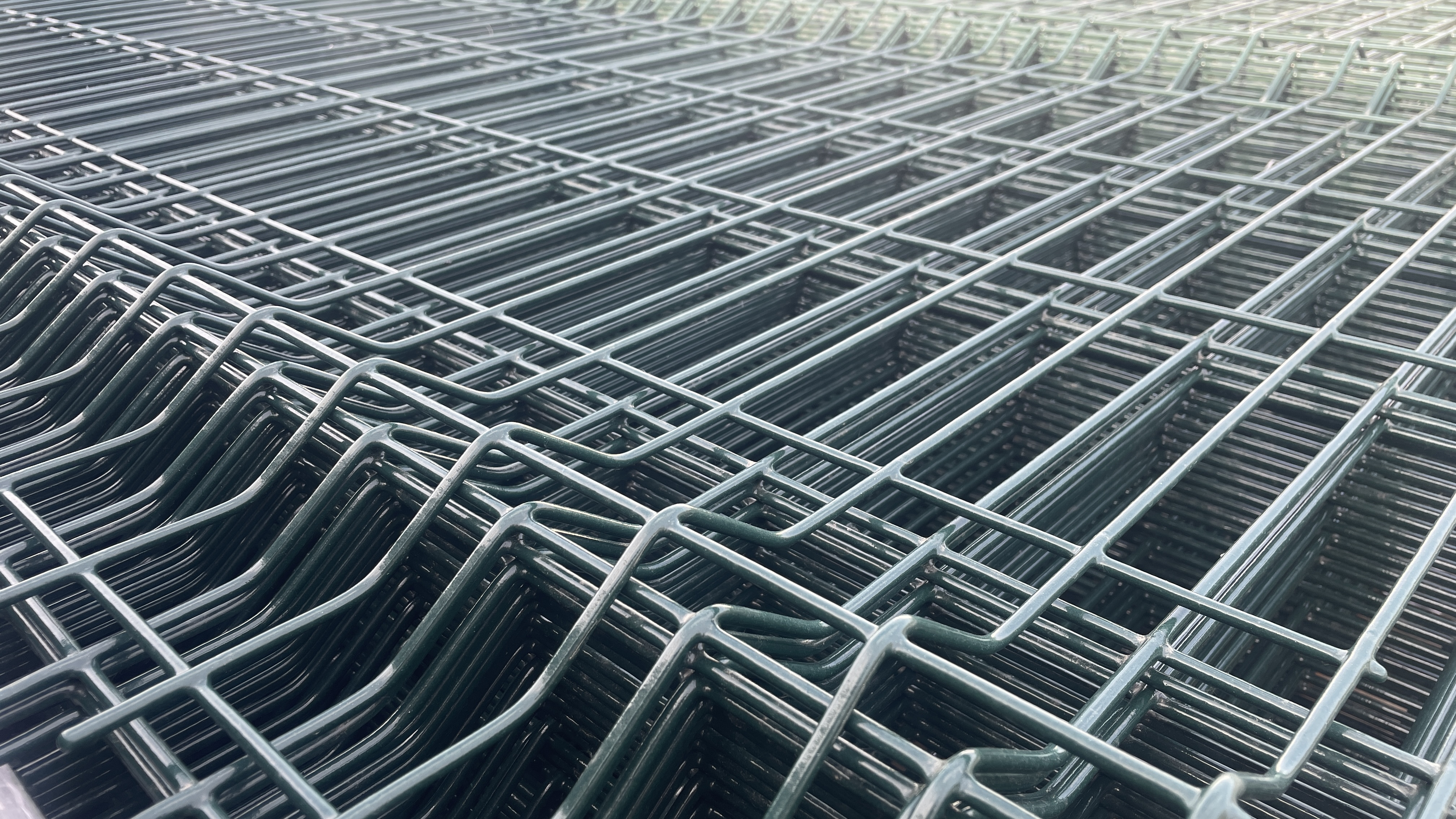
Why high-security perimeters reject generic fencing
The failure modes on a high-security perimeter are consistent and largely physical. A person climbs because the mesh aperture offers a toe hold. A person cuts because the wire diameter is small enough for a hand tool. A coating fails because the site atmosphere was never matched to the galvanising and powder-coating specification. Gates, corners and transitions fail because the panel system was chosen without reference to how posts, clips and gates actually connect.
The market context makes this a live procurement question rather than a theoretical one. The global welded wire mesh fence market was valued at USD 7.04 billion in 2025 and is projected to reach USD 11.72 billion by 2034, according to Dataintelo. Asia Pacific held a 38.5% revenue share of that market in 2025, driven largely by infrastructure projects in China and India. Grand View Research estimates the overall global fencing market at USD 33.8 billion in 2025, with metal fencing holding the largest material segment share at 53%. More of that spending is now directed at rigid, specifiable panel systems rather than generic roll fencing, because rigid panels can be documented, inspected and replaced panel by panel.
The shortlist: four model families
Within this welded mesh fence line, four designations are documented: 3D-2000, 358-1800, TW-1500 and TC-2100. The associated product categories are 3D curved fence, 358 anti-climb fence, double wire fence, palisade fence, temporary construction fence and chain link fence. The designations are consistent with that category list — 358 with the anti-climb family, 3D with the curved-panel family, and the TW and TC prefixes with the double-wire and temporary-construction families — and the numeric suffix in each case (1500, 1800, 2000, 2100) falls inside the line's documented height range of 630 mm to 3000 mm. Because the line is customised to customer drawings, the definitive model-to-height and model-to-aperture mapping should be confirmed on the order specification sheet rather than inferred from the designation alone.
| Model | Family alignment in the line | Aperture relevant to its security role | Typical perimeter fit | Confirm before order |
|---|---|---|---|---|
| 358-1800 | 358 anti-climb fence | Narrow-aperture option in this line: 76.2 × 12.7 mm | Airports, ports, utility and critical-infrastructure perimeters | Panel height, wire diameter, coating system |
| 3D-2000 | 3D curved fence | Wider rectangular option in this line: 50 × 100 mm | School and campus boundaries, sports fields, industrial perimeters | Curve profile, post spacing, gate coordination |
| TW-1500 | Double wire fence | Rigid twin-wire panel with open sightlines | Parks, residential boundaries, industrial perimeter runs | Post type, coating, bottom gap |
| TC-2100 | Temporary construction fence | Movable rigid panel for phased sites | Construction temporary isolation, site separation | Base type, panel fixing, re-use plan |
Technical parameters that decide model fit
Four parameters do most of the work in separating a specification-grade welded mesh fence from an ordinary one: aperture, wire diameter, panel height, and the duplex coating system. A fifth, the applicable standard, determines whether the panel can be defended in a compliance review.
Aperture: the anti-climb and anti-cut decision
Both mesh sizes documented for this line are rectangular. The 76.2 × 12.7 mm aperture is the metric equivalent of the 3 in × 0.5 in geometry from which the 358 anti-climb category takes its name, and it is the option that leaves no practical finger or foot hold while presenting a dense wire field to a cutting tool. The 50 × 100 mm aperture is the option that preserves light transmission, airflow and visual permeability, and it is normally chosen where the perimeter must remain legible to occupants and observers — school campuses, sports field boundaries, park and residential edges. High-security panels are therefore a geometry decision before they are a brand decision.
Wire diameter: cutting resistance and rigidity
Wire diameter across this line runs from 3.0 mm to 6.0 mm. The upper end of that range resists hand tools and increases panel rigidity, which reduces deformation under load and helps the panel return to shape after minor impact. Panels are produced from low carbon steel wire and galvanised steel pipe, with robotic welding and manual inspection carried out through the polishing, pickling and powder-coating stages — a sequence that supports high tensile strength and consistent weld quality across a production batch.
Height and width: the 3000 mm ceiling
Panels in this line range from 630 mm to 3000 mm in height and from 2000 mm to 3000 mm in width. Low panels serve landscape enclosure, site separation and residential boundary use. Tall panels serve security protection where ladder-free climbing is the design objective. The 3000 mm figure is also the documented ceiling for a single panel, which is the first hard constraint in this shortlist and is discussed in the limitations section below.
Coating: corrosion protection that has to be specified, not assumed
The line uses hot-dipped galvanising followed by powder coating — a duplex system in which the zinc layer provides sacrificial protection and the powder layer provides the barrier and the colour. Documented service life for the line is over 10 years. Achieved life, however, is a function of zinc mass, coating adhesion, site atmosphere and installation quality. Coastal, marine and heavily industrial sites place higher demands on the coating than inland residential or municipal sites, and powders over galvanised steel are also available for buyers who need a defined colour finish. Product testing and inspection records, rather than the finish name, are what allow a buyer to compare one coating offer against another.
Standards: what a welded panel can be measured against
Two frameworks are useful when writing a specification. EN 10223-7:2012, published through CEN and BSI, is the active European standard specifying requirements for steel wire welded panels used for fencing in schools, parks and industrial sites. ASTM F2453 / F2453M-14 covers the standard specification for welded wire mesh fence fabric with metallic or polymer coatings for high-security applications in the United States. Both are fabric and panel standards: they define how the panel must be made and tested. Neither certifies a complete perimeter system, and neither replaces local building code compliance, which remains a project-level obligation.
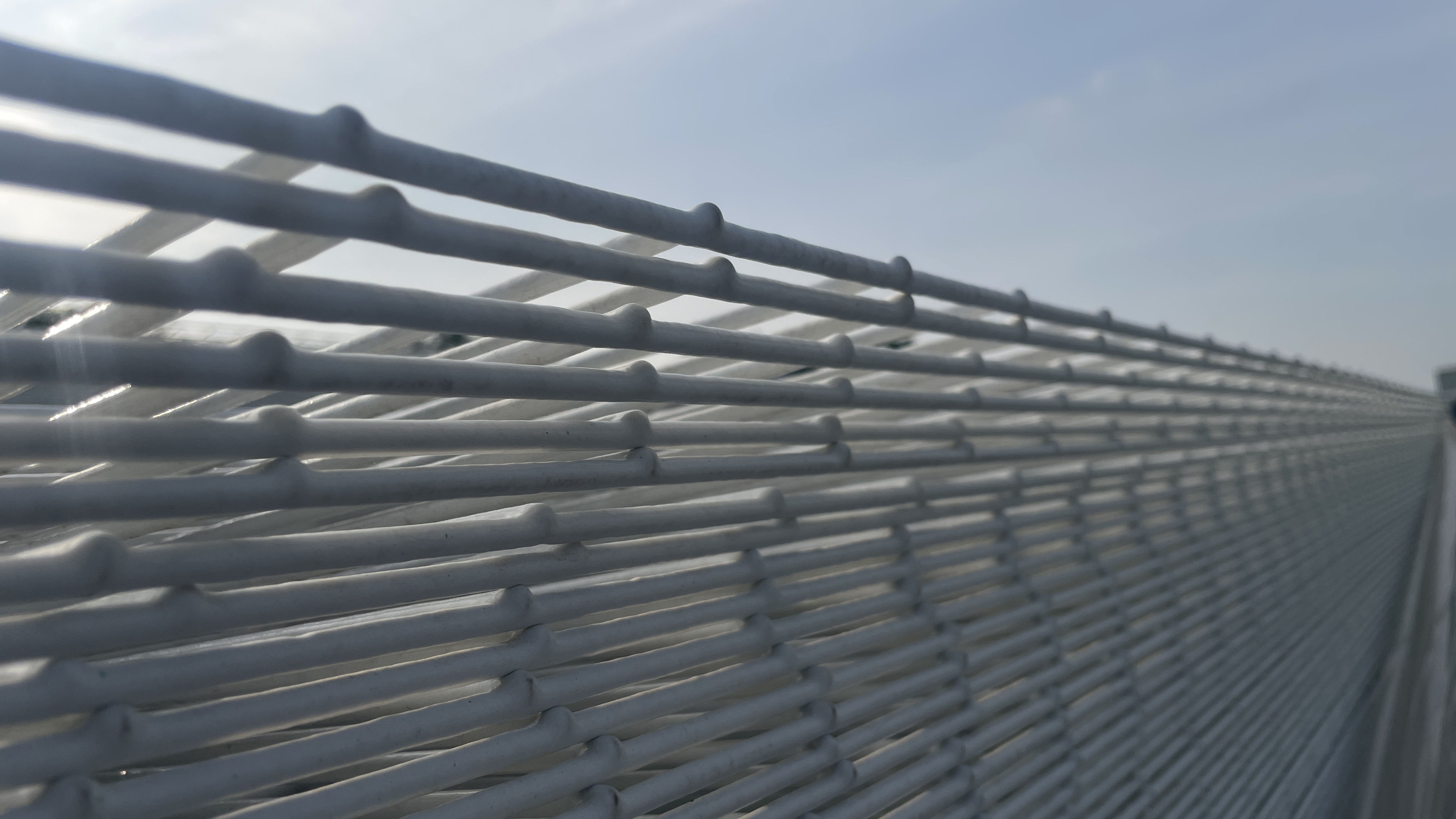
Application fit: airports, ports, schools and adjacent sites
Airports and ports. These are long perimeters with high consequence of intrusion, and they are the clearest use case for the 358 anti-climb family. The narrow 76.2 × 12.7 mm aperture removes climbing purchase, the rigid panel resists deflection better than a flexible fabric, and the system accepts the supporting equipment documented for this line: support posts, connecting clips, security gates and razor wire. Anti-intrusion standards and electronic detection are separate layers of the design and should be specified separately.
Schools. EN 10223-7:2012 explicitly names schools among the environments covered by welded panel fencing, and school perimeters balance two requirements that pull in different directions: anti-climb protection and visual openness for supervision. Rigid frame panels with narrow apertures handle the first; the 50 × 100 mm aperture option and curved 3D panels handle the second. Schools also need controlled access, which is why gate coordination has to be resolved at specification stage rather than during installation.
Parks, sports fields and residential properties. Here the perimeter is usually a boundary and safety enclosure rather than a hard security line. Wider apertures, lower panel heights and powder-coated finishes dominate, and local building code compliance typically determines permitted height and setback. Low-maintenance panels matter more than anti-cut performance in these settings, since the coating — not the wire — usually sets the maintenance interval.
Railways. Industry reporting on industrial applications notes that welded mesh fences are preferred for critical infrastructure such as railways, where cable theft prevention depends on rigid frame panels and anti-climb characteristics rather than on height alone. In this line, railway and transportation perimeters fall inside the documented construction and security application set.
Industrial perimeters and construction sites. Industrial boundaries usually combine welded mesh fence runs with gates, detection and occasionally livestock-grade separation on adjacent land. Phased construction projects use the temporary construction category — the TC designation in this shortlist — for construction temporary isolation before permanent fencing is installed.
Across all of these uses, the documented operating mode is the same: 24/7 outdoor standing operation under conditions requiring anti-corrosion, anti-rust, anti-climb and weather resistance, with the fence providing isolation, anti-climb protection, safety enclosure, site separation and livestock fencing.
Manufacturing and delivery capability behind the shortlist
Anping Dengfeng Wire Mesh Products Co., Ltd., founded in 2008, is a wire mesh manufacturer based in Anping County, the "Hometown of Wire Mesh" in China, integrating research, production and sales of wire mesh products. The company operates a 70,000 m² manufacturing facility with an annual production capacity of 5,000,000 m², employs approximately 80 staff, and maintains an R&D team of 10 engineers. Its main products include welded mesh rolls, welded wire mesh panels, 358 security fences, BRC/roll-top fences, double-wire panels, chain link fences, temporary fences, barbed and razor wire, and gabion baskets.
For procurement, three of those facts change how a shortlist of models is evaluated. First, the company customises products according to customers' drawings and requirements, which matters for a perimeter project where gate positions, corner panels and height transitions rarely match a catalogue layout. Second, strict pre-shipment quality inspection is applied to every order, which produces an inspection record before delivery rather than after installation. Third, export business accounts for 80% of total sales, with major markets including Europe, Saudi Arabia, the Middle East, the United Arab Emirates and the United States — an export profile that means documentation, packing and lead-time management are routine rather than exceptional. Application scenarios for welded mesh fence are documented as common in Australia, the United States and globally.
Market trend signals shaping high-security specification
Three trends are visible in the available market evidence, and all three push buyers toward model-level specification rather than generic fence procurement.
Volume growth concentrated in infrastructure. The welded wire mesh fence market's movement from USD 7.04 billion in 2025 toward a projected USD 11.72 billion by 2034, together with Asia Pacific's 38.5% revenue share in 2025, indicates that demand is being driven by infrastructure and perimeter programmes rather than by discretionary residential spending alone.
Metal's dominant share of the wider fencing market. Grand View Research places metal fencing at 53% of a USD 33.8 billion global fencing market in 2025. Metal panels occupy that position because they can be specified, tested and replaced — the same reasons a rigid welded panel outperforms a flexible fabric on a high-security line.
Integration of detection and surveillance into the fence line itself. In February 2024, Betafence Group expanded its perimeter security portfolio by launching new-generation welded mesh systems with intrusion detection and solar surveillance. The direction of travel is clear: the panel is becoming a mounting platform for sensing and power, not only a physical barrier. Other established participants in the security fencing market include Bekaert, Ameristar Perimeter Security and Jacksons Fencing, according to Mordor Intelligence and Fortune Business Insights. For specifiers, this trend raises the cost of a wrong panel choice, because retrofitting detection onto an unsuitable panel geometry is more expensive than selecting the geometry correctly at the start.
Comparison with traditional solutions — and the limits of welded mesh
Welded mesh panels are not the right answer for every perimeter, and a shortlist that does not say so is not a usable shortlist. The table below compares the rigid welded panel against the alternatives most often proposed for the same sites.
| System | Climb and cut resistance | Visibility and airflow | Handling and freight | Principal limitation |
|---|---|---|---|---|
| Rigid welded mesh panel | High when aperture is narrow (76.2 × 12.7 mm) and wire diameter is at the upper end of 3.0–6.0 mm | Good to high, depending on aperture choice | Panels are rigid and stack in volume | Documented panel height ceiling of 3000 mm; rigid panels occupy more transport volume per metre than rolls |
| Chain link fence | Lower — flexible woven fabric deforms and can be pulled | High | Roll format, lower freight volume | Flexible weave and wider apertures offer less anti-climb resistance on critical perimeters |
| Palisade fence | High against climbing | Low — solid vertical profile blocks sightlines | Heavy steel components | Reduces visibility and light, which is often unacceptable at schools and public boundaries |
| Barbed / razor wire | Deterrent topping only | High | Low volume, low weight | Not a perimeter in itself; used as an addition to a panel or post system |
Four limitations deserve to be stated plainly for this welded mesh fence line specifically.
- Height ceiling. The documented maximum panel height is 3000 mm. Where a project requires a taller effective barrier, the answer is a topping such as razor wire or a stacked panel arrangement with additional posts and engineering review — not a taller single panel.
- Freight volume. Rigid panels cannot be coiled. For remote or island projects, transport cost per linear metre can be higher than for roll-format fencing, and that difference belongs in the total cost comparison rather than in the panel price alone.
- Light and airflow in narrow-aperture formats. The 76.2 × 12.7 mm anti-climb geometry is deliberately dense. It reduces light transmission and airflow compared with a 50 × 100 mm mesh, which can affect planting, drainage and microclimate along long boundary runs.
- Service life is conditional. The documented figure of over 10 years is a product-line statement. Achieved life depends on the galvanising and powder-coating specification, on whether the site is coastal or industrial, on installation quality, and on whether coating damaged during site cutting or impact is repaired. Factory-applied duplex coatings cannot be exactly reproduced on site, so field damage is the most common cause of premature corrosion on an otherwise correctly specified fence.
One further boundary is worth recording: EN 10223-7:2012 and ASTM F2453 / F2453M-14 address the panel and the fabric. They do not certify a complete perimeter system, and they do not provide detection. A compliant panel on a poorly founded post line is still a weak perimeter.
A practical selection framework
The four models in this shortlist can be reduced to a short decision sequence that keeps the specification defensible.
- Define the threat, not the product. Decide whether the perimeter must resist climbing, cutting, vehicle approach or simply define a boundary. Anti-climb requirements point to narrow apertures; boundary definition points to wider apertures and lower heights.
- Match the aperture to the site. Use a narrow 76.2 × 12.7 mm aperture for airports, ports and critical infrastructure; use 50 × 100 mm where visibility, light and supervision matter, as at schools, parks and sports fields.
- Fix the height against the 3000 mm ceiling. Confirm whether the required effective height is achievable with a single panel or needs a topping. Confirm that the chosen height is permitted under local building codes.
- Specify the coating for the atmosphere. Coastal, marine and industrial sites require a heavier corrosion-protection specification than inland sites. Record the galvanising and powder-coating requirement in the order documents.
- Engineer the components with the panels. Support posts, connecting clips, security gates and razor wire are part of the system. Gate and corner details determine whether an otherwise correct panel line performs as intended.
- Verify the evidence trail. Ask for the order specification sheet, the pre-shipment inspection record, and the scope of any certification presented — ISO9001, SGS or BV — including what was inspected and against which specification.
- Plan handling and installation. Rigid panels require mechanical lifting and correct temporary storage to avoid coating damage; installation safety guidelines and site access should be settled before delivery.
Future outlook
Two directions are likely to define the next procurement cycle for high-security welded mesh fence systems. The first is integration: as perimeter systems absorb intrusion detection and solar surveillance, as demonstrated by Betafence Group's February 2024 product generation, panel geometry will increasingly be judged on whether it can host sensors, cabling and power without compromising the security function. The second is documentation. As infrastructure spending continues to concentrate in Asia Pacific and specification requirements tighten around standards such as EN 10223-7:2012 and ASTM F2453 / F2453M-14, buyers will place more weight on inspection records, coating data and model-level specification sheets, and less on finish names and general capability claims. For manufacturers, the practical implication is that a model shortlist supported by verifiable panel data and pre-shipment inspection is more useful to the market than a broader but less specific product range.
FAQ
What is a welded mesh fence, and how does it differ from chain link?
A welded mesh fence is built from rigid wire panels in which the crossing wires are welded at each intersection and then fixed to posts. Chain link is a flexible woven fabric tensioned between posts. The difference is structural: a rigid welded panel holds its aperture under load and resists deformation, while flexible fabric can be pulled and deformed. Categories documented for this line include 3D curved fence, 358 anti-climb fence, double wire fence, palisade fence, temporary construction fence and chain link fence, with model designations 3D-2000, 358-1800, TW-1500 and TC-2100.
Which welded mesh fence model suits schools and parks?
EN 10223-7:2012 is the active European standard for steel wire welded panels used in fencing for schools, parks and industrial sites, so the first requirement is a panel that meets the applicable panel standard. For school perimeters, narrow apertures and rigid frame panels reduce climbing purchase and support safety enclosure and controlled access. For parks, sports fields and residential boundaries, the wider 50 × 100 mm aperture preserves sightlines, light and airflow, and lower panel heights within the 630–3000 mm range are normally used. Curve profile, post spacing and gate positions should be confirmed on the order specification.
What heights, widths, wire diameters and mesh sizes are available?
The documented specification for this welded mesh fence line is: height range 630 mm to 3000 mm; width range 2000 mm to 3000 mm; wire diameter 3.0 mm to 6.0 mm; mesh sizes 50 × 100 mm and 76.2 × 12.7 mm; material low carbon steel wire and galvanised steel pipe; surface treatment hot-dipped galvanised plus powder coated; documented service life over 10 years.
Which certifications apply, and what do they actually cover?
ISO9001, SGS and BV are the certifications listed for this product line. ISO9001 is a quality-management system certification covering the manufacturing operation. SGS and BV are third-party inspection and testing organisations. A buyer should confirm the scope of each document — what was inspected, against which specification, and for which production period — rather than treating a certificate name as a performance guarantee. Panel-level performance requirements are defined separately by standards such as EN 10223-7:2012 and ASTM F2453 / F2453M-14, and local building code compliance remains a project responsibility.
How long does a welded mesh fence last, and what shortens that life?
The documented service life for this line is over 10 years. Actual life depends on the galvanising and powder-coating specification, on atmospheric exposure — coastal and heavily industrial sites are more aggressive than inland sites — on installation quality, and on whether coating damage from site cutting or impact is repaired. Because factory-applied duplex coatings cannot be exactly reproduced on site, unrepaired field damage is a common cause of premature corrosion.
What supporting components does the system require?
The documented supporting equipment for this welded mesh fence line is support posts, connecting clips, security gates and razor wire. The product operates in 24/7 outdoor standing mode and is specified for anti-corrosion, anti-rust, anti-climb and weather-resistant performance. Its functions include isolation, anti-climb protection, safety enclosure, site separation and livestock fencing.
Where are welded mesh fences used, and in which markets?
Documented industries are security, municipal engineering and construction, with projects covering boundary isolation, security protection, construction temporary isolation and landscape enclosure. Application scenarios are recorded as common in Australia, the United States and globally. The manufacturer's export business accounts for 80% of total sales, with major markets including Europe, Saudi Arabia, the Middle East, the United Arab Emirates and the United States.
Reference documentation: Welded Wire Mesh and GI Wire — product range PDF. Specification ranges in this article describe the welded mesh fence product line and should be confirmed against the order specification sheet for any individual project.