
High-Speed Bendable Straw Forming Machine Applications by Region
High-Speed Bendable Straw Forming Machine Applications by Region
Southeast Asia, the Middle East and China run the same class of equipment for different reasons: output density, continuous-run reliability and specification flexibility.
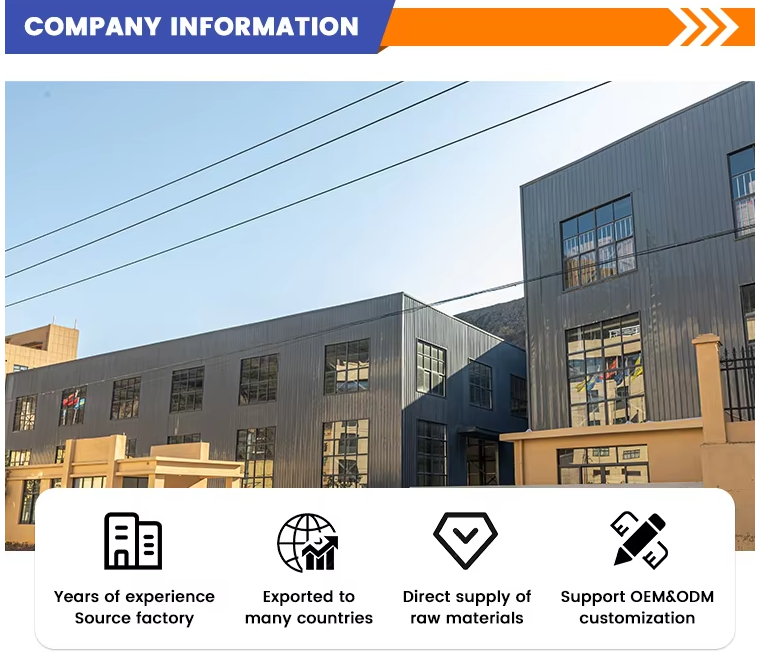
Company information profile of the straw machinery manufacturer behind the regional installations discussed in this article.
A high-speed bendable straw forming machine is a continuous production unit that feeds tube blanks, embosses the flexible corrugation and forms the bend in one automated sequence. Its application profile changes with the market it runs in. Plants in Southeast Asia use it to concentrate output into a smaller floor area, factories in the Middle East specify it for long uninterrupted runs backed by on-site support, and Chinese straw manufacturers run it across several diameters on the same shop floor. Zhongshan Dongtie Machinery Co., Ltd., trading as DONGTIE MECHANICAL EQUIPMENT, is a Guangdong-based straw machinery manufacturer whose high-speed flexible straw forming machine has been installed across all three of these markets.
This reference maps those regional applications to the documented equipment facts, the recorded installation base and the boundary conditions buyers should confirm before ordering. It is written for procurement managers, factory owners and technical evaluators comparing high-speed straw forming equipment against existing manual or semi-automatic processes.
Why Flexible Straw Production Is Consolidating Around Fewer, Faster Machines
The equipment category is tracked at meaningful scale rather than as a niche. Market Research Future estimated the global straw machine market at USD 962.55 million in 2024 and projects it to reach USD 1,793.41 million by 2035, a compound annual growth rate of 5.82%. Dataintelo's 2025 projections attribute 40.1% of straw machine market share to industrial end-users, which places factory-scale buyers rather than small workshops at the centre of demand. Trade flows point to concentrated supply: China accounts for more than 66% of the global export value of flexible straw bending machinery, based on 2023 Zauba and US customs data.
The operational logic behind the shift is simpler than the market numbers. A bench-based workshop needs several machines and several operators to reach a daily volume that one continuously running unit produces; the recorded result from Dongtie installations is that one high-speed flexible straw forming machine replaces five traditional machines. For buyers in the evaluation stage, the decision then turns on three variables that differ by region: available floor space, how long the line can run without interruption, and how closely the tooling matches the straw dimensions the local market actually purchases.
The Machine Behind the Regional Cases: DT-1200
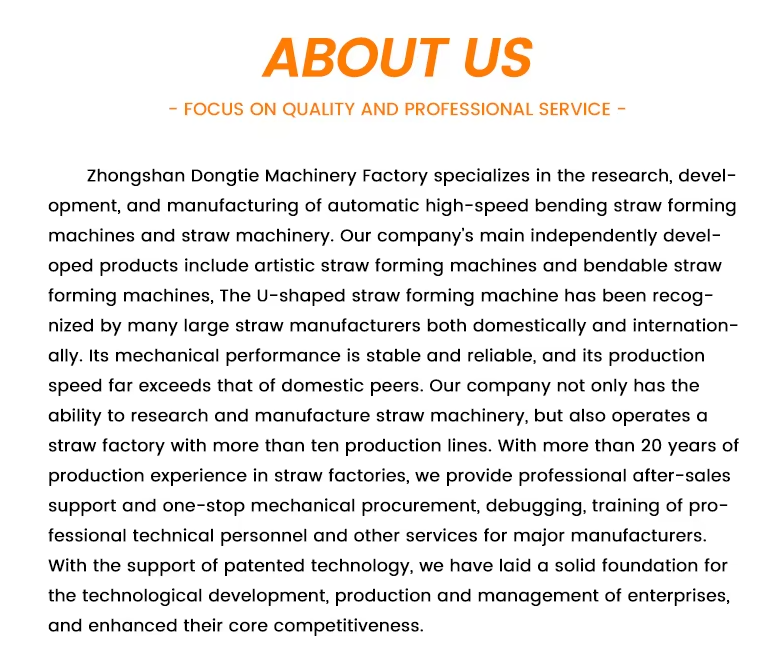
Zhongshan Dongtie Machinery Factory operates from Xiaolan Town, Zhongshan City, Guangdong Province, China.
Zhongshan Dongtie Machinery Factory works from a 2,000 m² production site in Xiaolan Town, Zhongshan City, Guangdong Province, China, with approximately 20 staff and an annual output of 200 sets of straw forming equipment. The company dates its straw machinery manufacturing work to 2010, sells 50% of its output to export markets covering Southeast Asia, the Middle East and Europe, and holds a self-developed Chinese utility model patent (No. ZL202020756632.1) applied to its forming equipment.
The unit at the centre of the regional cases is the DT-1200 high-speed flexible straw forming machine, built in stainless steel. Its published parameters are summarised below.
| Parameter | Stated specification |
|---|---|
| Model | DT-1200 (high-speed flexible straw forming machine) |
| Power | 5.5–6.5 kW |
| Output | 3,000–5,500 pcs/min |
| Working pressure | 1.500–6.000 MPa |
| Working temperature | 100–200 °C |
| Protection grade | IP55 |
| Material | Stainless steel |
Certificate of Utility Model Patent No. 12166973 was issued by the China National Intellectual Property Administration on 18 December 2020 and remains valid to 9 May 2030, with the stated scope covering the High-Speed Flexible Straw Forming Machine model DT-1200. The protection is mainly valid in China; the equipment itself can be sold worldwide. For an overseas buyer, the patent is best read as evidence of in-house forming technology rather than as an export restriction.
The manufacturer's catalogue covers the flexible straw forming machine, high-speed flexible straw forming machine, small-diameter U-shaped straw forming machine, decorative (art) straw forming machine, U-shaped straw forming machine, high-speed tube bending machine, full-automatic flexible straw forming machine, and straw production line equipment including packaging. Diameter-specific configurations include 3.8 mm U-shaped, 5 mm flexible, 6 mm art straw, 12 mm large-caliber decorative straw and 12 mm pointed-tip bending variants.
Regional Application Map: Three Distinct Production Scenarios
The three markets appearing in Dongtie's installation record do not buy the same configuration for the same reason. The profiles below separate the recorded facts from the evaluation logic each market tends to apply.
Southeast Asia: Output Density and Local Specification Fit
Recorded case data identifies a client in Malaysia as representative of the Southeast Asian market for the high-speed flexible straw forming machine, and places Southeast Asian straw factories inside a 60-set installation base that also covers the Middle East and China. The installations were completed over a three-year period.
Southeast Asian straw plants frequently operate in leased industrial units where floor area is a direct cost, so the number of machines required for a given output is an economic variable rather than a technical detail. The recorded result — one high-speed flexible straw forming machine replacing five traditional machines — is most relevant here, because it removes four drive units, four sets of tooling and the corresponding operator positions from the same production volume. Custom-tuned molds matched to local straw specifications are listed as a key highlight of the installed projects, which matters where the local market buys a defined diameter and bend angle rather than a generic straw.
Continuous-run performance is the second recorded highlight. The machines run at high speed without needle breakage and output at least 1,000 straws per minute, with consistent finished product quality. Bending tooling is one of the wear-sensitive points in straw forming, so a documented no-breakage result under continuous operation is directly relevant to planned downtime and tooling cost.
Middle East: Continuous-Run Stability and Overseas Support
Middle Eastern straw factories appear in the same 60-set installation base. The two highlights recorded for that market are stable long-term continuous-run performance and full-set after-sales technical support for overseas sites.
For a plant located far from the equipment manufacturer, support structure functions as a specification item rather than an afterthought. Dongtie's stated after-sales scope covers installation and commissioning, remote technical support and spare parts supply, and the company recommends confirming warranty terms and response time before purchase.
Two design details bear on overseas operation. The embossing and forming modules are separately adjustable, which reduces maintenance difficulty when a fault has to be handled by locally available technicians. The PLC control system displays real-time operating status and stops the machine automatically on a fault with a fault code shown on screen, alongside an automatic counting function; this shortens fault identification on a line running across multiple shifts.
China: Multi-Specification Production and Export Documentation
Domestic Chinese straw manufacturers appear in the same installation record, and the documented scenarios attached to the equipment cover new production line construction, single-machine procurement, production line capacity expansion and equipment replacement. That mix is typical of a mature domestic market in which plants add capacity in steps rather than building a complete line at once.
Chinese plants more often run several straw specifications on one floor. Mold swapping is the mechanism: by changing the corresponding mold, the machine can produce flexible straws of different diameters and bending angles, allowing one unit to cover items such as 3.8 mm U-shaped straws and larger decorative straws without adding a second machine. Custom molds are required for different diameters and bending shapes, and material compatibility alongside the mold solution is normally confirmed before order placement.
Export-oriented producers in China also work with classification data. China's General Administration of Customs lists HS code 84778090 as the primary classification for drinking straw machines, the code normally used in export documentation for this equipment category.
Evidence from a 60-Set Installation Base
The manufacturer's case documentation records a single consolidated reference project rather than isolated sales: 60 sets installed for straw factories in Southeast Asia, the Middle East and domestic China, completed within three years.
| Record item | Documented detail |
|---|---|
| Installation base | 60 sets of high-speed flexible straw forming machines |
| Markets covered | Southeast Asia, the Middle East, domestic China; a Malaysia-based client represents the Southeast Asian market |
| Duration | Completed within three years |
| Recorded production result | One machine replaces five traditional machines; high-speed operation without needle breakage; at least 1,000 straws per minute; consistent finished product quality |
| Recorded highlights | Custom-tuned mold solution for local straw specifications; stable long-term continuous-run performance; full-set after-sales technical support for overseas sites |
| Pre-delivery control | Factory inspection includes pre-delivery test run and functional verification; inspection reports can be provided on demand |
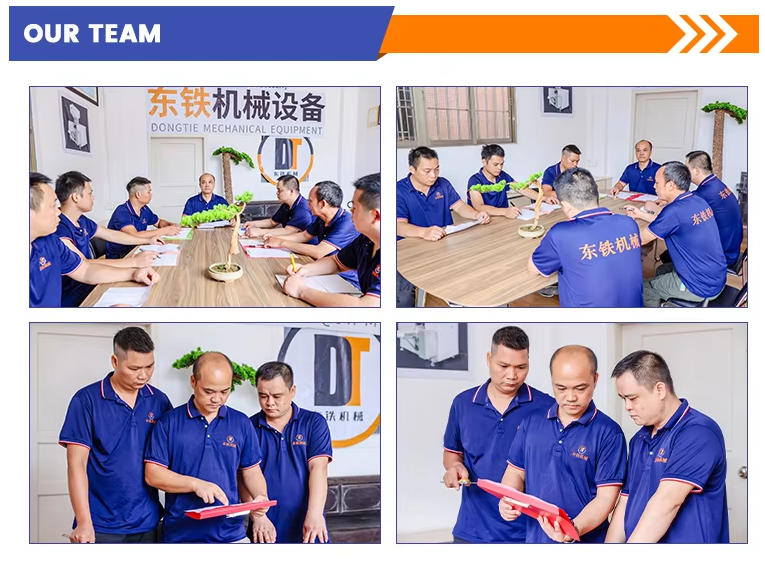
The technical function behind installation, commissioning and remote support for overseas straw production sites.
Two practical notes follow from the record. First, the figure of at least 1,000 straws per minute is a customer-side result from a specific production configuration, not a universal guaranteed rate; the DT-1200 specification lists a wider output range of 3,000–5,500 pcs/min. Second, on commercial terms the manufacturer states a monthly capacity of 20 sets, a lead time of 30 days and a minimum order quantity of one set, with customization available for molds, capacity specifications, control systems and line connection schemes.
How Local Straw Specifications Change the Mold and Forming Setup
Diameter and bend geometry are not adjusted by changing machine settings; they are set by molds. This is the single most important technical constraint in regional application planning, because a plant selling several straw types must plan mold inventory and changeover time, not only machine output.
The forming process works in two stages. An embossing module treats the tube surface to create the flexible corrugation, and a forming module bends and shapes the straw. Dongtie's patented design separates these two modules and makes them independently adjustable, which the manufacturer states reduces maintenance difficulty compared with combined-module designs. Because the modules can be adjusted separately, a wear or alignment issue in one stage does not require the whole forming assembly to be rebuilt.
Tube tolerance is the second technical lever. The manufacturer states that its high-efficiency embossing technology relaxes the tolerance requirements for incoming tube blanks, with the standard straw diameter tolerance controlled at ±0.05 mm, and that a precision feeding unit maintains long-term operating stability. For regional buyers, this matters where tube blanks are sourced locally and dimensional variation between batches is wider than a European or Japanese specification.
Operating control follows the same logic. The PLC system shows real-time machine status, stops automatically on a malfunction and displays a fault code on screen, and includes automatic counting. The manufacturer provides remote video technical guidance for common faults and can arrange on-site training in its own straw production workshop, which runs more than ten full production lines.
Output Comparison Across Production Modes
Output figures in this category are quoted on different bases — per minute, per hour, per machine or per line — and mixing them produces misleading comparisons. The table below keeps each figure with its stated basis.
| Production mode | Published output reference | Basis / source |
|---|---|---|
| Standard automatic straw bending machine | 200–300 pcs/min | Industry engineering specification (KEZHI) |
| High-speed industrial straw machines | 80,000–200,000+ pcs/hr | Dataintelo, 2025 |
| DT-1200 high-speed flexible straw forming machine | 3,000–5,500 pcs/min | Equipment specification |
| Recorded customer operation | At least 1,000 straws per minute | Installation case record |
| Replacement ratio | 1 high-speed machine replaces 5 traditional machines | Installation case record |
Limits, Trade-Offs and Checks Before Ordering
An evaluation that lists only advantages is incomplete. The following boundaries are part of the equipment's documented scope and should be planned for explicitly.
- Mold dependency. Different diameters and bending shapes require custom molds. The mold solution and material compatibility need to be confirmed before order placement, so tooling cost and tooling lead time belong in the project plan, not only the machine price.
- Changeover. Moving between straw specifications requires a mold change. Plants running many sizes should schedule changeover time into production rather than assuming instant switching.
- Supervision and maintenance. The machine runs fully automatically in continuous operation but requires manual monitoring and regular maintenance. It can operate standalone or be connected into a production line.
- Line integration. A complete line involves auxiliary equipment such as a feeder, sealing and cooling unit, packaging machine and conveyor system, with connection schemes customized per project. Control mode and HMI details are confirmed with the supplier.
- Commercial terms. Warranty terms and service response time are recommended to be confirmed before purchase rather than inferred from a general after-sales description.
- Patent scope. The utility model patent is mainly valid in China and does not extend protection in other markets.
- Evidence boundaries. The recorded results come from specific customer installations. They show what the equipment achieved in those configurations and are not a blanket performance guarantee for every plant layout or tube material.
- Export compliance. Straw machines sold into the EU must comply with the Machinery Directive 2006/42/EC and carry the CE mark. EN ISO 12100 is the primary harmonised safety standard for machinery of this type, and EU food-contact rules under Regulation (EC) No 1935/2004 restrict the transfer of constituents to food. Buyers in other regions should confirm applicable local requirements.
What the Market Data Suggests Next
Three third-party signals point in a consistent direction for regional buyers. First, the overall straw machine market is projected to grow at a 5.82% CAGR to USD 1,793.41 million by 2035, which implies steady rather than explosive equipment demand in established production regions. Second, Grand View Research expects paper straw machines to grow at a 15.6% CAGR between 2025 and 2030 under continuing plastic restrictions, a shift that affects the same disposable tableware and packaging buyer base that flexible straw equipment serves. Third, plastic straw machines are still assessed to hold significant market share in regions such as Asia-Pacific and Africa, according to Market Research Future.
Taken together with the 40.1% share attributed to industrial end-users, the practical implication is that supplier selection in this category will be decided less by headline speed and more by tooling engineering, documented installation history and the ability to support a site after commissioning. For factories in Southeast Asia, the Middle East and China planning an upgrade from manual or semi-automatic processes, those three factors determine whether the replacement ratio recorded in existing projects is reproducible on their own floor.
FAQ
What is a high-speed bendable straw forming machine, and how does it differ from a traditional straw bending machine?
It is a continuous production unit that feeds tube blanks, embosses the flexible corrugation and forms the bend in one automated sequence. Traditional bending setups process straws on benches in separate steps and require more units for the same volume; the recorded result from Dongtie installations is that one high-speed flexible straw forming machine replaces five traditional machines. The DT-1200 model is built in stainless steel with a stated power range of 5.5–6.5 kW, working temperature of 100–200 °C and protection grade of IP55.
Which markets have installed these machines, and at what scale?
Recorded installation data covers 60 sets of high-speed flexible straw forming machines supplied to straw factories in Southeast Asia, the Middle East and domestic China, completed within three years, with a Malaysia-based client representing the Southeast Asian market. The manufacturer, Zhongshan Dongtie Machinery Factory, states a 50% export ratio and serves markets in Southeast Asia, the Middle East and Europe from a 2,000 m² site in Zhongshan City, Guangdong Province.
Can one high-speed flexible straw forming machine replace several traditional machines?
In the recorded projects, one high-speed flexible straw forming machine replaced five traditional machines, running at high speed without needle breakage and outputting at least 1,000 straws per minute with consistent finished product quality. That figure reflects specific customer configurations rather than a universal guarantee, and the DT-1200 specification separately lists an output range of 3,000–5,500 pcs/min. Buyers should confirm whether a quotation cites equipment capability or a demonstrated production rate.
Can the machine produce different straw diameters and bending angles to match local specifications?
Yes, by changing the corresponding mold. Diameter and bend geometry are set by tooling rather than by control settings. Custom molds are required for different diameters and bending shapes, and material compatibility and the mold solution are confirmed before order placement. Catalogue configurations include 3.8 mm U-shaped, 5 mm flexible, 6 mm art straw, and 12 mm large-caliber and pointed-tip variants.
What should buyers confirm before ordering a machine for an overseas site?
Four items are decisive: the mold solution and material compatibility for the local straw specification; warranty terms and service response time; the configuration basis of the quoted output rate; and the after-sales scope, which the manufacturer states as installation and commissioning, remote technical support and spare parts supply. Factory inspection includes a pre-delivery test run and functional verification, with inspection reports available on demand. For EU destinations, CE marking under Machinery Directive 2006/42/EC and the food-contact requirements of Regulation (EC) No 1935/2004 apply.
Equipment and case facts in this article are drawn from Zhongshan Dongtie Machinery documentation, including the DT-1200 specification, utility model patent certificate No. 12166973 and the recorded 60-set installation project. Market figures are attributed to Market Research Future, Dataintelo, Grand View Research, Zauba and US customs data, and the General Administration of Customs of China.
The complete equipment parameter set and product list is available in the manufacturer's brochure: Dongtie Machinery product brochure (PDF).