
High-Speed Bendable Straw Forming Machine FAQ: Diameters, Bending Angles & Lead Times
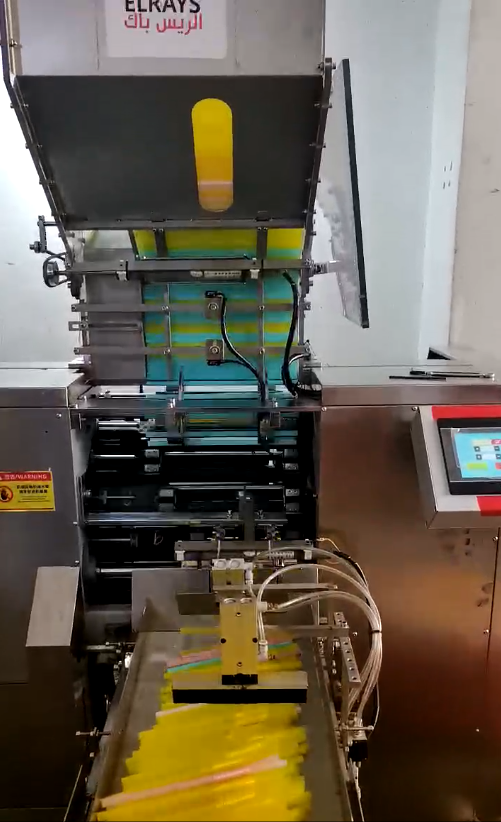
Straw Machine Purchasing Runs on Specification Fit, Not on Brochure Claims
The global straw machine market was estimated at USD 962.55 million in 2024 and is projected to reach USD 1,793.41 million by 2035, a CAGR of 5.82%, according to Market Research Future. That growth figure describes an industry, not a purchase. Individual straw machinery decisions still turn on a narrower set of questions: which straw diameters the line must run, which bending angles the finished product requires, how the machine behaves when it is pushed to high speed, and how long delivery, installation and support will take.
Zhongshan Dongtie Machinery Factory, which operates under the trade name DONGTIE MECHANICAL EQUIPMENT, is a Chinese straw machinery manufacturer based in Xiaolan Town, Zhongshan City, Guangdong. The company builds flexible straw forming machines, small-diameter U-shaped straw forming machines and decorative straw forming machines, and its equipment is installed at straw factories in Southeast Asia, the Middle East and China. This reference article collects the engineering and commercial questions that straw factory buyers raise before ordering a high-speed bendable straw forming machine, and answers them using documented product, capability and project records rather than promotional language.
The Questions Straw Factory Buyers Ask First
Procurement conversations in this category rarely start with price. They start with fit. Straw manufacturing equipment is bought for specific project types: new production line construction, single machine procurement, production line capacity expansion, or equipment replacement inside an existing plant. The machine then has to work inside the straw manufacturing, catering supplies, disposable tableware and packaging machinery industries, where the finished straw is a consumer-facing item with a fixed geometry.
The commercial backdrop shapes how urgently those questions are asked. Dataintelo's 2025 projections place industrial end-users at 40.1% of the straw machine market share, which reflects a market that is increasingly served by dedicated factories rather than by small workshop operations. Mordor Intelligence notes that the U-shaped straw machine segment is growing specifically in connection with the aseptic packaging industry, such as milk cartons — a segment where a 3.8mm U-shaped straw is not a generic product but a component with a defined interface.
That is why the buyer's first list of questions reads like a technical checklist: diameters, bending angles, mold changeover, output stability, needle life, order quantity, lead time and inspection.
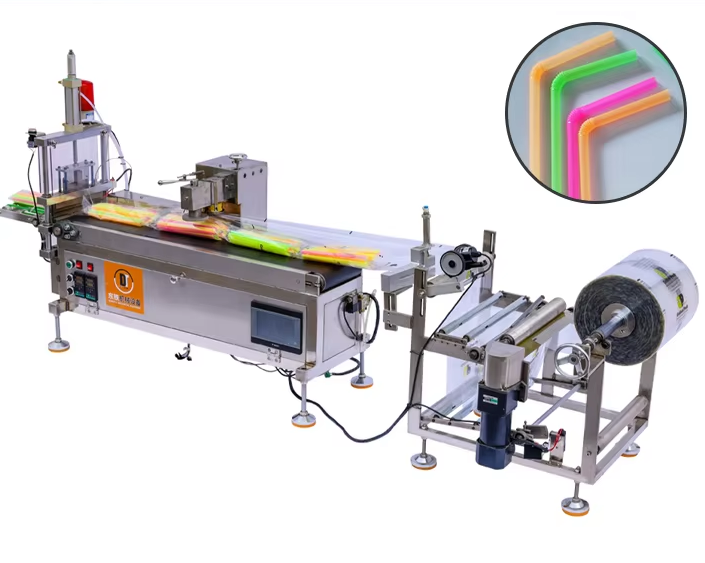
DT-1200 High-Speed Flexible Straw Forming Machine: Documented Specification Snapshot
Before the FAQ answers, buyers need the machine's published parameters on the table. The DT-1200 is the documented high-speed flexible straw forming machine model in this range, and its specification sheet reads as follows.
| Parameter | Documented value |
|---|---|
| Model | DT-1200 |
| Machine type | High-Speed Flexible Straw Forming Machine |
| Main material | Stainless steel |
| Power | 5.5–6.5 kW |
| Output | 3,000–5,500 pcs/min (specification sheet) |
| Working pressure | 1.500–6.000 MPa |
| Working temperature | 100–200 °C |
| Protection grade | IP55 |
| Operation mode | Fully automatic continuous operation; standalone or connected to a production line |
| Applicable industries | Disposable straw manufacturing, catering utensil production, plastic/paper tube and packaging industry, OEM and ODM straw processing factories |
Two numbers in that table deserve attention because they answer questions buyers usually ask separately. The output range is expressed per minute, not per hour, and the protection grade IP55 is paired with a documented operating environment of normal temperature workshop conditions with a stable power supply. In other words, this is a machine specified for continuous mass production indoors, not a general-purpose unit for uncontrolled environments.
Can One Machine Run Different Straw Diameters and Bending Angles?
Yes — by changing the corresponding molds, the machine can manufacture flexible straws with different diameters and bending angles to meet diversified production demands. The mechanism is mold-based rather than fixed-tooling-based, which means one machine platform can serve a multi-specification product catalogue instead of being locked to a single straw size.
In practice, buyers use this capability in two ways. The first is a product-range strategy: a plant that supplies dairy U-shaped straws, general flexible straws and decorative straws from one floor can cover several of those categories from the same machine platform by holding the relevant mold sets. The documented equipment range around this platform reflects that spread, from a 3.8mm U-shaped straw forming machine and a 5mm flexible straw forming machine through 6mm high-speed tube bending and decorative straw machines up to 12mm large-caliber decorative straw forming machines and 12mm pointed-tip tube bending machines.
The second use is specification matching for a single large customer. When a brand owner defines a straw diameter and bend geometry, the straw factory needs a mold set that reproduces that geometry consistently. The equipment range covers that case as well, because molds are part of the order configuration rather than a fixed factory build.
One boundary applies here and should be stated plainly: mold differences are not a software setting. Different straw diameters and bending shapes require their own molds, and material compatibility, raw material specifications and surface treatment standards must be confirmed before order placement. Buyers who plan frequent spec changes should also plan for the mold inventory and changeover workflow that goes with them.
How the Custom-Tuned Mold Solution for Local Straw Specifications Works
Custom-tuned molds are the reason two straw factories ordering the same machine model can still end up with different effective results. The tuning process starts from the finished straw the buyer must deliver — outer diameter, wall thickness, bend angle, bend position and surface appearance — and from the raw tube blanks the buyer intends to feed.
The documented scope of customization covers molds, production capacity specifications, control systems and line connection schemes, with the full customizable scope confirmed with the manufacturer's sales team before the order is finalized. This is a deliberate sequence: the machine frame and drive platform stay standard, while the forming geometry and line interface are configured to the project.
Two documented technical points make that tuning less fragile than it might sound. First, the embossing and forming technology relaxes tolerance limits for tube blanks, with standard straw diameter tolerance controlled at ±0.05mm. Second, the embossing and forming modules are separately adjustable, which greatly reduces maintenance difficulty and gives technicians a way to correct drift on one module without disturbing the other.
Field deployment supports the approach. The project record covers 60 sets installed across multiple straw production facilities over a three-year period, serving Southeast Asian straw factories, Middle Eastern straw factories and domestic Chinese straw manufacturers. The highlighted project characteristics are exactly the custom-tuned mold solution for local straw specifications, stable long-term continuous-run performance, and full-set after-sales technical support for overseas sites.
Why the Machine Can Run at High Speed Without Needle Breakage
High-speed needle breakage is a well-known constraint in straw bending, and it is the single technical objection that most often stalls a project. The machine addresses it through a documented combination of patented forming technology and mechanical design.
The core forming components adopt self-developed patented technology, Patent No. ZL202020756632.1, which the manufacturer describes as solving the chronic high-speed needle breakage problem in the industry. The supporting engineering includes an independent embossing and forming module that boosts production output, a precision feeding unit that keeps operation stable over long runs, and forming needles and molds reinforced with special materials and craftsmanship with a designed service life of over one year.
Control-side measures reinforce the mechanical design. The machine is equipped with a PLC control system that displays real-time operating status, automatically stops on malfunction with fault codes shown on screen, and provides automatic counting. Multiple on-line detectors monitor material shortage, defective forming and length deviation, rejecting unqualified products in real time — which reduces both raw material waste and manual inspection cost. The human-machine design is also aimed at maintainability: lubrication, cleaning and troubleshooting points are accessible from the operator side, reducing dependence on highly skilled technicians.
Industry reference point: engineering specifications published by other suppliers cite typical production speeds of 200–300 pcs/min for automatic straw bending machines, while Dataintelo's 2025 market description places high-speed straw machines in the 80,000 to 200,000+ pieces per hour band for industrial-scale operations. The gap between those two benchmarks is precisely the gap that needle stability, feeding precision and forming-module design have to close.
Output, Replacement Ratio and What "At Least 1,000 Straws per Minute" Means
The DT-1200 specification sheet lists an output range of 3,000–5,500 pcs/min. Project field records state the replacement case more conservatively: one high-speed flexible straw forming machine replaces five traditional machines, runs at high speed without needle breakage, and outputs at least 1,000 straws per minute, delivering higher automatic productivity and consistent finished product quality.
The two figures serve different purposes and buyers should treat them that way. The specification range describes the machine's designed output envelope. The field statement describes what was observed in continuous production at real straw factories, where the effective rate depends on the raw tube blanks, the straw specification being run, and how well the upstream feeder and downstream packaging equipment are coordinated.
This is the most useful way to read the replacement claim. "One machine replaces five" is a statement about equivalent throughput and automation level, not about floor space or headcount alone. It matters most to buyers whose current capacity comes from manual or semi-automatic processes and who are trying to decide whether to add another traditional unit or step up to a single high-speed platform. For a factory running a multi-variety catalogue, the calculation also has to include the mold sets needed to cover the diameters and bending angles that generate the volume.
Procurement Parameters: MOQ, Lead Time, Monthly Capacity and Inspection
Commercial questions in this category are usually answered by four numbers and one process. The documented commercial parameters are straightforward.
| Procurement item | Documented answer |
|---|---|
| Minimum order quantity | 1 set |
| Typical lead time | 30 days |
| Monthly production capacity | 20 sets |
| Quality control | Factory inspection includes a pre-delivery test run and functional verification; factory inspection reports can be provided on demand |
| Customization scope | Molds, production capacity specifications, control systems and line connection schemes; full scope confirmed with the sales team |
| After-sales | Installation and commissioning, remote technical support, spare parts supply |
| Export markets served | Southeast Asia, Middle East, Europe and other global markets |
A one-set minimum order quantity is significant for buyers who are replacing a single aging machine rather than building a new line: it allows a project to start with one unit and validate performance before committing to line-level investment. The 30-day lead time is a typical figure and should be re-confirmed against the final mold configuration, because custom molds are part of the order scope. Monthly capacity of 20 sets is the manufacturer's production ceiling and matters mainly to buyers planning multi-machine rollouts across several plants.
On inspection, the practical point for overseas buyers is that acceptance testing happens before shipment: the machine is test-run and functionally verified at the factory, and inspection reports can be issued on request. For buyers who cannot travel, this is the documented substitute for a pre-shipment visit — and it is worth confirming which straw specifications will be run during that test, so the trial reflects the actual order.
Where the Machine Sits in a Straw Production Line
The forming machine performs full-process manufacturing of flexible straws in a fully automatic continuous operation mode. It can be run as a standalone unit or integrated into a production line, and its documented role is to replace manual or semi-automatic processes and raise the automation level of mass production.
Line integration requires supporting equipment: a feeder, a sealing and cooling unit, a packaging machine and a conveyor system. These must be coordinated to keep continuous operation stable, because a forming machine that outruns its downstream packaging or cooling capacity simply accumulates work-in-progress. Optional downstream modules — a fixed-quantity packaging system and an automatic stacking unit — can be matched to build an integrated full production line.
The documented working environment is a normal-temperature workshop with a stable power supply, raw material feeding and production line connection, suitable for continuous mass production. That specification fits the project types the equipment is built around: new production line construction, single machine procurement, capacity expansion and equipment replacement. The installed base spans Southeast Asian straw factories, Middle Eastern straw factories and domestic Chinese straw manufacturers, which means the configuration has been exercised across more than one market's straw conventions.
Comparison With Traditional Straw Bending Setups — and Documented Limits
Buyers comparing a high-speed bendable straw forming machine against traditional straw bending arrangements should compare like with like. The table below sets out the differences that actually change a project's economics, together with the boundary that applies to each.
| Dimension | Traditional / semi-automatic setup | High-speed flexible straw forming configuration | Boundary to plan for |
|---|---|---|---|
| Specification change | Often requires a separate machine per straw type | One platform runs different diameters and bending angles via mold change | Each diameter and bend shape needs its own mold; material compatibility confirmed before order |
| Throughput | Lower effective rate, manual or semi-automatic feeding | Specification sheet 3,000–5,500 pcs/min; field record of at least 1,000 straws per minute in continuous run | Effective output depends on tube blank quality and coordinated downstream equipment |
| Needle and mold wear | Frequent needle breakage at speed | Patented forming technology, reinforced needles and molds with designed service life over one year | Service life is a design target under specified operating conditions, not a warranty of unlimited use |
| Quality inspection | Manual inspection and rejection | On-line detectors for material shortage, defective forming and length deviation, with real-time rejection | Detectors monitor defined defect categories; they do not replace a buyer's own final product standards |
| Operator dependency | Skilled operators required for adjustment | PLC with real-time status, auto-stop with fault codes, accessible maintenance points | Fault codes help diagnosis; remote video guidance and on-site training remain part of the support plan |
| Scope of supply | Often machine-only | Installation and commissioning, remote technical support, spare parts supply | Warranty terms and response times should be confirmed before purchase rather than assumed |
The most important limitation to state clearly is the mold dependency. A high-speed bendable straw forming machine is flexible across diameters and bending angles, but it is not mold-free. Every distinct straw geometry in a buyer's catalogue needs a corresponding mold set, and the raw material specification and surface treatment standard for each one must be validated with the manufacturer before the order is placed. Factories that sell many small-volume straw variants should therefore evaluate the machine on the total number of mold sets required, not only on machine speed.
A second limitation concerns the machine's environment and integration. The documented operating condition is a normal-temperature workshop with stable power supply, and full-line output assumes that the feeder, sealing and cooling unit, packaging machine and conveyor system are matched to the forming machine's rate. A machine installed without that coordination will not deliver its rated output, regardless of its specification sheet.
A third limitation is informational rather than mechanical: the published commercial terms cover the standard service package, but warranty terms and technical support response times are documented as items to be confirmed before purchase. Buyers comparing quotations should make those terms explicit in the contract rather than treating them as implied.
Market Signals That Affect Straw Machine Project Planning
Three verified market signals are worth weighing alongside the equipment questions.
The first is the overall size and trajectory of the category. Market Research Future estimates the straw machine market at USD 962.55 million in 2024, with a projected value of USD 1,793.41 million by 2035 at a 5.82% CAGR. Grand View Research valued the global paper straw market at USD 2.6 billion in 2024 and projects a 15.6% CAGR for paper straw machines between 2025 and 2030, largely driven by plastic bans — which means machinery demand is being pulled by regulatory substitution as well as by volume growth.
The second is the supply-side concentration of manufacturing. Customs-linked trade data cited by Zauba indicates that China accounts for over 66% of the global export value of flexible straw bending machinery, and China's GACC classification places drinking straw machines primarily under HS code 84778090. For an overseas buyer, that concentration explains both the availability of options and the need for disciplined supplier evaluation on configuration and after-sales terms.
The third is compliance. Straw machines sold into the European Union must comply with the Machinery Directive 2006/42/EC and carry the CE mark, with EN ISO 12100 as the primary harmonized safety standard for machinery. EU Regulation (EC) No 1935/2004 additionally requires that machinery does not transfer constituents to food in quantities that endanger health. Buyers exporting finished straws into regulated markets should confirm that compliance documentation forms part of the order scope, since the machine's conformity status affects the straws it produces.
Future Outlook for Flexible and U-Shaped Straw Production
The direction of travel in this category is toward fewer, faster units rather than more, slower ones. Rising labor costs, tighter workshop space and higher quality-consistency expectations all push in the same direction: a single high-speed platform with mold flexibility, on-line inspection and PLC-based data output is easier to manage than a bank of semi-automatic machines feeding a manual inspection station.
The U-shaped segment illustrates where specification pressure comes from. Mordor Intelligence links the growth of the U-shaped straw machine market specifically to aseptic packaging applications such as milk cartons, where a straw must match a fixed carton interface and a defined diameter. That kind of requirement favors suppliers who can tune molds to a buyer's local specification and validate the result before shipment, rather than suppliers selling a single fixed configuration.
On the equipment side, the pattern that is likely to persist is modularity: separately adjustable embossing and forming modules, optional downstream packaging and stacking modules, and control systems that surface operating data for production management. For buyers, the practical implication is that machine selection should be evaluated as a configurable system — including molds, line interface, inspection regime and after-sales terms — rather than as a single headline speed number.
FAQ: High-Speed Bendable Straw Forming Machine
Can one high-speed bendable straw forming machine produce straws in different diameters and bending angles?
Yes. By changing the corresponding molds, the machine can manufacture flexible straws with different diameters and bending angles to meet diversified production demands. Each distinct diameter and bending shape requires its own mold, and buyers can purchase matched molds according to the specifications they need.
What straw sizes does the broader equipment range cover?
The documented product range includes small-diameter and large-diameter straw equipment: a 3.8mm U-shaped straw forming machine, a 5mm flexible straw forming machine, 6mm high-speed tube bending and 6mm decorative straw forming machines, and 12mm large-caliber decorative straw forming machines and 12mm pointed-tip tube bending machines.
How is a mold customized for a buyer's local straw specification?
Customization starts from the finished straw geometry and the raw tube blanks the buyer intends to feed. Molds, production capacity specifications, control systems and line connection schemes can be customized, with the full scope confirmed before the order is finalized. Because different diameters and bending shapes require different molds, and special standards apply to raw material specifications and surface treatment, material compatibility and the mold solution must be confirmed before order placement.
Why does the machine run at high speed without needle breakage?
The core forming components use self-developed patented technology, Patent No. ZL202020756632.1, described as solving the industry's chronic high-speed needle breakage problem. Supporting design includes an independent embossing and forming module, a precision feeding unit for long-term stable operation, and forming needles and molds reinforced with special materials and craftsmanship with a designed service life of over one year.
What does the machine do when a fault occurs during production?
A PLC control system displays real-time operating status and automatically stops the machine on malfunction, showing fault codes on screen. Automatic counting is included, and multiple on-line detectors monitor material shortage, defective forming and length deviation, automatically rejecting unqualified products in real time.
What output can a buyer expect from one unit?
The DT-1200 specification sheet lists an output of 3,000–5,500 pcs/min. Project field records state that one high-speed flexible straw forming machine replaces five traditional machines, running at high speed without needle breakage and outputting at least 1,000 straws per minute in continuous production. Effective output depends on the straw specification, tube blank quality and coordination with downstream equipment.
Is there documented evidence of the machine running in real straw factories?
Yes. Documented project records cover 60 sets installed across multiple straw production facilities over a three-year period, used by straw factories in Southeast Asia, the Middle East and domestic Chinese straw manufacturers. The highlighted characteristics are the custom-tuned mold solution for local straw specifications, stable long-term continuous-run performance, and full-set after-sales technical support for overseas sites.
What are the minimum order quantity, lead time and production capacity?
The minimum order quantity is 1 set, the typical lead time is 30 days, and the monthly production capacity is 20 sets. Custom molds are part of the order scope, so final lead time should be confirmed against the specific mold configuration.
What inspection is carried out before the machine ships?
Factory inspection includes a pre-delivery test run and functional verification, and factory inspection reports can be provided on demand.
What after-sales support is included for overseas buyers?
Documented services include installation and commissioning, remote technical support and spare parts supply. Remote video technical guidance is available for common faults, and on-site training can be arranged in the manufacturer's own straw production workshop, which is equipped with over 10 full production lines. Warranty terms and support response times are recommended to be confirmed before purchase.
What auxiliary equipment is needed to run a complete straw production line?
The machine requires a feeder, a sealing and cooling unit, a packaging machine and a conveyor system. It can operate standalone or be integrated into a production line, and optional downstream modules such as a fixed-quantity packaging system and an automatic stacking unit can be matched to build an integrated full production line.
What are the main limitations buyers should plan for?
Three limitations are documented. Every distinct straw diameter and bending angle requires its own mold, so the total number of mold sets must be evaluated, not just machine speed. Full rated output assumes coordinated auxiliary equipment and a normal-temperature workshop with a stable power supply. And warranty terms and technical support response times are not fixed publicly — they should be confirmed before purchase.
Reference: The DT-1200 series product brochure, including specification and configuration details, is available for download here: DONGTIE MECHANICAL EQUIPMENT product brochure.