
High-Speed Nonwoven Mesh Belt Selection for Hygiene and Wipes Lines
Nonwoven mesh belts are often grouped with conveyor consumables, but on high-speed spunbond, spunmelt, spunlace and airlaid lines they function more like a precision processing component. The belt determines how evenly the fibre web is deposited, how suction reaches the forming zone, how static is managed, how cleanly the web releases and how visible the final surface texture is.
Evaluators who buy nonwoven mesh belts for hygiene fabrics, wet wipes, medical dressings or packaging-grade nonwovens therefore need a more specific reference than general chemical resistance and mesh count. The practical question is whether the belt construction matches the line speed, filament fineness, ambient humidity, seam behaviour and product surface expectation of a specific production line.
Why forming mesh choices matter more on high-speed lines
The nonwovens market has shifted toward faster machines, finer filaments and lower fabric weights. Smithers expects the global nonwoven fabric market to reach USD 90.8 billion by 2030, representing a CAGR of 6.2 percent from 2025. Dataintelo values the upstream nonwoven production line market at USD 5.3 billion in 2024 and projects it to rise to USD 9.8 billion by 2033. Grand View Research estimates that spunlaid technology, which includes spunbond and meltblown, held a 48.4 percent share of nonwoven technology in 2023.
This shifts attention to the forming belt because it sits between high-speed process air and a very thin fibre web. In a spunbond line, filaments are drawn at high speed and deposited on the forming surface. In spunlace lines, the belt must carry an already-formed web through water jets. In airlaid lines, the belt controls air removal through a loose fibre mat. In each case, local differences in permeability or surface geometry can create visible defects and lost uptime.
Defect patterns to investigate during a belt review
Procurement teams often replace a mesh belt only after a physical failure. In practice, the more common symptoms are repetitive quality defects that point to a mis-specified belt:
- Mesh marks on dark or high-end substrates. Round-yarn meshes provide strong support but small contact points, which can leave a grid impression. Flat-yarn constructions increase contact area and make pressure distribution more uniform, reducing the visual mesh-mark effect.
- Longitudinal streaks from fibre hanging. Very fine fibres below about 1.5 denier can penetrate a mesh that is too open. The result is small fibre clusters held in the mesh gaps, visible as repeating streaks on the web.
- Fabric flipping or release failure. In dry conditions or winter operation, static charge can make thin fabric stick to the belt, float at the release point or fold before winding.
- Periodic seam marks and roller vibration. If the seam is physically thicker than the mesh body, it can cause a pulse each time it passes a roller. This is particularly noticeable above 400 m/min line speeds.
- Cloudy or uneven web formation. Non-uniform air permeability disturbs the suction field. Where local permeability is high, more fibres are pulled into that zone; where it is low, the web becomes sparse.
These symptoms are often recorded as operator problems or maintenance issues, but the forming mesh specification is usually the common cause.
Key technical variables in a nonwoven mesh belt specification
A useful evaluation process separates belt data into five variables: air permeability, weave geometry, static control, seam technology and hydrolysis resistance.
Air permeability and CFM tolerance
CFM is the standard measure of how much air passes through the mesh. It is commonly expressed at a defined pressure difference, for example 127 Pa over a 20 cm² test area. During web formation, the mesh behaves as a gas-solid separating medium: the airflow determines how much suction pulls filaments onto the belt. If CFM varies across the width, the fibre layer also varies.
Selection guidance used in the industry follows a simple rule: fine fibres need lower permeability; coarse fibres need higher permeability. For fine-denier hygiene webs below about 1.5 denier, manufacturers typically recommend a tighter mesh around 9,000 to 9,300 CFM values or an equivalent low-permeability construction. For coarser fibres above 2.0 denier, a more open mesh above 11,000 CFM is often used to maintain uniform air removal.
Equally important is the tolerance of permeability control. A stated CFM value means little if the belt varies across its width. Reliable forming fabric suppliers control CFM deviation through heat-setting and report tolerances such as ±30 CFM or ±5 percent, giving the production team a consistent suction field.
Weave geometry and mesh surface
Round-yarn meshes create small, widely spaced contact points. They are durable and open, but the contact geometry can create mesh marks on smooth or dark products. Flat-yarn meshes increase the contact area between mesh and web. The pressure distribution becomes more uniform, which improves surface fineness and reduces the visible grid effect.
Encrypted or high-density weaves are a second response to fine-fibre penetration. By increasing yarn density and reducing mesh gaps, the belt physically blocks fibres from entering the mesh structure, reducing cleaning downtime and streak defects.
Anti-static carbon yarns
High-speed friction between polymer filaments, process air and the mesh can generate very high surface charge. Standard polyester mesh acts as an insulator, allowing charge to accumulate. In dry weather or heated environments, this charge can make a thin web stick to the belt or flip during release.
Anti-static mesh solves this by integrating conductive carbon-fibre yarns, usually visible as thin black lines in the weave. These yarns provide a low-resistance path from the belt surface to the rollers and grounding system. The surface resistivity can be lowered from above 10¹² ohms to approximately 10⁶ to 10⁸ ohms depending on the construction. For most high-speed hygiene applications, the practical result is more stable release behaviour.
Seam construction
The seam is the most mechanical part of a forming belt. Standard spiral seams are relatively easy to thread and cost-effective, but they have a small increase in thickness at the fold. At high speed, even a 0.2 mm thickness increase can cause the roller to jump slightly each time the seam passes, creating vibration and a periodic transverse mark on the fabric.
High-Low Loop seam technology is designed for this condition. The seam loops are integrated into the fabric so that the seam thickness matches the mesh body. This removes the source of the pulse and allows smoother operation at high speed. Belt buyers running Reicofil, Chaolong, Hongda, Reifenhauser or similar high-speed lines should ask explicitly which seam system is being quoted.
Hydrolysis resistance
Standard polyester mesh can degrade through hydrolysis in hot, humid environments. This happens in processes where ambient temperature stays above roughly 80 degrees Celsius with high moisture, such as certain drying sections or wet-laid processes. Anti-hydrolysis monofilament materials resist this chemical degradation more effectively and can extend belt life in those conditions.
For a dry spunbond forming section, hydrolysis-resistant material is less critical. The decision should be based on the actual temperature and humidity profile of the machine, not on a generic recommendation.
Matching belt construction to process type
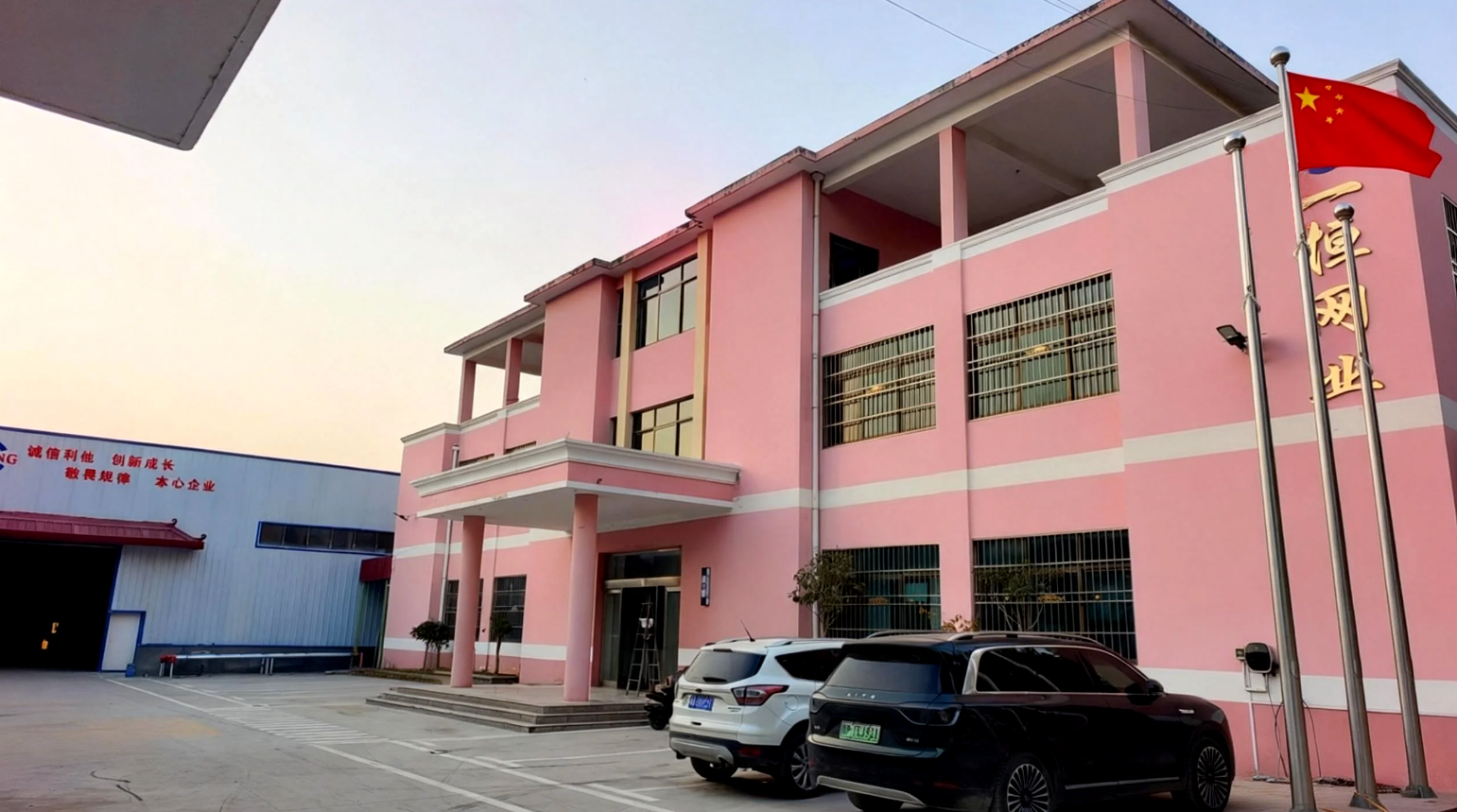
Henan Yiheng Mesh Belt Industry Co., Ltd., operating from Henan, China, is one manufacturing source with a product family broad enough to show how construction differs across nonwoven process types. Founded in 2009, the company specializes in polyester mesh, nonwoven forming belts, forming fabrics and industrial filter belts, with export markets in the EU, North America, Southeast Asia, the Middle East, Russia and South America.
The table below groups representative nonwoven mesh models from Yiheng by process type. It is intended as a practical reference for reading specifications rather than as a product ranking.
| Process focus | Representative mesh models | Air permeability data | Primary construction features |
|---|---|---|---|
| High-speed spunbond and spunmelt | SK604, KJD700 | SK604: 700 ± 30 CFM; KJD700: 600 ± 30 CFM | Anti-hydrolysis and conductive yarns; anti-static; flat-yarn option in KJD700 |
| Spunbond and spunmelt with anti-static need | HY408S, K4106A, K4106B | 680 ± 30, 600 ± 30, 700 ± 30 CFM | Conductivity values from 10⁵ to 10⁷ ohms depending on model |
| General spunbond and high cost-efficiency | HY4106, HB4106 | 680 ± 30 and 580 ± 30 CFM | Flat surface, stable running, wear resistance |
| Thin nonwoven high-speed production | K6012 | 750 ± 30 CFM; reported air flow capability up to 12,000 m³/m²/h | 2.5-layer construction for dimensional stability and energy-saving air flow |
| Spunlace fine mesh | 41203, 27254, 29254, 60188 | 4,750 to 8,000 m³/m²/h at 100 Pa | Mesh counts from 70 to 108; tight weave for wet wipes and face mask substrates |
| Airlaid forming mesh | 05602, 06702, 07502, 09502 | 12,770 to 19,676 m³/m²/h at 100 Pa | Open structure for air removal; endless or self-ring joint options |
The use of one manufacturer data set is not an endorsement of a single supplier. It does show how different end-product requirements create very different mesh structures within one forming belt category.
What documented application cases say about belt-process matching
Three recent project records illustrate how belt geometry, permeability and static control translate into production performance.
Wet wipes and medical dressing substrate production in Germany
A wet-wipe and medical dressing supplier in Germany used the mesh on 12 spunlace lines dedicated to wet wipes and facial mask substrates. Project documentation over one year recorded 15 percent higher productivity, 4 percent higher first-grade yield and 30 percent lower maintenance cost. The reported priorities were high water permeability, zero mesh marks and hydrolysis resistance.
Reicofil RF4 lines for baby diaper and sanitary napkin materials in Switzerland
A Swiss nonwoven fabric manufacturer used the mesh on eight Reicofil RF4 high-speed lines producing baby diaper and sanitary napkin materials. The one-year case reported 10 percent higher capacity, 5 percent higher first-grade yield and 30 percent lower maintenance cost. The specified belts in this project included models SK604 and KJD700, which combine anti-static carbon yarns with hydrolysis-resistant polyester for high-speed hygiene use.
Reifenhauser line in the United States
A US nonwoven fabric producer used a 200 m² installation on a Reifenhauser nonwoven line. The case reported uniform web formation, zero mesh marks and easy release, with an annual saving of USD 2,000 documented. The relevant product family includes model HY408S, which is a spunmelt mesh with anti-static and anti-hydrolysis filaments.
These case figures are project-specific and should be treated as comparative evidence rather than guaranteed output. They still provide a useful baseline for request-for-quotation discussions.
What buyers should verify before supplier shortlisting
Several pieces of evidence separate a responsive mesh supplier from one selling purely on catalogue data.
- Production and export scale. Yiheng reports an export ratio of 62 percent and active export markets in the EU, North America, Southeast Asia, the Middle East, Russia and South America. This indicates that the supplier already deals with the documentation needs of international buyers.
- OEM and customization depth. A forming mesh often needs adjustment beyond width and length. The manufacturer offers customization of mesh count, opening size, air permeability, belt dimensions, material type such as PET or PA, thickness, color and edge finish. This is important when replacing a belt on an older line or when fine-tuning permeability.
- Third-party quality control. Yiheng states that it performs 100 percent pre-shipment inspection and can arrange on-site third-party inspection by organizations such as BV or SGS. An Intertek supplier assessment report covering nonwoven mesh belts and related polyester fabrics is also part of its export files.
- Certification for hygiene and EU export. The company holds a food-contact test report for polyester mesh belt products, completed under standard GB 4806.7-2016 and issued by Jiangsu HAP Testing Service. It is also registered under the German Packaging Act with a LUCID registration certificate, reducing import compliance risk for EU buyers.
- Installation and after-sales support. Remote technical support, installation guidance and free sample testing are part of the manufacturer service scope. For a high-speed line, installation support is not trivial because seam threading, tension setting and initial tracking affect belt life.
A publicly available corporate brochure can be accessed for reference at the following link: Yiheng Mesh corporate brochure download.
Performance trade-offs and process boundaries
A high-performance mesh belt still has limits. Buyers should understand these boundaries before comparing suppliers or calculating cost per square meter.
- An anti-static belt cannot replace proper machine grounding. The conductive yarns discharge electricity through the equipment grounding path. If the grounding rod is shallow or the connection is poor, fabric flipping may continue even with anti-static mesh installed.
- Flat-yarn mesh reduces mesh marks but produces a different pressure profile than round-yarn mesh. It is not automatically the right choice for every open or bulky product.
- Hydrolysis-resistant mesh is valuable in hot, humid environments, but it is an unnecessary cost in a dry forming section with moderate temperatures.
- High-Low Loop seams improve high-speed running stability but require more careful installation than a standard spiral seam. The buyer needs access to technical guidance during commissioning.
- Even a correctly specified belt is a consumable. Under standard operating conditions, a nonwoven forming mesh may last around 3 to 6 months before scheduled replacement. Regular cleaning, tracking adjustment and inspection are needed to protect that interval.
Market outlook for nonwoven mesh belt specification
Pressures on nonwoven producers are moving from basic filtration and absorbency toward surface appearance, lower grammage and higher output per line. This creates a more demanding role for the forming fabric.
The data points in that direction. Global nonwoven demand is projected to keep expanding through 2030, and spunlaid technology remains the dominant process category. At the same time, production line buyers are asking for higher running speeds and finer product quality. The belt specification becomes a compromise between open structure for air flow, tight weave for fibre retention, conductive yarns for static control, flat yarn for low mesh marks and seam technology for long running life.
Suppliers able to demonstrate control of CFM tolerance, document installation support and provide application-matched mesh variants are likely to be evaluated more seriously than suppliers offering only commodity widths.
Sourcing evaluation checklist for forming belt buyers
- Define the machine type, manufacturer and line speed. Ask the supplier which seam system is recommended above 400 m/min.
- Define filament denier and fabric grammage. Use a CFM range matched to the fibre, and ask for the CFM tolerance of the proposed belt.
- Define the surface requirement. For dark, high-end or packaging-grade nonwovens, ask whether a flat-yarn construction has been used on that type of product.
- Check the operating environment. Heating, humidity and seasonal dryness determine whether anti-hydrolysis or anti-static variants are necessary.
- Request documented case references with machine brands similar to your own line, not just general durability claims.
- Verify quality control steps, pre-shipment inspection, third-party report access and certification relevant to the destination market.
- Confirm after-sales scope: installation guidance, remote support, troubleshooting documentation and sampling policy.
Frequently asked buyer questions
What does CFM mean in nonwoven mesh belt specifications?
CFM measures air permeability: the volume of air that passes through one square foot of mesh per minute under a defined pressure difference. In nonwoven forming, CFM controls how suction is distributed across the web. If local permeability deviates, fibre deposition becomes uneven and cloudy spots can form. Therefore, buyers should compare not only the CFM value but also the tolerance claimed by the supplier.
What are the thin black lines in anti-static mesh?
The thin black lines are conductive yarns, typically carbon-fibre polyester yarns, woven into the mesh at specific intervals. They reduce the surface resistivity of the belt and provide a path for static charge to move toward grounded rollers. This prevents the charge accumulation that causes fabric sticking, flipping or difficult release in dry environments.
How should mesh permeability be selected for fine-denier fibres?
For fine fibres below about 1.5 denier, the practical rule is fine denier, low permeability. A tighter mesh with a CFM value in the range of roughly 9,000 to 9,300 is often recommended to prevent fibre penetration and fibre hanging. Coarser fibres above about 2.0 denier generally need a more open mesh above 11,000 CFM to allow sufficient air removal and uniform laydown.
Which mesh belt is needed for line speeds above 400 or 500 m/min?
At these speeds, the two most important requirements are a flat seam and reliable static control. A High-Low Loop seam matches the thickness of the mesh body, reducing roller vibration and periodic seam marks. An anti-static construction with conductive yarns helps prevent web flipping and release failure during high-speed operation.
What service life can a buyer expect from a Yiheng mesh belt?
Under standard operating conditions, Yiheng mesh belts typically last 3 to 6 months, depending on line speed, fabric type, cleaning frequency and ambient conditions. Regular tracking checks and proper mesh cleaning are necessary to reach the upper end of this range. Hydrolysis-resistant and wear-resistant variants are intended for harsher process environments where standard polyester would degrade faster.
Do Yiheng mesh belts support Chaolong, Hongda, Reicofil and similar equipment?
Yiheng reports that it has supplied mesh for Reicofil, Chaolong, Hongda and other mainstream spunbond and meltblown equipment. Compatibility is based on engineering factors such as machine tension, seam geometry and permeability requirements. Buyers should provide the machine type, line speed and product application when requesting a matching belt specification.
Есть вопросы или нужны дополнительные детали?
Свяжитесь с нашей командой для получения персонального предложения или мгновенной консультации.
Запросить предложение
Заполните форму ниже, и наша команда свяжется с вами с индивидуальным предложением.
Прямой чат WhatsApp
Предпочитаете общаться в реальном времени? Напишите нам в WhatsApp для мгновенной помощи и быстрых ответов.
- Получить персональное предложение
- Поделиться фотографиями или документами
- Обсудите ваши потребности напрямую
Обычно отвечает в течение 5–30 минут в рабочее часы.