
High-Speed Straw Machine Qualification: Patent and Test Run
High-Speed Straw Machine Qualification: Patent and Test Run
A qualification file for a high-speed bendable straw forming machine is a documentary chain, not a marketing folder. It should let a buyer connect a named model to a specific patent, a pre-delivery test run, a factory inspection record, a mold configuration, and the acceptance language in the purchase order. For the High-Speed Flexible Straw Forming Machine Model DT-1200 from DONGTIE MECHANICAL EQUIPMENT (Zhongshan Dongtie Machinery Co., Ltd.), a straw machinery manufacturer based in Zhongshan, China, the supplied evidence supports a clear starting point: a Chinese utility model patent (Patent No. ZL202020756632.1; Certificate No. 12166973), pre-delivery test run and functional verification, factory inspection reports available on demand, custom mold tuning, and full-set after-sales support. The same evidence also sets a boundary: a utility model patent is not a CE mark, an ISO certificate, or a food-contact approval.
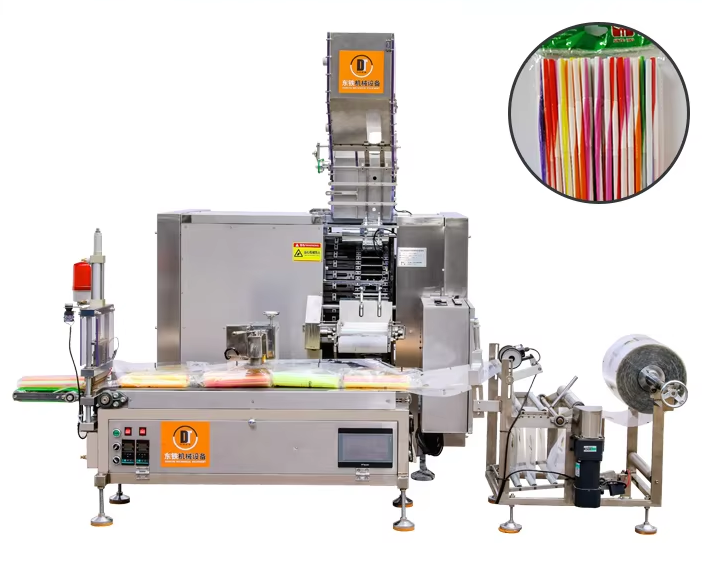
A high-speed bendable straw forming line shown with a packaging system. Qualification records should identify the actual machine configuration, not only the product family.
What the qualification file should prove, and what it should not
The practical purpose of a straw-machine qualification file is to reduce ambiguity at three points: what intellectual property sits behind the forming method, what was checked before delivery, and what the buyer will accept on arrival. These are separate questions. A patent document answers the first. A test run and inspection report answer the second. A purchase order and acceptance protocol answer the third. Combining them into one impression of approval is where procurement files become unreliable.
For the DT-1200, the supplied evidence is specific enough to separate those layers. The machine is covered by a Certificate of Utility Model Patent issued by the China National Intellectual Property Administration, with certification number No. 12166973. The patent number cited for the core forming components is ZL202020756632.1. The certificate is mainly valid in China, while the product can be sold worldwide. That is an intellectual-property statement. It should not be read as a statement that the machine meets every destination-market safety, electrical, or food-contact requirement.
| Document or evidence | What it can establish | What it does not establish by itself |
|---|---|---|
| Certificate of Utility Model Patent No. 12166973 | A registered utility model right in China for the High-Speed Flexible Straw Forming Machine Model DT-1200; patent number ZL202020756632.1 for core forming components | CE marking, ISO certification, food-contact approval, or automatic market access in the destination country |
| Pre-delivery test run and functional verification | That a specific machine was run and checked before shipment against agreed functions and configuration | An independent laboratory result, a long-term reliability guarantee, or a universal performance benchmark |
| Factory inspection report, available on demand | A recorded factory-side inspection with a stated scope, machine identity, date, and results | Third-party certification or a substitute for mandatory import compliance |
| Custom mold record | Which straw diameter, bending shape, material, and mold set were agreed for the buyer's product | That every future straw specification will run without a new mold trial |
| After-sales scope | Installation and commissioning, remote technical support, spare-parts supply, and training scope where supplied | A guaranteed response time unless the warranty and service terms state one in writing |
The patent evidence: a utility model, not a market-access certificate
The patent record is the most concrete document in the file because it has fixed identifiers. The Certificate of Utility Model Patent for the High-Speed Flexible Straw Forming Machine is issued by the China National Intellectual Property Administration. The certificate number is No. 12166973. The issue date is 2020-12-18, and the expiry date is 2030-05-09. The certificate applies to the High-Speed Flexible Straw Forming Machine Model DT-1200. These details should be copied exactly into the qualification file; shortening the patent number or replacing the certificate number with a generic description makes later verification harder.
The technical claim attached to the patent is also specific: the core forming components incorporate patented technology under Patent No. ZL202020756632.1. Dongtie describes this as self-developed domestic patented technology for the forming module. For a buyer, the relevant question is not whether a patent sounds impressive. It is whether the patent evidence matches the machine model being purchased, whether the certificate is current, and whether the supplier can explain which part of the forming process the patent covers. The file should therefore include the certificate copy, the model reference, and a short supplier statement linking the patent to the core forming components.
The jurisdictional limit matters. The supplied certificate is mainly valid in China, while products can be sold worldwide. Those two statements can coexist, but they answer different questions. The first is about the territorial scope of the utility model right. The second is about the commercial sale of the product. Neither statement removes the need to check the import market's machinery safety, electrical conformity, labeling, or food-contact requirements for the finished straw. A buyer who needs a destination-market approval should ask for that approval separately, not accept a utility model certificate as a substitute.
From certificate to machine parameters: what the DT-1200 file should pin down
Patent evidence becomes more useful when it is tied to the machine parameters that the buyer will actually accept. The DT-1200 specification record lists a rated power of 5.5–6.5 kW, a protection grade of IP55, stainless steel construction, a working pressure range of 1.500–6.000 MPa, and a working temperature range of 100–200 °C. The same record states that key wearing parts such as forming needles and molds have a designed service life of over one year. These are the values to attach to the model and serial number in the purchase file.
| Parameter or claim | Supplied value | Why it belongs in the qualification file |
|---|---|---|
| Model | DT-1200 High-Speed Flexible Straw Forming Machine | Prevents a generic product brochure from being used as evidence for a different configuration |
| Rated power | 5.5–6.5 kW | Supports site power planning and confirms the machine variant being quoted |
| Protection grade | IP55 | Gives the buyer a stated enclosure protection reference for the workshop environment |
| Material | Stainless steel | Identifies the construction stated for the machine |
| Working pressure | 1.500–6.000 MPa | Defines the stated operating range to be checked during commissioning |
| Working temperature | 100–200 °C | Defines the stated process window for the forming operation |
| Output statement | Specification lists 3,000–5,500 pcs/min; company also states stable output of no less than 1,000 straws per minute | Requires the acceptance test to state the product, diameter, mold, and running condition rather than using a peak figure as a universal guarantee |
| Diameter tolerance | Standard straw diameter tolerance controlled at ±0.05 mm | Provides a stated tolerance reference for sample approval and incoming checks |
| Wearing parts | Designed service life of forming needles and molds over 1 year | Supports spare-parts planning, subject to actual material and operating conditions |
The output figures need careful treatment. A specification sheet may list a high peak range, while a production statement may use a lower stable figure. For the DT-1200, the supplied product specification lists 3,000–5,500 pcs/min, and the operational statement says the machine steadily outputs no less than 1,000 straws per minute. These are not interchangeable acceptance values. The qualification file should state which figure is being warranted, under which straw diameter, material, mold, and running period. Otherwise, a buyer may compare a peak catalogue number with a stable production requirement and reach a false conclusion.
The same discipline applies to automation features. The product description states that the machine uses a PLC control system to display real-time operating status, stops automatically upon malfunctions with fault codes shown on screen, and provides automatic counting. It also states that multiple on-line detectors monitor material shortage, defective forming, and length deviation, and automatically reject unqualified products. These are useful functional points to verify during the test run. They should be recorded as observed functions on the tested machine, not assumed to be identical on every configuration without checking the order specification.
Pre-delivery test run and functional verification: a buyer-side agenda
The factory inspection process is stated to include a pre-delivery test run and functional verification. A buyer-side agenda should make that statement auditable. The agenda below is not a claim that every item appears in Dongtie's standard report. It is a practical list of what a purchaser can request or witness so that the report connects to the machine being shipped.
- Identify the machine. Record the model, serial number, manufacturing batch where available, and the exact configuration, including the mold set and any optional downstream modules.
- Record the straw specification. State the straw diameter, wall thickness where applicable, length, material, and bending shape. Custom molds are required for different straw diameters and bending shapes, so the test run must name the mold used.
- Run the agreed material. Confirm the polymer or tube blank specification. Material compatibility and mold solutions are to be confirmed before order placement, so the test record should not use a different material without explanation.
- Measure stable output. Run for an agreed sampling period after warm-up. Record total output, rejected pieces, and any stops. Separate stable output from peak or maximum speed.
- Check the forming function. Verify bending angle, shape consistency, and the absence of visible defects on the agreed sample. Keep a first-article sample with the report.
- Verify control and safety responses. Confirm the PLC status display, automatic counting, fault-code display, and automatic stop response where the configuration includes them. Record any alarm or stop event during the run.
- Check rejection and counting. If on-line detectors are part of the ordered configuration, verify the response to material shortage, defective forming, and length deviation. Confirm how rejected pieces are separated.
- Close with signatures and attachments. The record should identify the inspector, date, test conditions, results, and attachments such as the mold drawing and sample photo. Without those, a test run becomes an anecdote.
For overseas projects, the test run has an additional value: it creates a common reference before the machine is packed. The buyer can compare the pre-delivery record with the installation and commissioning report. If the machine behaves differently on site, the two records show whether the change is due to installation, material, mold condition, operator setting, or a genuine machine fault. That is more useful than a general statement that the machine was tested.
Factory inspection report: on-demand evidence with a defined scope
Dongtie's capability record states that factory inspection includes a pre-delivery test run and functional verification, and that factory inspection reports can be provided on demand. The phrase on demand is important. It means the report is available when requested, not that every quotation automatically includes a report with a standardized content list. The buyer should define the request in the purchase process.
A useful request asks for the report's scope before accepting its conclusion. The buyer should check whether the report identifies the specific model and serial number, the inspection date, the test conditions, the mold and material used, the measured output, the observed functions, the defects or stoppages, and the inspector. If the report is a one-page checklist without machine identity or measured results, it is weaker evidence even if it carries a company stamp. If the report includes those details, it becomes a practical acceptance reference.
The report should not be presented as third-party certification. It is factory-side evidence. That distinction protects both sides. A factory inspection report can show that the supplier checked the machine before delivery. It cannot replace an independent test, a destination-market safety approval, or the buyer's own incoming inspection. The qualification file should therefore label it clearly as an internal factory record, with any third-party documents kept in a separate section.
Custom mold tuning and local straw specifications
Straw specifications vary by market and application, and the machine is configured through molds. The supplied application record states that custom molds are required for different straw diameters and bending shapes, and that special standards for raw material specifications and surface treatment apply. It also states that material compatibility and mold solutions shall be confirmed before order placement. This is a qualification issue, not only an engineering detail, because the acceptance sample depends on the mold.
The equipment also supports mold changes to produce flexible straws with different diameters and bending angles, which allows one machine platform to serve more than one product specification. That flexibility should be documented rather than assumed. The qualification file should include the approved mold drawing or mold identifier, the first-article sample, the straw diameter and bending shape, the material used, and the agreed changeover procedure where multiple specifications are planned. If the buyer intends to produce several diameters or shapes, the file should state which molds are included in the order and which are optional.
For local projects, the practical test is simple. Can the supplier show that the mold was tuned for the buyer's straw specification, not only for a generic sample? The answer should be visible in the test-run record. A machine that runs well on one straw size may need a different mold set and retesting for another. That is why the acceptance protocol should tie the result to a specific mold and product sample, not only to the machine model.
How the documents connect to purchasing terms and acceptance
A qualification file has little value if the purchase order does not refer to it. The commercial terms and the quality evidence should be linked at the clause level. The capability record states a minimum order quantity of 1 set and a lead time of 30 days. Those are commercial terms. They belong beside the delivery schedule, not in place of the inspection evidence. Warranty terms and response time are recommended to be confirmed before purchase, so they should be written into the order rather than left to a general after-sales statement.
- Model and configuration: name the DT-1200 and list the included mold set, voltage configuration where applicable, and any optional modules.
- Patent evidence: attach the Certificate of Utility Model Patent No. 12166973 and cite Patent No. ZL202020756632.1 for the core forming components. State clearly that this is IP evidence, not market-access certification.
- Test-run evidence: require a pre-delivery test run record with machine identity, material, mold, output sampling, defects, and inspector. Keep the first-article sample.
- Inspection report: request the factory inspection report on demand and specify that it must identify the shipped machine. Do not accept a generic report for a different serial number.
- Acceptance sample: define the straw diameter, bending shape, material, and tolerance. The stated standard straw diameter tolerance is ±0.05 mm, subject to the agreed specification and material.
- After-sales scope: record installation and commissioning, remote technical support, spare-parts supply, training scope, warranty terms, and response time where agreed.
Acceptance should also include a remedy path. If the test run or incoming inspection shows a deviation, the file should say what happens next: re-test, mold adjustment, replacement of a wearing part, or a joint review of material and settings. This is ordinary procurement discipline, not a suggestion that every machine will need correction. It simply prevents a dispute from being resolved only through recollection.
Application fit and the limits of the evidence
The DT-1200 is positioned for flexible straw production in straw manufacturing, catering supplies, disposable tableware, and packaging-related operations. The working condition is described as a normal-temperature workshop with a stable power supply, raw-material feeding, and production-line connection, suitable for continuous mass production. It can work as a standalone machine or be connected to a line. The qualification file should therefore record the actual installation concept, because a standalone unit and an integrated line have different acceptance boundaries.
Dongtie's case material reports a 60-set, three-year deployment context across Southeast Asian, Middle Eastern, and domestic Chinese straw manufacturers. In that material, one high-speed flexible straw forming machine is reported to replace five traditional machines and to output at least 1,000 straws per minute, with custom-tuned molds and full-set after-sales support for overseas sites. The same material describes the comparison as replacing manual or semi-automatic processes. These are company-reported operating outcomes. They are useful for understanding the intended application, but they are not an independent benchmark.
The 1:5 comparison needs a boundary. Traditional straw forming machines in the supplied market listings are often described in the 200–300 pcs/min band, while high-speed units are listed at higher nominal outputs. A replacement ratio depends on the actual product mix, uptime, reject rate, and line staffing. The qualification file should record the compared machine types, the straw specification, and the measurement period. Without that, the ratio is a planning illustration rather than a verified site result.
The wider Dongtie range covers high-speed flexible straw machines, small-diameter U-shaped straw machines, and decorative straw machines, including product references such as 5 mm flexible, 3.8 mm U-shaped, 6 mm high-speed, 12 mm large-diameter decorative, and 12 mm pointed-tip configurations. These are portfolio references, not proof that one DT-1200 configuration covers every diameter or shape. Buyers should match the model and mold set to the intended product rather than selecting from the product-family name alone.
Market context: documentation as part of the buying decision
A Market Research Future report dated 24 August 2026 estimated the global straw machine market at USD 962.55 million in 2024 and projected it to reach USD 1,793.41 million by 2035 at a compound annual growth rate of 5.82%. That is a commercial research estimate, not a validation of any individual supplier. Its practical relevance is narrower: as the equipment market expands, buyers need comparable, model-specific evidence rather than general claims.
Growth estimates do not tell a buyer whether a particular machine will meet a particular straw specification. They do explain why documentation becomes a competitive signal. A supplier that can produce a patent certificate, a test-run record, an inspection report, and a mold-specific acceptance sample is easier to evaluate than one that offers only a brochure. The buyer still has to check the documents, but the evaluation starts from evidence rather than assertion.
After-sales support as practical qualification evidence
For overseas projects, after-sales support is part of qualification because it affects how a fault is handled after installation. Dongtie's capability record lists installation and commissioning, remote technical support, and spare-parts supply. The company profile adds remote video technical guidance for common faults and on-site training in its own straw production workshop, which is described as having more than 10 full production lines. These are relevant service facts, but warranty terms and response time still need to be confirmed before purchase.
The qualification file should record the service scope in plain terms. Who installs and commissions the machine? What remote support is available, and through which channel? What spare parts are recommended for the first year? What training is included, and where does it take place? If the buyer needs a specific response-time commitment, it should be written into the order. A general statement of full-set after-sales support is useful context, but a service-level commitment is stronger evidence.
Future outlook for straw-machine qualification
The practical outlook is not that every buyer will demand the same file. It is that the file should become more machine-specific. A patent certificate is most useful when it names the model. A test run is most useful when it names the mold, material, and output condition. An inspection report is most useful when it names the serial number and the inspector. An after-sales statement is most useful when it names the service scope and the terms that can be enforced.
For the DT-1200, the supplied evidence already supports that direction. The patent identifiers are fixed, the model is named, the test-run and inspection process is stated, the mold requirement is documented, and the after-sales scope is described. The next step for a buyer is to turn those elements into purchase-order language and an acceptance record. That is a more reliable route than treating a patent certificate as a universal approval or treating a catalogue output figure as a guaranteed production result.
Reference resource: A public company brochure is available for download from the supplied link: DONGTIE company brochure (PDF).
FAQ
Does the utility model patent certificate certify the DT-1200 for export markets?
No. The Certificate of Utility Model Patent No. 12166973 is an intellectual-property document issued by the China National Intellectual Property Administration. It is mainly valid in China, while the product can be sold worldwide. It does not by itself establish CE marking, ISO certification, food-contact approval, or compliance with the destination market's machinery and electrical requirements. Those should be checked separately for the specific market and configuration.
What documents should a buyer request for a pre-delivery qualification file?
A practical file should include the patent certificate copy with Patent No. ZL202020756632.1 and Certificate No. 12166973, the model and serial-number record, the pre-delivery test run and functional verification record, the factory inspection report available on demand, the agreed mold drawing or identifier, the first-article sample, and the after-sales scope. The buyer should check that every document refers to the same machine configuration.
Which parameters should be checked during the test run?
The test record should identify the actual straw diameter, material, mold, and bending shape, then record stable output over an agreed period, rejects, stops, and the observed functions. The DT-1200 specification lists 5.5–6.5 kW rated power, IP55 protection, 1.500–6.000 MPa working pressure, 100–200 °C working temperature, and a stated standard diameter tolerance of ±0.05 mm. Output should be recorded as tested stable output, not only as a peak catalogue figure.
How do custom molds affect acceptance of the machine?
Custom molds are required for different straw diameters and bending shapes. Material compatibility and the mold solution should be confirmed before order placement. Acceptance should therefore refer to the approved mold identifier, the first-article sample, the straw specification, and the material used. A machine that passes on one mold and straw size should not be assumed to pass on another without a new sample check.
Can the factory inspection report replace third-party certification?
No. The factory inspection report is factory-side evidence. It can record the pre-delivery test run, functional verification, machine identity, and inspection results. It does not replace an independent laboratory test, a destination-market safety approval, or the buyer's incoming inspection. The report is most useful when it is specific to the shipped machine and is kept alongside any separate compliance documents.
Есть вопросы или нужны дополнительные детали?
Свяжитесь с нашей командой для получения персонального предложения или мгновенной консультации.
Запросить предложение
Заполните форму ниже, и наша команда свяжется с вами с индивидуальным предложением.
Прямой чат WhatsApp
Предпочитаете общаться в реальном времени? Напишите нам в WhatsApp для мгновенной помощи и быстрых ответов.
- Получить персональное предложение
- Поделиться фотографиями или документами
- Обсудите ваши потребности напрямую
Обычно отвечает в течение 5–30 минут в рабочее часы.