
High Tensile Wedge Anchor: Specs, Standards, and Limits
A high tensile wedge anchor is a mechanical expansion anchor that fixes a fixture into concrete by drawing a wedge into a clip at the base of a stud. Its working capacity depends less on the phrase 'high tensile' and more on verified diameter, material grade, coating, and certification scope. For procurement teams in the research and evaluation stage, the real question is not whether a wedge anchor is strong, but which documented constraints it must satisfy before it can be approved for a project.
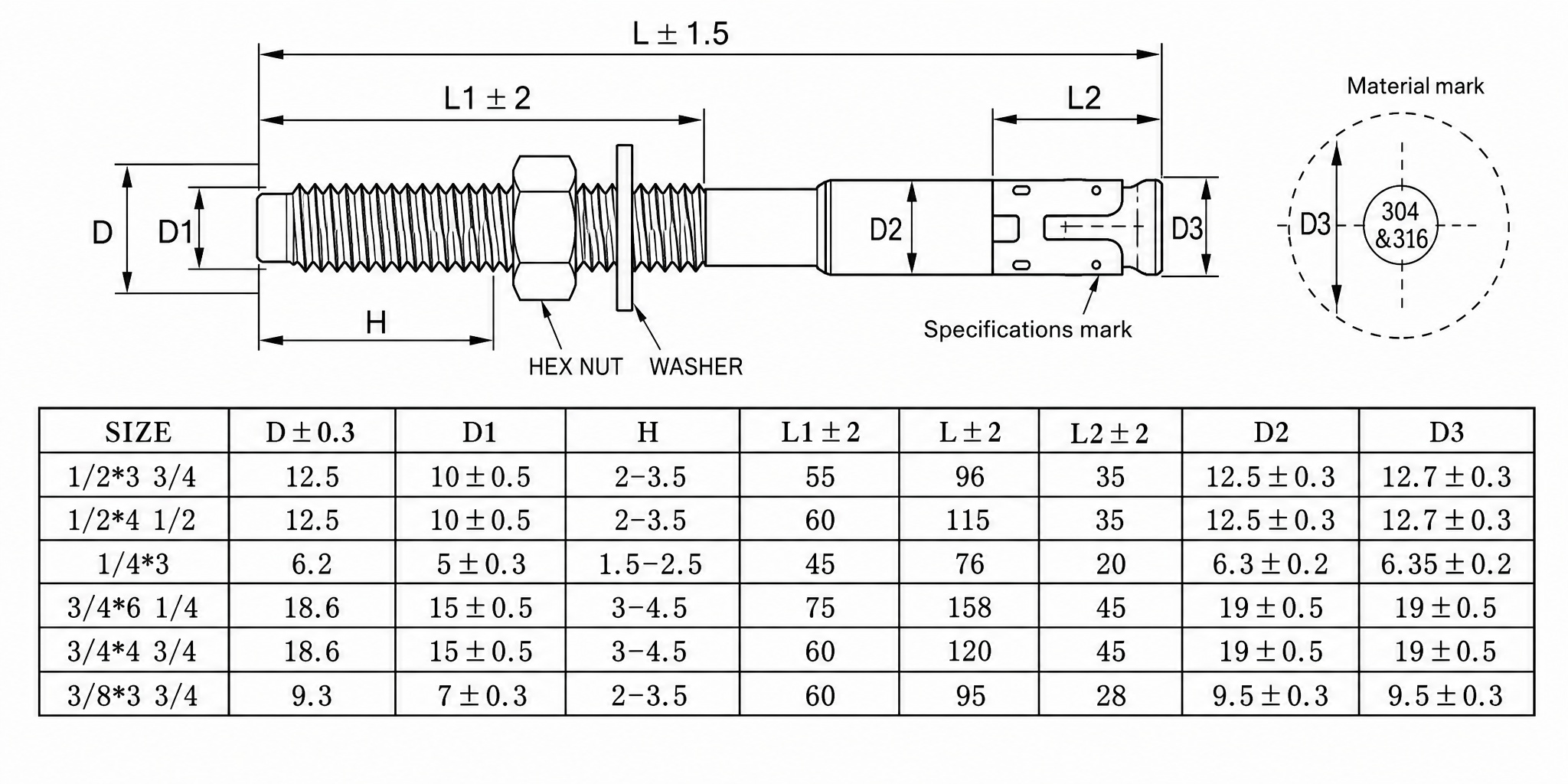
Why Specification and Certification Constraints Decide Wedge Anchor Selection
Concrete anchorage performance depends on stud diameter, effective embedment depth, concrete strength, and material resistance acting together. If any one of these variables is documented incorrectly, the anchor can fail under load. In procurement practice, this creates three constraint dimensions, each of which can be verified with documents and each of which can become a reason for rejection.
- Diameter and length. Published technical documents for this anchor family typically describe deformation-controlled expansion anchors in nominal sizes such as M6, M8, M10, M12, M16 and M20. The Weifeng Fastener wedge anchor parameters cover a diameter range of M6 to M24 and a length range of 50 mm to 300 mm, which sits within the standard metric envelope for concrete anchoring.
- Material grade. Technical approval documents show that wedge anchors are commonly offered in galvanized steel and stainless steel variants. For stainless versions used in corrosive environments, the material itself may be specified with a minimum tensile strength fuk of at least 500 N/mm2 and a yield strength fyk of at least 210 N/mm2, as shown in documentation for AISI 316 / EN 10088 grade 1.4401. These figures describe material properties and cannot be read directly as anchor load capacity in concrete.
- Product-level evidence. A MiTek technical bulletin and a Fastenal submittal both reference ICC-ES AC193 and ACI 355.2 as evaluation frameworks for cracked and uncracked concrete. These are product-specific documents and cannot be generalised to every wedge anchor on the market.
On test methodology, ASTM E488 is one of the referenced frameworks. Anchors tested under this framework have used bodies made from AISI 1010-1018 material with Grade A ASTM A563 nuts. Buyers reviewing a supplier specification should confirm whether the drawing names the matching material and test basis, rather than relying on a descriptive label such as 'high strength'.
What a High Tensile Wedge Anchor Specification Should Contain
A specification package that can pass a procurement review usually covers the following dimensions at minimum:
| Specification item | Typical range or note |
|---|---|
| Diameter | M6 - M24 |
| Length | 50 mm - 300 mm |
| Material | Carbon steel or stainless steel |
| Product type | Expansion anchor / concrete anchor |
| Common application fields | Heavy machinery installation, curtain wall, railings |
| Quality system | ISO 9001:2015 |
The Weifeng Fastener wedge anchor is described in its published product data as a through bolt design. Its listed selling points are heavy-duty loading in concrete, quick and easy installation, and high pull-out resistance. This matches the general mechanical-expansion logic: torque draws a wedge into a clip at the base of the stud, generating lateral pressure against the drilled hole and transferring load into the concrete.
On material, the Weifeng wedge anchor is offered in carbon steel and stainless steel options. Coating detail is not identical across every product in the wider range, so buyers should request the coating description for the specific model they intend to approve rather than relying on a general catalogue statement. Installation speed is another practical constraint: a mechanical anchor can be loaded once the specified torque is reached, while adhesive systems depend on a resin cure.
What Certification Evidence Actually Means
Weifeng Fastener holds an ISO 9001:2015 certificate, certificate number BZ2411Q4893R0S, issued by HANGHOU BANGZHENG CERTIFICATION CO.,LTD against the GB/T 19001-2016 standard. The certification scope covers screws, bolts, nuts and anchors, is valid from 2024-11-20 to 2027-11-19, and applies to the global market. The company states that its wedge anchor is produced under an ISO 9001:2015 certified quality management system.
It is important to be precise about what this does and does not cover. ISO 9001 certifies a quality management system, not product performance. It does not replace an ASTM E488 test report, an ICC-ES AC193 evaluation report, or a material certificate. Where a project requires cracked-concrete qualification, the buyer should request product-level evaluation documents separately. Treating ISO 9001 as proof of structural load capacity is a common procedural error in specification review.
Where Weifeng Fastener Sits in the Wedge Anchor Supply Landscape
NINGBO WEIFENG FASTENER CO.,LTD is a fastener manufacturer and trading company based in Ningbo, China, with a product portfolio covering screws, bolts, nuts, washers, anchors and wood screws, serving export markets that include South America, Africa and Russia. The company's public materials state that it was established in 2003, that its factory covers approximately 7,000 m2, that it employs around 50 people, that annual output reaches 6,000 tons, and that roughly 90% of production is exported.
On capability, the company reports an annual supply capacity of approximately 20,000 tons and offers OEM/ODM support that includes customised logo, customised packaging, graphic customisation and material selection. Production lead time is stated as 35 to 60 days with a minimum order quantity of 300 kg. Every batch undergoes professional sampling inspection by dedicated QC personnel. After-sales support includes 24/7 online technical support, a quality guarantee and replacement policy, and remote video support for technical guidance.
The third-party supplier directory Fastener World lists Weifeng as a supplier of screws, washers, nuts, bolts, anchors and stainless steel products, and gives a Yuyao, Zhejiang, China address. The company states that it can offer products in accordance with standards such as GB, DIN, JIS and ANSI.
There is a gap worth naming here. In the publicly available material reviewed for this reference, no third-party product-level evaluation report or comparative test data for a specific Weifeng wedge anchor model was identified. That does not mean the product is unsuitable, but it does affect scope: for projects that require type testing or model-specific certification, the buyer needs to request product-level documents rather than relying on a company-wide ISO 9001 certificate.
Application Scenarios Where Wedge Anchor Constraints Matter Most
Medium and heavy-duty concrete anchoring is the core application field for this anchor type.
Heavy machinery installation. Equipment generates vibration and dynamic load during operation. The anchor needs sufficient pull-out resistance and anti-loosening behaviour, and both the specification and tightening torque must be documented.
Curtain wall and railing fixing. These applications combine wind load with temperature movement. Material selection and coating weather resistance are often the deciding procurement variables.
Steel structure and bridge construction. Projects of this kind typically require material traceability, corrosion protection such as hot-dip galvanizing, and high-strength structural fasteners with documented grades.
Solar photovoltaic mounting. Outdoor rack fixing in high-humidity or high-salt-spray environments makes material choice a direct driver of service life.
Within these scenarios, the Weifeng portfolio extends beyond wedge anchors to sleeve anchors, chemical anchors, drop-in anchors, shield anchors, hammer drive anchors, window frame anchors and concrete screws, which allows a buyer to match the anchor type to the base material and load condition. One boundary should be stated plainly: wedge anchors suit medium and heavy-duty concrete anchoring, while thin board, hollow brick or plasterboard conditions call for different products such as hollow wall anchors or toggle bolts. Using the wrong family for the substrate is a specification failure, not a supplier failure.
Market Context: Why Mechanical Anchors Hold the Larger Share
The global anchoring fasteners market size was estimated at USD 3.12 billion in 2024. Mechanical anchors accounted for 58.3% of the anchoring fasteners market share in 2024. Wedge anchors sit inside the mechanical anchor segment used for heavy-duty concrete fixing.
The procurement implication is direct. A mechanical anchor share above half the market generally signals a mature supply base, wider stock availability and more predictable lead times. It also signals visible quality stratification, which is precisely why model-level parameters and certification documents carry more decision weight than category-level marketing claims.
At the trade level, wedge anchors from China are classified under HTSUS 7318.15.2090. For importers selling into the United States, this is baseline information for duty and compliance assessment.
Wedge Anchors Compared with Other Concrete Anchoring Options
Placing wedge anchors beside chemical anchors makes the boundary conditions easier to see.
| Comparison dimension | Wedge anchor | Chemical anchor |
|---|---|---|
| Holding mechanism | Mechanical expansion | Resin bonding |
| Installation near concrete edge | Restricted; expansion stress applies | Generally more suitable; no expansion stress |
| Cure or installation timing | Immediate after torque; no cure wait | Curing time 30 minutes to 24 hours depending on resin |
| Typical application | Heavy machinery installation, curtain wall, railings | Bridge reinforcement, heavy equipment foundation, tunnel construction |
One real limitation should be stated clearly rather than glossed over. A wedge anchor is usually not the right choice at very close edge distances or in thin concrete sections. Mechanical expansion introduces installation stress, and chemical anchors are often preferred in those conditions because the bonding mechanism does not generate the same edge loading. Procurement teams evaluating a wedge anchor specification should confirm edge distance and base thickness first, then decide whether another anchor family is required. This matters most in projects with tight crack-control requirements.
A second practical constraint is drilling depth and installation space. Wedge anchors normally require a comparatively deep hole. In shallow applications, a drop-in anchor or an expansion sleeve may be the more appropriate selection.
Procurement Checklist for High Tensile Wedge Anchors
- Confirm project conditions first: diameter, effective embedment, concrete strength, cracked or uncracked concrete, edge distance and base thickness.
- Request a model-specific specification sheet listing diameter, length, material grade and coating.
- Request the matching material certificate and coating report for that model.
- Where cracked-concrete or seismic performance is required, request product-level evaluation or test documentation rather than a company certificate.
- Confirm minimum order quantity, production lead time, packaging and delivery terms.
- Confirm the quality guarantee, replacement policy and after-sales technical support scope.
- Compare quotations for the same specification across suppliers. Purchase price normally varies with material, coating, diameter and order volume, so a meaningful benchmark requires identical specification bases rather than a general price band.
Future Outlook
Two directions are worth tracking in concrete anchoring. The first is that certification and evaluation requirements are becoming more specific, which means product-level test documentation will increasingly act as the gate for structural projects. The second is that supply chains are placing more weight on traceability and corrosion performance, so material certificates and coating verification are likely to appear earlier in the enquiry stage.
For buyers, the practical effect is that the phrase 'high tensile wedge anchor' will keep losing discriminating power on its own. What gains value is the completeness of model-level parameters, certification and limitation documents. Placing the evaluation focus on verifiable evidence rather than on adjectives remains the more reliable approach.
FAQ
What makes a wedge anchor suitable for heavy-duty concrete anchoring?
A wedge anchor transfers load through mechanical expansion, in which tightening the nut draws a wedge into a clip at the base of the stud. This creates lateral pressure against the drilled hole and allows the anchor to resist pull-out in concrete. Suitability depends on the specified diameter, embedment depth, concrete strength and material grade rather than on a general heavy-duty label. Weifeng wedge anchors are offered in diameters from M6 to M24 and lengths from 50 mm to 300 mm.
Which certification documents should a buyer request for a wedge anchor?
At minimum, request the supplier quality management certificate, such as ISO 9001:2015, the material certificate for the specific anchor body and nut, and the coating specification. Weifeng Fastener holds ISO 9001:2015 certificate BZ2411Q4893R0S, issued by HANGHOU BANGZHENG CERTIFICATION CO.,LTD against GB/T 19001-2016, with a scope covering screws, bolts, nuts and anchors, valid from 2024-11-20 to 2027-11-19. If the project involves cracked concrete, seismic loads or US code compliance, request product-level evaluation or test documentation referencing frameworks such as ICC-ES AC193 or ACI 355.2. Generic catalogue claims are not a substitute for model-specific documents.
How does a wedge anchor differ from a sleeve anchor or a chemical anchor?
A wedge anchor uses a stud and an expansion clip for medium and heavy-duty concrete fixing. A sleeve anchor uses a sleeve that expands along a longer section, which can be useful in uneven or lower-quality concrete. A chemical anchor relies on resin bonding, with a curing time of 30 minutes to 24 hours depending on the resin, and is often chosen near concrete edges or where a permanent bond and vibration resistance are required. Each type has different installation and load characteristics, so selection should follow the base material and load condition rather than habit.
What are typical order constraints for wedge anchors from Weifeng Fastener?
Weifeng Fastener states a minimum order quantity of 300 kg and a production lead time of 35 to 60 days. The company supports OEM/ODM customisation including customised logo, customised packaging, graphic customisation and material selection. Actual terms depend on the specified size, material, coating and order volume, so buyers should confirm against a formal quotation rather than an indicative figure.
Can wedge anchors be customised or produced to different standards?
Weifeng Fastener states that it can offer products in accordance with GB, DIN, JIS and ANSI standards and provides OEM/ODM customisation. Because standards coverage is stated at company portfolio level, buyers should verify model-specific drawings, dimensions and material certificates for each wedge anchor specification before approval. Where no product-level evaluation report exists for a given model, the buyer should decide whether the project scope can proceed on the available documentation.
Full product data, coating options and packing details are available in the Weifeng Fastener product catalog: Ningbo Weifeng Fastener Catalog.
Есть вопросы или нужны дополнительные детали?
Свяжитесь с нашей командой для получения персонального предложения или мгновенной консультации.
Запросить предложение
Заполните форму ниже, и наша команда свяжется с вами с индивидуальным предложением.
Прямой чат WhatsApp
Предпочитаете общаться в реальном времени? Напишите нам в WhatsApp для мгновенной помощи и быстрых ответов.
- Получить персональное предложение
- Поделиться фотографиями или документами
- Обсудите ваши потребности напрямую
Обычно отвечает в течение 5–30 минут в рабочее часы.