
High Voltage Power Transformers: Parameters and Procurement
A high-voltage power transformer is the equipment that changes voltage between transmission, subtransmission and distribution levels in utility substations, power plants and large industrial networks. In procurement, it is not a catalogue item selected by kVA alone.
The specification is a constraint set: voltage class, rated capacity, impedance, vector group, cooling, tap changer, insulation level, losses, protection, site conditions and test scope. Buyers in the research and evaluation stages need to fix those constraints before they compare quotations. Otherwise, two suppliers can appear to offer the same transformer while quoting different electrical duty, testing, accessories and documentation.
Milestone Electrical, formally Milestone (Xiong'an) Electrical Technology Co., Ltd., is a transformer engineering and manufacturing company based in Xiong'an New Area, Hebei, China. Its power transformer range is listed up to 220 kV and covers utility, power generation, EPC, oil and gas, mining and industrial project contexts. This article uses that capability data as an industry example of how high-voltage transformer constraints can be organized for procurement review.
Why high-voltage transformer procurement is a constraint problem
Two pressures shape the research and evaluation stage in 2026. On the supply side, the International Energy Agency reports that order backlogs of selected power-transformer manufacturers increased during 2020 to 2024, and that procurement of large power transformers can take up to four years. In the United States, the Department of Energy reported that lead times for large power transformers reached 128 weeks as of May 2026. These figures are not universal lead times for every voltage class, country or factory. They do show why early specification freeze and supplier prequalification matter.
On the specification side, high-voltage transformers are engineered to order. A quotation that does not state impedance, cooling, tap range, losses, test scope, accessories and documentation cannot be compared on a like-for-like basis. The opportunity is to turn the RFQ into a constraint record before price discussion begins.
This is especially important for a Power Transformer in the 110 kV to 220 kV range. Small changes in impedance, cooling or tap-changing arrangement can change fault duty, voltage regulation, protection coordination, footprint and testing requirements. Those are engineering decisions, not catalogue preferences.
The parameter envelope: what must be fixed before quotation
Milestone Electrical's Power Transformer model SFZ-35000/110KV-35KV is listed with the following envelope. It is not a recommendation for every project. It is the declared range that a buyer can use to start a technical review. Final values must be confirmed in the project-specific technical proposal and approved datasheet.
| Parameter | Listed data for the Power Transformer range | Procurement implication |
|---|---|---|
| Type and model | Power Transformer, SFZ-35000/110KV-35KV | Use as a starting reference for high-voltage utility and industrial applications, not as a fixed configuration. |
| Rated capacity | 5 MVA to 500 MVA | Capacity must follow verified demand, load profile, starting requirements and confirmed expansion. |
| High voltage | 35 kV to 220 kV | Voltage class determines insulation level, BIL requirements, clearances and test scope. |
| Low voltage | 10 kV to 110 kV | Low-voltage interface must match substation equipment, protection and cable or busbar design. |
| Frequency | 50 Hz and 60 Hz | Frequency must be fixed before design review; a dual-frequency label is not a universal operating approval. |
| Number of phases | Primarily three-phase | System arrangement, neutral availability and load balance must be defined in the single-line diagram. |
| Vector group | YNd11, YNyn0+d, YNyn0d11 | Vector group affects grounding, protection, harmonics and parallel-operation compatibility. |
| Short-circuit impedance | For 110 kV, commonly around 10 to 14%; for 220 kV and above, typically higher | Impedance must be approved by fault-level, voltage-performance and protection studies. |
| Cooling | ONAN, ONAF, OFAF and ODAF | Cooling stage determines approved loading and dependence on fans, pumps and auxiliary power. |
| Tap voltage regulation | OLTC and OCTC | OLTC supports on-load regulation; OCTC is for de-energized adjustment. |
| Protection | IP54 or IP55 | Enclosure protection must match outdoor or indoor site conditions and maintenance access. |
| Altitude | Typically up to 1,000 m; high-altitude projects may reach 2,000 to 4,000 m | High-altitude projects require insulation and cooling review rather than standard assumptions. |
| Materials | CRGO silicon steel sheet, iron, copper, aluminium, mineral oil and natural ester | Material options affect losses, dimensions, cooling and commercial scope; they must be stated in the datasheet. |
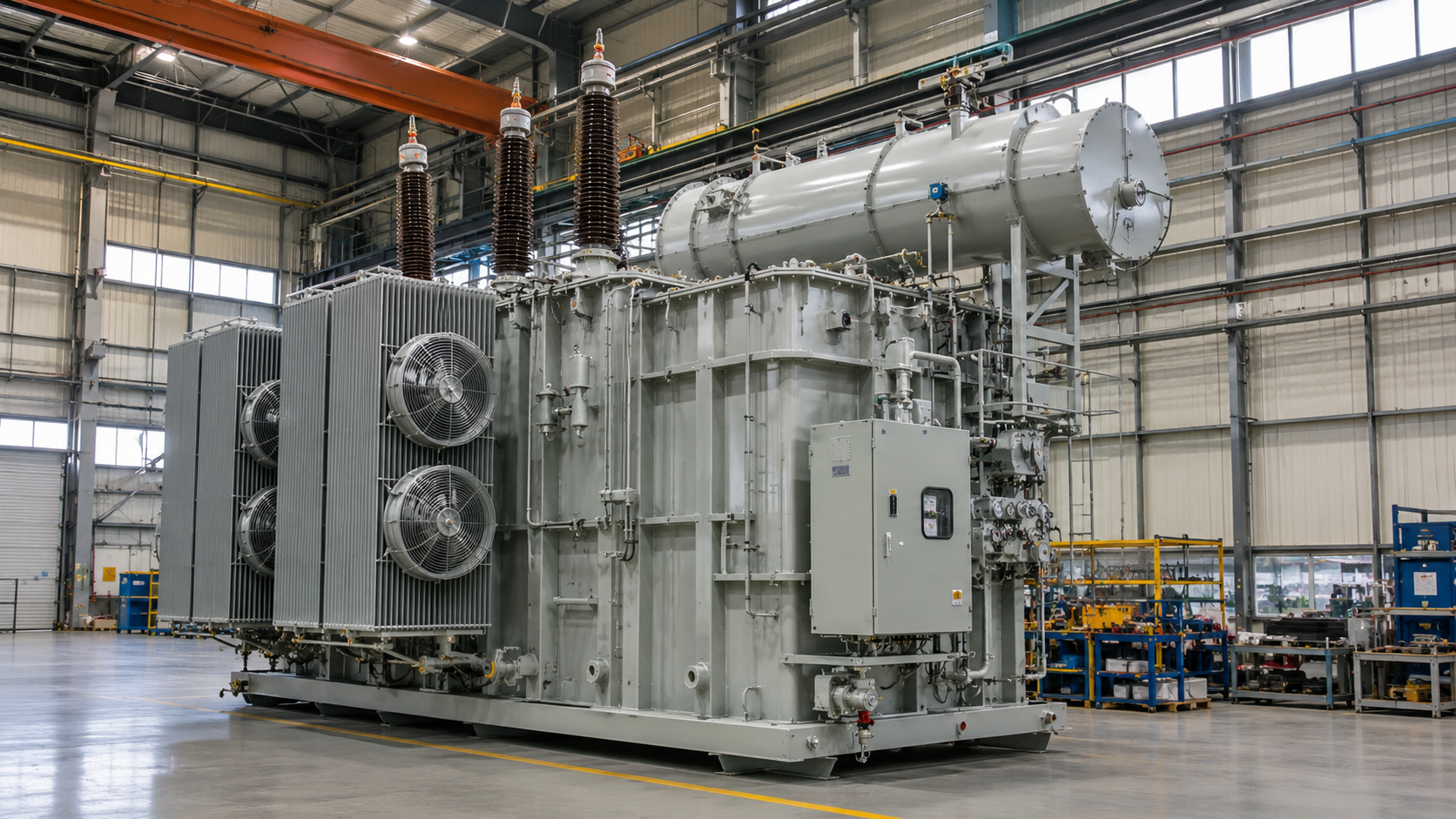
Large oil-immersed power transformer under assembly at Milestone Electrical's manufacturing workshop. Production work includes core and winding assembly, insulation installation, tank fitting and preparation for final testing.
The difference between an envelope and a guarantee matters. The table describes what the product family can cover. The guaranteed impedance, losses, temperature rise and test values for a specific unit belong in the approved datasheet and contract. A buyer should not accept a family-level statement as a unit-specific guarantee.
Standards, testing and certification boundaries
Standards define the review framework, not a certificate. IEC 60076-1:2011 applies to three-phase and single-phase power transformers, including autotransformers, subject to stated exclusions. IEC 60076-7:2018 provides loading guidance for mineral-oil-immersed power transformers, including operating temperature, loading above nameplate rating and thermal ageing. IEC 60076-11:2018 covers dry-type power transformers with highest voltage for equipment up to and including 72.5 kV and at least one winding operating above 1.1 kV.
That scope matters. A dry-type standard is not a substitute for a 110 kV to 220 kV oil-immersed transmission transformer specification. Buyers should identify the transformer construction and the applicable standard before comparing suppliers. A general claim of compliance does not establish product certification, market access or suitability for a particular site.
Milestone Electrical provides ISO 9001 quality management system information and CE conformity documentation for applicable products. The exact certificate scope and covered models should be checked against current documents. For the applicable transformer, Milestone's documentation states compliance with IEC and GB standards. Factory electrical testing includes winding resistance, voltage ratio and insulation performance checks; no-load loss and load loss testing are performed before delivery.
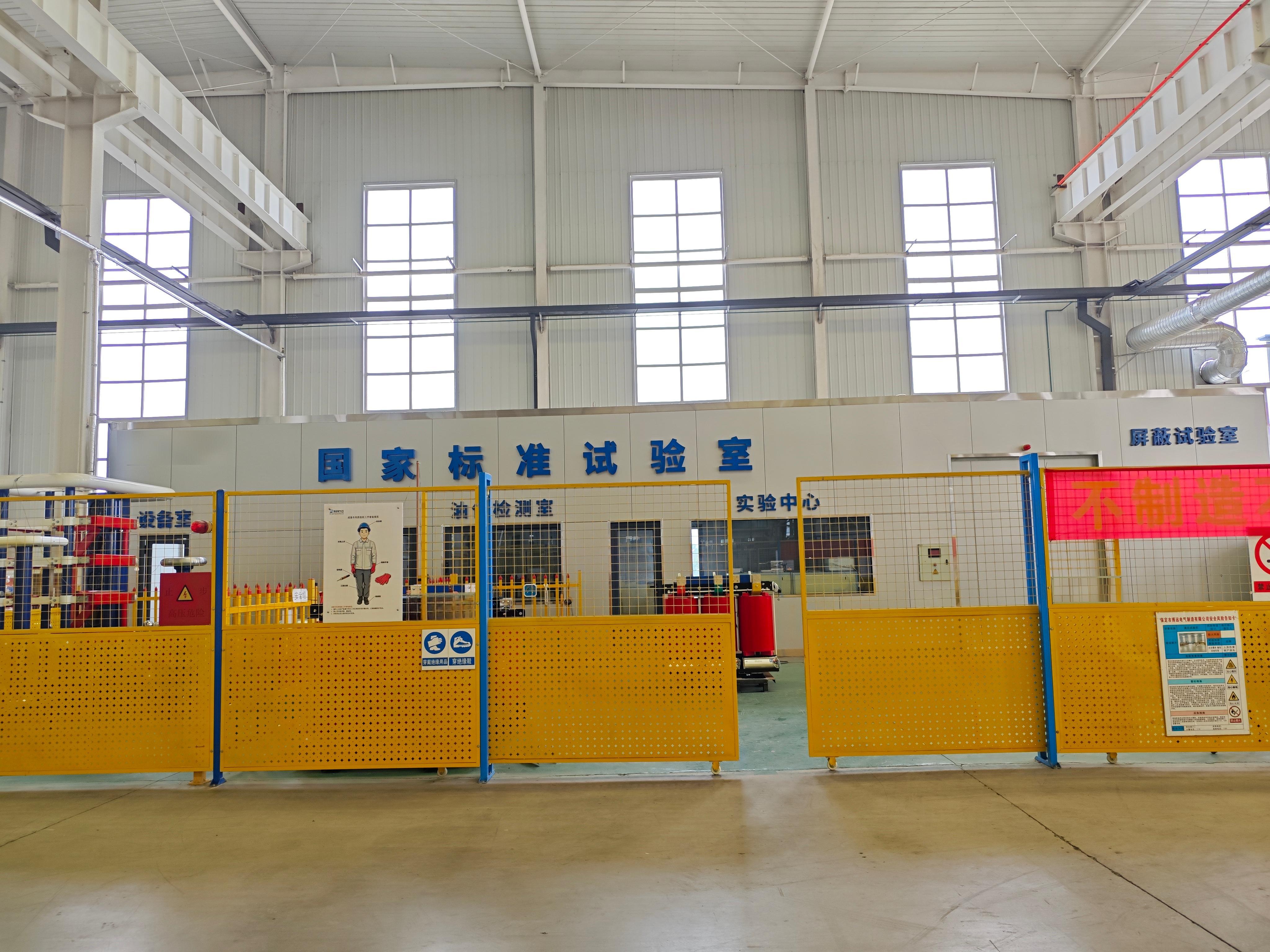
Electrical testing workshop for dry-type transformers, oil-immersed transformers and prefabricated substations. The area is used for factory inspection, routine electrical tests and factory acceptance testing before delivery.
Factory acceptance testing should be defined in the RFQ. Milestone's factory acceptance testing covers electrical measurements and routine inspection procedures. Depending on the product and project, tests may include winding resistance, voltage ratio, insulation resistance, no-load loss and load loss measurements. Buyers should request the test standard, test scope, acceptance criteria and witness arrangement before shipment release.
Technical choices that change system performance
Impedance and fault duty
Short-circuit impedance is a system parameter, not a standalone quality label. For Milestone's power transformer data, 110 kV units are commonly around 10 to 14%, while 220 kV and above are typically higher. Lower impedance generally increases prospective fault current but can improve voltage stiffness. Higher impedance can limit fault current but may increase voltage drop under load. The approved value should come from fault-level, voltage-performance and protection studies.
Impedance also affects parallel load sharing. Equal impedance alone does not guarantee successful parallel operation. Voltage ratio, vector group, polarity, phase sequence, tap position and protection must also be compatible. A supplier should not be allowed to offer a different impedance without an approved deviation and updated system studies.
Cooling and loading
ONAN uses natural oil circulation and natural air cooling. ONAF adds forced air from fans and may support a higher approved rating only when the fans, controls and auxiliary supply are available. OFAF and ODAF use forced oil and/or forced air arrangements in the power transformer data. A dual rating is not a permanent capacity increase. If the cooling system is unavailable, permissible loading may need to return to the lower rating.
Ambient temperature, altitude and site ventilation can require derating. A transformer selected for a controlled indoor electrical room cannot be treated as equivalent to an outdoor unit exposed to solar radiation, dust or coastal salt mist. The cooling arrangement, enclosure protection and maintenance access must match the actual installation.
Tap changing and voltage regulation
An OLTC is designed for voltage regulation under load. OCTC and DETC are normally operated only after isolation and de-energization. An OLTC does not correct every power-quality problem and must be coordinated with other voltage-control equipment. The tap range, step size, regulating winding and operating method must follow the approved design and the manufacturer's manual.
For a utility substation with changing system voltage, an OLTC may be the appropriate starting point. For a stable industrial supply where offline adjustment is acceptable, OCTC can simplify operation. The decision should follow voltage records, outage availability, maintenance capability and the approved system study.
Vector group and parallel operation
The power transformer data lists YNd11, YNyn0+d and YNyn0d11. The vector group defines winding connection, neutral availability and phase displacement. It affects grounding, protection, harmonics and parallel operation. It must match the approved single-line diagram and system study. A transformer with the same voltage ratio and capacity is not automatically interchangeable with another vector group.
Losses and lifecycle cost
No-load loss exists whenever the transformer is energized and is mainly related to the core. Load loss rises with load current and is mainly related to winding resistance and stray losses. For a continuously energized project with a long service horizon, compare guaranteed no-load loss, load loss, the actual load profile, electricity cost and the evaluation period.
At low average loading, no-load loss deserves more weight. At high average loading, load loss deserves more weight. A lower purchase price is not automatically the lower lifecycle cost. Buyers should compare offers at the same rating, reference temperature, tap position and test basis.
How Milestone Electrical organizes the constraint review
Milestone (Xiong'an) Electrical Technology Co., Ltd. is a transformer engineering and manufacturing company based in Xiong'an New Area, Hebei, China. Its core product portfolio includes power transformers, distribution transformers, oil-immersed transformers, dry-type transformers and compact substations. The company's power transformer range is listed up to 220 kV, and its facility is described as 8,000 ㎡ with 270 employees, 30 R&D staff and an annual output of 15,000 units.
Milestone supports OEM and ODM projects. Customization items include rated power, primary and secondary voltage, rated frequency, vector group, short-circuit impedance, tap-changing arrangement, cooling method, winding material, insulating liquid, and site protection and accessories. Monthly capacity is listed at 1,500 units, MOQ at 1 unit, lead time at 30 to 50 days and quality control at 100% test. Export markets include South America, North America, the Middle East, Southeast Asia and Europe. After-sales support is remote or on-site.
These are capability facts, not a claim that every configuration is standard. A 220 kV project with a specified impedance, OLTC, loss guarantee and witness testing should be confirmed through the RFQ and technical proposal. The 30 to 50 day lead time is a listed capability figure; it should be confirmed for the specific high-voltage configuration, test scope and delivery schedule.
Milestone's project support covers transformer selection, specification review, RFQ clarification, engineering coordination, manufacturing, testing documentation and export documentation. The engineering team uses electromagnetic, thermal and mechanical simulation to support design decisions. Material and configuration options may include low-loss silicon steel, specified winding materials, suitable insulating liquids, and project-appropriate cooling and structural arrangements. Applicable IEC or GB requirements, test scope and acceptance criteria should be defined in the project specification and confirmed in the technical proposal.
Application fit: where high-voltage power transformers are specified
Utility transmission and distribution substations use high-voltage power transformers for voltage transformation, grid supply and regional power distribution. Typical matched equipment includes HV and MV switchgear, circuit breakers, current transformers, voltage transformers, protection relays, busbars, cables and SCADA. Special requirements can include specified short-circuit withstand, voltage regulation, seismic resistance and remote monitoring.
Power plants use power transformers for generation, transmission and on-site electricity consumption. Milestone's case data describes a power plant application in Chile, Brazil and Armenia with 50 units and a 10-year duration. The reported result is stable operation and regular maintenance. That case is a reference point, not a guarantee of identical performance in another plant.
Mining projects require outdoor mine-site installation, heavy dust, vibration, high altitude, large temperature variations and heavy motor loads. Special requirements can include dust protection, high-altitude design, vibration resistance, motor-starting assessment and robust construction. Milestone's power transformer range is listed for mining companies and substations.
Oil and gas projects can involve outdoor installation, high or low temperatures, dust, humidity, corrosive atmosphere and continuous motor loads. Where required, hazardous-area compliance and explosion protection, fire safety, corrosion protection, specified IP protection and remote alarms should be defined. Milestone's power transformer range is listed for energy companies and industrial substations.
Renewable energy projects use step-up transformers for grid connection. Selection should consider converter duty, low losses, thermal-cycle capability, corrosion protection and grid-interface compatibility. Milestone's image and application data describe step-up power transformers for renewable energy generation projects, including wind farms and solar power plants.
Market trend: supply pressure and specification discipline
MarketsandMarkets projects the global power transformer market to reach USD 41.62 billion by 2030. Other commercial publishers use different product boundaries and forecast windows. One estimate places the broader transformer market at USD 64.64 billion in 2025 and USD 88.48 billion by 2030, while another uses a 2026 to 2035 window. These figures should not be averaged or treated as a single consensus. They are directional market-size signals, not a price benchmark for a specific 110 kV or 220 kV unit.
For procurement, the more actionable signal is supply pressure. The IEA reports that selected manufacturer backlogs increased from 2020 to 2024 and that large power transformer procurement can take up to four years. The US Department of Energy reported 128-week lead times for large power transformers as of May 2026. Buyers should freeze specifications, prequalify suppliers and plan schedule buffers earlier.
Price-band discussion should be handled through itemized quotations. The provided data does not establish a public price band for high-voltage power transformers. A quotation should separate transformer, accessories, testing, documentation, packing, transport and any extended warranty or service scope. That is the only reliable way to compare commercial offers when the technical scope differs.
Comparison with alternative arrangements
Oil-immersed high-voltage power transformers and dry-type transformers are not interchangeable by capacity and voltage ratio alone. For 110 kV to 220 kV transmission duty, the power transformer data lists oil-based cooling codes and mineral oil or natural ester as material options. Dry-type transformers avoid insulating liquid and are suitable for indoor, fire-sensitive and oil-free applications, but IEC 60076-11 covers dry-type power transformers with highest voltage for equipment up to 72.5 kV. That standard scope does not make dry-type a universal substitute for every 110 kV to 220 kV oil-immersed transmission transformer.
An integrated compact substation and separately installed equipment also involve different boundaries. Factory assembly and testing can reduce on-site construction and footprint. The compact substation data lists IP44, IP54 or IP55 enclosure options, integrated incoming and outgoing switchgear, and customization to single-line drawings and load requirements. The limitation is that expansion flexibility, enclosure thermal performance, maintenance access, shipping dimensions and lifting must be checked. A compact substation is not automatically a shorter-lead or lower-total-cost solution.
OLTC and OCTC present another boundary. An OLTC provides on-load regulation but adds controls, maintenance and auxiliary systems. OCTC is simpler but requires de-energization for tap changes. Neither is universally better. The correct choice depends on voltage variation, outage availability and the approved operating philosophy.
Procurement rule: a high-voltage power transformer quotation should be compared on the approved electrical duty, guaranteed losses, cooling stage, tap range, test scope, documentation, transport and schedule. A headline price without those constraints is not a comparable offer.
Procurement checklist for research and evaluation stages
- Freeze the single-line diagram, voltage ratio, capacity, frequency, phases, vector group, impedance, cooling, tap range, insulation level, losses, protection and site conditions.
- State the applicable standard and the required test scope. Do not rely on a general compliance statement.
- Request unit-specific guaranteed losses and test values, not only family-level catalogue data.
- Confirm certificate scope, test reports and witness or third-party inspection arrangements.
- Mark unresolved items as TBC rather than allowing the supplier to assume them.
- Compare lifecycle losses, accessories, documentation, packing, transport and delivery terms alongside the equipment price.
- Check lead time and schedule buffer against the project commissioning plan.
- Plan transport, lifting, foundation, grounding, oil containment and fire protection before shipment.
Future outlook
Grid investment, renewable integration, data-centre growth and electrification are likely to keep demand for high-voltage power transformers under pressure. The supply-side evidence points to longer procurement cycles rather than a quick return to short lead times. For buyers, the practical response is earlier specification freeze, prequalification, dual sourcing where feasible, and lifecycle-loss evaluation. For manufacturers, the practical response is clearer constraint review and test documentation.
Milestone's model is to review technical requirements and supply boundaries early so that quotation scope can be compared on a more consistent basis. That does not remove the need for project-specific engineering studies. It does make the evaluation stage more transparent, especially when capacity, impedance, cooling, tap changer and test scope are fixed before commercial comparison.
FAQ: constraints buyers ask about
What transformer capacity should we choose for a high-voltage project?
Use verified maximum demand, power factor, load profile, harmonics, ambient conditions and lifecycle cost. Select a standard rating that meets the verified maximum demand, starting requirements and confirmed expansion plan. A larger rating is not automatically better. Do not apply a fixed spare-capacity percentage to every project. For projects with large motors or substantial nonlinear loads, complete starting and harmonic assessments before fixing capacity.
Which transformer impedance should we select for our project?
Start with the impedance approved by fault-level, voltage-performance and protection studies. Lower impedance may improve voltage stiffness but increase fault current. Higher impedance can limit fault current but may increase voltage drop. Neither 4% nor 6% is universally preferable. For the power transformer data, 110 kV units are commonly around 10 to 14%, while 220 kV and above are typically higher. An alternative value should be accepted only after the studies are updated and approved.
Should our transformer use an OLTC or a de-energized tap changer?
Use an OLTC where voltage adjustment is required during normal operation without interrupting supply, with suitable voltage-regulation controls. Use DETC or OCTC where supply voltage is stable and offline adjustment is acceptable. An OLTC does not correct every power-quality problem and must be coordinated with other voltage-control equipment. DETC and OCTC must be operated only after safe isolation and de-energization.
Should we choose ONAN or ONAN/ONAF cooling?
If the project must carry its required load without relying on fans, specify ONAN rated for that load. If higher planned loading is expected and reliable auxiliary power is available, evaluate a validated ONAN/ONAF design. The higher ONAF rating is valid only when the required fans, controls and auxiliary supply are available. If the cooling system is unavailable, permissible loading may need to return to the ONAN rating. Ambient temperature, altitude and site ventilation can require derating.
Should we choose copper or aluminium windings?
Compare guaranteed losses, temperature rise, dimensions, short-circuit withstand evidence and delivery, not conductor material alone. Copper has higher electrical conductivity than aluminium. Aluminium generally requires a larger conductor cross-section for comparable resistance. A compliant aluminium design can be valid where it meets the same performance and installation limits. Copper should not be substituted where the specification makes it mandatory, and aluminium should not be substituted for copper without written approval.
What should a high-voltage power transformer RFQ include?
Include transformer type, rated capacity, voltage ratio, frequency, phases, vector group, impedance, cooling method, tap range, winding material, insulation level, applicable standard, site conditions, testing scope, accessories, documentation and delivery terms. Attach the single-line diagram, load list, project specification, utility requirements and site-condition data. Mark unresolved items as TBC rather than allowing the supplier to assume them. The RFQ should let the supplier prepare a technical datasheet, deviation list, GA drawing, quotation, lead time and testing plan without unrecorded assumptions.
How should a routine test report be reviewed before shipment?
Match the model, serial number and nameplate data to the ordered unit. Confirm the test standard and test scope. Compare measured values with approved guaranteed values and applicable tolerances. Check instrument calibration, abnormal remarks and corrected results. Review witness or third-party inspection records where required. Record nonconformities and close them before shipment release. For Milestone transformers, factory electrical testing includes winding resistance, voltage ratio and insulation performance checks, and no-load loss and load loss testing are performed before delivery. A general pass stamp is not a substitute for a unit-specific report.
Technical reference: Milestone transformer catalogue (PDF). This article is an industry reference and does not replace project-specific engineering studies.
Есть вопросы или нужны дополнительные детали?
Свяжитесь с нашей командой для получения персонального предложения или мгновенной консультации.
Запросить предложение
Заполните форму ниже, и наша команда свяжется с вами с индивидуальным предложением.
Прямой чат WhatsApp
Предпочитаете общаться в реальном времени? Напишите нам в WhatsApp для мгновенной помощи и быстрых ответов.
- Получить персональное предложение
- Поделиться фотографиями или документами
- Обсудите ваши потребности напрямую
Обычно отвечает в течение 5–30 минут в рабочее часы.