
Home Fitness Specs FAQ: Motors, Resistance, Flywheel Weight
Home Fitness Specs FAQ: Motors, Resistance, Flywheel Weight
Home fitness equipment is now bought on specification data, and the specification data that reaches buyers is written in at least four different languages: horsepower, wattage, resistance levels and flywheel kilograms.
One vibration plate publishes 20 speed levels; another publishes 99. One treadmill is specified at 2.5HP with a 1–20 km/h range; another at 2.0HP with the same top speed and a different deck. One rowing machine is described by a 2.5 kg flywheel and 16 resistance levels; a spinning bike by a 6.0 kg flywheel and stepless resistance. For procurement teams, distributors and private-label brand owners evaluating home fitness equipment, the practical question is not which number is largest, but which number describes a capability the end user will actually use after delivery.
This reference works through the specification and procurement questions that recur most often in home fitness sourcing. The worked example is the published model data of Ningbo Healthmate Health Technology Co., Ltd., a manufacturer of home fitness equipment founded in 2007 and based in Ningbo, China.
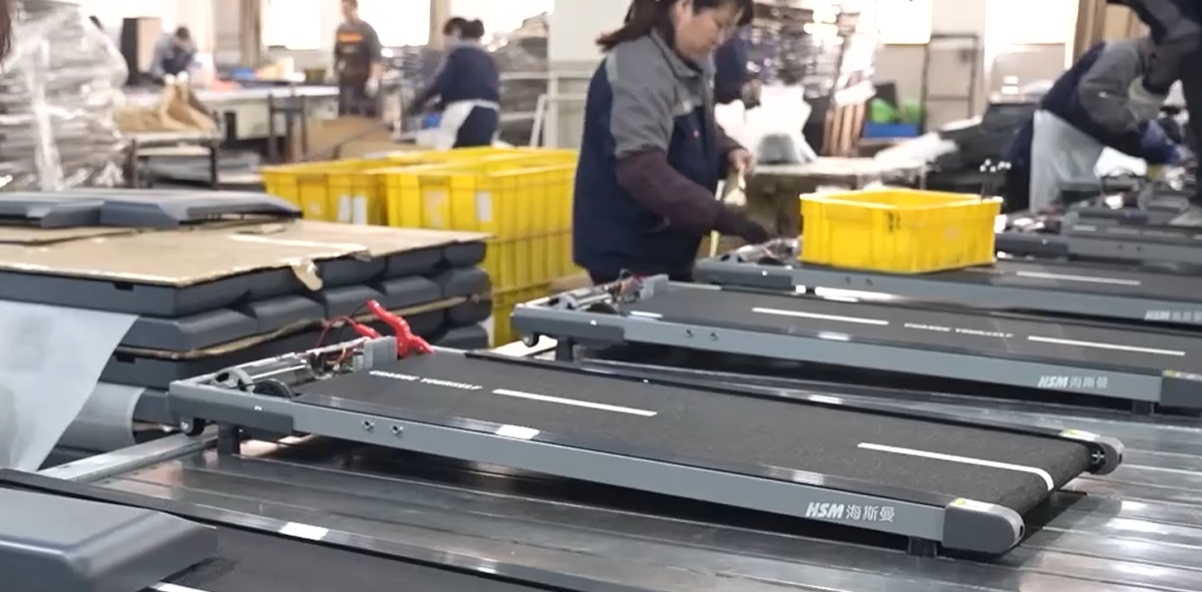
Production line assembly of home fitness equipment: frame, drive and console sub-assemblies that determine the published performance figures.
Why Specification Questions Now Decide Home Fitness Purchases
The global home fitness equipment market was valued at approximately USD 12.88 billion in 2025 and is projected to reach USD 22.99 billion by 2034, according to Fortune Business Insights. Within that total, cardiovascular equipment — the group that contains treadmills, walking pads, exercise bikes and rowing machines — holds a 58.89% revenue share.
The sub-categories tell buyers where the specification risk sits. The global home treadmill market was valued at USD 5.51 billion in 2025, with motorized models holding a 58.2% share, according to Dataintelo. Straits Research values the walking pad (under-desk treadmill) niche at USD 4.9 billion in 2025, driven largely by remote-work habits. Dataintelo places the global vibration plates and therapy platforms market at USD 1.8 billion in 2025, with an expected CAGR of 7.8% through 2034.
All of those figures should be read as directional. Published research disagrees on where a category ends: one source counts compact foldable treadmills inside the walking pad market while a narrower definition of core under-desk units produced a valuation of USD 132.6 million for the same period. Category numbers set context; they do not answer the questions a buyer has to answer before placing a purchase order.
The sourcing problem is that comparison breaks down at the specification line. A 200W vibration plate and a 500W vibration plate can both be advertised as “multi-level”. A 1.5 kg flywheel and a 6.0 kg flywheel can both be described as “magnetic resistance”. A 0.75HP walking pad and a 2.5HP treadmill can both be listed as “home use”. The opportunity for buyers who can read these figures correctly is a product range that matches the end user’s room, routine and budget — and a lower return rate as a result.
The Reference Range and the Manufacturer Behind It
Ningbo Healthmate Health Technology Co., Ltd. is a Chinese fitness equipment manufacturer and supplier founded in 2007 that designs, produces and exports home-use treadmills, walking pads, vibration machines, spinning bikes, magnetic X-bikes, upright bikes, elliptical trainers, electric mini bikes and rowing machines. Its factory occupies 100,000 m² and is staffed by 850 employees, including a 38-engineer research and development team, with an annual output of 700,000 units and roughly 80% of production exported to Europe, the USA, Japan, Korea, India, the Middle East and South America.
For buyers, the operational facts behind those numbers matter more than the numbers themselves. The company runs OEM/ODM production with customization of colour, logo, voltage and plug type, holds a monthly capacity of 8,000 pieces, quotes a 35–40 day lead time and a minimum order quantity of 100 pieces, and applies 100% testing plus third-party inspection before shipment. Every damaged part is covered by a one-year warranty.
The field data attached to this range includes a programme that shipped 100,000 pieces globally, with stable running performance, an after-sales failure rate below 2%, a high customer repeat order rate and positive market feedback on household space demand. Product-level highlights recorded for the same programme include foldable compact structures, multi-level shock absorption, a simple operation panel, multiple vibration modes, anti-slip foot mats and lightweight portability.
Reading Motor Power Ratings on Home Treadmills
Q: What does a treadmill motor rating actually describe?
In this range the motor rating spans 0.75HP to 2.5HP, and it correlates with three other visible specifications: top speed, deck size and unit mass. The 0.75HP walking pads — HSM-W04L2B, HSM-W04L1BL and HSM-W04M2A — run at 1–6 km/h (1–10 km/h on HSM-W04M2A) on 900–920 × 380 mm runways and weigh between 19 kg and 21 kg gross. The 1.5HP units, HSM-T20 and HSM-W09E, reach 1–14 km/h on a 1100 × 400 mm runway at 33.5 kg and 31 kg gross respectively. The 2.0HP group, HSM-MT296 and HSM-W08A, reaches 1–20 km/h and 1–16 km/h on 1200 mm runways, at 72 kg and 54 kg gross. The 2.5HP group — HSM-MT19, HSM-MT550 and HSM-MT60 PRO — carries 1300–1350 mm runways and 77–91 kg gross weights.
Q: Is a brushless motor worth specifying on a walking pad?
HSM-W04L1BL is specified with a brushless motor at the same 0.75HP rating and the same 1–6 km/h speed range as the brushed equivalent. Buyers who place walking pads in office or multi-user environments generally treat a brushless configuration as the lower-wear option, and in this range it is the model with the lowest published height: 1130 × 510 × 91 mm.
Speed Ranges and Incline Types
Q: How should a buyer read a speed range?
Speed ranges in this range fall into three usable bands. Walking band: 1–6 km/h, used by HSM-W04L2B and HSM-W04L1BL; 1–10 km/h on HSM-W04M2A. Light-jog band: 1–14 km/h on HSM-T20 and HSM-W09E, with HSM-W09E offering a dual-speed mode of 1–14 km/h and 1–6 km/h. Running band: 1–16 km/h on HSM-W08A, 1–20 km/h on HSM-MT19 and HSM-MT296, and 1–22 km/h on HSM-MT550. A 1–6 km/h device is a walking product, not a reduced treadmill, and should be positioned to end users that way.
Q: Manual incline or auto incline?
Manual incline is used on HSM-T20, HSM-W04L2B and HSM-W04M2A, while HSM-W09E is listed with a 1-level manual incline function. Auto-incline is used on HSM-MT19, HSM-MT296, HSM-MT550, HSM-MT60 PRO and HSM-W08A. Auto incline adds electronics, a heavier frame and a higher shipping weight; manual incline keeps the unit lighter and mechanically simpler but requires the user to adjust it before training. HSM-MT19 also specifies a hydraulic soft-drop folding system and an emergency stop key with an anti-slip belt, and both HSM-MT19 and HSM-MT296 are rated to 150 kg user capacity.
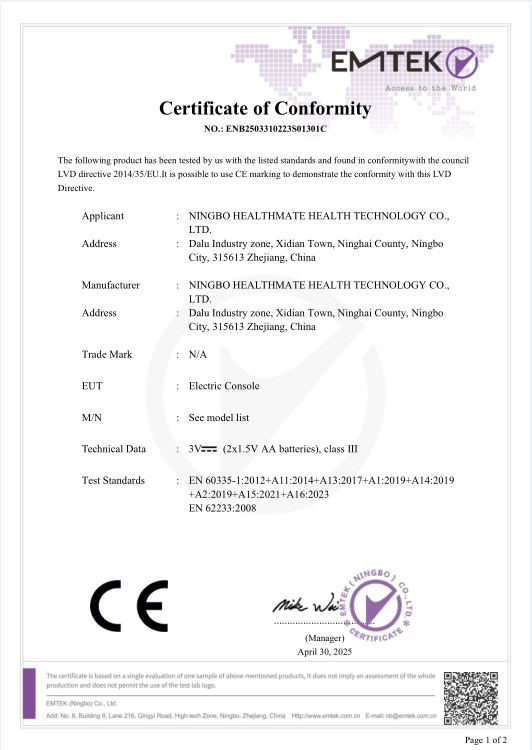
Conformity documentation is product-specific: the CE-LVD certificate in this range is scoped to the X-bike and rowing machine models named on it.
Resistance Systems, Flywheel Weight and Drive Type
Q: Does flywheel weight equal resistance?
No — they describe different things. Flywheel weight describes the inertia a user feels, while resistance levels describe how the load can be set. HSM-B135J5 is a foldable X-bike with a 1.5 kg flywheel, 8 resistance levels and 7 levels of handlebar height control, at 19.1 kg gross. HSM-S300 is a magnetic resistance spinning bike with a 6.0 kg flywheel, stepless resistance plus app-linked 1–10 levels, handrail altitude control of 1–5 levels and cushion control of 1–7 levels, at 30 kg gross. HSM-R06 is a magnetic rowing machine with a 2.5 kg flywheel, 16 resistance levels, a 0–705 mm slideway distance and a 0–1700 mm handlebar belt length, at 24 kg gross.
Q: Stepped resistance or stepless resistance?
Stepped resistance (8 levels on HSM-B135J5, 16 levels on HSM-R06) gives repeatable, documentable settings, which suits dealers selling to users who follow a fixed routine. Stepless resistance on HSM-S300, combined with app-linked levels, gives continuous load changes and shifts part of the control experience to the app. Buyers specifying for apartment or shared-floor use should also note that HSM-S300 is positioned as a quiet magnetic resistance spinning bike, which reflects the magnetic drive rather than a friction pad.
Vibration Plates: 20 Levels Versus 99 Levels
Level counts are the single most misread figure in the vibration plate category. In this range, level count runs in the opposite direction to power and weight:
| Model | Positioning | Power | Speed levels | Timer | Gross weight | Footprint |
|---|---|---|---|---|---|---|
| HSM-08VW | Vibration plate with elastic ropes | 500+300W | 20 | 1–15 min | 21.8 kg | 775×430×180 mm |
| HSM-08VQ | Portable whole body vibration plate | 500W+300W | 20 | 1–10 min | 24 kg | 805×450×190 mm |
| HSM-08VS | Compact slim vibration machine, with magnetic stone | 200W | 99 | 1–10 min | 9.8 kg | 530×320×145 mm |
| HSM-08VF | Upright vibration plate with handlebar | 500W | 99 | 1–10 min | 31 kg | 710×700×1080 mm |
The practical reading: a 99-level plate is not automatically a more powerful plate. HSM-08VS reaches 99 levels with a 200W system and a 9.8 kg gross weight, making it a compact, easily stored unit. HSM-08VF reaches the same 99 levels with a 500W system and a 31 kg gross weight, and adds a handlebar for upright use. HSM-08VW and HSM-08VQ use twin ratings of 500+300W with 20 levels and longer timers, including a 1–15 minute timer on HSM-08VW. Level count should not be used as a proxy for amplitude or frequency; those values should be requested from the supplier directly.
Dimensions, Materials and Space Planning
Every model in this range is specified with an ABS material housing. The differentiator for buyers is footprint, and the spread within the category is wide. The thinnest walking pad, HSM-W04L1BL, is 1130 × 510 × 91 mm; HSM-W04L2B is 1090 × 495 × 120 mm; HSM-W04M2A is a folding walking pad with a safety handlebar. Within the folding walking group, HSM-W09E measures 1335 × 665 × 1050 mm, HSM-W08A 1525 × 745 × 1200 mm, and HSM-T20 1474.3 × 604 × 1124 mm. Treadmills scale up from there: HSM-MT296 at 1580 × 865 × 1300 mm, HSM-MT60 PRO at 1750 × 840 × 1425 mm, HSM-MT19 at 1705 × 835 × 1380 mm and HSM-MT550 at 1790 × 910 × 1525 mm.
Bikes and rowers occupy a different floor pattern. HSM-S300 is 1075 × 353 × 1090 mm; HSM-B135J5 is 1110 × 525 × 1100 mm; HSM-R06 is 1666 × 504 × 623 mm, a long, low profile. Vibration plates are the smallest group, from 530 × 320 × 145 mm on HSM-08VS to 805 × 450 × 190 mm on HSM-08VQ, with upright HSM-08VF the tallest at 710 × 700 × 1080 mm.
Carton data is what determines freight cost, not product size. Two examples show why. HSM-T20 measures 1474.3 × 604 × 1124 mm as a product but ships in a 1380 × 625 × 225 mm carton, indicating a fully folded package. HSM-R06 measures 1666 mm long as a product but ships in a 970 × 220 × 595 mm carton, indicating knock-down assembly. HSM-MT19, by contrast, ships in a 1930 × 870 × 380 mm carton against a 1705 × 835 × 1380 mm product, so container planning should be based on carton volume.
Screens, Programs and Electronic Functions
Console specifications divide the range into three tiers. LED consoles without app functions are used on HSM-W04L2B, HSM-W04L1BL, HSM-W04M2A, HSM-W08A and HSM-W09E, displaying speed, distance, time and calories, with pulse added on HSM-W09E. LCD consoles are used on the treadmill and cycling group: HSM-MT19, HSM-MT296, HSM-MT550, HSM-MT60 PRO, HSM-T20, HSM-B135J5 and HSM-R06, all of which display speed, distance, time, calories and pulse except HSM-R06, whose console shows stop, scan, time, distance, total strokes and strokes. HSM-S300 uses an APP link screen.
Program counts range from 6P on HSM-T20, HSM-W09E and the walking pads, to 12P on HSM-MT19 and HSM-MT60 PRO, and 16P on HSM-MT296, HSM-MT550 and HSM-W08A. Bluetooth music and app functions appear on HSM-MT19, HSM-MT296, HSM-MT60 PRO and HSM-T20, and HSM-MT550 adds wireless charging. For a dealer, the electronic tier determines the support workload after sale as much as it determines the retail price.
Consolidated Specification Table
| Model | Type | Power / drive | Speed or resistance | Flywheel | Gross weight | Product size |
|---|---|---|---|---|---|---|
| HSM-MT19 | Foldable home treadmill, auto incline | 2.5HP | 1–20 km/h, 12 programs | — | 77 kg | 1705×835×1380 mm |
| HSM-MT296 | Folding treadmill, auto incline | 2.0HP | 1–20 km/h, 16 programs | — | 72 kg | 1580×865×1300 mm |
| HSM-MT550 | Multifunction motorized treadmill | 2.5HP | 1–22 km/h, 16 programs | — | 91 kg | 1790×910×1525 mm |
| HSM-MT60 PRO | Electric home treadmill, auto incline | 2.5HP | 12 programs | — | 83 kg | 1750×840×1425 mm |
| HSM-T20 | Compact folding treadmill, manual incline | 1.5HP | 1–14 km/h, 6 programs | — | 33.5 kg | 1474.3×604×1124 mm |
| HSM-W08A | Walking treadmill with support bar | 2.0HP | 1–16 km/h, 16 programs | — | 54 kg | 1525×745×1200 mm |
| HSM-W09E | Folding walking pad with handrail | 1.5HP | 1–14 / 1–6 km/h dual speed | — | 31 kg | 1335×665×1050 mm |
| HSM-W04M2A | Folding walking pad with handrail | 0.75HP | 1–10 km/h | — | 20.2 kg | folding design |
| HSM-W04L2B | Under-desk walking pad | 0.75HP | 1–6 km/h | — | 19 kg | 1090×495×120 mm |
| HSM-W04L1BL | Slim walking pad, brushless motor | 0.75HP | 1–6 km/h | — | 21 kg | 1130×510×91 mm |
| HSM-B135J5 | Foldable magnetic X-bike | Magnetic | 8 resistance levels, 7 altitude levels | 1.5 kg | 19.1 kg | 1110×525×1100 mm |
| HSM-S300 | Magnetic resistance spinning bike | Magnetic, stepless | Stepless / APP 1–10 levels | 6.0 kg | 30 kg | 1075×353×1090 mm |
| HSM-R06 | Magnetic rowing machine | Magnetic | 16 resistance levels | 2.5 kg | 24 kg | 1666×504×623 mm |
| HSM-08VW | Vibration plate with elastic ropes | 500+300W | 20 levels, 1–15 min | — | 21.8 kg | 775×430×180 mm |
| HSM-08VQ | Portable whole body vibration plate | 500W+300W | 20 levels, 1–10 min | — | 24 kg | 805×450×190 mm |
| HSM-08VS | Compact vibration machine, magnetic stone | 200W | 99 levels, 1–10 min | — | 9.8 kg | 530×320×145 mm |
| HSM-08VF | Upright vibration plate with handlebar | 500W | 99 levels, 1–10 min | — | 31 kg | 710×700×1080 mm |
Application and Use-Case Fit
Documented applications for this range include family daily cardio workout, indoor weight loss training, elder daily rehabilitation exercise, office standing walking, small apartment daily light exercise, post-meal fat burning, low-impact leg cardio training, home daily light fitness and rehabilitation exercise for joint mild discomfort. Matching the configuration to the application is where specification reading pays off.
- Office standing walking and desk-side movement: HSM-W04L1BL and HSM-W04L2B, at 91 mm and 120 mm height and 1–6 km/h.
- Small apartment light exercise with balance support: HSM-W04M2A and HSM-W09E, both folding walking pads with a handrail.
- Daily cardio and light jogging: HSM-T20, HSM-W08A and HSM-MT296, in the 1.5HP to 2.0HP band.
- Running-oriented home programmes: HSM-MT19, HSM-MT550 and HSM-MT60 PRO, at 2.5HP with auto incline.
- Low-impact leg cardio and joint-friendly movement: HSM-B135J5 (foldable X-bike) and HSM-S300 (magnetic spinning bike).
- Full-body cardio and strength conditioning: HSM-R06 magnetic rower.
- Recovery and light full-body sessions in limited space: HSM-08VS, HSM-08VQ and HSM-08VW.
- Upright vibration training with hand support: HSM-08VF.
Market Trend Analysis
Three trends are visible in the published data and in the specification direction of this range. First, the walking pad niche is being pulled forward by remote and hybrid work; Straits Research puts it at USD 4.9 billion in 2025, although definitions of the category vary widely and narrower definitions produce far smaller valuations. Second, vibration platforms are growing steadily rather than explosively: Dataintelo records USD 1.8 billion in 2025 with an expected CAGR of 7.8% through 2034. Third, motorized models remain the dominant format in the treadmill segment at a 58.2% share of a USD 5.51 billion market, which keeps motor ratings and deck dimensions at the centre of buyer comparison.
Two further signals come from the compliance side. UKCA verification documents listed for the treadmill group cover EMC standards including BS EN IEC 55014-1, BS EN IEC 61000-3-2 and BS EN 61000-3-3, with an issue date of 16 May 2025. Separate RED verification for the same treadmill models lists radio spectrum standards including ETSI EN 300 328 and the ETSI EN 301 489 series, issued 27 January 2026, alongside CE EMC verification issued 4 February 2026. The direction of travel for connected home fitness equipment is toward radio and EMC documentation as a routine part of the file, not an optional extra.
At brand level, Fortune Business Insights identifies ICON Health & Fitness (iFIT), Johnson Health Tech, Technogym and Peloton among the key global competitors in home fitness. Those companies compete on connected ecosystems and branded retail presence, which is a different arena from the specification-and-volume supply model described here.
Boundaries: What These Specifications Cannot Do
A specification-led evaluation is only useful if the limits are stated as clearly as the capabilities.
- A 0.75HP walking pad running at 1–6 km/h is a walking device. It is not a substitute for a 2.5HP treadmill at 1–20 km/h or 1–22 km/h, and end users expecting running performance from it will be disappointed.
- A higher level count does not mean higher power. HSM-08VS offers 99 levels on a 200W system at 9.8 kg gross, while HSM-08VW offers 20 levels on a 500+300W system at 21.8 kg gross. Buyers comparing only the level count will misprice the category.
- Flywheel weight does not transfer across formats. The 1.5 kg flywheel on the folding X-bike HSM-B135J5 and the 6.0 kg flywheel on the spinning bike HSM-S300 suit different training intensities.
- Certification scope is product-specific and cannot be extended. The CE-GPSD verification of conformity in this range is scoped to the rowing machine under EN ISO 20957-1:2013 and EN ISO 20957-7:2021, and the CE-LVD document is scoped to the X-bike and rowing machine under EN 60335-1 and EN 62233:2008. One certificate does not cover a full catalogue.
- Every model listed here is specified for home use with an ABS material housing. Buyers sourcing for commercial gym duty cycles should verify load and duty ratings beyond the published home-use specification rather than assume them.
- Walking pads without a handrail require the user to balance unaided. Where balance support matters, the folding walking pads with handrails and the walking treadmill with support bar are the appropriate configurations within this range.
Future Outlook
On the current trajectory, three things are likely to shape home fitness sourcing decisions. Space will keep driving format change: walking pads at 91 mm and 120 mm height exist because the user base is increasingly desk-bound and apartment-bound, and the remote-work demand that supports that niche is the same demand pulling compact folding designs into the treadmill segment. Electronics will keep migrating down the price ladder: app-linked resistance on HSM-S300, wireless charging on HSM-MT550 and Bluetooth music with app functions on four treadmill and walking models already show how console features are spreading from premium to mid-range configurations. Compliance will keep tightening around connectivity: with RED verification for treadmill models issued in January 2026 and CE EMC verification issued in February 2026, the documentation burden for wireless-enabled home fitness products is increasing rather than stabilising.
For buyers, the practical consequence is that supplier selection will depend less on catalogue breadth and more on whether the supplier can produce consistent specification data, certification scope statements and carton-level logistics figures on demand.
Technical & Procurement FAQ
Are higher motor power ratings always better on a home treadmill?
No. Motor rating sets the ceiling for speed and deck capacity, not the suitability of the product. Within this range a 0.75HP walking pad serves desk-side and apartment walking at 1–6 km/h, a 1.5HP unit serves light jogging at 1–14 km/h, a 2.0HP unit reaches 1–20 km/h, and a 2.5HP unit reaches 1–20 km/h or 1–22 km/h with a 1300–1350 mm deck. Higher power also brings higher gross weight, from 19–21 kg on the walking pads to 77–91 kg on the 2.5HP models, which changes delivery, assembly and floor-space requirements.
How many resistance levels should a home exercise bike or rowing machine have?
It depends on how the resistance is delivered rather than on the count alone. In this range the foldable X-bike HSM-B135J5 provides 8 stepped resistance levels with a 1.5 kg flywheel, the magnetic rower HSM-R06 provides 16 stepped levels with a 2.5 kg flywheel, and the spinning bike HSM-S300 provides stepless resistance with app-linked 1–10 levels and a 6.0 kg flywheel. Stepped levels suit routine-based training because settings are repeatable; stepless resistance suits progressive or class-style training because load changes continuously.
Why do some vibration plates have 20 speed levels and others 99?
Level count describes control granularity, not power output. HSM-08VW and HSM-08VQ combine 20 levels with twin 500+300W or 500W+300W power ratings and weights of 21.8 kg and 24 kg. HSM-08VS reaches 99 levels on a 200W system at 9.8 kg, and HSM-08VF reaches 99 levels on a 500W system at 31 kg. Buyers should select on power rating, form factor and timer range, and should request amplitude and frequency values from the supplier rather than inferring them from the level count.
How much floor space does a walking pad need compared with a folding treadmill?
Published product dimensions give the comparison. The slimmest walking pad, HSM-W04L1BL, is 1130 × 510 × 91 mm and HSM-W04L2B is 1090 × 495 × 120 mm. Folding walking pads with handrails measure 1335 × 665 × 1050 mm on HSM-W09E. Folding treadmills measure 1474.3 × 604 × 1124 mm on HSM-T20 and 1580 × 865 × 1300 mm on HSM-MT296. Carton dimensions should also be checked, because they determine shipping volume rather than in-use footprint.
Which certifications should a buyer verify before ordering home fitness equipment?
Buyers should verify the certificate that names the exact model being ordered, since scope is product-specific. Documents in this range include CE-GPSD verification for the rowing machine under EN ISO 20957-1:2013 and EN ISO 20957-7:2021, and for the spinning bike under EN ISO 20957-1:2013 and EN ISO 20957-5:2016; CE-LVD covering the X-bike and rowing machine under EN 60335-1 and EN 62233:2008; CE-MD for the X-bike under 2006/42/EC plus (EU) 2023/1230; FCC supplier’s declaration of conformity for the stationary exercise bicycle; UKCA and CE-LVD documents for the vibration plate group; and UKCA, RED, CE EMC and CE LVD+EMC verification for the treadmill and walking pad group. Certificate numbers, issuing authorities and issue dates should be verified against the documents themselves.
What is a realistic MOQ and lead time for OEM home fitness equipment?
For this manufacturer the published terms are a minimum order quantity of 100 pieces, a monthly capacity of 8,000 pieces and a lead time of 35–40 days. Customization covers colour, logo, voltage and plug type, and quality control consists of 100% testing plus third-party inspection. Buyers planning a first order should treat the monthly capacity figure as the practical ceiling for a single production slot and schedule accordingly.
How should buyers assess after-sales risk in home fitness supply?
Verifiable field data is more useful than a warranty statement alone. The programme data associated with this range records an after-sales failure rate below 2%, a high customer repeat order rate, stable running performance, stable vibration output and positive market feedback on household space demand across a programme that shipped 100,000 pieces globally. Service terms cover a one-year warranty for every damaged part. Buyers evaluating any supplier should ask for the equivalent figures for the specific model and market they intend to sell into.
Conclusion
Specification reading is the evaluation work that happens before a purchase order, and it is where most sourcing errors are either prevented or locked in. The figures that matter most in home fitness are the ones that can be checked against a document: motor rating and deck size, speed range and incline type, resistance delivery and flywheel weight, level count against power rating, product dimensions against carton dimensions, and certificate scope against the exact model being ordered. Detailed specifications and carton data for the models referenced in this article are compiled in the Ningbo Healthmate e-catalogue, and company-level information is published at healthma.com.
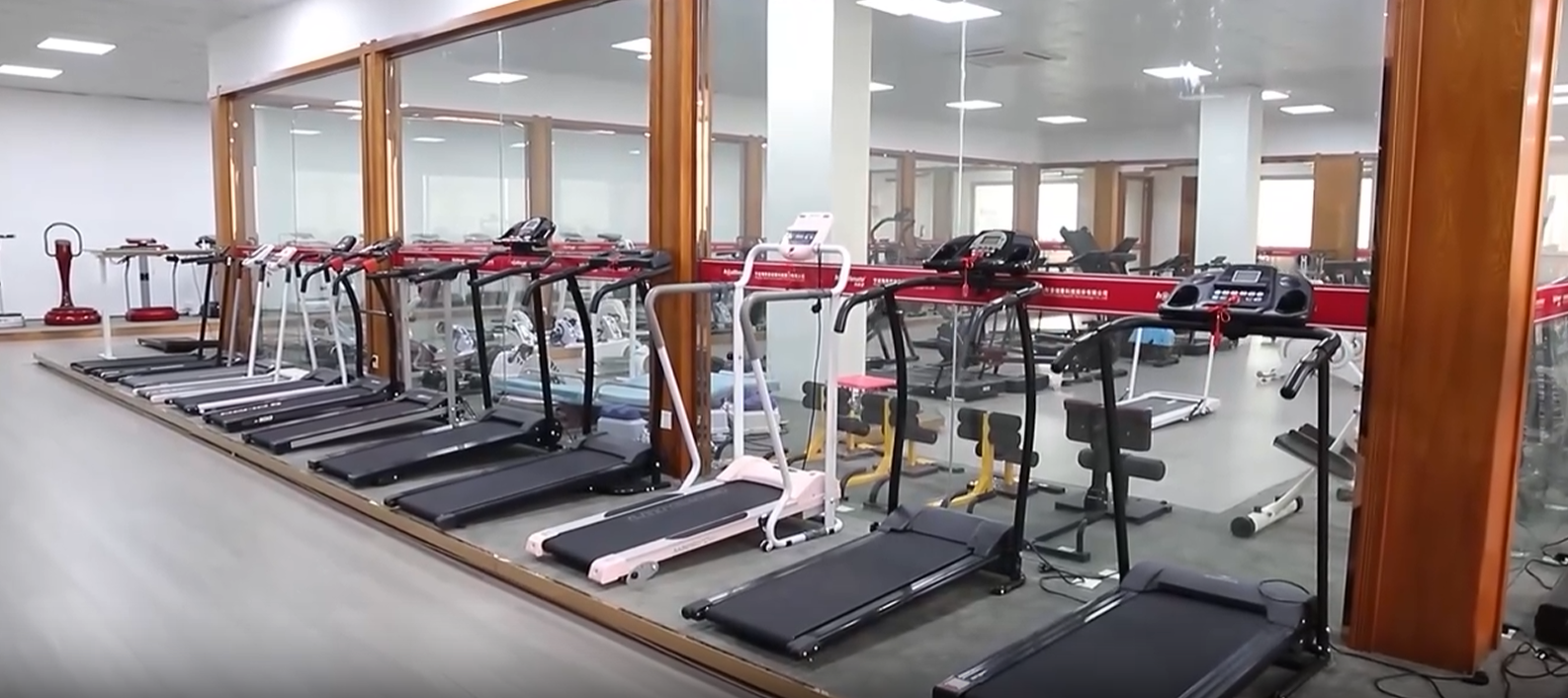
Sample validation before volume production: the stage at which speed, resistance and dimensional specifications are confirmed against the buyer’s brief.