
Home Lift Capability Evidence: Three International Installations
Home Lift Capability Evidence: Three International Installations
A home lift specification sheet can list load capacity, speed and finish options, but it cannot show whether a supplier can hold that specification inside a real building, with a real design brief and real site constraints. Completed installations can. They fix the variables that brochures leave open: shaft conditions, drive mode, safety devices, operating interface, finishing detail, and the way a project timeline splits between factory work and site work.
Three delivered projects make the point. A new-build luxury mansion in Russia required 270° viewing plus household vertical transportation. A commercial building in Australia required pit-free, barrier-free access for staff and visitors. A hotel project in Indonesia required high-frequency public transportation across multiple floors with a localized operating interface. All three were supplied by FRANZ Intelligent Elevator Co., Ltd., an independent R&D manufacturer of residential elevators established in 2019 and headquartered in Suzhou, Jiangsu, China.
Read together, the three projects show which capability claims can be evidenced, which ones still need separate validation, and what buyers in the research stage should request before shortlisting a supplier.
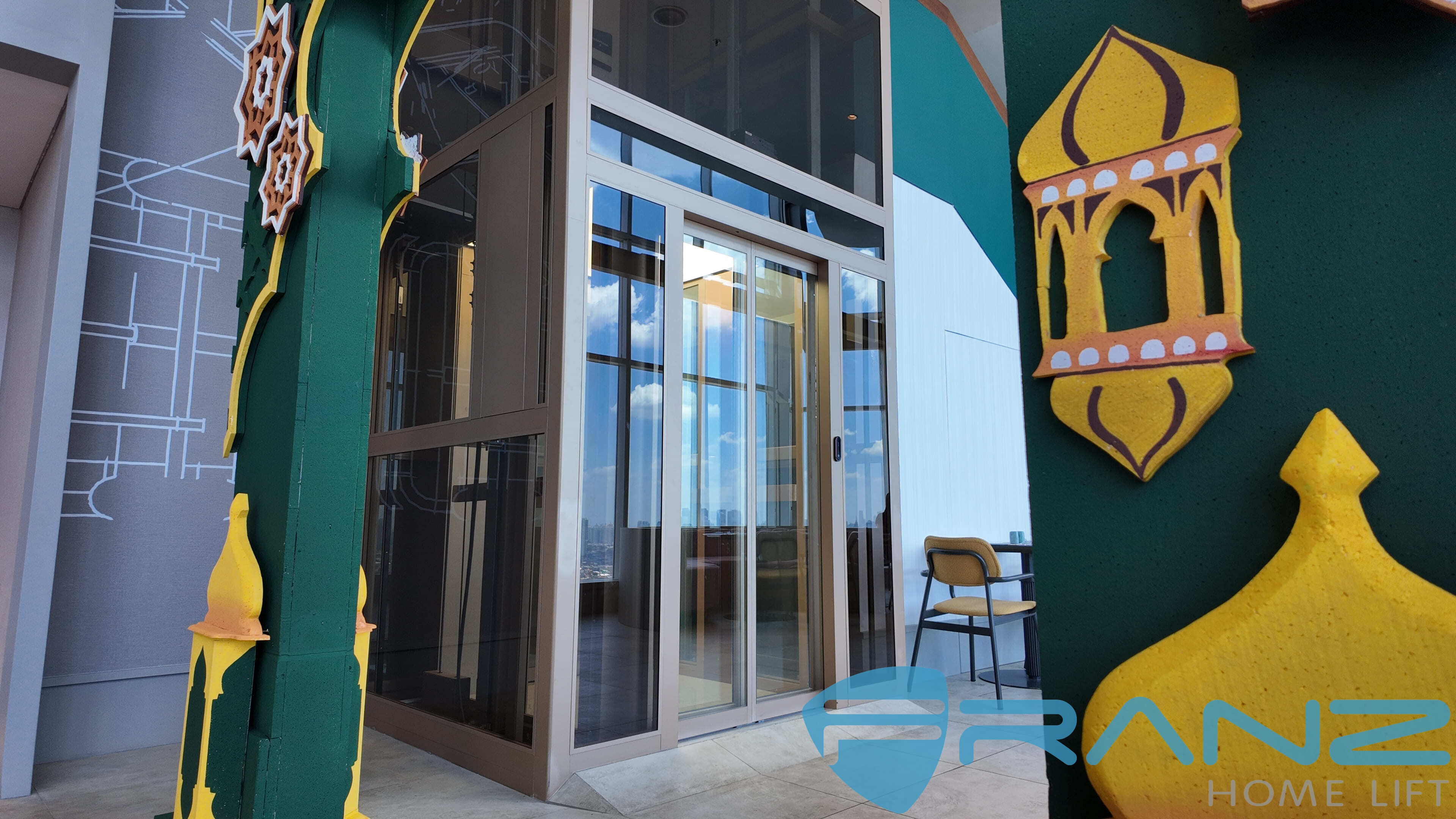
Application scene from the Indonesian hotel project: glass lift type with steel-belt traction and automatic power-failure leveling for high-frequency public operation.
Why Completed Installations Outweigh Product Lists
Product data answers the question “what can be ordered.” Installation evidence answers a harder question: “what has already been delivered under constraints?” Buyers comparing suppliers at the research stage usually find that published headline numbers look similar across the category, so the differentiator has to come from somewhere else — documented project scope, the equipment actually installed, the site problems that were resolved, and the safety and accessibility functions that were specified rather than assumed.
Four questions turn an installation reference into usable evidence:
- Is the scope documented? A credible reference names the project type, the function the lift performs, the matched equipment, and the special requirements that shaped it.
- How did the timeline split between factory and site? In residential and retrofit lifts, long schedules are usually driven by civil works, shaft preparation and interior coordination rather than by equipment manufacturing.
- Was it a single customized unit or a repeat batch? Scale capacity proves volume capability, not the ability to engineer a one-off specification.
- What was specified about noise, vibration and safety behaviour? And can any of it be verified independently, rather than only through the manufacturer’s own specification sheet?
The three installations below are useful precisely because they are not variations of one standard product. They required different product families and different engineering priorities, in three different regulatory and cultural environments.
The Three Installations at a Glance
| Installation | Market | Project type | Function scope | Matched equipment | Product family |
|---|---|---|---|---|---|
| Private villa | Russia | New-build luxury mansion project | 270° viewing plus vertical transportation, for high-frequency daily private household use | Classic platform lift, aluminum frame, steel-belt traction, vibration-damping technology, millimeter-wave radar cloud detection | Platform lift, FP-S/E Series |
| Commercial building | Australia | Office and shopping mall commercial project | Vertical passenger transportation for staff and visitors, plus barrier-free access, under high-frequency daily public commercial operation | Platform lift, steel-belt traction, emergency leveling and anti-pinch device, one-key emergency call system | Platform lift, FP-S/E Series |
| Hotel | Indonesia | Commercial real estate, travel and tourism | Vertical passenger transportation for hotel guests and office staff across multiple floors, under high-frequency daily public commercial operation | Glass lift, steel-belt traction, automatic power-failure leveling system | Glass lift, FT/FJ series |
Case One — Russian Private Villa: Glass and Light as a Specification
The Russian reference is a new-build luxury mansion project where the lift had to deliver 270° viewing together with vertical transportation, in high-frequency daily use by a private household. The matched equipment list names a classic platform lift with an aluminum frame, steel-belt traction, vibration-damping technology, and millimeter-wave radar cloud detection.
The special requirements are the part that separates this from a catalogue order: a solid aluminum frame with large-area transparent glass; a custom wavy luminous background panel and rattan-pattern carpet; adjustable frame colour temperature to suit Russian artistic aesthetics; and thickened explosion-proof tempered glass.
What this project evidences
- Finish specification is engineering, not decoration. An adjustable frame colour temperature and a luminous background panel have to be integrated without compromising the traction system, structural fixing points or safety functions.
- Active sensing was part of the scope. Millimeter-wave radar cloud detection appears in the matched equipment list, not as an optional extra.
- Vibration damping was specified for a private residence, which is consistent with how the FP-S/E platform lift is positioned: a low-speed, high-comfort configuration.
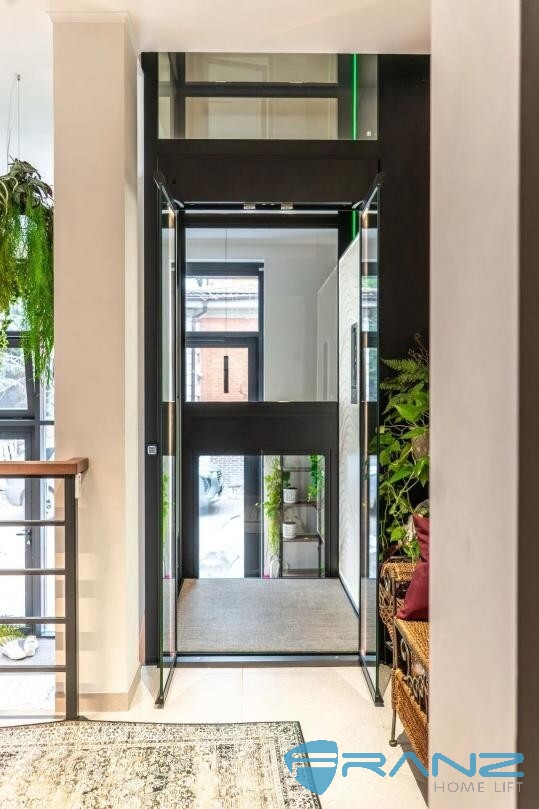
Platform lift configuration of the kind installed in the Russian villa project, with aluminum frame, large-area transparent glass and vibration-damping technology.
Case Two — Australian Commercial Building: Pit-Free and Barrier-Free
The Australian reference is an office and shopping mall commercial project where the lift carries staff and visitors and provides barrier-free access, under high-frequency daily public commercial operation. The matched equipment list adds functions that a residential-only lift would not normally require: steel-belt traction, emergency leveling, an anti-pinch device, and a one-key emergency call system.
The site conditions are the real test. The project required a shaft-less and pit-free installation solution, an aluminum frame with laminated tempered glass, a threshold-free flat-floor design for disabled users, and a cream-white colour scheme matched to log-style staircases — while complying with Australian high-safety standards.
What this project evidences
- Existing-building retrofit capability. Shaft-less and pit-free installation is the constraint that most often disqualifies a conventional lift in a finished building, because the civil work would be disproportionate to the benefit.
- Space efficiency is a documented design feature. The FP-S/E platform lift uses a shallow-pit high-efficiency design that can be installed in as little as 1 m², and is intended for small spaces, existing houses and disability (wheelchair) accessibility, alongside residential housing, public commercial space and office buildings.
- Accessibility was treated as a safety specification. Threshold-free flat-floor design, emergency leveling and anti-pinch protection are accessibility functions and public-safety functions at the same time.
- Aesthetic integration with an existing interior. Matching a cream-white finish to log-style staircases is small in cost terms but decisive in whether an installed lift looks like building infrastructure or an afterthought.
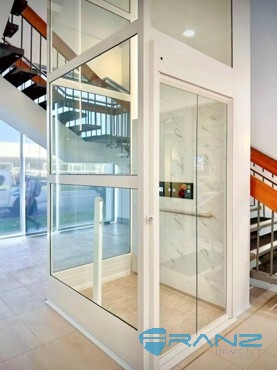
Platform lift type used in the Australian commercial project: shaft-less and pit-free installation with threshold-free flat-floor design for barrier-free access.
Case Three — Indonesian Hotel: High-Frequency Public Use in a Glass Cabin
The Indonesian reference is a commercial real estate project in the travel and tourism sector, where a glass lift carries hotel guests and office staff across multiple floors in high-frequency daily public operation. The matched equipment list names steel-belt traction and an automatic power-failure leveling system — a public-building requirement rather than a household one.
The special requirements combine hospitality aesthetics, accessibility and cultural fit: a champagne-gold metal frame glass cabin, a large-capacity car, and a touch-screen operating panel supporting multi-language switching, face recognition, voice broadcast and an enlarged-font high-contrast mode, designed to respect local Muslim cultural aesthetics and barrier-free requirements.
What this project evidences
- Interface localization is now a specification item. Multi-language switching, voice broadcast and an enlarged-font high-contrast mode serve accessibility and guest experience simultaneously, and they have to be engineered into the control panel rather than added later.
- Power-failure behaviour matters in public buildings. Automatic power-failure leveling keeps the car at a floor level when supply is interrupted, which reduces entrapment risk in a venue with continuous guest traffic.
- Cultural and aesthetic adaptation is deliverable. Frame and cabin finishes were adapted to a regional aesthetic while keeping the glass cabin and large-capacity car.
What the Three Installations Say About the Supplier
FRANZ Intelligent Elevator Co., Ltd. is an independent R&D manufacturer of residential elevators for villas, established in 2019 and headquartered in Suzhou, Jiangsu, China. The company specializes in R&D, smart manufacturing, sales, installation and maintenance of residential elevators for villas. Its main product types are shaft-built cabin lift, glass lift and platform lift — the three families that appear across these installations.
The operational facts behind those references are:
| Capability indicator | Documented figure |
|---|---|
| Manufacturing facility | 30,000 m² |
| Annual production capacity | 6,000 units |
| Employees | Approximately 310 |
| R&D team | 32 engineers |
| Showrooms | More than 220 |
| Market coverage | Five continents, more than 30 countries; major markets Southeast Asia, Russia, Australia, Middle East, Africa |
| Export share | 15% of total sales |
| Certification | In 2025, commercial platform elevators received the TÜV Rheinland EU EC Whole-Machine Safety Certification, among the first domestic elevator brands to obtain it |
| Proprietary safety system | Active millimeter-wave radar situational awareness system for residential elevators |
| Brand designation | Official residential elevator partner for Dragon TV’s Dream Home |
Two readings of this table matter for procurement. First, the TÜV Rheinland EU EC Whole-Machine Safety Certification applies to commercial platform elevator products, so it should not be presented as covering the entire residential range; buyers of glass or shaft-built cabin products should confirm which certificate applies to the ordered family. Second, an annual capacity of 6,000 units describes scale, not fitness for a single customized unit. The evidence that matters for a villa buyer is whether the supplier can document a single, non-standard delivery with customized finishes and site-specific equipment — which is exactly what these three references represent.
How the Equipment Works: Traction, Sensing and Space
All three installations name steel-belt traction in their matched equipment, which is the common technical thread running through otherwise different projects. The surrounding engineering explains why the same drive principle suits a private villa, a commercial retrofit and a hotel lobby.
- Drive and noise. The FP-S/E platform lift uses steel-belt traction technology and a silent system, described in the product specification as achieving library-level quietness. Within the FT/FJ families, drive options are traction steel belt or wire rope, with drum drive also available depending on configuration.
- Active sensing rather than passive protection. FRANZ has developed a proprietary active millimeter-wave radar situational awareness safety system for residential elevators. The system emits electromagnetic waves to continuously sense human presence and posture inside the cabin; if an anomaly such as a fall or prolonged inactivity is detected, it triggers an alert without manual intervention. Paired with an IoT platform, it notifies the maintenance team of abnormal situations.
- Space engineering. The shallow-pit high-efficiency design of the platform lift can be installed in as little as 1 m², which is what makes the Australian shaft-less and pit-free requirement achievable rather than aspirational.
- Energy envelope. Published energy consumption is 1.1 kW for the FP-S/E platform lift and 1.1–2.4 kW for the FT/FJ families, depending on load and speed configuration.
- A naming detail worth verifying at specification stage. The FT/FJ designation is used for both the glass lift and the shaft-built cabin lift, while the platform lift carries the FP-S/E series name. Buyers reviewing quotations should confirm which family a model code refers to before comparing prices.
Traction, hydraulic and screw-drive alternatives
The configurations documented across these three projects are traction-based: steel-belt traction in every case, with wire-rope traction and drum drive available in the FT/FJ families. Hydraulic and screw-drive platform lifts are a separate category that many villa buyers evaluate in parallel. The comparison points are the same regardless of drive type, and they should be checked on the specific model rather than on the category:
- Rated load and rated speed against the actual travel and traffic pattern.
- Pit depth and headroom allowed by the building, which determines whether a shaft-less and pit-free solution is possible at all.
- Indoor or outdoor installation: the glass lift family is specified for indoor and outdoor use, while the platform lift and the shaft-built cabin lift are specified for indoor use.
- Whether emergency behavior — leveling, anti-pinch protection, one-key emergency call — is included as standard or priced separately.
- Daily noise and vibration behavior, which the specification sheet alone cannot settle.
Market Context: Residential Elevators, Standards and Retrofit Demand
The three installations sit inside a market where retrofits and standard harmonization are reshaping what buyers expect from a supplier.
- Market size. The global residential elevator market reached USD 54.61 billion in 2024, according to Grand View Research.
- Standards harmonization. TÜV SÜD has documented the transition from EN 81-20/50 to ISO 8100-1 and ISO 8100-2, which is harmonizing global elevator safety standards. For a supplier delivering across Russia, Australia, Indonesia and other markets, the practical effect is that project documentation increasingly has to be readable under more than one national safety framework.
- Retrofit growth. The modernization segment of the elevator market is projected to grow at a CAGR of 7% through 2030, according to Roland Berger’s Elevator Market Outlook 2030. Retrofit demand is what turns a pit-free and shaft-less option from a niche configuration into a standard requirement for existing buildings — the same requirement the Australian project was built around.
- Competitive context. Aritco Lift AB, a Sweden-based platform lift manufacturer, produced approximately 3,000 elevators per year as of late 2025 and operates in 60 countries, according to Aritco’s own company information. Its positioning as a platform-lift specialist is a useful reference point for buyers comparing independent R&D manufacturers with imported European platform brands.
One gap deserves to be stated plainly rather than glossed over: published third-party decibel and vibration measurements comparing home lift brands are scarce. Publicly available technical benchmarking for noise and vibration across premium residential lift brands remains limited, which means acoustic claims currently rest on first-party specification rather than independent laboratory data.
Limits and Boundaries Buyers Should Verify
Capability evidence is more useful when it includes what a supplier cannot do as well as what it can. These boundaries follow directly from the documented specifications and service model.
- Speed and load limits of the platform family. The FP-S/E platform lift is specified at 320–400 kg and 0.15–0.3 m/s. That is a comfort-led, low-speed envelope; it is not intended for long travel distances or heavy traffic. Where higher speed is required, the shaft-built cabin lift family is specified at 320–1000 kg and 0.4 m/s, 0.63 m/s or 1.0 m/s, and is positioned as the choice for high-speed demand.
- Indoor and outdoor boundaries. The platform lift and the shaft-built cabin lift are specified for indoor use, while the glass lift family is specified for indoor and outdoor use. An outdoor villa or terrace installation points to the glass family, not the platform family.
- Certification scope. The TÜV Rheinland EU EC Whole-Machine Safety Certification obtained in 2025 applies to commercial platform elevators, so its relevance depends on the product family ordered.
- Timeline depends on site readiness. Installation and commissioning takes 7–15 working days when site conditions are ready, and the duration is extended if civil work does not meet requirements. A long project schedule therefore usually signals civil and coordination issues rather than slow equipment manufacturing — a distinction worth checking in any reference the supplier provides.
- Service depends on distribution. Installation support combines online and offline layers: 24/7 remote support and guidance, plus on-site technical guidance or professional installation. After-sales service is normally provided through the local distributor network; the manufacturer helps end customers locate local dealer resources. In markets without a nearby distributor, buyers should confirm service distance and response arrangements before ordering.
- Warranty and running cost. The standard warranty covers one year for the whole unit. Annual maintenance cost varies by country; the standard cost is currently between RMB 3,000 and RMB 5,000 per year in China, and prices in other markets differ.
Future Outlook
Three shifts look likely to change how home lift capability is evaluated over the next few years.
First, retrofit demand will keep pushing pit-free and shaft-less configurations toward the default. With the modernization segment projected to grow at a CAGR of 7% through 2030, buildings that were never designed around a lift shaft will increasingly be the normal project brief, and the documented ability to install in as little as 1 m² becomes a procurement criterion rather than a marketing detail.
Second, standards harmonization will make cross-market evidence more comparable. As ISO 8100-1 and ISO 8100-2 replace EN 81-20/50, a supplier that can show installations delivered under different national safety frameworks will find that evidence easier to reuse in tender documents, while suppliers who rely on a single-market reference will have less to show.
Third, sensing and remote monitoring will move from differentiator to expectation. The millimeter-wave radar and IoT combination documented in FRANZ’s residential elevator systems — sensing presence and posture, detecting anomalies such as a fall or prolonged inactivity, and notifying maintenance teams automatically — addresses an aging-in-place need as much as a luxury one. The same logic applies to interface accessibility: multi-language panels, voice broadcast and high-contrast enlarged fonts are now specified in hospitality projects, and are likely to appear in more residential tenders as accessibility regulation tightens.
For buyers, the practical implication is to ask for installation evidence in the same structure used here: documented scope, matched equipment, site constraints resolved, safety functions specified, and the limits the supplier is prepared to state. For suppliers, the implication is that single-unit, non-standard references carry more weight than capacity numbers.
Frequently Asked Questions
What installation and after-sales services are included for home elevators?
Installation support has two layers. Online support provides 24/7 remote support and guidance; offline support provides on-site technical guidance or professional installation. After-sales service is normally provided through the local distributor network. Distributors receive after-sales guidance and training or can obtain online solutions promptly; end customers are helped to find local dealer resources so that service is delivered professionally and locally.
How long does installation and commissioning take?
If site conditions are ready, installation and commissioning takes 7–15 working days. The duration will be extended if civil work fails to meet requirements, so site readiness should be confirmed before a completion date is planned.
What does the standard warranty cover?
The standard warranty covers one year for the whole unit.
What is the annual maintenance cost of a home elevator?
Costs differ by country. The standard cost is currently between RMB 3,000 and RMB 5,000 per year in China; pricing in other markets is set locally and should be confirmed with the local service provider.
How are custom orders and delivery timelines handled?
Factory-direct customization is supported, which effectively shortens the customization cycle and speeds up project delivery. Custom requirements — such as frame finishes, cabin detailing and interface configuration — are handled at the factory rather than through third-party modification.
How can the lift’s status be known during use?
A lift LOT system is installed in the lift, allowing distributors to check its status at any time.
Technical documentation for the glass and civil product families, including shaft and cabin configurations, is available in the company brochure: Franz Civil & Glass product brochure.
FRANZ Intelligent Elevator Co., Ltd., B5-2, No.199 Hongwu Avenue, High tech Zone, Zhangjiagang, Jiangsu, China. Overseas Department contact: Liyi Luo, Director of Overseas Department, luoll015@franzlift.com, +86 18595625216 (phone and WhatsApp).